Fattening Up

Out of town last weekend for a wedding, and my are parents in town all this week. It’s hard to compose a coherent post on a full stomach and two or three glasses of wine (moral: ya gotta stay hungry and not quite as drunk in this racket, kid). My takes on Bill James and Willie Randolph will have to wait a few more days. Thanks for checking in…

Don’t Grieve for Him

On Monday, the Rookie of the Year Awards were announced, and the winners were no big surprise to anybody who’s kept up with online voting results such as the Internet Baseball Awards and the Baseball Primer Staff contributor picks. Both of those matched the rather decisive results of the baseball writers’ votes.

As a quick perusal of the list of past winners will tell you, the Rookie of the Year Award isn’t a particularly good predictor on which players will continue to develop into stars. Over the last 25 seasons (from 1978 on) and not including last year’s Ichiro-mania, only three ROY winners have gone on to win an MVP award (Jeff Bagwell, Jose Canseco, and Cal Ripken Jr.), and three a Cy Young (Rick Sutcliffe, Fernando Valenzuela, and Dwight Gooden). The most recent winner to be inducted into the Hall of Fame was 1972 AL ROY Carlton Fisk, though 1977 AL winner Eddie Murray should join him soon, to be followed by Ripken and 1987 AL winner Mark McGwire in the next few years.

But plenty of washouts litter the list. Pat Listach, Bob Hamelin, Joe Charboneau, John Castino, Butch Metzger and Mark Fidrych were all done within five years of winning the award, and only the last two had the excuse of being pitchers. The colorful Charboneau didn’t even manage 200 plate appearances over the rest of his career.

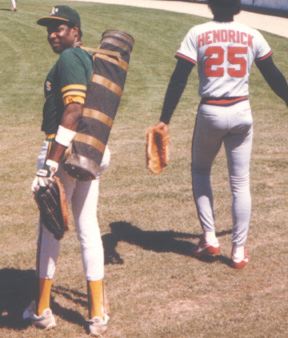
While not quite falling off the face of the earth like that bunch, one recent winner who seems to be traveling the road to oblivion is Ben Grieve, who won the AL award as an Oakland A in 1998 and looked for all the world to have a bright future. Here are his numbers for that rookie season and the ones since:

      AGE  HR  RBI   AVG  OBP   SLG   OPS  GIDP

1998 22 18 89 .288 .386 .458 844 18
1999 23 28 86 .265 .358 .481 840 17
2000 24 27 104 .279 .359 .487 845 32
2001 25 11 72 .264 .372 .387 760 13
2002 26 19 64 .251 .353 .432 784 15

Grieve put together three solid years in Oakland, but two statistical facets stuck out. One, he didn’t seem to be improving his fine rookie season, merely maintaining that level of play. The ups and downs in batting average belied an extremely consistent OPS. However, his penchant for grounding into double plays set off alarm bells by his third season. David Levins of the A’s-themed Elephants in Oakland blog writes about Grieve from the green-and-gold perspective:

With the A’s Grieve was very patient at the plate and made decent contact. Skills that are rarely as well developed as young as Grieve was. Problems arouse when Grieve made contact and ground into so many double plays. Grieve failed to grasp the ability to foul off pitches rather than put them in play… Grieve killed so many rallies that the Chicago police were attempting to requisition him for riot patrol.

As Levens writes, Grieve’s ascendence had been highly symbolic for the A’s organization: “The A’s pushed Grieve’s star from the beginning because he was the beacon. The A’s were announcing their awakening form the mid 1990’s funk that saw their entire organization re-worked.” But as his performance levelled off, Grieve apparently developed problems in the clubhouse and with A’s management, earning a reputation as an uncoachable prima donna. “[W]ith Grieve in Oakland there were a slew of left-handed hitters offering help and suggestions,” writes Levens. “Instead of being professional and admitting he needed to adjust he went with his ego.”

Chock full of corner outfield prospects but in need of a leadoff hitter, A’s GM Billy Beane packaged Grieve off to Tampa Bay as part of a three-way deal which brought Johnny Damon, Cory Lidle, and Mark Ellis in return — a deal which continued to pay dividends as Lidle contributed to playoff runs the last two years and Ellis emerged from a crowded pack to become the team’s starting second baseman last season.

Meanwhile, Grieve’s two years in Tampa Bay have been considerably less productive. His On Base Percentage has remained relatively consistent, but his Slugging Percentage dropped precipitously, as did his counting stats and his average. In what should, statistically speaking, be the prime of his career — his Age 27 season — he’s entering his contract year. But his star has fallen considerably. Three things could happen this season: he could improve his play under a new manager (Lou Piniella), he could entice another team with his relatively low salary ($4 million) and potential productivity (Levens mentions the Mets and the Blue Jays, both featuring A’s alums in prominent management positions), or he could continue his downward spiral in baseball’s backwater. Ah, sweet mystery of youth.

Away with Jorge?

The New York Times reports that the Yankees may be willing to trade catcher Jorge Posada in an effort to lower payroll. Despite being the top-hitting catcher in the American League in 2002, Posada is potentially expendable. Of the five players the Yanks have signed to weighty long-term contracts (Jason Giambi, Derek Jeter, Mike Mussina and Bernie Williams are the others), Hip Hip Jorge is the only one without a no-trade clause. With a substantial payroll tax headed the Yanks’ way (courtesy of the new Collective Bargaining Agreement), dealing Posada is one very obvious opportunity to cut costs.

Yankee GM Brian Cashman downplays the Posada trade rumors: “I’m certainly open to listening, but if someone wants to inquire about him, they’d better come with frankincense and myrrh and make me an offer I can’t refuse. He’s obviously one of the best at his position in the game. Is it realistic that we’d end up trading him? No. If he ever is moved, it would be at a steep price.”

Posada brings many positives to the table; he’s a switch-hitter with a high on-base percentage (.370 last season) and plenty of power (.468 slugging percentage, 40 doubles and 20 homers). He’s also very durable, averaging 144 games a year over the last three seasons. But he’s 31 years old, and like the other homegrown Yankees who man their up-the-middle positions, he’s sub-par defensively. Though he cut back dramatically on the number of passed balls he allowed in 2002 (7, down from 18 in 2001), Posada led the league in errors and threw out only 29% of attempted steals (11th in the league).

Posada is entering the second year of a five-year, $51 million contract–an absurdly large deal to give an over-30 catcher. I wrote about Posada’s contract back in February, noting that of the 10 most similar catchers (using Bill James’ Similarity Scores), none had any kind of productive year beyond age 29. But those comps lacked the durability of Posada as well as his high walk rate (something Similarity Scores don’t measure directly). It’s also worth noting that Posada converted to catcher in the minors and thus may not have as much mileage on him as a typical 31-year old backstop.

Is now the right time to trade him? The Yankee organization is thin at the position. Chris Widger and Albert Castillo backed up Posada in 2002, combining for a meager .238 AVG/.252 OBP/.317 SLG in 107 plate appearances. Top catching prospect David Parrish (son of eight-time All-Star Lance Parrish, who caught 19 seasons in the bigs) isn’t ready, hitting only .238/.328/.322 at AA Norwich. ESPN’s John Sickels had this to say about him in May:

New York’s first pick in the 2000 draft, Parrish was a successful college player at Michigan, compared to his father Lance both offensively and defensively. He didn’t play well in ’01, but shows signs of having turned things around this year, hitting .293 with solid strike zone judgment in the early going at Double-A Norwich. He doesn’t have as much raw power as his father did, and it seems unlikely that he’ll emerge as a star. But he has potentially solid skills across the board.

But Sickels left Parrish off of his most recent list of top catching prospects. So if the Yanks do trade Posada, they’d basically start from scratch in finding a full-time catcher.

While he’s productive now, the day when Posada’s contract becomes a burden to the Yankees will likely arrive. At that point his bat might still have some value, but given the occupation of first base and DH slots by Jason Giambi and Nick Johnson, Posada may have nowhere to play in pinstripes. I’d hate to see the Yanks trade Hip Hip Jorge, but Branch Rickey’s sage advice about trading a player a year too early rather than a year too late should weigh heavily on Cashman’s mind.

• • • • •

“You know as well as I do that Seasonal Affective Disorder is just a fancy name for the end of the baseball season. “–Brad Zellar, Twin Cities CityPages.com

Rest assured that season’s end doesn’t mean I’ll be mothballing this site. Unlike some of my colleagues in the bloggerverse, I don’t really give a damn about football, at least not enough to write home about it (you were expecting maybe the Futility Lineman?). It’s baseball all year long at the Futility Infielder, and I’ll crank up the hot stove to keep warm. In the tradition of my successful series of “Remaking the Yankees” articles last winter, I’ll be taking a closer look at the team’s roster needs and options in the next month or so. Plus I have plenty of catching up to do around here — a minor facelift for the site, along with game reports, Wall of Fame inductions, book reviews, and the long-threatened Futility Infielder of the Year award.

Re-Pete After Me

Ever since the rousing ovation Pete Rose received at the World Series last week (during that godawful Memorable Moments ceremony, itself a new high in lows), writers have been weighing in on both sides of the Rose reinstatement/Hall of Fame issue. I don’t have much time or energy to tackle the arguments with any depth; “No apology? No reinstatement, no Hall,” sums up my position quite succinctly. But if you’re eager for vigorous debate on both sides of the issue, John Perricone of Only Baseball Matters hosts a couple of guest columnists from around the online baseball community this week.

Now don’t even get me started regarding the blight on the face of baseball that was the Memorable Moments campaign. Suffice it to say that any list purporting to cover the game’s top highlights yet excluding the dramatic home runs of Bobby Thomson, Bill Mazeroski and Carlton Fisk has exactly as much value as a $3 bill. MasterCard’s Memorable Moments program: worthless.

ThunderStruck

If he’d lived to see it, Gene Autry would have declared himself Back in the Saddle Again. After 41 years and from beyond the grave, the Cowboy got the Monkey off his back on Sunday night. Mike Scioscia’s Lackeys did their bidding quite well (even his Molinas didn’t do too badly), and the Angels are World Champions, beating the the Giants 4-1 in Game Seven.

While not a classic on the order of 1991 or even last year, this was a memorable World Series, filled with some strange and often surreal moments. Sunday night’s most bizarre image was that of a blonde female Angels fan reaching down to “whack” Giants outfielder Reggie Sanders with her ThunderStix as Sanders retrieved Garret Anderson’s bases-clearing double. While hailing this as the probable death (and with good cause) of the Big Inflatable Dildo era in sports souvenirs, let’s give thanks for those other slices of weirdness which will forever earmark this series:

• J.T. Snow falling on his can in pursuit of a foul ball and then rising to retrieve it in Game One

• J.T. Snow scooping up young Darren Baker as he crossed home plate in Game Five

• J.T. Snow batting .407 in a World Series on Earth, played by Humans

• Bengie Molina getting on base five straight times in one game — twice via intentional walk — in Game Three

• Shawon Dunston hitting a home run in Game Six that for a few innings looked as if it might stand up as the Series-winner

• Jay Witasick reliving last year’s i-can’t-get-anybody-out-and-I-haven’t-even-registered-for-this-class-which-I’m-failing-and-the-test-is-today nightmare all over again

• Barry Bonds dribbing two consecutive hits like basketballs out in left field during the fateful Game Six

Of course, plenty of conventional memories, both spectacular and prosaic, will endure as well:

• Bonds hitting a towering home run seemingly every time the Angels dared pitch to him

• Bonds un-Velcro-ing his ridiculous body armor after taking yet another walk

• Benito Santiago corkscrewing himself into the ground on every swing

• Dusty Baker chewing a toothpick nervously

• Pint-sized David Eckstein sprinting to first after a walk

• Baby-faced Francisco Rodriguez dropping a succession of nasty sliders on Giants hitters

• Troy Percival and the other near-sighted, self-described dirtbags of the Angels bullpen squinting in for the sign from the catcher

• Darin Erstad laying out for a spectacular grab in centerfield

• Tim Salmon’s pair of homers in Game Two, the second capping a wild and woolly 11-10 win

• Scott Spiezio’s just-over-the-wall 3-run homer in Game Six, keying one of the most dramatic comebacks in Series history

In the end, I’m certainly happy that the Angels won. Their brand of baseball has made for consistently engaging viewing over the past few weeks, a bare minimum of hair-loss, and some food for thought in the world of sabermetrics. I may never find myself rooting for them again, but I’ve enjoyed this ride with Ecks and Erstad, Kennedy and K-Rod, Troy and Troy, Donnelly and Weber, the Salmon and the Sandfrog, Soc and Hatch. On the other hand, if I never again have to pull for Kevin Appier while poring over his pock-marked neck or hearing about his camels, it will be too soon.

On the other side, while I’m gleeful that the Giants lost (roll over Durocher, and tell Dusty Baker the news: “The Giants Lose The Series! The Giants Lose the Series!” ), I don’t envy their fans. The second-guessing of Baker which will inevitably ensue may pale in comparison to the second-guessing of Baker and owner Peter Magowan if they part ways this offseason. In the meantime, the concerned parties can ponder Baker’s use of the bullpen in Game Six, staying too long with Livan in Game Seven, pinch-hitting Goodwin for Sanders — hell, the entire bench for the entire postseason, period. Better your problem than mine, pal.

Game Seven was a fitting conclusion to a fine season of baseball, Bud Selig’s best efforts to destroy the sport notwithstanding. Congratulations to the Angels, their organization, and their fans. And by my watch, there’s only about 110 days until Pitchers and Catchers. Are we there yet?

Game Seven

If they’re going to play a World Series where your team isn’t involved, it may as well be an entertaining one of the seven-game variety. This year’s Series has lived up to that wish, right down to a shocking late-inning jaws-of-defeat reversal in Game Six by the Anaheim Angels. Now we’re left with one game in the baseball season, with all the well-marbled cliches on the table. If you’re a fan of the game, you can’t ask for much more, period. Well, besides less Tim McCarver and a quicker game and fewer of those enlarged-pore closeups, and a pitching duel, or at least a couple of staffs that don’t look gassed…

By the seventh inning of last night’s game, I had pretty much given up on the Angels, resorting to mocking their dorky, feeble, “Yes We Can” slogan right up until Scott Spezio’s three-run homer landed in the rightfield seats. “If they’re not going to entertain me by winning this, I’m free to start hating them,” I told my fellow viewers. Fortunately I didn’t have to make good on a threat to vomit on myself in the event of a Giants win (I’m withdrawing that threat tonight).

Despite my grouchy resignation, I knew better than to give up. With Shawon Dunston’s home run threatening to stand up as the Series-winning hit, we were obviously on the wrong side of the looking glass. Sooner or later reality was bound to return in the form of the Rally Monkey, whose cult I have now joined. That mojo WORKS.

The play from last night that will endure in my memory was pinch-runner Chone Figgins taking third on Barry Bonds. That aggressiveness — a hallmark of these Angels — pressured the best player in the world into bare-handing and ultimately bobbling Garret Anderson’s bloop single. The result keyed Dusty Baker to bring in closer Robb Nen early, and set up Glaus’s game-winning double four pitches later. It also served to reminded us that Bonds is at least partially human, as he further proved when he bobbled Glaus’ double.

Call him 1/3 Human and 2/3 Remorseless Hitting Machine. And consider the Angels lucky that Bonds didn’t get a chance to atone for his mistakes, because there’s still that air of inevitablity about him. Face it, he’s GOING to hit a home run in this game tonight; the key for the Angels is damage control.

It certainly doesn’t help that Anaheim is scrapping for pitchers. John Lackey will start on three days rest, taking the place of the injured Ramon Ortiz. Lackey already started Game Four on short rest, having been called upon in relief of Kevin Appier in Game Two; he ran out of gas in the fifth and allowed a 3-spot. K-Rod went a long 2 2/3 yesterday (and Bonds went long off of him). Ben Weber is toast. Don’t even look at Appier or Washburn at this point, because it’s just plain ugly to contemplate either getting lit again.

Against that, the Giants offer Livan Hernandez, who himself was lit up in Game Three. His sudden descent from Clutch Pitching God to Fat Hittable Slug was surprising (except perhaps to Giants fans), but it’s not why I’m revising my prediction from my previously stated Giants in Seven. Ortiz’s absence as starter (due to tendonitis in the wrist, reportedly), is reason enough for a reappraisal, but the real dealn is that Monkey business. I’ve seen too much over the past few weeks not to believe in it for one more day.

Johnnie B. Paycheck and the Musical Chairs

Back in elementary school, a teacher once told me that the surest way to get somebody to think of something was to tell them explicitly NOT to think about it. An order not to think about elephants produces nothing but deep thoughts about those pachyderms. So it’s been with Bud Selig’s edict prohibiting teams from making any managerial announcements during the World Series. Selig’s reasoning was that such news would detract from the action on the field, lest four and a half hours per night of whooshes, clangs, thundersticks and McCarver-blather fail to remind us that there’s a ballgame going on. But if anything, Selig’s pronouncement only heightened the intensity of media speculation over the current round of managerial musical chairs, and revealed more leaks in baseball’s front offices than a 99 Cent Store Life Raft.

In the catbird seat is Dusty Baker, who now stands one win away from validating a widely held opinion that he’s the best manager in the game with a World Series trophy. That Baker may turn around and whisper the immortal words of Johnny Paycheck (“Take this job and shove it!”) to Giants owner Peter Magowan only adds to the drama, not to mention the media feeding frenzy. Recent reports have Baker bound for Seattle, Chicago, and, in a fanciful bit of speculation by ESPN’s Ray Ratto, across the Bay to Oakland.

Seattle’s doors are open because Lou Piniella, with one more year on his contract, yet no apparent desire to remain in the Emerald City, requested the opportunity to work closer to his Tampa home. The Mariners management, while offering to free Piniella, took his closer-to-home request at face value, and allowed the Devil Rays to negotiate compensation — said to be All-Star outfielder Randy Winn — in the event Piniella agreed to a contract. But the M’s played hardball when it came to Piniella possibly returning to New York to manage the Mets; no compensation could be agreed upon between the two teams, thus preventing the Mets from even interviewing Piniella. Though they’re fairly bereft of high-level prospects that might entice Seattle, the more likely story is that Mariner management simply gave Sweet Lou a sour kiss-off. Sour to the tune of $13 million over 4 years to manage in his own backyard a team that’s never won 70 games in a season. It’s worth remembering, of course, that Piniella’s the manager who turned the Mariners around after a decade and a half of post-expansion futility.

As for Oakland, their bench is now officially vacant. They willingly let Howe go to the Mets because, as Ratto writes, “after helping drag the Athletics out of Contraction Row… general manager Billy Beane saw less in Howe than the American League standings did. Now that’s perverse.” Howe had been on the hot seat in each of the past three seasons, in part because he demonstrated more resistance to Beane-ball than the GM (and perhaps the owner) preferred. Slow starts by the A’s in each of the past two seasons didn’t help. But most damning in his critics’ eyes was his inability to win the big one — literally. Merely one game away from advancing to the second round of the playoffs in each of the past three years, the A’s went 0-6 as they failed to close out the Yankees (twice) and the Twins.

Not to be forgotten is that Billy Beane has been sitting on the hottest managerial prospect in the game for some time now; this past spring, Beane denied the Red Sox permission to interview bench coach Ken Macha for Joe Kerrigan’s job. With Macha making the rounds as a candidate, reportedly even offered the Milwaukee Brewers job, and still in the running for the Cubs slot (and perhaps the Mariners one as well), Beane likely felt that he couldn’t afford to lose the man he preferred to his sitting (duck) manager.

As for the Dusty-cross-the-Bay, it’s highly unlikely, which didn’t prevent Ratto from floating the thought balloon:

While the A’s might not seem all that keen on paying a new manager four times what they paid only grudgingly to the old guy, it’s still a fascinating thought that begs the question: How much is it worth to you to stick your finger in another guy’s eye up to the second knuckle?

Understand here that Schott and San Francisco owner Peter Magowan regard each other with the same mutual feeling one normally finds with firemen and arsonists. The most charitable way to put it is that each man dreams nightly of driving the other into the sea.

But would Steve Schott make Peter Magowan a fool for $4 million?

Ratto’s conclusion is that such a scenario is no more perverse than anything else in this saga. But cross-bay animosity is one thing; cold, hard cash is another, and the Cubs may be the team willing to dig the deepest for Baker. Aside from the 1-2 punch of Kerry Wood and Mark Prior, and a pile of that green stuff, it’s hard to see what Chicago has that SF doesn’t. Though it’s in its infancy, Pac Bell rivals Wrigley Field as one of the game’s great ballparks, Barry Bonds has it all over Sammy Sosa, and it’s been 57 years since the Cubs went to a World Series and 94 since they won one. Dusty’s a stubborn man, but that stubborn?

Meanwhile, the reception of the Mets new manager (not officially, of course) by the New York media is an unjustly cold one. “Settled for” seems to be the preferred choice of words, and by them you’d think that Howe couldn’t manage his way out of a paper bag. Never mind the fact that Howe racked up 298 wins over the past three years piloting a ballclub with one of the game’s lowest payrolls — one that finished ahead of Piniella’s team twice. Or that the last manager to be dubiously received in this town, “Clueless Joe” Torre, has done rather well for himself and his employer. That parallel wasn’t lost on Roberto Alomar, who told the New York Post, “It reminds me of ’96 when the Yankees got Joe Torre and everyone was hammering him. What did they do? They ended up winning a world championship.”

Howe’s laid-back style is 180 degrees from that of his predecessor, Bobby Valentine, which may be exactlyt what the Mets need after tuning out Bobby V’s often-grating words. Not that Valentine should have been the sole scapegoat for the Mets lousy season; general manager Steve Phillips’ acquisitions of too many expensive and over-the-hill players (while gutting an already thin farm system) sealed their fate early. The player also carry their fair share of the blame; when geniuses like Mo Vaughn and Roger Cedeno admit late in the season that they actually need to keep themselves in shape, one has to wonder how they’ve survived all these years.

Howe made his reputation in Oakland working with a young, bargain-basement team. While the Mets don’t have much in the way of youngsters (or bargains), that reputation might be inaccurate — young players such as Terrence Long and Ramon Hernandez stagnated in their development, while Carlos Pena washed out early and was shipped off to Detroit. On the other hand, the trio of great young pitchers Howe had in Oakland flourished on his watch; it remains to be seen whether Howe will be able to import pitching coach (and New Jersey native) Rick Peterson. And Howe seemed to do just fine with the veterans; to my recollection, Kenny Rogers was the only player to ask out of Oakland recently, and several A’s vets, including Jason Giambi and Matt Stairs, went to bat for Howe against management when the skipper’s job was on the line.

As for the pressure of New York, Howe ought to be able to handle it after hanging tough in the A’s job despite the whispers and the weight of expectation. Not to sound too Peter Gammons-y, but Howe has shown character during his time as manager. He’s even-tempered, classy, and he doesn’t rip his players in the press. He’s no Bobby V. It’s revealing that the Mets gave Howe a four-year contract, providing him with more security than the GM. Phillips’ job is justifiably on the line, and faced with a roster of cumbersome contracts, he may have to take a page from Billy Beane’s playbook and find some bargains to patch the holes. Whether he’s willing to do so remains to be seen.

With only two games and one weekend left in the baseball season, this saga will probably simplify itself come Monday, when the music stops and Piniella and Howe are introduced. By then we may know who else has found a seat. Willie Randolph? Bob Melvin? Billy Martin? Casey Stengel?

Hey Jude

Jay Witasick is really making a name for himself in October baseball. Unfortunately for Witasick, that name is synonymous with futility. Tyler Kepner of the New York Times calls him “baseball’s St. Jude, the patron saint of lost causes.” Ouch.

Tuesday night only added to Witasick’s sorry legacy. Summoned in relief of Livan Hernandez in the fourth inning with the score 5-1 Angels, Witasick surrendered three hits and a walk in only 1/3 of an inning, allowing two runs plus an inherited runner to score. Adding injury to insult, he even took a run-scoring line drive off his pitching arm, whereupon Giants manager Dusty Baker and pitching coach Dave Righetti conferred, found him not sufficiently injured to remove, and sentenced him to further beating. More insult: an RBI single by Bengie Molina. The only batter he retired was the Angels pitcher, Ramon Ortiz, who struck out looking.

Witasick, you may recall, built his legend last fall with the Yankees. He pitched in three games in the 2001 postseason, giving up runs in each. All three were losses, the last two complete drubbings, 14-3 and 15-2. Witasick didn’t just mop up those games, he doused them with kerosene. In his World Series appearance, following Andy Pettitte in Game Six but supplying no relief, he allowed 9 runs (8 earned) in 1 1/3 innings, taking a 4-0 game to an absurd 13-0. His stats for that postseason: 5 innings pitched, 17 hits, 12 earned runs, and a 21.60 ERA. Turn off the ugly.

The Times’ Murray Chass points out, in a separate article, that after last night Witasick has now faced 20 batters in his two World Series appearances, with 16 reaching base and 11 scoring. Ugly would be an improvement.

Witasick wasn’t nearly so much of a lost cause for the Giants during the season. In 68.1 innings, he posted a 2.37 ERA, allowed only a .234 average, and struck out 54 batters. Of course, Dusty Baker was smart enough to keep him out of games where much was at stake; Witasick’s line for the season was 1-0 with 0 saves and only 4 holds (a dumb statistic, but considering he got a hold for his one batter-one walk performance in Game Two, a telling one). One could sense Baker’s regard for Witasick as cannon fodder last night, ordering him through the ol’ up-down-up-down-up in the bullpen before bringing him in. No, it isn’t bad enough to be Witasick time yet, one imagines Dusty saying to himself.

Of course, these Angels have been slapping the ball around enough to make several of the Giants pitchers look silly. Witasick can take a seat alongside Hernandez, Russ Ortiz, Felix Rodriguez, and the pitching staffs of the Minnesota Twins, the New York Yankees, and several others in the American League in that regard.

K-Rod and Other October Surprises

It certainly appears there’s something to my assertion that Angels phenom Francisco Rodriguez, now known as K-Rod, may indeed be the real Rally Monkey. During Sunday night’s epic slugfest, the Halos scored three more runs to back his three dazzling innings, coming from behind 9-8 to beat the Giants, 11-10. The Angels have now scored 26 runs to back K-Rod’s 13 postseason frames, enabling him to garner five wins in October.

Even the Angels are bying into it. Says fellow reliever Ben Weber, “I don’t think Frankie is just lucky to be in there when our offense comes alive. Seeing him come in and do what he does to teams has a way of firing everybody up. I don’t think it’s a coincidence they hit for him.”

Practically every sports section in America has at least one article on K-Rod today. In the Daily News, they’re even giving Brian Cashman heat for not signing him. According to the Yankee GM, the Angels outbid the Yanks, who weren’t willing to give the young Venezuelan the $950,000 bonus that the Halos offered. Who said George wins every bid?

Rodriguez is hardly the first unheralded player to surprise everybody in the postseason. ESPN’s Jim Baker weighs in with a Baker’s Dozen of October surprises, including Dusty Rhodes, Gene Tenace, Brian Doyle, Buddy Biancalana, Kurt Bevacqua, and current Angels hitting coach Mickey Hatcher, who hit .368 with 2 HR and 5 RBI against the A’s in 1988. Number 13 on the list (which requires a subscription to ESPN Insider) is Dr. Bobby Brown, who never found a full-time job as a big-league player but did go on to become President of the American League. Notably absent from the list is Howard Ehmke, the surprise starter for Connie Mack’s Philadelphia A’s against the Chicago Cubs in 1929. Ehmke, at the tail end of his career, struck out a Series record 13 Cubs, but never won another game in the big leagues.

• • • • •

Given how much I’ve enjoyed the first two games of this World Series, I don’t want to nitpick too much. But in Game One, Mike Scioscia made a move that’s still driving me crazy. In the bottom of the eighth inning, the Angels trailed 4-3, facing Giants righty Tim Worrell. With two outs, Worrell walked first baseman Scott Spiezio. Scioscia sent in designated pinch-runner Chone Figgins (I love that name) to run for Spiezio, and with weak-hitting catcher Bengie Molina (596 OPS) due up next, the decision to pinch-hit for him was a no-brainer.

It was Scioscia’s choice of pinch-hitters that bothered me. He had only one left-handed batter on his bench, Orlando Palmeiro, and three righties, Alex Ochoa, Shawn Wooten, and Jose Molina. With his 626 OPS, Molina bears a bit too much family resemblance to his brother, and he was slated to enter the game as catcher anyway, so we won’t consider him among Scioscia’s options:

           REG SEASON     POST       RUNNER ON     vs. RHP

OBP SLG OBP SLG OBP SLG OBP SLG
Palmeiro .368 .354 .000 .000 .377 .367 .348 .341
Ochoa .361 .404 .000 .000 .331 .270 .361 .416
Wooten .331 .442 .471 .647 .368 .481 .333 .429

Scioscia played the straight platoon, choosing Palmeiro, despite the fact that he doesn’t even hit righties as well as the other two (689 OPS vs 777 for Ochoa and 752 for Wooten). Palmeiro’s virtue is that he can take a walk, but he’s got almost zero pop in his bat (3 major-league homers in over 1600 plate appearances). With two outs and a man on first, a single or walk would have kept the inning going, which is certainly nice. Wooten, on the other hand, offers a reasonable amount of thunder and a chance to drive in Figgins; he’s been swinging the bat very well during the postseason, not to mention relatively frequently (17 at bats, while the while the other two have seven between them). Since Scioscia ended up putting Wooten in the ballgame as the defensive replacement for Spiezio, why the hell didn’t he just let him swing the stick as well?

Scioscia’s preference for Palmeiro (who ultimately popped out foul to third base) in that situation may have been tied to keeping the inning alive for Adam Kennedy, who’s swinging the bat well enough to be called the most feared #9 hitter in baseball. But I still think the Angles best option was taking a shot at a big hit by the Man from Moose Jaw.

Looking for an Angle

On the day of the first game of the World Series, I spent part of my morning working on my healthy Giants hatred. I watched a well-made HBO documentary called “The Shot Heard ‘Round The World”, about the 1951 pennant race which climaxed with Bobby Thomson’s home run. The hour-long doc was interesting for its variety of footage (some of it color), its lengthy interviews with the two principals of the event, Thomson and Dodger pitcher Ralph Branca, and for incorporating the relatively recent revelations about the Giants’ system of stealing signs. Without those revelations, which came to light via Giants bullpen catcher Sal Yvars last year, this is a tale I know all too well. But watching Thomson squirm in his seat as he denied being tipped off about the fateful pitch made for some entertaining viewing.

Mind you, I don’t necessarily believe that Thomson *was* tipped off, but on the other hand, what the hell was he doing swinging at an 0-1 fastball that was high and inside? There’s no question in my mind that the Giants’ sign-stealing did help them, at least enough to aid the stretch drive which force the tie and necessitated that playoff series. Rob Neyer had a good column about the Giants’ sign-stealing when it broke as news in early 2001, pointing out (thanks to statistics supplied by Dave Smith of Retrosheet, who appears in the documentary) that the Giants’ hitting performance at home actually worsened after the sign-stealing started. In the doc, Smith points out that only three Giants hitters improved at home after the sign-stealing started, but that one of them was Thomson. That doesn’t lessen his achievement, in my mind–he still had to hit the damn ball, and I’ve always shared the view as it pertains to baseball that it ain’t cheating if you don’t get caught. But it doesn’t endear me to the Giants, either.

Other than that loathing, and my general appreciation for the World Series, I don’t have a lot to latch onto in this matchup. I’m rooting for the Angels primarily because of who they aren’t, and secondarily because of the impressive way they demolished everything in their path to the Series. Their contact-hitting philosopy is a different approach from what we’ve seen the past few years, and it seems to make solid but otherwise innocuous hitters into dangerous pests. Their two 10-hit innings–something done only one other time in postseason baseball history–have magnified their stature as a rally-making machine.

And speaking of rally-making, I have a sneaking suspicion that rookie pitcher Francisco Rodriguez is the real Rally Monkey. Not only have his first four major-league wins have all come in the postseason, but the Angels have scored an astounding 23 runs while he’s occupied the pitcher’s spot, including those two 10-hit innings. Meanwhile, Rodriguez has made hitters look foolish; scouts have compared him to a young Mariano Rivera with his nasty stuff. I look at Rodriguez and, despite a notable lack of girth. I see Fernando Valenzuela circa 1980. Valenzuela came up as a 19-year old in mid-September and became the secret weapon out of the Dodger bullpen as they came down the stretch, tossing 17.2 scoreless innings in the last two weeks of the season–his first two weeks in the bigs. Had Tommy Lasorda the courage to hand him the ball for their one-game playoff against the Houston Astros instead of free-agent failure Dave Goltz, they may well have won the NL West that year.

That digression brings me to the angle which interests me most about this World Series. Namely, both managers were key players on the Dodger teams I rooted for in my youth and teammates for four seasons, including their 1981 World Championship. Baker played eight of his 19 big league seasons for the Dodgers, and was their starting leftfielder for four division and three pennant winners. He also played on two All-Star teams during his Dodger tenure. After a miserable debut season in LA in 1976 (4 HR and a 605 OPS in 421 PA), Baker rebounded to become one of their record-setting quartet of 30-homer hitters in 1977, and was the MVP of the 1977 LCS against the Phillies. But on a team with Steve Garvey, Ron Cey, Reggie Smith, and Davey Lopes, Dusty was a secondary weapon who often hit sixth and rarely had to carry the offense.

Baker had something of an acrimonious parting from the Dodgers. They tried to trade him to Oakland during the 1983 winter meetings, but as a 10-and-5 man, Baker vetoed the trade. The Dodgers unceremoniously waived him shortly afterwards, and he was signed by the Giants, the only season he ever played for the team he currently manages. Baker then found his way to the A’s for the final two years of his career. I actually got his autograph in spring training 1986 in Arizona while he was with the A’s, as well as a pretty decent photo of him, taken as I called out “Hey, Dusty!”

Mike Scioscia was one of only two regulars who played on both Dodger World Championship teams of the Eighties (the other being Steve Sax). A catcher for whom the term “solidly built” was an understatement, Scioscia’s primary asset was his defense; simply put, he blocked the plate like no other player. Most famously, in 1985 he was knocked unconscious in a collision with the Cardinals’ Jack Clark, but held onto the ball. Offensively, Scioscia biggest asset was a keen batting eye–he walked almost twice as often as he struck out, and had a lifetime OBP of .344. He didn’t have much power (68 career homers over 13 seasons). But he’ll always have a spot in the hearts of Dodger fans for the ninth-inning, game-tying home run he hit off of Dwight Gooden in Game Four of the 1988 NLCS–the game in which Orel Hershiser, who’d pitched the night before, came out of the bullpen in the 12th inning to get the save. In the annals of great Dodger homers of my era, Scioscia’s bomb sits behind only Kirk Gibson’s pinch-hit miracle in the 1988 World Series and Rick Monday’s 9th inning homer in the 1981 NLCS which sunk Les Expos. On the Angels, Scioscia’s bench includes two other players from that 1988 championship, hittting coach Mickey Hatcher and first base coach Alfredo Griffin.

Baker and Scioscia are the fourth set of former teammates to oppose each other as World Series managers, and the first to have played on a Series winner together. Tommy Lasorda, who’s got a quote for all occasions, has weighed in, saying that he told both that they would become big-league managers. No word on which of his proteges he’s pulling for to win the World Series, but if he’s anything like me, he can’t find it in him to pull for those hated Giants.

• • • • •

Oh, you want a prediction? Mine haven’t fared so well this postseason, and neither have my rooting interests. If the Series is short, I’d say it favors the Angels. But unless Scioscia brings back Washburn to start Game Four, a Game Seven matchup would feature the excitable Ramon Ortiz against cucumber-cool Livan Hernandez. If I’ve learned anything over the past five years, it’s never bet against los dos Hernandez in October. I wouldn’t mind being wrong (hey, being wrong seems to be what I do whenever I make one of these whack-ass predictions), but I’m saying Giants in seven.