You Discussed Posada’s Hall of Fame Candidacy and Didn’t Invite Me?

With about 17 things on my plate this week, I didn’t get a chance to weigh in on the latest round of debates regarding Jorge Posada’s building candidacy for the Hall of Fame. Rob Neyer fired the opening salvo suggesting that while he’s probably the top catcher of the current decade, Posada isn’t worthy. Jonah Keri got all up in his grill, and others, including Craig Calcaterra and Beyond the Box Score, weighed in as well.

I won’t rehash anyone’s argument, but having last checked in on Posada in the context of Mike Piazza’s candidacy, I’ll offer the numbers from the latest build of JAWS, which showed him continuing to close in on the Hall of Fame average as the season began (* = Hall of Famer):

Rk  Catcher           Career  Peak   JAWS        
 1  Johnny Bench*     105.8   69.3   87.6
 2  Ivan Rodriguez    114.0   57.0   85.7
 3  Gary Carter*       99.0   64.8   81.9
 4  Yogi Berra*        90.0   54.0   72.1
 5  Gabby Hartnett*    91.0   50.7   71.0
 6  Bill Dickey*       88.6   52.7   70.7
 7  Carlton Fisk*      93.5   47.0   70.4
 8  Buck Ewing*        83.0   56.7   70.0
 9  Joe Torre          80.0   53.0   66.7
10  Mike Piazza        77.3   55.5   66.4
    AVG HOF Catcher    78.3   50.9   64.6
11  Deacon White       77.5   49.4   63.5
12  Charlie Bennett    70.1   51.5   60.8
13  Mickey Cochrane*   70.0   49.8   60.0
14  Jorge Posada       64.6   50.9   57.8 <<<
15  Lance Parrish      67.9   44.3   56.1
16  Roy Campanella*    56.1   48.6   52.4
17  Thurman Munson     57.9   46.4   52.2
18  Ted Simmons        63.5   40.4   52.0
19  Gene Tenace        58.5   44.7   51.6
20  Bill Freehan       57.8   40.0   49.0
21  Ray Schalk*        54.0   43.4   48.7
22  Jason Kendall      54.6   42.4   48.5
23  Jim Sundberg       54.0   37.9   46.0
24  Darrell Porter     53.1   38.5   45.8
25  Chief Zimmer       55.9   35.6   45.8
26  Ernie Lombardi*    55.1   36.3   45.7
27  Wally Schang       57.3   33.9   45.6
28  Johnny Kling       48.3   42.1   45.2
29  Roger Bresnahan*   52.8   37.6   45.2
30  Del Crandall       50.8   39.3   45.1
31  Duke Farrell       53.1   36.1   44.6
32  Mickey Tettleton   47.9   41.0   44.5
33  Benito Santiago    52.5   33.0   42.8
34  Tony Pena          48.6   36.5   42.6
35  Elston Howard      43.8   38.6   41.2
36  Sherm Lollar       48.0   33.7   40.9
37  Terry Steinbach    48.1   33.0   40.7
38  Javy Lopez         44.6   36.0   40.3
39  Johnny Roseboro    45.4   33.9   39.7
40  Jack Clements      44.6   34.3   39.5
41  Al Lopez           49.3   29.6   39.5
42  Bob Boone          47.4   30.9   39.2
43  Walker Cooper      43.4   34.4   38.9
44  Mike Scioscia      43.1   34.5   38.8
45  Darren Daulton     40.0   37.0   38.6
46  Rick Ferrell*      45.9   30.3   38.1

Posada began the year ranked 14th according to JAWS, and he’s currently hitting a sterling .320/.402/.630, albeit through only 100 at-bats due to a hamstring injury which cost him most of May. Because of that, he won’t approach his 2006-2007 numbers (7.9 and 8.5 WARP3, respectively).

Nonetheless, he’s already put together a peak which is exactly equivalent, in WARP terms, to the average Cooperstown backstop, and his .300 career EqA is well above the group average of .286. He simply needs to continue his progress towards the career numbers, which look to be about two great or three good seasons away, including this one. Barring injury, that’s certainly doable, particularly as he’s a good enough hitter to stick around as a DH-1B as his catching days wane, but having lost most of last year and part of this year to the disabled list, it’s no guarantee.

So, from here, it’s too early to say Posada absolutely belongs in the Hall, but Neyer to the contrary, his peak suggests he’s certainly Hallworthy, and his status as the decade’s best catcher is another point in his favor, albeit a mild one, since “zero years” are arbitrary endpoints. What’s more relevant is that he’s basically the third-best catcher of the Wild Card era behind Ivan Rodriguez and Piazza, better than the former (.279 career EqA) with the stick and the latter with the leather. There certainly ought to be room in Cooperstown for three catchers over what will wind up being at least a two-decade span, since it will fall to the Joe Mauer generation before anyone else starts mounting a case.

And no, Jason Varitek ain’t even close (33.2/27.6/30.4).

Update: Jonah shares the love.

Update II: Rob returns to the conversation: “More on Jorge Posada’s Hall of Fame qualifications — as opposed to chances, which (as I think some of my friends are forgetting) is a completely different thing — this time from Jay Jaffe (and I’m sorry, Jay, but I don’t believe that Ray Schalk and Rick Ferrell are remotely germane to the discussion).”

Rob’s right in that chances and qualifications are different things, which is why Ron Santo and Bert Blyleven, respectively the single most qualified hitter and pitcher outside the Hall, aren’t in. They’re overqualified by any rational stretch of imagination, but the electorates (the re-re-re-constituted Veterans Committee in Santo’s case, the Baseball Writers Association of America in the former) don’t see it that way — or at least the portion that refuses to heed the value of sabermetrics in advancing a Hall case. The numbers on both players are pretty damning of those voters’ obstinacy, but so long as they occupy more than a quarter of the electorate, those two candidates’ chances remain doomed.

But Rob’s initial point addressed both Posada’s chances and qualifications — “Ivan Rodriguez is going into the Hall of Fame. Posada isn’t, and shouldn’t” — and it’s the latter note to which I’ve added my data. And as to the question of Schalk and Ferrell, well, only the former is actually included in the JAWS score, because as the lowest-ranking VC honoree, the latter has his score dropped before the average is computed. I merely ran the entire chart because I could, not because it’s terribly applicable here beyond the stretch of good-not-great catchers towards the bottom of the list.

On the JAWS scale, Posada already outscores four of the five VC-elected catchers (all but Ewing) and by the end of the year he’ll top the two lowest BBWAA elects, Campy and Cochrane, both of whose careers ended short due to injury. The question is whether he can make any headway into the upper group of six BBWAA elects plus his two contemporaries, and that’s a taller order. The chances aren’t great, but so long as he continues to hit like he is, they’re still there. And if he does reach that group, he’ll certainly deserve enshrinement. Whether he’ll get it even if that happens remains to be seen, but it sounds as though at least one eventual BBWAA voter (Neyer, of course) will have to be much more convinced before he casts a ballot Jorge’s way.
Koko Taylor, RIP

Chicago blues icon Koko Taylor passed away on Wednesday at age 80. In my rather expansive music collection, I’m ashamed to say I’ve got precious little of her work, a compilation cut or two. But I do have a story.

In late September 1999, the aforementioned Nick Stone and I took a trip to the Midwest to see some baseball. The impetus was a chance to see a game at Tiger Stadium, which was in its final week of functionality. We began our trip in Cleveland, where we visited the Rock and Roll Hall of Fame and saw the Yankees beat the Indians in an 11-7 slugfest. From there we drove to Detroit, where we saw the Tribe bow to the Tigers, and then it was onto Wrigley Field for a pair between the Cubs and Cardinals.

Those are stories for another day, but back to the matter at hand, in looking for something to do on Saturday night, Nick and I discovered that Taylor was playing at some downtown restaurant/bar. It was a rather cheesy venue, too brightly lit, and by the look of things, so was Ms. Taylor. “Man, that’s a fucked-up hair situation,” I famously remarked, seeing her beaded, multi-colored wig as it shifted uneasily around her head while the 70-year-old legend belted out blues standards. Still, she had the joint shaking, no more so than when she got down to business with her most famous hit, “Wang Dang Doodle,” late in the set.

Here she is, performing it circa 1965, when she originally recorded the song, a Willie Dixon number originally written for Howlin’ Wolf:

It wasn’t baseball she was singing about, but you gotta love these lyrics:

Tell automatic Slim
To tell razor toting Jim
To tell butcher knife toting Annie
To tell fast-talking Fanny
We’re gonna pitch a ball
Down to the union hall
We’re gonna romp and stomp till midnight
We’re gonna fuss and fight till daylight
We’re gonna pitch a wang dang doodle all night long

Damn right. Rest in peace.

The Eternal Joba Question

Today I’ve got a piece on a topic that’s been kicking around the Yankeesphere for the past 18 months, and one that’s been the subject of heated internal debate practically since the dawn of the Baseball Prospectus/ESPN partnership: should Joba Chamberlain be moved to the bullpen. Two pieces, in fact, since the ESPN version differs significantly from the BP version due to space and other considerations. Here’s a taste from the latter:

You can’t have too much pitching, as the old saw goes, and the weight of the evidence — a staff ERA of 4.88, 12th in a 14-team league — suggests that the Yankees don’t, despite their $200 million payroll. For the past year and a half, wags have pitched their solution: return Joba Chamberlain to the bullpen, clearing the rotation logjam while fortifying the bullpen with a top-flight setup man. Superficially, the move makes sense: once Chien-Ming Wang demonstrates full health and command, he and Phil Hughes can round out the rotation behind CC Sabathia, A.J. Burnett and Andy Pettitte, with Chamberlain resuming his late-2007 dominance as the bridge to Mariano Rivera, sans midges. But that notion rests on flawed assumptions.

That the bullpen is the Yankees’ bigger need is hardly clear. Though more expensive and better pedigreed than the staff’s other end, the Yanks’ rotation ranks seventh in the league in both SNLVAR and Fair Run Average. The bullpen is seventh in WXRL, and though their Fair Run Average is considerably higher than the starters (5.53 to 5.04)—second-to-last in the league, in fact—much of the damage has been confined to low-leverage situations; those 14 runs they yielded on April 18 once Wang departed trailing 8-2 meant little beyond mop-and-bucket duty for Nick Swisher. Though a few of manager Joe Girardi’s go-to guys — Jose Veras, Edwar Ramirez and Jonanthan Albaladejo — have been lousy, the skipper proved adept at weeding through his no-name relievers last year, and the team’s recent hot streak owed something to the emergence of similarly unheralded Phil Coke and Alfredo Aceves as viable late-inning options in the absence of top setup man Brian Bruney.

Furthermore, Chamberlain leads the rotation in strikeout rate (8.6 per nine), ranking second in ERA (3.71) and third in Support Neutral Winning Percentage (.532). Though he’s averaged just 5.3 innings per start (1.1 less than Burnett), that includes a line-drive-induced departure after just two-thirds of an inning. Excluding that jumps his average by half an inning while nudging the Yankees above the league average in the percentage of innings thrown by starters (65 percent), so it’s tough to argue he’s putting an undue burden on the pen. At worst, he’s been the team’s third-best starter, far better than Hughes (5.45 ERA, .496 SNWP and a shade under five innings per start), all while being paced to toss around 150 innings to avoid the so-called Verducci Effect.

The shift also assumes the setup role is a better match for Chamberlain’s abilities — and vulnerabilities. While he’s known no greater success in the majors than his 2007 relief stint, the role is beneath him. Although he’s struggled with his command at times this year, in part due to difficulties in pacing himself, Chamberlain is the rare possessor of three plus pitches. According to the Baseball America Prospect Handbook 2008, scouts grade his fastball, slider and curve at 70 or 80 on the 20-80 scouting scale, and consider his change-up solid-average as well. Rivera and his legendary cutter aside, most relievers survive on two pitches because they’ll only face each hitter once. With his deep arsenal, Chamberlain has proven his ability to retire hitters multiple times in one outing; those in their third or fourth plate appearance against him have batted a feeble .222/.306/.324, essentially equal to their first turn (.231/.299/.314), albeit in a smaller sample size.

…For a third point, the shift assumes that a top-flight setup man can be more valuable than a frontline starter. Our win expectancy-based pitching metrics (SNLVAR, WXRL and the associated leverage score) allow for direct comparison of each role’s impact in terms of wins above replacement level. In what we’ll call the Eckersley Era (1987 onward), 67 starters have finished the year with at least 8.0 SNLVAR, while just six relievers have reached 8.0 WXRL, all closers — and remember, Chamberlain won’t be closing. Lower the bar to 6.5 and the ratio is 225 to 30, with only two saving fewer than 29 games and thus working in lower-leverage situations: Rivera in 1996 and Rafael Betancourt in 2007. While the former is obviously the Jobaphiles’ model, the latter has been a disaster since that season, underscoring the risks of heavy relief usage. Expecting Chamberlain to live up to the best reliever in baseball history is a ridiculously tall order.

While the piece was in the pipeline — and while I was conducting the BP chat I somehow forgot to mention here — the Yankees announced that Wang would take Thursday’s start, while Hughes would move to the bullpen, a course of action I suggest further down in the piece, noting that Hughes has compiled a 5.22 ERA through 28 starts, and that the Yanks’ best course of action is to acclimate him to getting major league hitters out the first time rather than worrying if he can do it a third.

The ESPN version thus carries the following intro: “Shortly after Jay Jaffe filed this piece explaining why the Yankees should keep Joba Chamberlain in the rotation and move Phil Hughes to the bullpen, the team announced its plan to do just that. Coincidence? You decide.” Nice.

Choice chat cuts in the next post…

Sucking in the Seventies

There are futility infielders, and there are Futility Infielders. Today’s New York Times features a Tyler Kepner article on Yankee first base and infield coach Mick Kelleher, an exemplar of the good-field/no-hit players whose baseball cards clogged my collection in the late ’70s. Joe Posnanski has his Duane Kuiper, owner of one major league home run in 3,754 plate appearances. Kelleher, who plied his trade for five teams over 11 years, never homered in 1,202 PA. “Since he retired in 1982,” notes the article, “no position player with that many plate appearances has failed to hit a homer.”

For his career, Kelleher hit .213/.266/.253, which if you’ll pardon my French is spectacularly craptatstic. Though not as bad as the late, legendary John Vukovich, Kelleher ranked in the top 15 in the Futility Infielder Foulness Index. None of which is to heap abuse on his lack of ability or love for the game. Men like Kelleher, Vukovich and Mario Mendoza are the glue that holds baseball together, lifers who despite their limited playing skills find ways to pass on their love and knowledge of the game, often with half a century of service.

In Kelleher’s case, he’s consistently worked as a coach, instructor and scout following his 15 years as a player (including the minors). According to the article, he’s spent most of the past 13 years in the Yankee organization, and has worked extensively with Robinson Cano and Derek Jeter. While neither has a sterling defensive reputation by any stretch, a bit of sun is shining on the Mick these days as the man behind the scenes of the team who went a record 18 games without making an error, a streak that ended last night when Jorge Posada threw one into center field on a stolen base. A lack of errors or high fielding percentage isn’t the defining stat of a good defense, but it’s worth noting that the Yankees rank fifth in the league in Defensive Efficiency, the frequency with which they turn batted balls into outs, and third in Park Adjusted Defensive Efficiency. Last year they were 12th and 11th, respectively. And that’s in a 14-team league. So if Kelleher’s a part of the improvement, he deserves a tip of the cap.

I was at the park last night, as it stands, in the company of one of the usual reprobates, Nick Stone, as well as Matador Records/Can’t Stop the Bleeding domo Gerard Cosloy, the first time we’d met after years of occasional link swapping. As we watched the Rangers get their asses handed to them — seriously, the ghost of Johnny Oates was shaking his head as he watched their more well supported than actually improved pitching staff get the shit knocked out of them — we spent plenty of time discussing the finer points of Wilco and Fall personnel changes as well as the relative career arcs of AL Rookie of the Years gone sour Angel Berroa, Bob Hamelin and Joe Charboneau. Meanwhile, spurred by a pair of plunkings by Vicente “Shitty Pitcher” Padilla, Mark Teixeira had a big takeout slide which uncorked a seven-run inning for the Yanks (the two don’t like each other much at all, going waaaay back. Good times.

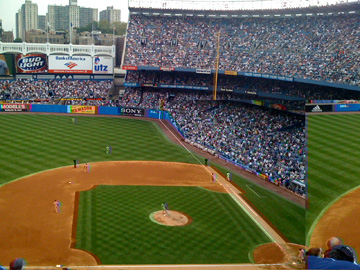
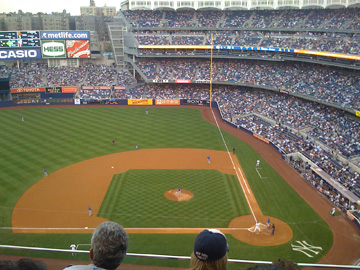
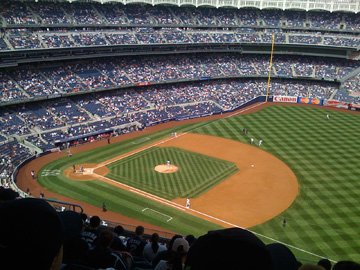
And maybe it was a couple of those big $11 beers talking, but our seats in section 423, in the fourth row of the upper grandstand between third base and home plate, felt a little like home. Observe the following triptych from my iPhone’s crappy little camera:


Last night


Our current plan seats


My final game at the old park

OK, I’m not exactly sure why the last one is so messed up — it appears I shot while the camera was scrolling from pic to pic — but it’s the sense of scale that’s the take-home. We were still further back and up than our old seats; about halfway into the old Tier Reserved, if I had to hazard a guess. But a definite improvement on our current lot.

Speaking of Kelleher, his former Cubs teammate Steve Swisher, father of current Yankee Nick Swisher, also came up for discussion as a thoroughly crappy hitter (.216/.279/.303 in 1,577 PA). In fact, both rank among the Seventies’ 30 worst in terms of OPS+ with an 850 PA minimum (stats 1970-1979 only):

Player              PA   HR    BA     OBP    SLG  OPS+
Mario Mendoza 879 2 .201 .237 .247 31
Luis Gomez 1043 0 .216 .265 .248 44
Mick Kelleher 943 0 .223 .272 .265 46
Rob Picciolo 907 6 .224 .238 .291 46
Luis Alvarado 1177 5 .218 .251 .276 48
Jack Heidemann 1210 9 .212 .264 .269 49
Dal Maxvill 1593 1 .210 .289 .241 49
Hal Lanier 887 6 .227 .263 .273 49
Rich Morales 998 6 .195 .270 .249 50
Terry Humphrey 1170 6 .211 .265 .267 52
Bobby Wine 951 4 .219 .272 .276 52
Pepe Frias 1153 1 .239 .269 .294 53
Paul Casanova 1173 20 .213 .243 .307 53
Jim Mason 1756 12 .203 .259 .275 54
Bill Plummer 1005 14 .189 .267 .280 54
Tim Johnson 1408 0 .223 .274 .265 55
Dave McKay 1289 12 .224 .259 .307 57
Paul Popovich 1036 11 .226 .279 .303 57
Randy Hundley 1403 24 .222 .273 .311 58
Hector Torres 1321 16 .216 .267 .294 58
Doug Flynn 1863 6 .240 .271 .298 59
Tom Veryzer 2243 11 .237 .281 .295 60
Bob Heise 1129 1 .243 .274 .288 60
Steve Swisher 1458 18 .219 .282 .307 61
Enzo Hernandez 2612 2 .224 .283 .266 61
Tim Cullen 893 3 .211 .274 .278 61
Johnnie LeMaster 1016 6 .223 .275 .304 62
Pete Mackanin 1107 22 .212 .255 .335 62
Darrel Chaney 2164 14 .220 .298 .294 63
Ted Martinez 1574 7 .240 .270 .309 63

Ah, so many memories of worthless baseball cards and automatic outs, from Papa Mario on down to the Dodgers’ resident futilityman, Teddy Martinez. Somebody ought to start a web site.

Young Guns, Old Clip

Last week’s WWZN Young Guns radio hit, discussing Russ Ortiz’s short-lived lead over namesake David in the 2009 home run rankings, the possibility of the Blue Jays remaining factors in the AL East, the sudden power outbursts of Mark Teixeira and Alex Rodriguez, and other fun stuff. The segment was recorded via iPhone while I was out in front of the Jeollado sushi restaurant in the East Village, so apologies if the sound is less than studio quality.

Joy in Mudonna-Ville

Greetings from Minneapolis, where I’m spending about a week centered around my wife’s cousin Julie’s wedding. Our trip kicked off in fine fashion on Friday, as within an hour of arriving at the airport, we were kicking back at a St. Paul Saints game, drinking beer and eating bratwursts. Awww yeah!

The Saints, an independent team in the independent American Association, won behind a couple of long home runs, but I didn’t actually pay too close attention to the game, even failing to notice former big-leaguer Kerry Ligtenberg closed the door with the save. In addition to my own beverage and pork consumption, I was busy shelling peanuts and otherwise playing with five-year-old Kate and two-year-old Jackie, the daughters of our hosts, who also had a one-month-old infant son in tow. This was the kids’ first baseball game, and while they weren’t overly interested in the proceedings, they were thoroughly sugared up and entertained by the between-innings shenanigans, particularly the mascot Mudonna, a bright pink pig who alternately scared and fascinated my new buddy, Jackie, who understandably had trouble figuring out exactly what she was looking at: “Where pink bear go now? Where pink bear go now?”

I’d read about the Saints years ago in Neal Karlen’s excellent Slouching Towards Fargo, a book that chronicled life in the independent Northern League during the mid-90s. The Saints, owned even to this day by a group that includes actor Bill Murray as well as baseball’s Barnumesque scion, Mike Veeck, featured Darryl Strawberry on his way back to the majors as well as Jack Morris on his way out of baseball, along with a whole bunch of other characters just happy to be playing ball anywhere for a living. Anyway, more than a decade after reading Fargo, I was glad to finally get a chance to attend one of their games, a particularly welcome antidote to Epic Fail Stadium in the Bronx. Tomorrow, I’ll pay a visit to the Metrodome (another first) for a Twins-Brewers game, but I’ll be hard-pressed to top the fun I had here.

• • •

This week at Baseball Prospectus, I wrote a “Pair Up in Threes” piece about a trio of teams whose overall showings were in marked contrast to the performance of their rotations. Both the Red Sox and Phillies continue to contend despite abysmal 6.00+ ERA showings from their starters, while the Diamondbacks are deep into the second division despite strong showings from their starters even with Brandon Webb sidelined. Here’s part of what I wrote about the D-Bags:

What’s Happened: After lasting just four innings on Opening Day, Webb was pushed to the Disabled List due to bursitis in his shoulder. He was expected only to miss a few weeks, but since suffering a setback in late April, he’s been limited to playing catch and won’t be back until sometime in June. While Yusmeiro Petit has pitched poorly in his place (8.03 ERA, -0.2 SNLVAR, .367 SNWP), Haren leads the league in SNLVAR, [Doug] Davis is 11th, and [Max] Scherzer is 26th.

Alas, Webb’s absence has been the least of the club’s problems; right now this may be the unhappiest team in the majors. Manager Bob Melvin was fired on May 8 with the team a disappointing 12-17, 8½ games out of first. They’ve gone just 2-6 under replacement A.J. Hinch, whose lack of managerial experience has drawn fire from the media as well as departed pitching coach Bryan Price. Last Friday, upon pulling Davis for a pinch-hitter, the pitcher — who had thrown just 80 pitches but trailed by a run in the seventh — confronted his new skipper in full view of the TV cameras, never a good sign.

The real problem isn’t a lack of respect for the manager’s authoritah, it’s a snake-bitten offense that’s scraping together just 3.9 runs per game, which ranks 15th in the league; their .236 EqA is the NL’s worst. Three lineup regulars (Chad Tracy, Conor Jackson, and Chris B. Young) are below the Mendoza Line, and Stephen Drew and Eric Byrnes aren’t much above it. As well as Haren and Davis have pitched, both rank in the league’s bottom 10 in run support, well under three runs per game; Haren is second-to-last at 2.3. Meanwhile, the bullpen’s been pretty lousy (12th in the league in WXRL and 13th in Fair Run Average), but most of the damage has been done in lower-leverage situations. Closer Chad Qualls and set-up men Tony Pena and Juan Gutierrez, the only relievers with Leverage scores above 1.00, are all in the black, WXRL-wise, while the mop-and-bucket patrol has sloshed kerosene around during their aisle nine cleanups.

What Will Fix It: Even if Webb returns at full strength, the Diamondbacks have dug themselves a huge hole. The PECOTA-based version of our Playoff Odds Report puts their chances at reaching the postseason at just 9.3 percent, down from 45.0 percent to start the year. The suspension of Manny Ramirez won’t do very much to bring the Dodgers back to the pack; in fact, the Diamondbacks have lost three games in the standings since then. If they don’t start scoring runs soon, it’s going to be a long summer in the Arizona heat.

As for the Hit List, the Dodgers continue to hold onto the top spot, the Brewers are third despite some bad news, and Yankees are 10th. Here’s a taste:

[#1 Dodgers] Life Without Manny: Clayton Kershaw no-hits the Marlins for seven innings; he’s allowed just six runs and 13 hits and zero homers over his last four starts, and batters are hitting just .205/.313/.333 against him overall. The Dodger rotation has picked up the slack since Manny’s suspension via a 2.81 ERA and just three homers in 80 innings despite the presence of both Jeff Weaver and Official Hit List Whipping Boy Eric Milton, two pitchers who survived the fly-ball pitcher’s hell of Albuquerque to return to the majors.

[#3 Brewers] Weeks, Months, Year: Amid a seven-game winning streak, the Brewers incur a loss of a different sort, as Rickie Weeks suffers a torn tendon sheath in his left wrist, ending his season at a point when he was hitting .272/.340/.517 while tied for the team high with nine homers. Given that the injury is in the opposite wrist as his 2006 season-ender, this only perpetuates the concern that he’ll never be durable enough for full-time duty; he’s topped 100 games only twice in five years. For the moment, the Brewers will patch from within via Craig Counsell, Casey McGehee, Hernan Irribaren, and perhaps Alcides Escobar.

[#21 Astros] Ortiz Finally Homers! Russ Ortiz beats Big Papi to the punch by a day with a two-run shot, his first homer since 2003. With a 5.81 ERA and a 21/22 K/BB rate, he ought to consider a career move, as he hit .252/.301/.403 with four homers in 2002-2003, numbers that outdo more than one current Astros lineup regular. On the other side of the coin, Wandy Rodriguez allows his first home run since last August 10, a span of 88 1/3 innings. He’s second in the league in ERA and fourth in SNLVAR; the Astros are 7-2 in his starts.

[#23 Marlins] Crouching Tiger, Rotting Fish: Andrew Miller returns from the disabled list and notches his first win in 11 months, but it’s the Marlins’ only victory in an eight-game span. The Miguel Cabrera/Dontrelle Willis deal hasn’t turned out well for the Fish thus far, as Miller’s put up a 5.88 ERA in 124 innings, Cameron Maybin’s been sent back to Triple-A after a .202/.280/.310 start, and Mike Rabelo, Burke Badenhop, and Eulogio de la Cruz have all been below replacement level as well.

That last entry came out of an on-air conversation with WLQR-Toledo radio host Norm Wamer during my weekly spot, while the Ortiz one was something I made light of during my WWZN-Boston spot on the Young Guns (audio link hopefully forthcoming).

Meanwhile, I’ve got one more article in the pipeline, an ESPN Insider/BP piece related to Randy Johnson’s pursuit of his 300th win that will be held until he finally reaches the milestone. I hope it happens soon — he took a no-decision on Friday night, keeping him at 298 — because I gots to get paid.

Ranging

For my money, last year’s biggest story in baseball was the way the Tampa Bay Rays’ turnaround was triggered by a record-setting improvement in their Defensive Efficiency. Of course, it certainly helped to have a stockpile of young talent, a shrewd GM and an innovative manager, but none of them would have likely gotten such a dramatic reversal so quickly without that defensive improvement — a development that Baseball Prospectus’ PECOTA forecasting system foresaw.

Over the winter a few teams took a page from the Rays’ book, one of them being a team that’s suddenly surprising people:

Don’t look now, but the Rangers are leading the American League West. Coming off four straight sub-.500 seasons, projected for just 70 wins and the #29 spot on the preseason Hit List, they’re out of the gate at 19-14 clip, with the fifth-best run differential in the majors. With the A’s, Angels and Mariners stumbling and bumbling, the Rangers are starting to look like plausible contenders in a division where 84 wins may be enough. Our PECOTA-based Playoff Odds report estimates they have around a 23 percent shot at the flag, more than double their chances as of Opening Day but still roughly half of the Angels’ estimate.

…Though the pitchers have gone backwards in two of the three key categories, they’re surviving thanks to the Rangers’ defense, which after ranking dead last in Defensive Efficiency in 2008 has improved by 45 points and now leads the AL. The shift of Young to third base to accommodate the arrival of the slick-fielding Andrus — a pair of decisions I criticized in this space, much to the dismay of our Rangerly readers — is bearing fruit.

More than that, it’s following the template of one of last year’s top story lines, the record-setting defensive turnaround of the Rays, a point that certainly factored into the decision to skip [Elvis] Andrus from Double-A to the majors even at the tender age of 20. In fact, the Rangers were one of three teams who elected to try replicating the Rays’ recipe, patching a porous defense with a defensively sound shortstop regardless of his offensive limitations.

…If the Rangers’ 45-point DE improvement were to hold, it would rank as the third-best turnaround ever, behind the Rays and the 1980 A’s (Billyball comes to Oakland) and ahead of the 1991 Braves, who kicked off a dynasty. That would translate into about 100 runs saved based on Ben Lindbergh’s math, and perhaps more, given the inflated value of each hit in the Rangers’ offensive environment. In all likelihood, that would probably spell a postseason berth.

As noted in the excerpt, I was critical of the decision to promote Andrus during a season where it didn’t look as though the Rangers could win much. But since then, the AL West favorite Angels, who won 100 games last year, took several hits in the pitching department, losing both Ervin Santana and John Lackey for the first month of the season, and suffering the tragic loss of Nick Adenhart. The A’s, who were predicted to win the division in BP’s preseason projections, have fizzled and already look a bit green around the gills.

I got my first extended look at Andrus on Wednesday night against the Mariners, who led the West until recently. The kid made a couple of really nice plays, including a spin-and-fire move behind second place which the Rangers’ announcers called his best one of the year. He also had a couple of hits, including a game-tying RBI triple in the sixth. The kid wasn’t expected to hit much (PECOTA .248/.301/.334), but he’s shown better contact skills and more gap power than the system gave him credit for, and his speed has helped him take advantage of that. I can see why Rangers fans were excited enough to rush him to the majors, and why they’re excited about their team’s chances after years of futility. I’m not incredibly optimistic they can pull it off, particularly with the Angels surging while getting Santana and Lackey back this week, but suddenly I’ve got another team to keep an eye out for on the Extra Innings package.

• • •

Meanwhile, this week’s Hit List is still topped by the Dodgers, who’ve seen Juan Pierre go 12-for-25 with five doubles since you-know-who was suspended. Sampling a few entries of interest:

[#3 Mets] Tossing the Bad Apple: The Mets reel off seven straight wins to take over first place in the NL East, yielding just 20 runs in that span. The streak is part of a larger stretch of nine straight quality starts for the previously beleaguered rotation, one that coincides exactly with Oliver Perez’s exile. The offense takes a hit as Carlos Delgado is sidelined by hip woes just as he’s heating up (.423/.516/.654 in May), but replacement Fernando Tatis (.328/.385/.517) has been no slouch.

[#5 Brewers] Prince and the New Power Generation: Rickie Weeks homers in three straight games, while Prince Fielder bashes a trio of homers in a three-game sweep of the Marlins, two of them go-ahead shots. Fielder’s hitting .341/.472/.659 ths month, one of five Brewers—along with Weeks, Ryan Braun, J.J. Hardy, and Craig Counsell (!)—who are slugging above .600 in May. The Brewers are tied for the league lead in homers, and they’re a major league-best 18-6 since their 3-8 start, helping them grab a share of the NL Central lead.

[#12 Tigers] D-Train and E-Jax: Dontrelle Willis returns to the majors in shaky fashion (4.2 8 4 4 2 0), but the real story in the rotation is their three shutouts in a four-game span, including a two-hitter by Justin Verlander and a combined seven-hitter spearheaded by Edwin Jackson. Jackson appears to have finally turned the corner. He’s got the rotation’s best ERA (2.60), his 3.18 K/BB ratio is more than double his career rate, and he’s still getting excellent double play support for such an extreme flyballer.

[#15 Yankees] Alex Rodriguez drills a three-run homer on the first regular-season pitch he sees, but he goes just 3-for-21 amid a stretch that sees Jorge Posada hit the DL and Derek Jeter and Hidkei Matsui both miss time due to nagging injuries. The Yanks need A-Rod to hit like the guy in the catalog, and they need Mark Teixeira (.203/.333/.424) to heat up as well. He’s getting his walks and homers (four of the latter in a seven-game span), but his .193 BABIP is the lowest among the league’s 105 batting title qualifiers.

Finally, I’ve been to each of the two new NYC ballparks twice over the past couple of weeks, and I’m quite sure I’m getting the short end of the stick with my current arrangement. CitiField, though it’s definitely overplaying the Brooklyn Dodgers angle at the expense of Mets history, and though it has some particularly hideous signage, particularly around their gigantotron video, has an intimacy that lends it an energy which has been sorely lacking at the new Yankee Stadium. Additionally, the refreshment prices are much more reasonable, and the management hasn’t embarrassed itself on a daily basis with odious pronouncements from Lonn Trost and Randy Levine about ingenious new ways to beat the peasants back from the playing field or otherwise separate them from their cash.

New name for the park in the Bronx, as noted in the Hit and Run article: Epic Fail Stadium. Use it.

Can’t Get No Relief

For today’s installment of “Pair Up in Threes,” I examine a trio of American League contenders whose bullpens have been extraordinarily awful thus far, the Yankees, the Indians and the Angels. For each team, I ran down their stats and rankings in two key BP metrics, Reliever Expected Wins Added (WXRL) and Fair Run Average (FRA). I also discussed their recent histories coming into the year (“The Setup”), their troubles thus far (“The Fall”) and outlined some potential solutions which may or may not be in progress (“The Fix?”). Here’s some of what I had to say abuot the Yanks:

The Fall: The Yankees’ staff as a whole is allowing an MLB-worst 6.23 runs per game, and while the rotation has had its problems — particularly with Chien-Ming Wang — the bullpen has been even worse. Injuries have been a major problem, as [Brian] Bruney and [Damaso] Marte, expected to be Rivera’s top set-up men, are both on the DL, the former with a strained flexor mass, the latter with shoulder tendonitis. Worse, Rivera has been battling arm-strength issues and experiencing discomfort in his surgically repaired shoulder. While his 18/1 K/BB ratio is impeccable, he’s yielded four homers in his past six outings, as many as he allowed in 2007 or 2008, and more than he yielded in eight other seasons; last week he surrendered back-to-back shots for the first time in 863 career games.

Indeed, homers have been the staff’s downfall; their 2.0 HR/9 rate is dead stinking last in the majors. The new Yankee Stadium, where an MLB-high 3.62 homers per game are flying out of the park, is a particularly poor match for a corps whose holdovers aside from Rivera are decidedly fly ball-oriented:

Pitcher                  IP     WXRL    FRA      GB%
Jonathan Albaladejo 16.0 -0.046 5.62 53.7%
Edwar Ramirez 15.0 0.193 6.22 37.5%
Jose Veras 15.0 -0.209 6.24 34.1%
Phil Coke 13.2 -0.021 4.19 33.3%
Mariano Rivera 12.1 0.652 4.73 41.2%
Brian Bruney 8.0 0.611 1.88 40.0%
Damaso Marte 5.1 -0.099 17.17 35.0%
David Robertson 4.2 -0.044 7.42 36.4%

With their primary trio failing to fire on all cylinders, the less experienced members have been called upon to shoulder a larger workload, and in doing so, they’ve looked like small-sample flashes in the pan whose 2008 performances were flukes. Veras and Ramirez have combined to walk 21 hitters in 30 innings, and the latter has yielded five homers.

The Fix? Predictably, the bullpen’s disarray has renewed calls to move Chamberlain back to the set-up role in which he flourished in 2007 and early 2008, particularly given his early struggles as a starter and the recent return of Phil Hughes. But with Chamberlain heating up — 23/7 K/BB in 18 2/3 innings over his last three starts, as opposed to 11/10 in 16 innings over his first three — and Hughes getting cuffed in two of his three starts, the Yankees need for a Jobaful rotation is clear; he’s third on the team in SNLVAR, and tops among the starters in strikeout rate.

That still leaves the team muddling through without Bruney and Marte, neither of whom is likely to be back much before the end of the month, if then. Power arm Mark Melancon debuted a few weeks ago, and he showed good stuff in a couple of outings while failing to find the plate in two others; he was sent back down to Triple-A Scranton/Wilkes-Barre to make room for the return of Alex Rodriguez, but he’ll likely be back soon. Mexican League refugee Alfredo Aceves, who made two relief appearances and four starts for the 2008 Yanks, has been recalled to fulfill a long-relief role; he could find a home in the later innings if Wang or Hughes or whomever can establish a habit of getting through five innings (those two are 1-for-6 in that category). Would the team consider moving the latter to a relief role assuming Wang returns close to full strength? If not, they may be left to twiddle their thumbs while shuffling through an assortment of Brett Tomkos and hoping the likes of Veras, Ramirez, and Albaladejo can find the strike zone sooner or later.

Seriously, I think I’m going to slap the next pundit who suggests Joba would pitch better in relief, particularly if they cite his win total as evidence.

The Dodger 100

And now for a welcome break from the steroids hubbub, I’ve got a couple books which recently landed in my in-box to plug this week. The first, which has actually been sitting on my desk for a few weeks, is Jon Weisman’s 100 Things Dodger Fans Should Know & Do Before They Die, a 300-page paperback (Triumph Books, $14.95 list, $10.17 at Amazon) ideal for summer reading. If you’ve been reading this site or following the baseball blogosphere for any length of time, you know that Jon is the keeper of Dodger Thoughts, the top blog covering the boys in blue, and one of the best baseball blogs around.

He’s also somebody I count as a friend, so I won’t pretend to offer an objective review here (full disclosure: this site is generously included in his bibliography). Instead I’ll note that even for a grizzled Dodger know-it-all such as myself, this book has plenty to offer. Leaning mostly on the key events and personalities (the Know, as opposed to the Do), Jon’s selected 100 of the most important in the team’s history across their Brooklyn and Los Angeles residencies and offered three or four well-researched pages on each. Not all of the players he profiles are Hall of Famers like Sandy Koufax (#3) and Duke Snider (#28); cult favorites like Pedro Guerrero (#40), Wes Parker (#64) and Manny Mota (#71) get their entries, as does the Fernandomania phenomenon (#7). Not all of the highlights are warm and fuzzy, either — hey, this is Dodger history we’re talking, full of reckoning with what it means to wait ’til next year, so the painful endings to the 1980 and 1982 seasons (#42 and #48) are recounted, as is Mickey Owen’s dropped third strike from the 1941 World Series (#54) and Al Campanis’ disastrous Nightline appearance from 1987 (#39).

If I have a criticism of the book, it’s that the Brooklyn side of things gets a bit of short shrift, with very little on longtime mananger Wilbert Robinson (“Uncle Robbie”), Dazzy Vance and Babe Herman. While Zack Wheat (#58) and Burleigh Grimes (#74) get to stretch their legs out, those three larger-than-life personalities — who helped define the Daffy Dodgers of the Twenties and Thirties — are all squashed into one entry, tenement style at #81. They’re an essential, colorful part of Dodger history, because their antics, such as the time Herman, Vance and another baserunner all wound up at third base (briefly recounted here), made the team’s evolution into National League powerhouse all the more surprising.

That still leaves plenty to cheer about, starting with the authority with which Jon stakes out his top two spots: Jackie Robinson and Vin Scully. By Jon’s reckoning, the former still provides the best reason to celebrate the Dodgers and their history, and the latter is the strongest existing link to that history given his 60 years of service for the club. I was particularly struck by the combination of those choices when I sat down to watch the April 15 Dodgers game, the one where young Clayton Kershaw whiffed 13 Giants on the 62nd anniversary of Robinson’s breaking of the color barrier. Though the event was noted with considerably less fanfare than on its decennial anniversaries, Scully interwove details from Robinson’s debut with his account of the action at hand, providing both historical gravitas — particularly during his usual “this date in history” spot at the top of the sixth inning — with enthusiasm for the moment he was watching. Such a delicious combination, and so well suited to the top two spots of this book.

Here’s how Jon starts the Robinson entry:

From beginning to end, we root for greatness.

We root for our team to do well. We root for our team to create and leave lasting memories, from a dazzling defensive play in a spring training game to the final World Series-clinching out. With every pitch in a baseball game, we’re seeking a connection to something special, a fastball right to our nervous system.

In a world that can bring frustration on a daily basis, we root as an investment towards bragging rights, which are not as mundane as that expression makes them sound. If our team succeeds, if our guys succeed, that’s something we can feel good about today, maybe tomorrow, maybe forever.

The pinnacle of what we can root for is Jackie Robinson.

Robinson is a seminal figure — a great player whose importance transcended his team, transcended his sport, transcended all sports. We don’t do myths anymore the way the Greeks did — too much reality confronts us in the modern age. But Robinson’s story, born in the 20th century and passed on with emphasis into the 21st, is as legendary as any to come from the sports world.

And Robinson was a Dodger. If you’re a Dodgers fan, his fable belongs to you. There’s really no greater story in sports to share. For many, particularly in 1947 when he made his major league debut, Robinson was a reason to become a Dodger fan. For those who were born or made Dodgers fans independent of Robinson, he is the reward for years of suffering and the epitome of years of success.

If that’s not reason to pick up a copy and dig into the other 99 entries in this book, I don’t know what is. Perhaps two entries a day will help the time between now and Manny Ramirez’s return pass more quickly.

Mo’ Manny, Mo’ A-Rod

Baseball Musings’ David Pinto picks up the link from my last post and wonders if teams will stand pat in the face of the Dodgers losing Manny Ramirez for 50 games:

The Diamondbacks fired their manager, so does a change of field leadership improve the team? Do the Giants try to trade for a bat to help their fine pitching staff win with a good ERA? If you think the Dodgers are going to run away with the division, maybe you don’t make moves to try to catch them. With Manny out, however, there’s an opening to catch them by improving your team.

I’m skeptical that this will trigger any big moves unless either of those teams close the gap significantly, because both are relatively budget conscious these days. The Diamondbacks spent the winter bracing for hard economic times, laying off around 30 front office employees and letting expensive free agents such as Adam Dunn, Orlando Hudson and Randy Johnson depart; they then turned around and signed Jon Garland for nearly the same price as the Big Unit. For all of their belt-tightening, their payroll rose by abut $7.3 million over last year; they ranked 20th in Opening Day payroll at $73.5 million.

The notoriously tight-fisted Giants, on the other hand, increased their payroll from $76.6 to $82.6 million (13th) this winter in an effort to break their two-year streak of 90+ losses. They made $37.25 million in salary commitments, the NL West’s largest outlay and the eighth-largest in the game, though admittedly that’s a rounding error relative to the Yankees’ $441 million worth of commitments. Aside from a few untouchable blue-chippers, including giggleworthy pitcher Madison Bumgarner (yes, really) they don’t have a lot to deal in a midseason prospects-for-veterans swap.

Both teams probably have some wiggle room to add salary if they’re truly contenders, but recently we’ve seen a shift in the way teams value prospects in general. Even if either one pulls the trigger, the Dodgers have far more resources — prospects as well as mony — and more leeway, as they cut salary from $118.6 million to $100.4 million while still signing making an NL-high $105.9 million in commitments via free agents Hudson, Ramirez, Casey Blake, Rafael Furcal, Randy Wolf et al. Certainly, I don’t think you’ll see either of their competitors go to the whip early and trade for a CC Sabathia or an Adam Dunn until they make up considerable ground on the Mannyless Dodgers.

• • •

Here’s this week’s Hit List. That’s my fourth article at BP in the last three days, breaking last week’s record of four in four. Mixing things up from my usual selection, here are the Yankees as well as a couple of the more interesting entries:

[#13 Braves] You’re a Dull Boy, Frenchy: After supposedly finding the religion of plate discipline over the winter, Jeff Francoeur is back to his old ways, drawing just four walks in 118 PA, and getting on base at a .305 OBP clip that’s actually seven points below his career rate. “If on-base percentage is so important, then why don’t they put it up on the scoreboard?” he muses, indicating that yes, there are questions so dumb they shouldn’t be asked.

[#14 Angels] Nap Time At Last: Just three days shy of three full years in the majors, Mike Napoli finally gets a start at DH—three of them, in fact — and responds by going 8-for-11 with 13 total bases. You’d think such a move would have been glaringly obvious by now given the presence of a defensively superior catcher and the absence of Vlad Guerrero, the lone Angel with a higher OPS since Napoli hit Anaheim back in 2006. Alas, old-schooler Mike Scioscia labors under the notion that there are only two positions for a backstop: a-squattin’ and a-sittin’. Napoli’s hitting .328/.444/.642, just two points of batting average shy of leading the team in all three triple-slash categories.

[#19 Yankees] The Yanks lose five straight and fall to 3-10 within the AL East after defeats by Boston and Tampa Bay, and they lose Jorge Posada to the disabled list due to a hamstring strain along the way. The good news is that Alex Rodriguez will rejoin the lineup on Friday; in his absence, Yankee third basemen have hit .202/.248/.283. The bad news is that he can’t do anything about the MLB-worst 6.3 runs per game the pitching staff is allowing.

Also at BP, in addition to my Manny math is my two-part series (National and American Leagues) on which April results are meaningful as far as the playoff races are concerned. From the AL piece:

In the East, history suggests that we ignore Toronto’s hot start at our peril; 18-10 teams with three straight seasons above .500 tend to keep the good times rolling. On the other hand, particularly with three teams forecast to win at least 94 games, the PECOTA-based odds suggest a deck still stacked heavily against the Blue Jays, and last week I identified a handful of reasons they might regress. Forecast to have the league’s lowest-scoring offense, they’re suddenly and improbably the highest-scoring unit, fueled by an infield that’s hitting a combined .303/.380/.479, with Aaron Hill (.360/.404/.552) and Marco Scutaro (.262/.400/.458) both particularly over their heads. Their rotation has been decimated by injuries, and it’s possible that three starters who helped them post the league’s top ERA last year — Dustin McGowan and Shaun Marcum, both rehabbing from off-season arm surgeries, as well as departed free agent A.J. Burnett — won’t throw a single pitch for them this year. Through the end of April they had played the league’s second-easiest schedule (.474, based on PECOTA-projections), but they’ll face the AL’s second-hardest (.513) overall. Not helping the Jays is the fact that the indicators suggest that neither the Yankees nor Rays have scuffled enough to rule them out, and both have substantial upgrades waiting in the wings — the former in the form of Alex Rodriguez, the latter via David Price, the game’s top pitching prospect.

If you like the ESPN Insider flavor better, you’ve got your AL and NL versions too.

• • •

Thanks to Manny, A-Rod’s latest controversy is old, old news. I don’t feel particularly inclined to weigh in to great extent except to note that it seems clear the worm has turned for Selena Roberts, author of the dumpster-diving exposé which has rocked the baseball world with revelations that Rodriguez only tips 15 percent at Hooters. Where her discovery that the slugger tested positive during the supposedly anonymous 2004 survey testing was a legitimate (if rather unsavory) journalistic coup, her latest allegations reek of smear tactics and innuendo, serving to remind the world of her own tarnished past and her execrable writing style.

Before you close your mental drawer on the situation, here are a few must-read links:

• The Kansas City Star‘s Jason Whitlock reminds readers of Roberts’ infamous handling of the Duke lacrosse rape allegations:

She claimed that the players’ unwillingness to confess to or snitch about a rape (that did not happen) was the equivalent of drug dealers and gang members promoting antisnitching campaigns.

When since-disgraced district attorney Mike Nifong whipped up a media posse to rain justice on the drunken, male college students, Roberts jumped on the fastest, most influential horse, using her New York Times column to convict the players and the culture of privilege that created them.

Proven inaccurate, Roberts never wrote a retraction for the columns that contributed to the public lynching of Reade Seligmann, Colin Finnerty and David Evans.

In a follow-up column at Fox Sports, Whitlock continues his attack: “By refusing to acknowledge her mistakes in the Duke case, she creates the impression that her agenda trumps the truth.” Ahem.

• Steve Goldman weighs in with an excellent Pinstriped Bible:

I don’t trust Roberts’ judgment, I don’t trust her understanding of baseball, and I don’t trust her motives in writing a book about Alex Rodriguez that surely would not exist were it not intended to be a hit piece. If Rodriguez was juicing in high school or kindergarten, it goes to character, not performance, and we have had countless reasons to know that he’s not Mother Theresa in the clubhouse or off the field. Neither were Ty Cobb, Babe Ruth, Ted Williams, Mickey Mantle, et al. Cobb’s reward was to die friendless, Ruth and Mantle died young, the causes of their cancer probably not unrelated to their youthful carousing, and Williams’ own son had him decapitated and stuck in a freezer.

…If Rodriguez used steroids in high school, that tells us a little more about Rodriguez the man but nothing of substance about Rodriguez the ballplayer. If he used HGH as a Yankees, well, HGH seems to help athletes with recovery time and healing, not performance. So does aspirin. Move on. Xavier Nady is having platelets shot into his elbow. The dividing line between these two therapies is entirely arbitrary.

As for Roberts’ allegations of Rodriguez tipping pitches as a Ranger, they had best be better sourced than her work on the Duke case. According to SI.com, “Roberts said that over the course of a couple years, some people with the Rangers began to detect a pattern whereby Rodriguez would appear to be giving away pitch type and location to hitters, always middle infielders who would then be able to repay him in kind when he was at the plate, with his body movement.”

It is extraordinary to think that “some people” would notice this and not alert management as to the practice. Unless there is videotape evidence, or Roberts’ sources are willing to come forward and explain why they sat on their knowledge that Rodriguez was damaging his own pitchers, this must be dismissed as the worst kind of hearsay. That Roberts knows relatively little about baseball must be considered here — her credulity and our skepticism must be of equal proportion.

Word.

• Of all people, it’s noted blogger/blog-hater Murray Chass who offers the definitive takedown of Roberts:

In general, Roberts makes far too many serious allegations about Rodriguez to hide them behind anonymous quotes. Rodriguez deserves more, but more importantly readers deserve more. There is far too much in this attack book for Roberts to expect readers to take it on faith that her anonymous sources are real and they can be trusted.

The use of anonymous sources has come under increasing criticism from readers of all types of publications. Having used them frequently in my decades as a reporter and columnist, I am aware of the problems they pose. Reporters have to establish their credibility with their use of unidentified sources for readers to accept them.

Roberts and I were once colleagues at The New York Times, and I can’t say she established that credibility. She also didn’t strike me as being a top-flight reporter. As a result, I don’t feel I can trust her book full of anonymous sources. Even if every single A-Rod transgression she reports is accurate, it’s too easy for her to write one former teammate said this and another player said that.

…Roberts belies her understanding of baseball with an observation she makes in trying to offer an example of A-Rod on steroids. Citing the game in August 2002 in which he hit three home runs, she writes that his “performance set off the steroid alarms,” explaining, “In the dog days of the season, when players are wilting, A-Rod had fresh legs and a fresher bat.”

And she quotes an unnamed “Ranger teammate” as saying, “It’s that stuff that makes you say no (bleeping) way.”

No way? Both Roberts and the teammate should consult The Elias Book of Baseball Records,” pages 359 through 362. The list of players who hit three or more home runs shows that 76 players other than Rodriguez hit three or more home runs in August.

Gil Hodges slugged four for the Brooklyn Dodgers Aug. 31, 1950. Hall of Famer Jim Rice hit three in a game twice, both games being played Aug. 29. Other Hall of Famers who hit three in an August game were Ralph Kiner, Larry Doby, Ernie Banks, Roberto Clemente, Frank Robinson and Eddie Murray (twice).

It has never been suggested that any of those players used steroids.

Yeah, ouch.