Pitchers and Catchers: Dawn of the Undead

Having raised more than one toast to the arrival of Pitchers and Catchers earlier this week, I’m lucky it didn’t all come up on me at midnight last night, when I did a spit-take after reading that the Yankees had signed Scott Erickson to a minor-league deal. Suffice it to say that I was not amused at the specter of a 38-year-old, injury-addled has-been who hasn’t been anywhere near useful since 1999. “I thought we killed this piece of shit off last summer in L.A.,” I wrote in an email to a few friends. “What is he, some kind of zombie? I guess Donovan Osborne, Darrell May and Tim Redding had better ditches to curl up and die in, and Hideo Nomo wasn’t biting either.”

Erickson spent the first half of last season with the Dodgers, posting a 6.02 ERA in 55.1 innings, allowing 12 homers while walking 25 and striking out 15, and reportedly stirring shit in the Dodger clubhouse. Even given the injuries that the team was suffering, that Erickson was even on the roster was a horrible miscalculation on the part of GM Paul DePodesta. That Jim Tracy tapped him to start eight games was equally indefensible. That he lasted with the team until the trading deadline was tantamount to a war crime. What, the Red Sox wouldn’t take him straight up for Manny Ramirez?

My email continued: “It would take a nuclear holocaust, a flash flood of biblical proportions, and a plague of 50-foot-tall flesh-eating red ants for Erickson to merit ‘meaningful innings’ in the major leagues, and if he’s still living at that point, I’d rather be dead.”

Erickson is hardly the only washed-up pitcher who’s washed up on the shores of a major-league team in recent weeks. The Mets, who began the offseason with a good amount of depth in their rotation before squandering Kris Benson and Jae Seo in trades, have turned to Jose Lima, who posted a 5-16 record with a 6.99 ERA in 169.2 innings in Kansas City. As Baseball Prospectus’ long-suffering Royal rooter Rany Jazayerli summarized:

The owner of both the American and National League records for highest ERA in a season of 30+ starts is now a member of the New York Mets, who are apparently unaware of the information contained in the preceding clause. No team stands to gain as much from a case of addition-by-subtraction as the Royals will by changing their clocks away from Lima Time.

Yeesh. Lima’s no stranger to high ERAs; he’s finished a season above 5.50 five times in eleven-plus seasons, and his career mark of 5.21 is 15 percent below the park-adjusted league average. And to think it was less than 18 months ago that Lima capped a storybook season by shutting down the mighty St. Louis Cardinals for the Dodger’ sole postseason victory since 1988, one of the most electrifying performances in franchise history.

Obviously feeling the void left by Erickson, the new-look Dodgers tapped one of the Yanks’ favorite whipping boys, Aaron Sele. Last year in Seattle, Sele went 6-12 with a 5.66 ERA in 116 innings, an amazing accomplishment considering he had the Giant Fork of Done-ness sticking out of his ass. Sure, it’s only a minor-league deal like those of Erickson and Lima, and the range of reasons teams bring these guys to camp runs from personal favors to veteran herbs and spices to simply having a few extra arms to send on the bus to Clearwater while the A-listers shag fly balls at the home complex. But Lord knows that none of these systems is so threadbare that they don’t have a few Triple-A types who would benefit from a bit more work instead of standing by while these zombie retreads dish out 425 feet worth of Cream of Slider soup.

So, having covered the Yanks, Dodgers, and Mets, who are some of the other similarly undead pitchers who will be serving up meatballs in the Grapefruit and Cactus Leagues over the next few weeks? Inquiring minds want to know.

Hitting in a Pinch

In a recent L.A. Daily News article, Kevin Modesti strained a metaphor in comparing the Dodger organization’s history with that of the (sigh) Super Bowl champion Pittsburgh Steelers. No matter. What caught my eye was Modesti pointing out that in the entire organization, the current Dodgers have but two links to their World Series glory days of the ’70s and ’80s: Special Advisor to the Chairman Tommy Lasorda, who managed the team from 1977-1996, and coach Manny Mota, their pinch-hitter extraordinaire for more than a decade.

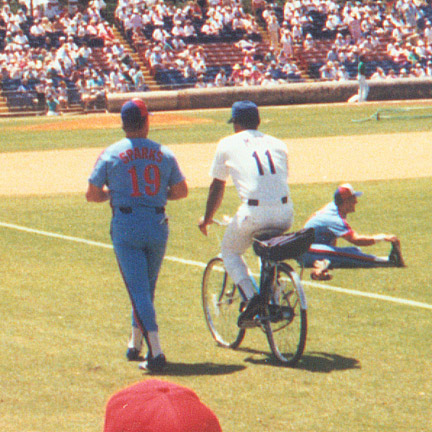
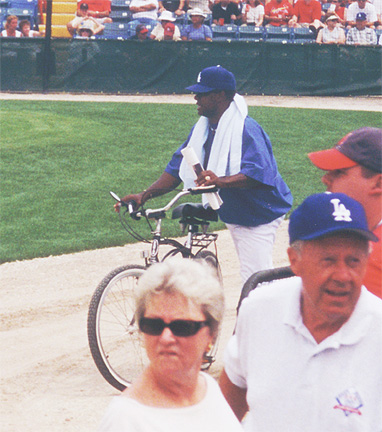
While nobody could miss Lasorda’s bluster, Mota flies much further under the radar, but his role in the team’s continuity hasn’t escaped my notice. When I went down to the Dodgers’ spring-training facility in Vero Beach back in 2003, I was amused to find him still riding his bike onto the field before games, just as he had been doing on my first trip to Vero back in ’89. Roll on, Manny.

When he retired in 1980 (he got a token at-bat in ’82), Mota held the all-time major league record with 150 pinch-hits. He’s since been surpassed by Lenny Harris; here’s the leaderboard (updated from Wikipedia):

 1. Lenny Harris     212
2. Manny Mota 150
3. Smoky Burgess 145
4. Greg Gross 143
5. Dave Hansen 139
6. Mark Sweeney 131
7. John Vander Wal 129
8. José Morales 123
9. Jerry Lynch 116
10. Red Lucas 114
11. Steve Braun 113
12. Terry Crowley 108
Denny Walling 108
14. Gates Brown 107
15. Mike Lum 103
16. Jim Dwyer 102
17. Rusty Staub 100
18. Dave Clark 96
19. Larry Biittner 95
Vic Davalillo 95
Gerald Perry 95
22. Jerry Hairston 94
23. Dave Philley 93
Joel Youngblood 93
25. Jay Johnstone 92
Dave Magadan 92

Harris may have taken the top slot, but he can’t carry Mota’s jock to the end of the bat rack. He’s been squeezing out the occasional single at a near-replacement level for the past several years (that’s exactly 1.3 WARP3 since ’99) and overall has hit a rather weak .260/.312/.330 in 816 PA the role, according to Retrosheet. For comparison, Mota hit .288/.360/.359 in 614 PA (per Retrosheet), and that’s without considering the lower-scoring era in which Mota played.

In any event, Harris is virtually the last of a dying breed. At the Hardball Times, Steve Treder recently offered up a history of pinch-hitting specialists, which he defined as players appearing in at least 40 games a year, with at least 80% of their appearances as a PH. Since 2000, just six player-seasons have qualified under that definition, including two by Harris. That’s an average of 0.067 per NL team (there hasn’t been one in the AL since Bobby Molinaro on the 1981 White Sox, managed by that master fidgeter, Tony La Russa), down from 0.088 in the ’90s and a peak of .217 in the ’80s.

Treder has compiled a decade-by-decade breakdown of each PH specialist season, along with some commentary, making for an entertaining stroll through the history of this particular species and providing an appreciation for how difficult the job is even for very experienced players. Suffice it to say that in 40 to 100 plate appearances, anybody can hit anything, so you’ve got a players like Gerald Perry and John Vander Wal who shows up on Treder’s Top and Bottom 20 seasons lists just two years apart.

Here’s what he had to say about Mota:

Manny Mota was another pinch-hitting legend, deployed by the Dodgers as an extreme pinch-hitting specialist through much of the decade of the 1970s. Unlike the vast majority of these guys, Mota was a right-handed batter, but it didn’t make any difference to Mota who was pitching; he was going to hit a line drive anyway. As a Giants fan, I can attest that in the late innings of a tight game against the Dodgers, the presence of Mota looming in the L.A. dugout was frightening indeed. Mota was constitutionally incapable of doing anything other than smacking a solid line drive in any at-bat against any pitcher in any circumstance. Mota turns 68 years old this month, but I suspect if you go to Mota’s house tonight at 3 AM, yank him out of bed, jam a bat in his hands and have a fully-warmed up Mariano Rivera in the front yard flinging his nastiest cutter, the groggy, barefoot pajama-clad Mota will stumble out there and drill the first wicked offering for a solid line drive. In the dark. (Smash! There goes the neighbor’s living room window.)

As interesting as his research is, Treder’s strict definition leaves out many renowned pinch-hitters. Just comparing the names in his article to the leaderboard above, fourth-ranked Greg Gross is nowhere to be found. Jose Morales, who set a single-season record with 25 pinch-hits in 1976, is represented only by his 1983 season with the Dodgers because he spent about half his at-bats in the Bicentennial campaign playing catcher or first base. Also MIA is Red Lucas, who doubled as a pitcher (157-135, 3.72 ERA in his career, which ran from 1923-1938) while racking up 437 PH at-bats (he hit .281/.340/.347 for his career during a high-offense era). No love for Denny Walling, Jim Dwyer, Larry Biitner or Jerry Hairston (Sr.) — guys who were staples of pinch-hitting in the ’70s and ’80s, at least in my mind — to be found.

As for those flying the Dodger blue flag, while Reggie Smith injury-addled 1981 season and Boog Powell’s odd 1977 finale make Treder’s cut along with Mota, a couple of other Dodger favorites, Vic Davalillo and Jay Johnstone, missed it. Davalillo was Mota’s even-more-ancient partner in crime. A diminutive (5’7″ 155 lbs) Venzuelan outfielder who reached the majors at age 25 in 1963, Davalillo was a light-hitting regular for a decade. A late-season pickup for the 1973 champions-to-be Oakland A’s, he went 5-for-8 with a double and a triple in their ALCS win. Released in May ’74, Davalillo spent three years in the Mexican League before the Dodgers purchased him in August ’77, shortly after his 41st birthday. He hit .312/.312/.354 in 48 at-bats the rest of the way, and played a crucial role in the postseason. In Game Three of the LCS against the Phillies, the Dodgers were down 5-3 with two outs in the top of the ninth when pinch-hitter Davalillo beat out a daring drag bunt. Pinch-hitter Mota followed him with a drive that was misplayed by leftfielder Greg Luzinksi (“The worst outfielder I ever saw, bar none.” — Bill James, NBJHA) into a double, with Davaillo scoring on an accompanying error. In all, the rally produced three runs, and the Dodgers finished the series off the next day. Davalillo went on to another fine season in 1978, hitting .312 /.333/.390 in 77 at-bats, including 47 as a pinch-hitter, but the returns diminished from there. He got just 27 at-bats the next year, and six the following, retiring at age 43.

Johnstone was a handy outfielder who’d passed through six different teams over 14 years by the time he reached the Dodgers in 1980. In addition to emerging as Lasorda’s comic foil, he hit .307/.372/.406 that year as a fourth outfielder. He was lousy in the latter role the next year, but still hit .289/.341/.600 in 38 pinch-hit at-bats. In the World Series, he drove in a run with a pinch-hit in a Game One loss, then entered the pantheon of Dodger heroes with a two-run pinch-homer in Game Four that trimmed a 6-3 Yankee lead to 6-5. They tied the score later in the inning, then took the lead for good in the next, and knotted the series at 2-2. When the Dodgers won the Series, Johnstone’s homer was cited by teammates as the turning point (for more on Johnstone, see here).

In any event, the pure pinch-hitting specialist is clearly a vanishing breed; as Treder points out, the roster spot seems to have been usurped by an even more questionable specialist, the LOOGY (left-handed one-out guy). Treder is skeptical that either role is a great use of a roster space, and while I’d agree, it does seem that having a very good one who can also play a bit of defense here and there, as many of the names I’ve dredged up could, is considerably more useful. Towards that end, here are a couple of quick lists based on data I dredged up from ESPN’s Sortable Stats, the best and worst pinch-performers of the last six years, with a minimum of 40 At-Bats + Walks (no HPB or sacrifice data available):

BEST           TEAM   Year   AB   H   HR  RBI  BB    AVG   OBP   SLG    OPS
Craig Wilson Pit 2001 34 10 7 11 7 .294 .442 .912 1.354
Wes Helms Mil 2005 41 16 2 6 6 .390 .469 .634 1.104
Dave Hansen LA 2000 55 15 7 14 10 .273 .385 .673 1.057
David Dellucci Ari 2001 56 18 5 16 9 .321 .415 .607 1.023
Greg Norton Col 2003 71 23 4 17 6 .324 .385 .606 .990
Tony Clark Ari 2005 44 14 3 15 4 .318 .375 .614 .989
Julio Franco Atl 2004 43 15 2 16 6 .349 .429 .558 .987
Danny Bautista Ari 2001 40 14 1 7 3 .350 .409 .525 .934
Hal Morris Det 2000 40 13 2 7 5 .325 .404 .525 .929
Jason Lane Hou 2004 36 12 2 6 4 .333 .400 .528 .928
Mark Sweeney Col 2004 65 16 5 23 12 .246 .366 .554 .920
Marlon Anderson StL 2004 51 17 3 10 3 .333 .370 .549 .919
Alex Cintron Ari 2005 46 14 3 12 3 .304 .347 .565 .912
Keith Lockhart Atl 2001 46 15 1 6 8 .326 .426 .478 .904
O. Palmeiro Hou 2005 52 15 1 8 6 .288 .361 .519 .880
Erubiel Durazo Ari 2001 45 11 5 13 1 .244 .255 .622 .878
Mark Sweeney SD 2005 62 18 2 12 13 .290 .408 .468 .876
Orlando Merced Hou 2001 58 15 4 17 6 .259 .323 .552 .875
Olmedo Saenz LA 2004 48 15 3 13 4 .313 .345 .521 .866
Bobby Bonilla Atl 2000 39 12 0 10 6 .308 .404 .462 .866
Carlos Baerga Ari 2003 55 19 1 10 8 .345 .429 .436 .865
John Valentin NYM 2002 50 15 1 13 10 .300 .419 .440 .859
Ricky Ledee LAD 2005 35 11 1 9 6 .314 .419 .429 .847
Greg Norton Col 2001 63 17 3 11 5 .270 .319 .524 .843
A. Galarraga SF 2003 40 12 2 6 4 .300 .364 .475 .839
Julio Franco Atl 2005 45 14 1 12 5 .311 .392 .444 .837
Robin Ventura LA 2004 48 13 3 14 8 .271 .368 .458 .827
Miguel Cairo StL 2002 59 19 0 10 4 .322 .364 .458 .821
Tony Fernandez Mil 2001 43 15 0 7 5 .349 .420 .395 .815
Jacob Cruz Cin 2005 76 20 3 11 11 .263 .352 .461 .813

WORST TEAM Year AB H HR RBI BB AVG OBP SLG OPS
Abraham Nunez Pit 2002 43 5 0 4 4 .116 .204 .116 .320
Jose Vizcaino Hou 2001 45 7 0 0 4 .156 .224 .156 .380
Darren Bragg Atl 2002 42 6 0 1 3 .143 .200 .190 .390
Tomas Perez Phi 2005 43 6 0 6 6 .140 .260 .140 .400
John Mabry StL 2001 41 7 0 5 3 .171 .239 .195 .434
Wilton Guerrero Cin 2002 56 11 0 3 4 .196 .250 .196 .446
Jose Macias ChC 2005 54 10 0 5 2 .185 .207 .241 .448
Troy O'Leary ChC 2003 39 5 1 7 5 .128 .222 .231 .453
Jose Macias ChC 2004 47 10 0 6 2 .213 .260 .213 .473
Kevin Sefcik Phi 2000 43 6 0 2 9 .140 .288 .186 .475
Brant Brown ChC 2000 44 8 0 2 3 .182 .234 .250 .484
Lenny Harris ChC 2003 40 8 0 2 5 .200 .289 .200 .489
Dave Hansen SD 2003 55 9 0 3 10 .164 .292 .200 .492
Julio Franco Atl 2002 39 7 0 2 6 .179 .289 .205 .494
Matt Mieske Hou 2000 53 8 2 7 4 .151 .207 .302 .509
Dave Hansen LA 2002 53 9 1 4 7 .170 .267 .245 .512
Todd Zeile NYM 2004 39 6 1 2 4 .154 .233 .282 .515
Matt Franco Atl 2003 78 15 2 10 5 .192 .238 .282 .520
Dave Hansen Sea 2004 51 8 1 6 11 .157 .306 .216 .522
Q. McCracken Ari 2003 54 12 0 3 3 .222 .263 .259 .522

Another former Dodger, Dave Hansen, at one point looked like a solid bet to eclipse Mota and move into second place. But with two dubiously chart-making seasons in 2003 and 2004, plus an anemic 2-for-31 last year, Hansen appears to have run out of gas. Unless he somehow finds a job this spring, he will have finished with just 19 hits in his final 137 pinch-ABs (.139). For his career, he’s still hit .234/.351/.358 in 593 at-bats in the role, and as his presence on the first list attests, was one of the best in his “prime.” It’s a dirty job, but somebody’s gotta do it.

Angels in the Out-on-a-Limb-Field

I had lunch on Thursday with an old college pal who works down in the Wall Street area — we’ll call him B. Ever since reconnecting at our 10-year reunion in 2002, we’ve been playing fantasy baseball together, more as an excuse to talk smack than anything else. This is the friend who’s called his team “Jaffe’s Big Stinky” in each of the last two years, and let’s just say that I exacted some revenge by using his surname as part of my even-less-printable team name. Since I took the league crown last year, he’s in for more of the same.

He’s a Red Sox fan, and most of our spirited conversation centered around the offseason maneuvers of the Sox and Yankees. But at some point, after mutually second-guessing the team’s dumping of Andy Marte and the slim chances of a healthy Curt Schilling, the conversation drifted to the Angels, whose essay I came out of the bullpen to write for Baseball Prospectus 2006.

Now, I’ve never been an Angels fan, but I’ve gotten an eyeful of the franchise as it’s eliminated the Yankees in 2002 (on their way to a long-elusive World Championship) and 2005. While the team isn’t exactly what you’d call sabermetrically inclined, they’ve done a pretty good job of handling those paragons of the Moneyball way, the Oakland A’s, over the last four years, reaching the playoffs three times while the A’s have missed in each of the past two years. In doing so, they’ve topped three million in attendance in each of the past three years, including a franchise-record 3.4 million last year. With an owner, Arte Moreno, who’s willing to spend money, a nice combination of depth and versatility, and an impressive crop of prospects in the pipeline, they have much reason for optimism. The essay I quickly pulled together reflected that.

Moreno, who bought the team from Disney fresh off of their 2002 title, made a bold move last winter by recomissioning them the Los Angeles Angels, targeting L.A. county’s diverse population (10 million) over Orange County’s much less colorful three million. In doing so, he also put an embattled Dodger franchise’s assumption that they owned the town directly in his crosshairs, even going so far as to put up billboards near Dodger Stadium.

Per a 1996 lease agreement with their host city, a court ordered “of Anaheim” appended to the Angels’ name, creating an unprecedentedly unwieldy moniker. One would have expected a backlash, and certainly many writers, both professional and amateur, seized on the ridiculousness of the name. But the controversy certainly didn’t hurt the Angels at the gate or on the field, and even as the court case between the team and the jilted city of Anaheim loomed, I maintained my note of optimism in my essay.

In the three weeks since I’ve handed it in, I’ve been sweating both the trial and the negative PR it generated, and as B. and I discussed the Angels, I proffered the opinion that if they’d lost the suit, Moreno would either begin threatening to move the team — an ugly, no-win battle that we’ve seen the Marlins, Twins, and Expos/Nationals fighting for the better part of the past decade — or else unload them once his five-year depreciation window shut. Given the bold vision Moreno has shown, either of those outcomes would have been a shame. After ridiculing him myself, I’ve come to admire the owner’s chutzpah; if the true lesson of Moneyball is about capitalizing on inefficiencies in the market, what’s more Moneyball than leveraging a $294-million franchise to take advantage of the demographics of his locale and the weakness of his competition?

Just a few hours after finishing lunch, the verdict came down. Team 1, City 0:

Ending a yearlong dispute that sparked regional one-upmanship and talk-show ridicule, an Orange County jury Thursday decided that the Los Angeles Angels of Anaheim could keep their geographically awkward name.

After deliberating just over four hours in a trial that pitted the city of Anaheim against its hometown team, jurors voted 9 to 3 that the Angels did not violate five words in the stadium lease that required that the team “include the name Anaheim therein.”

Anaheim Mayor Curt Pringle, who led the city’s multimillion-dollar fight to restore the name, said: “There was a really a broader issue, and that was to make sure our identity of Orange County and Anaheim be preserved. We’re very disappointed.”

The city had asked for damages up to $373 million it said it would lose in media exposure and tourism revenue. The jury awarded it nothing. The city also may be on the hook for as much as $10 million in legal fees — their own and the Angels’ — if the team seeks reimbursement.

City officials will discuss whether to appeal the decision at a meeting Tuesday, but council members said it was not likely.

Angel owner Arte Moreno — popular among fans for investing millions in superstar players, lowering beer prices and schmoozing in the stands — clapped as the verdict was read and gave a thumbs-up sign.

“Believe it or not, what we’ve been trying to do is enhance the Angels brand,” said Moreno, a self-made billionaire from Arizona. “I know local fans were very emotional about it. We understand that. But in the long run … we believe this gives us a better chance of being a perennial upper-echelon franchise, and a chance to compete for a championship every year.”

So that note of optimism I sounded in my essay doesn’t look so unwarranted. But as for the team’s on-field performance, let’s just say PECOTA isn’t so impressed. When Nate Silver released the 2006 projections to the BP staff, he had the team coming in at 78-84 thanks to an offense worse than any AL team save the Royals. One reason for that is the anticipated presence of Darin Erstad, who comes in at a craptastic .264/.314/.364 weighted mean projection in 545 plate appearances, mainly as a first baseman. Since the Angels have announced that Erstad is moving back to centerfield — thereby not only lessening the load his bat should be expected to carry but also increasing his chances for injury — I don’t think things are nearly that dire. As I told B., I see Erstad limping his way out of the lineup in 60-70 games. But PECOTA isn’t exactly bullish on his first-base replacement either. Casey Kotchman’s weighted mean comes in at an Erstadian .270/.328/.398 in 461 PA. The system simply doesn’t think the 23-year-old’s power is going to develop, but the fact that he clubbed seven dingers in 142 PA over the season’s last two months leads me to believe he’s turned a corner. Kotchman’s been addled by various wrist injuries during his development, but if he’s put them behind him, I think he’s more likely to find himself on the upper reaches of his projection, somewhere between the 75th percentile (.284/.344/.428) and 90th (.299/.361/.463). That’s not world-beating, but it is a difference of a couple of wins if it happens. (For more on Kotchman’s projections, see Beyond the Box Score.)

Regardless, PECTOA thinks the Angels have plenty of other troubles, more than I care to delve into at this point. I may well end up with egg on my face for my predicting they’d take this year’s AL West in my BP chat last month. But with prospects like Howie Kendrick and Brandon Wood (both among the top 10 in BP’s forthcoming Top 50 Prospect list) and one of the game’s best owners behind them, I remain bullish on their future.

• • •

Speaking of the Angels, former LAAoA outfielder and FI favorite Jeff DaVanon inked a one-year contract with the Arizona Diamondbacks this week, capping several weeks of intense pursuit by, oh, about half the teams in baseball, with the Rockies, Mets, Red Sox and Indians reportedly among them. Back around the time of the Yanks signing Johnny Damon, I had touted DaVanon as a low-cost alternative who, as a swicth-hitter capable of playing all three positions, made for an ideal fourth outfielder or pre-deadline centerfield stopgap. That meme caught on, most notably with Steve Goldman, who mentioned DaVanon in several Pinstriped Bible/Blog entries.

Alas, the Yanks seem wedded to the idea that the dessicated remains of Bernie Williams and the Make-A-Wish kid, Bubba Crosby, can fulfill those responsibilities. Here are PECOTA’s weighted mean forecasts for the trio:

          Age   AVG   OBP   SLG   MLVr
Williams 37 .261 .336 .384 -.049
Crosby 29 .249 .302 .382 -.116
DaVanon 32 .266 .360 .389 .002

MLVr is Marginal Lineup Value rate, the per-game comparison of how many runs a player would add to an offense of league-average hitters. None of these guys have a lot of power at this stage, but DaVanon’s plate discipline is superior at this stage to Bernie’s. Even with enough questions about his health (shoulder) to downgrade his contract from a once-rumored $3.5 million to $525K plus incentives and conditional options, he’d have been a better use of roster space than #51, if only to dissuade Joe Torre from pencilling in Williams as the DH to the point of 300-400 PA. The guess here is that nobody would have batted an eye if the Yanks had just tossed DaVanon $2 million back in December and been done with it. As it is, the Yanks are woefully thin on the bench and at DH, while DaVanon is likely the D-Backs’ starting CF, at least until rookie Chris Young heals his broken hand (thanks to Rob Mc at 6-4-2 for calling attention to that news). Grrrrr.

• • •

Have you got Olympic fever? My wife did, literally, so we stayed home on Friday night to watch the Opening Ceremonies of the Winter Games at Torino as she nursed a triple-digit temperature. Brought back a lot of fond memories of the 2002 Salt Lake City games, which my pals and I attended. Sunday’s slate includes an event which supercedes even the Super Bowl in my personal pantheon of great sporting events: the Men’s Downhill. You know I’ll be watching that one, not to mention a good deal of the rest of the coverage, which should help the time between now and Pitchers and Catchers fly.

• • •

Following up on my entry on Ben Sakoguchi’s Orange Crate Label Series, Don Malcolm has a lavishly illustrated, in-depth look at the exhibit over at Baseball Think Factory. Malcolm brings a lot more background to the subject than I do, and — befitting his own checkered past — is well-attuned to the confrontational aspects of the artist’s work. Here’s some of what he had to say:

Sakoguchi likes to draw startling, jagged, and even surreal parallels in these paintings. In fact, 33 of the paintings in the new group (28%) feature “two-shots” of players or individuals shown either as contrasts or “hidden selves.” The one most pertinent to the question of race is the painting entitled “Cubanos,” where Ben explores the taboos of skin pigmentation (light-skinned Cuban Dolf Luque is “eligible” to play in the 1920s milieu of baseball, while dark-skinned Cuban Martin Dihigo is “ineligible”).

It isn’t surprising that Sakoguchi would be interested in “otherness” as it is manifested in baseball. After all, we are talking about a Japanese-American who, as a very young boy, was interned at Manzanar, one of America’s “detention centers” during World War II. From an artistic standpoint, Ben’s interest in color probably stems from the early realization of how much importance it seemed to have in the minds and actions of those in power in America. As a painter, Sakoguchi wields a palette of colors that covers the artistic waterfront—from Impressionism to “plein air” to pulp art and back again.

Some of his most arresting images, however, are reserved for another casualty of American history—the Indian. During the deadball era, there were several Native Americans who fashioned notable careers in spite of their “otherness.” It could be claimed that the lone reason for their assimilation into the American culture of that time was located in their abilities on the baseball diamond. All of these themes are captured masterfully in “Chiefs,” Sakoguchi’s tribute to Chief Meyers and Chief Bender.

Sakoguchi has also mined the imagery of baseball that links the game with war, patriotism and other knee-jerk topics that people in present-day America use as tools of divisiveness and demonization. Eleven of the paintings (just under 10%) touch upon these themes, and they cover the full spectrum of baseball’s presence in American history. In “National Past Time,” Sakoguchi conjures up a baseball setting for the Civil War, making a comic contrast between Abraham Lincoln and Stephen Douglas (the height difference between the celebrated debate opponents has been exaggerated, with Douglas looking like a nineteenth-century version of Eddie Gaedel) that is nevertheless only half the story on the canvas. In “All-American Boy,” Ben’s colors are at their most impressive as he examines the two sides of heroism attached to the deadball era’s most celebrated role model, Christy Mathewson. Moving up to the present day, Sakoguchi has some fun with our current “red-blue” stereotypes with two paintings depicting Democratic and Republican presidents in that wearying-but-time-honored-act of throwing out the first pitch.

A must-see, especially if you can’t actually get to the exhibit.

Happy B-Ref to You!

Though the main banner I designed for the site has since been replaced to no great advantage, it’s with no small amount of respect and admiration that I tip my cap to the sixth birthday of the mighty Baseball-Reference.com website. Congratulations to Sean Forman on the site’s success.

Quite simply, there’s virtually no chance you’d be reading this site without the advent of B-R, because that site, with its infinitely cross-linked database of player, team, and league stats helped to rejuvenate my own interest in baseball, one which led me to start FI back in 2001 (yes, we’re rapidly coming up on five years here). Hardly a day goes by without me making at least one trip to the site. In fact, the contextual toolbar link which allows me to highlight a player’s name in a random web page and instantly jump to his B-R page is about as essential as any of my ten fingers (if you’re not running Firefox, the other bookmarklets are available here).

Some interesting tidbits from the Philadelphia Inquirier article linked above:

Traffic on the site is the best measure of its popularity. According to Forman, the site is visited by 30,000 to 40,000 users per day. On Jan. 10, the day Hall of Fame results were announced, there were 70,000 visitors.

If that’s not enough to show you how much people like the site, dig up a copy of the July 2005 issue of GQ magazine. In a list of 75 reasons to love America, the magazine ranked the Web site No. 7, one behind “Pot delivery” and one ahead of “The wineries of the Pacific Northwest.”

…As Baseball-Reference.com moves into its next year, Forman hopes to add features, like up-to-date daily stats and sortable stats, which would allow users to generate lists and comparisons.

One of the top 10 reasons to love America? I’m not so sure that’s accurate, given the fact that B-R can be accessed worldwide via the Internet — even by those damned Al Qaeda killjoys whose hatred for this country is tempered only by a hunger for the season-by season OBP and SLG numbers which don’t make it onto the backs of the baseball cards distributed in the Middle East.

How about “One of the top 10 reason to love electricity?” That’s more like it.

For a good history of B-R’s genesis, see King Kaufman’s Salon piece on Forman and his site, which oddly enough reminds me that the brief period when B-R went dark began the exact day this site started, April 9, 2001. Weird…

Crate Stuff

Even with Pitchers and Catchers just about a week away, and the new PECOTA cards now up at BP, it’s about the deadest time in the year as far as baseball is concerned, s as dead as the Pittsburgh Pirates’ chances in the NL Central — and I’ve got no more sympathy for Steeltown after that bag job of a football game on Sunday. With Bengie Molina now a Blue Jay, our long international nightmare is over; just about every major free agent has signed somewhere. Meanwhile, I’m afraid of going blind playing with my DIPS spreadsheet, as if squinting harder with my head cocked at a 45 degree angle might provide some brand new insight into the vexing mysteries of year-to-year correlations.

With all that, it’s nice to come across something as colorful as artist Ben Sakoguchi’s Orange Crate Label Series: The Unauthorized History of Baseball in 100-Odd Paintings. Those paintings are part of an exhibit — curated by those wonderfully wacky folks at the Baseball Reliquary — called “Winter Ball” which opened yesterday at the Los Angeles City College Library and runs through March 4.

Here’s what Sakoguchi’s web site has to say about the Orange Crate series:

From the 1880’s to the 1950’s, California oranges were sent to market packed in wooden crates with big, multi-colored labels pasted on the ends. Among Ben Sakoguchi’s early influences were the bold graphics and fanciful images on the orange crates that were stacked behind his parents’ grocery store.

In the 1970’s — after cardboard cartons had replaced wooden crates — beautifully printed labels that had long been stored in packing houses were being sold as collectors’ items at the flea markets Sakoguchi frequented. He was attracted by the familiar orange crate label format, and started using it in a series of small paintings.

Sakoguchi produced several hundred 10″ x 11″ orange crate paintings (acrylic on canvas) from the mid-’70s to the early ’80s, depicting “events, issues and attitudes of modern culture,” as the site says. After moving onto other projects, he began revisiting the form in the mid-’90s. Created last year, the baseball series is but a small subset of a much larger body of work, one with an edge that often reminds me of the satirically remixed war propaganda posters of Micah Ian Wright. If you’re like me, destined to remain several thousand miles away from the exhibition as it runs, you ought to set aside a chunk of time to check it out.

Sakoguchi’s work uses wonderfully vivid colors, but its message isn’t always so sunny. One painting for “Iron Horse Oranges” depicts Yankee star Lou Gehrig and Negro League legend Buck Leonard standing on either side of the frame, with the word “Ineligible” stamped over Leonard. The phrase “White Knight” appears below Gehrig, while “Black Buck” is inscribed below Leonard. In the painting preceeding it, “Topsy Turvy,” Babe Ruth and Josh Gibson are juxtaposed in a circle, with Gibson labelled “The Black Babe Ruth,” and the Bambino rechristened “The White Josh Gibson,” yet another example of just how ridiculous and arbitrary the color line seems now. Further down the page, the old, garishly Semitic-looking Cleveland Indians logo is used for “First American Oranges” alongside a depiction of Larry Doby. “Bush League” offers George H.W. Bush in his Yale baseball uniform and his idiot son Dubya outfitted in a Texas Rangers jacket from his days as an owner.

Not all of the paintings are quite so charged. One called “L.A. Heat” has Sandy Koufax and Nolan Ryan side by side, while “Pirate Hats” offers Dave Parker in a creepy hockey-style mask (which he wore for a broken jaw, I think), Kent Tekulve in the star-spangled train conductor hat of the late ’70s Fam-i-lee, an old time Pittsburgh ballplayer wearing what looks like a pith helmet, and a few scurvy dogs lacking only the parrot on the shoulder. Arrrrgh!

In all, only 30 of the 100+ baseball paintings from the current exhibit are up, but there are plans to add more, and several of the artist’s earlier baseball paintings are among the hundreds of images shown elsewhere on his site. As enjoyably edgy as these little pictures are, I’d love to see them in a book. Sakoguchi is definitely onto something that’s worthy of your coffee table.

(Thanks to Jon Weisman for the exhibit link).

Futility Infielder Book Rodeo — Super Duper Edition

I received a couple of interesting book-related emails yesterday, and with a few other books I’ve been meaning to mention and the need for something to do while the blue-and-green face paint dries before kickoff of the big game, I bring you the latest Book Rodeo:

• Starting with the obligatory plugs of things I’m involved with, lest this post be accused of not being self-serving enough: both Baseball Prospectus 2006 and Baseball Between the Numbers (also from BP) will be shipping in the next few weeks.

• The Fantasy Baseball Idex 2006, of which I wrote a good chunk, is available directly from Fantasyindex.com and will hit the stores on February 14. Warning: if you think your significant other has that kind of fantasy in mind for Valentine’s Day, you ought to spend that sleepless night on the couch rethinking more than your draft strategy.

• If you’ve spent any time discussing sabermetrics on the Web, you’ve no doubt come across the rather enigmatically named MGL (Mitchel Lichtman) and Tangotiger (Tom, uh, Tango) somewhere along the way. That duo, along with one Andrew Dolphin, have joined forces to produce The Book: Playing the Percentages in Baseball. The book, which seeks to “continue[s] where the legendary Bill James Abstracts and Palmer and Thorn’s The Hidden Game of Baseball left off over twenty years ago,” promises in-depth analyses of the sacrifice bunt, the intentional walk, the optimal batting order, streaks and clutch performance, and platooning, according to their website. The site generously offers excerpts of each chapter; just cherrypicking what they’ve posted about the “Clutch Hitting” one:

The concept of “clutch” is so central to our understanding of sports that it needs little in the way of introduction. Simply put, a clutch player is one who performs better when the game is on the line. The usual criterion for recognizing “clutchness” is something along the lines of, “If your life depended on a jump shot/putt/hit being made, whom would you want to attempt it?” For most people, the answers would be Michael Jordan and Tiger Woods—but what about baseball? If you’re a manager, whom do you want at the plate in the ninth inning with two outs and you’re down by a run? Or if you’re up by a run and the other team is batting in the ninth, whom do you want on the mound? Is there any way to answer these questions objectively? Let’s take a look.

The most obvious way is to look at a player’s history—compare his wOBA in high-pressure situations to his overall wOBA, and chalk up any difference to the player’s ability to come through in the clutch. That much is straightforward, but what exactly constitutes a high-pressure situation? Obviously there is no concrete definition, but as long as we divide plate appearances into two groups, such that one set is mostly low-pressure and the other is mostly high-pressure, we’re fine. We’ll define a high-pressure situation as one in which runs are needed in the very near future but the game is not yet out of hand: i.e., any plate appearance in the eighth inning or later in which the batting team is trailing by one, two, or three runs. Again, there really is no perfect definition of a “clutch” or high-pressure situation, but this will do just fine for our analysis. All other PA will be classified as “non-clutch.”

Looking at all players with at least 100 high-pressure plate appearances between 2000 and 2004, we find that the best clutch hitter in our sample was Scott Spiezio, with a clutch wOBA of .416 and a non-clutch wOBA of .329. In other words, Spiezio is pretty much an average offensive player overall, but when the game is on the line, he seems to turn into one of the game’s top players. That’s saying something, right? Of course, one might expect that Spiezio would be getting some more attention (Scott who?) if this transformation could be counted on in the future. Well, maybe Spiezio is a statistical fluke. What about some other elite clutch performers? Aramis Ramirez is second-best with a clutch/non-clutch differential of .079, followed by Bret Boone (.075), and J.T. Snow (.067). And how about Derek Jeter, who is widely regarded as one of the game’s great clutch hitters? His improvement is a mere .022. Perhaps something else is going on.

One of the pervasive themes of this book is the danger of inferring too much from too little by underestimating the influence of randomness. In the case of clutch hitting, clutch plate appearances, according to our definition of “clutchness,” typically account for 7% of a player’s total, which means that a regular player will see approximately 30 clutch situations over the course of a full season. Perhaps what we’re actually seeing is just random variation caused by the small number of clutch plate appearances? Recalling the Toolshed chapter, we expect that the typical random fluctuations (for the mathematicians, one standard deviation) to be around .050 in wOBA after 100 plate appearances, meaning that 16% of players in our sample will have clutch wOBA more than 50 points higher than their true clutch wOBA due to randomness alone.

As you have already seen a few times in this book, the quickest way to examine this is to determine whether or not a player’s history of clutch performance is useful in predicting his future clutch performance. For example, in 2005, would a manager have had any reason to expect Spiezio’s .416 clutch wOBA to continue, and thus make decisions accordingly? Or put differently, if you’re managing a team, how important is it to your decision-making process that a player has done well in the clutch in the past?

I’m not exactly sure what wOBA is, but I’ll guarantee that it’s spelled out in great detail for readers. Tango and MGL have done some of the best sabermetric work to be found anywhere over the past several years (for example, Lichtman’s Ultimate Zone Rating fielding statistics, and Tango’s work on leverage, Win Expectancy, and contributions to the further understanding of DIPS), and this book should more than live up to those standards.

• My Baseball Prospectus colleague, Dayn Perry, has just come out with Winners : How Good Baseball Teams Become Great Ones (And It’s Not the Way You Think). Having studied 124 playoff teams of the recent past, Perry offers some statistical analysis on various trends which unify these winners as well as some straight history about how the teams were built. An excerpt of the first chapter is available from the publisher’s website and I’ll say this: any book that opens by using Pedro Guerrero’s fantastic 1985 season as a point of entry is one that I look forward to reading. And once I do read it, I’m planning to interview Perry in the manner that I did Steve Goldman. Stay tuned.

• Speaking of Guerrero’s 1985, in which he hit 15 homers in the month of June, I included that season in my ballot for the All-Time Dodger Single-Season MVP over at Jon Weisman’s Dodger Thoughts. Voters get to choose five player seasons from a list of 35 (including several repeaters) that Weisman has nominated (and no, pitchers weren’t included because Jon ran a All-Time Dodger Cy Young Award ballot a few years back, won by Sandy Koufax’s 1966 finale.

Here’s how my MVP ballot — for which the team winning a division or pennant in that year was a prerequisite, and WARP3 and EqA were my roadmaps — shook down: 1. Jackie Robinson 1949, 2. Duke Snider 1955, 3. Pedro Guerrero 1985, 4. Roy Campanella 1953, 5. Adrian Beltre 2004.

Weisman’s got a self-published compilation of The Best of Dodger Thoughts available now, and while Book Season has distracted me from picking my own copy up, that’s something I intend to remedy soon.

• Alex Belth’s bio of the man who challenged baseball’s reserve clause, Stepping Up: The Story of All-Star Curt Flood and His Fight for Baseball Players’ Rights, ships in mid-March. Having followed this book’s trajectory via my friendship with Alex, I’m very excited for it to hit the streets.

• Belth’s partner in crime, Cliff Corcoran, reports that the paperback version of Howard Bryant’s Juicing the Game (which Corcoran edited) is out in March, with an epilogue covering the 2005 season. The book was a must-read the first time around, so if you slept on it, be sure to avail yourself of the opportunity to get right.

• Neil deMause has popped up in a few blog entries lately, and according to his personal website, a new version of Field of Schemes is forthcoming from Common Courage Press next fall. No word on whether Andrew Zimbalist has pre-ordered his copy yet.

• Sometime between the moment the White Sox popped the champagne corks and the point when my own work started to pile very high, I received a copy of Saying It’s So: a Cultural History of the Black Sox Scandal, by Daniel A. Nathan. Haven’t done more than browse a bit, but it looks to be a pretty interesting academically-oriented take on the way the 1919 scandal has been depicted by journalists, historians, novelists, filmmakers, and fans; Eliot Asinof’s Eight Men Out, Bernard Malamud’s The Natural, W.P. Kinsella’s Field of Dreams — and the movies which brought them to life — all make appearances here, as does Bill Veeck’s semi-obsucre The Hustler’s Handbook. It might not be everybody’s cup of tea, but those with a more scholarly bent should get plenty of mileage.

The Big One

This Sunday’s Super Bowl is a bit more special for me than most. I grew up rooting for the Seattle Seahawks, who are making their Super Bowl debut after 30 seasons notable more for futility and a few trick plays than for glory. I’m not a die-hard football fan, but when I was a kid the game meant as much to me as baseball did. To the horror of my parents, I played tackle football every recess in elementary school, taking my lumps while catching passes in the manner of another undersized receiver, the Seahawks’ All-Pro, Steve Largent.

Salt Lake City didn’t have an NFL team, of course. I first found out about the Seahawks via the Sears catalog, which had licensed merchandise of every team in all variety, not just clothing like jerseys, tees, and sweats, but also bed sheets, waste baskets, lunch boxes… hell, probably toilet seats as well. Browsing through the catalog with my brother, who was too young to read — I must have been seven, in 1977, making him five — I kept picking out the menacing blue-and-green bird logo, knowing that the team represented the city of my birth. Bryan, for some reason, fell for the Houston Oilers.

At that point I didn’t actually watch much football, but by the time we moved across town later the next year, I was a Sunday and Monday regular. The new house my parents were building wasn’t ready when we had to leave our old one, so we spent about six weeks as nomads, staying in the houses of friends who either had room or were conveniently traveling for a week or so in November or December. We spent a few weeks with the family of a girl I’d known since preschool. Her bratty older brother, Larry, was a Steelers fan. So long as Bry and I were around him, Larry lorded over us based on the superiority of the Steelers, who were on their way to a 14-2 record, tops in the AFC that year, and the Super Bowl trophy. The Oilers were hardly slouches, thanks to a brilliant rookie running back named Earl Campbell, and a likbly down-home coach named Bum Phillips. Even the Seahawks were emerging as respectable in their third season of existence, on their way to a 9-7 record.

Seattle was coached by Jack Patera, whose brother Ken went from Olympic weightlifting fame to pro wrestling ignominy and later the police blotter sheet. The team’s defense was one of the worst in the game, but in that third season, their offense was beginning to gel. A lefthanded quarterback named Jim Zorn improved by leaps and bounds that year, upping his completion percentage from the low 40s to the mid-50s and throwing for 3,283 yards, third in the NFL. The other end of the dynamic duo was Largent, a possession receiver who ranked among the league leaders with 71 receptions and 1,168 yards. In the backfield, the tandem of Sherman Smith and David Sims combined for over 1,500 yards and 20 touchdowns to give Seattle a respectable running game, one augmented by Zorn’s own scrambling skills. I was hooked.

I got to know the key players in the same way I learned about baseball players, via the magic of 2.5″ x 3.5″ cardboard slabs I’d purchase at a little convenience store we’d walk by on our way to school called Table Supply. I used my 1978 set doubles to trade for Larry’s 1977 doubles, building up a stack of cards that was about three inches thick. Unfortunately, one night I left the entire stack at Skippers, a fast-food seafood joint, and was back to square one. In a touching show of solidarity, Larry got me started by handing over his duplicate checklist cards. With friends like that…

Seattle earned some respect with that 9-7 finish, and and even more notoriety in the following season when they matched that record. But it was Monday night game against the Atlanta Falcons that year which cemented those early Seahawks teams in legend. First Patera ordered a fake punt, with punter Herman Weaver completing a pass for a first down. Then on a field goal attempt, holder Zorn threw a perfect peg to kicker Efren Herrera, who gained 20 yards. As this website devoted to memorable trick plays recalls: “The best way I know to explain the play is to ask you to imagine a little 4’6″ Hispanic penguin waddling up field to catch a ball between its flippers. Efren Herrera…the least athletic person to ever catch a pass in the NFL. Final Score: Seahawks over Falcons 31-28.” Suddenly the ‘Hawks were the toast of the NFL for flying their freak flags. To a Jewish kid growing up in Mormon-heavy Salt Lake City, where the bland conformity of “America’s Team,” the Dallas Cowboys, held sway, they were a welcome tonic. Still, they missed the playoffs again.

Including the strike-torn 1982 season, Patera lasted three more years at the helm, with diminishing returns. Following his dismissal, the team paraded through a succession of head coaches better known for their successes elsewhere — Chuck Knox (who took four squads to the playoffs in LA and Buffalo), Tom Flores (who coached two Super Bowl winners), Dennis Erickson (who won two national championships at the University of Miami), and finally Mike Holmgren (who won a Super Bowl with the Packers). In 1983, Knox’s first season, Zorn gave way to understudy Dave Kreig, while former Penn State standout Curt Warner became one of the NFL’s top running backs, and the team not only won the AFC Wild Card with a 9-7 record, but made it all the way to the AFC Championship game before falling to the Raiders. Despite a 12-4 record the next year, they lost in the divisional playoff game, and in seven more years under “Ground Chuck,” the team vacillated between 7-9 and 9-7 (with one 10-6 anomaly), losing their only two playoff games.

Largent retired after the 1989 season, ranking as the NFL’s all-time leading receiver in terms of catches, yardage, touchdowns, and consecutive-game streak. He’s since been surpassed by a handful of receivers including Jerry Rice, who rewrote the record books. Can’t say I shed a single tear over the matter, as I discovered that beneath his silver helmet lurked a vapid right-wing Congressman in waiting. Blech.

If the mediocrity of Knox’s teams was a drag, Flores’ squads were even worse, winning just 14 games over three years; I half-suspected he was planted there by hated Raiders owner Al Davis to destroy the team from the inside. As if starting Stan Gelbaugh, Kelly Stouffer and Rick Mirer didn’t make that patently obvious.

I lost touch with the team somewhere around then. Living in Providence, Rhode Island, I turned my focus to the QB the Seahawks should have gotten, Washington State’s Drew Bledsoe. With a shot at the top pick in the NFL draft, Seattle had lost a coin flip to the New England Patriots and ended up with The Wrong Guy in Mirer. Meanwhile, Bledsoe, in his second season, threw for an improbable 4,555 yards, helping the 1994 Pats to reel off seven straight wins, overcoming a 3-6 start and making the playoffs.

As Erickson took over the Seahawks, the team became virtually unlikeable. The University of Miami (strike one) coach left had his school just as the NCAA closed in and placed the team on probation for three years. Running back Chris Warren, the team’s leading rusher, was charged with assaulting a woman (strike two) outside a club. Leading receiver Brian Blades was charged with manslaughter (strike three) in the shooting death of his cousin. Mirer egregiously impersonated an NFL quarterback for four years under the Seahawk colors (strike four), posting QB ratings in the 50s and 60s. All deserved the gallows or worse.

Even when Holmgren took over in 1999, leaving behind the winning tradition of Green Bay, I hardly stirred. By this point I was living in New York City, where the NFL’s arcane blackout rules mandated a weekly diet of Giants and Jets games while blotting out Sunday afternoon for every other team. The advent of this website in 2001, making baseball a year-round intellectual pastime for me, was the final nail in the coffin for any real passion I felt for the pro game. I still tune in for the playoffs, but rarely do I bother with even the fourth quarter of a regular-season game, armed with a TiVo to whisk me through the dead spots punctuated with occasional action.

In his first four years in Seattle, Holmgren finished below .500 twice, and up until this year had just a 50-46 record with one 10-win team — hardly enough to rouse me from my disinterest. But behind running back and league MVP Shaun Alexander, who ran for a league-leading 1,880 yards and set an NFL record with 28 TDs, the team roared to a 13-3 record this season. Despite Alexander sustaining a concussion in the divisional playoff game against the Redskins, the team advanced, relying on QB Matt Hasselbeck’s mastery of the West Coast offense. In the NFC Championship Game (they switched leagues, for a second time, back in 2002, while unveiling a hideous metallic, monochromatic color scheme), they even dug into their trick play legacy by completing a pass to backup quarterback Seneca Wallace, who lined up as a receiver and made an over-the-shoulder grab for a 28-yard gain that set up Seattle’s first touchdown. Now they’re in Super Bowl XL underdogs to — who else? — the Steelers. Somewhere I’m sure Larry is watching.

So there it is. I’m not going to paint my face blue and green, nor don my old Largent jersey (which won’t fit, and which I wouldn’t touch with a ten-foot pole anyway). But I’m looking forward to those grainy clips of the old days. Zorn even patrols the sidelines as the team’s QB coach, offering a tangible connection to that freak-flag past. Fly it, boys.

• • •

Speaking of big games, I haven’t written much about the controversial inaugural World Baseball Classic in this space. Except to counter a rather jingoistic assault on Alex Rodriguez’s admittedly embarrassing Hamlet act in choosing to play for the U.S. or the Dominican Republic, and to cross my fingers in the hopes that Barry Bonds gets drilled in the earhole, I hadn’t even given it much thought until last week. But when my brother-in-law invited Andra and me to join him and his girlfriend for a long weekend in San Juan, Puerto Rico, to take in some baseball, I perked up. Since I was already mulling a spring-training pilgrimage to Florida, it didn’t take long to buy into Adam’s sales pitch: a pair of second-round games including one matching up the Pool C (Cuba, Netherlands, Panama, Puerto Rico) and Pool D (Austrialia, Dominican Republic, Italy, Venezulea) winners, a pairing we hope nets us D.R. vs. P.R. We’ve also got the Pool D winner vs. Pool C Runner-Up game the night before.

Like most other fans, I’m a bit wary of the cocked-up manner in which the Classic has been devised; really, there’s no ideal solution that allows major-league players to partake when they’re in game shape, and I can hardly hold it against a franchise for discouraging its players’ participation. Pitching is the real problem; even with limits of 65, 80 and 95 for the various stages, the workloads are a few weeks ahead of major-league pitchers’ typical schedules, and if you thought hearing Mike Mussina whine about Opening Day in Japan all the way into October, get ready for this topic to get beaten like a dead horse all season long if even one team’s middle reliever goes down with a hangnail. As it is, the limits stack the deck in favor of the U.S., which has much more pitching depth than any other country.

Just the same, with a few World Series games and an All-Star Game under my belt (not to mention a Winter Olympics), I’m excited for this even though I know it’s closer to a glorified exhibition than it is a World Cup (the intended model). It’s still baseball in March in a warm climate, with some fantastic talent at hand. How much more do you need than that?

JAWS and the Supercilious Writer

Thanks to the great amount of feedback my recent JAWS series on the Hall of Fame ballot and its subsequent follow-up chat generated, I received enough good questions from Baseball Prospectus readers to make a mailbag piece worthwhile. Topics include the cases for Tim Raines, John Olerud, and Pete Rose, the relative merits of Mariano Rivera, Trevor Hoffman, the already-elected relievers (including this year’s inductee, Bruce Sutter), and the eminently worthy Goose Gossage, and Yankee overrepresentation in the Hall. Here’s the part about Raines:

Great job covering the Hall of Fame this year, as always. I was curious to know what Tim Raines’ JAWS score is. In my opinion, he’s a Hall of Famer, but I know that his candidacy is borderline and that in many ways he doesn’t stack up. Regardless, a leadoff hitter with a career .385 OBP, who stole 808 bases at an 85% clip, while maintaining an OPS of .810 over more than 10,000 plate appearances at least deserves some consideration. If you have it, can you tell me his JAWS score? Also, what do you think of his chances of making it to the Hall?

Jake Berlin

Gotta love the Rock! Friend of BP Alex Belth probably calls me twice a year to ask whether I think Tim Raines could make it, chirping, “I wish he was on this ballot, man!” On some level, I share Alex’s excitement, and if ever there were a candidate I’d want to launch a preemptive campaign to enshrine, it’s Raines, who in his Expo days was an unforgettable, electrifying ballplayer, the kind whose obvious joy at playing the game made you savor it–and him–all the more.

Raines’ JAWS numbers (121.6 career WARP/67.7 peak/94.7 JAWS) are far enough beyond the average Hall left fielder (105.2/59.7/82.4) that there shouldn’t be any doubt about whether he’s a Hall of Famer, and I think it’s fair to say that I don’t know a single stathead who doesn’t endorse him as Hallworthy. His combination of speed and ability to get on base made him the best leadoff hitter in the game this side of Rickey Henderson. Even into his latter days, he was a valuable roleplayer for a couple of champion Yankees teams.

That said, I get the sense that Raines will be pushing the rock uphill when he reaches eligibility in 2008, mainly because he’s often measured in direct comparison to his contemporary, Henderson. He can’t match Henderson’s unassailable resume–didn’t reach 3,000 hits, doesn’t hold the all-time record for steals or runs, never spoke of himself in the third person. As good as his JAWS is, it can’t hold a candle to Rickey’s 165.2/70.4/117.8, which ranks 22nd all time. That’s an unfair standard to measure anybody against, but it’s something Raines will have to contend with. He may end up in a boat similar to Bert Blyleven, another blindingly obvious candidate whose merits the BBWAA has thus far failed to appreciate. I think he’ll get in eventually (it certainly doesn’t hurt to see him as the first-base coach of the World Champion White Sox) but it may take him a good while, perhaps when a larger handful of writers who were raised on the work of Bill James (a huge fan of Raines) and more comfortable with sabermetrics gain their voting eligibility.

Check it out.

• • •

Also at BP today is an article from economist Andrew Zimbalist, who didn’t take too kindly to the tone of my blog entry about Neil deMause’s dispute with the figures Zimbalist cited in last weekend’s New York Times Op-Ed. Through an intermediary, Zimbalist sent me the following late Wednesday night:

[Name of said intermediary deleted]: please send this comment to the guy who wrote that supercilious piece on me.

Neil’s math is wrong. My 75% estimate is accurate. And his comment about the state parking investment is strange. So what if they do an RFP and have a private company manage it. That does not mean that the state will not get back its investment.

Supercilious? My vocabulary training kicked in, as did my biology background. I grasped for a Latin handhold: “many cilia” — maybe an especially speedy centerfielder? Chone Figgins came to mind. Close, but I was way off. “Behaving or looking as though one thinks one is superior to others,” said my desktop dictionary, offering “arrogant, haughty, conceited, disdainful, overbearing, pompous, condescending…” and another dozen unflattering adjectives. The Robert A. Woods Professor of Economics at Smith College had sicced 12-letter word on me (no, no that one), one that I needed a dictionary to decipher, yet I was the arrogant one.

Zimbalist and I traded a couple more snarky emails, none of which flatter either of us. I’m pretty sure he set a modern-day record (I’m not sure how that compares to pre-1900) by using “supercilious” in three straight exchanges. In one he also allowed that he might write a follow-up piece for BP, an approach I encouraged as much more constructive than having me mediate an email pissing contest.

Before the aforementioned piece ran, Zimbalist and deMause both appeared on this weekend’s edition of Baseball Prospectus Radio. Math doesn’t always play well on the radio, so in trying to get at the root of the reason the two writers’ figures disagreed, I transcribed some of it:

Neil deMause: This article wasn’t particularly to respond to him, it was in the works before Professor Zimbalist came out with his piece on Sunday. But given the fact that he was using the sort of up-front “who’s paying the cost?” numbers for the Yankees deal — he said that the public was going to put up about 21 percent, I think, of the cost. That’s just what they’re spending in terms of up-front costs, and he didn’t include these rent breaks, property tax breaks, some of the other side subsidies. I have it as about — if you look at the Yankees versus public breakdown — it’s about 58 percent public, 42 percent Yankees. If you include all the others — private garage developers and again, Major League Baseball is kicking in some — it winds up being 36 percent public and 30 percent Yankees or something like that. The public is putting in more than the Yankees for this stadium that’s being sold as an entirely Yankees-funded project.

DeMause had offered a more clear breakdown of the money via a comment in my last blog entry, something I’m virtually certain Zimbalist hadn’t seen at the time he was interviewed:

Along those lines, I should clarify what I meant when I said that the new Yankees stadium would be “58 percent public, 42 percent private.” I was only referring there to the split between the taxpayers and the Yankees – the ballclub being the private partner with the city in the stadium deal. If you count the third parties who are also involved, both shares go down proportionately: more like 36% public, 26% Yankees, 25% other MLB teams, and 13% parking garage developers. (Though the parking garage developers and the Yankees, unlike the public and the rest of MLB, will have a chance to recoup their investment via new revenues.)

Probably a better way of putting it would have been: The public will be paying for 47% of the stadium and 30% of the associated parking garages, while George Steinbrenner will be putting up just 40% of the stadium costs, and getting the garages built for free.

Back to the radio, DeMause continued his portion of the interview:

The cost is that this is money that could be spent elsewhere by the city. It’s red ink on the city’s ledger and taxpayers wind up putting it out. Is it worth spending 200 or 300 million dollars of public money to move Yankee Stadium across the street into what’s currently a public park. People in the Bronx neighborhoods are not very happy about that. If it’s a bad project, it’s certainly a worse project if it loses 200 million dollars, 300 million dollars in the process.

Zimbalist starts his portion of the interview by taking a thinly-veiled jab at deMause’s credentials before coming around to the matter at hand:

Andrew Zimbalist: I’m not sure it’s a dispute between economists, it’s a dispute between an economist and a journalist, first of all. But my side of the story is that the Yankees are proposing to build a stadium for $800 million and they’ve made a deal with the city and the state whereby the city and state will put up $210 million for infrastructural related purposes. Some of those are to accommodate the stadium and some of them are directly beneficial to the neighborhood and some of those expenses from the public sector will in fact be paid back, for instance the parking garage that will cost the state $70 million. It is fully anticipated that that money will come back to the state in parking fees or through an RFP they do with a private company.

But even if you ignore the fact that there’s $210 million the public is putting out and that some of that $210 [million] might come back, and if you also look at some implicit subsidies that there are embedded in the deal, that the Yankees are putting up 75 percent of the overall cost of the plan. Whereas in a perfect world this deal might be struck in a different way, in the world of major league sports in the United States for the team to put up 75 percent of the total cost of a stadium is a very large percentage. So my Op-Ed simply observed that, said that this is a fair deal as these deals generally go. Prior to the Yankees deal, assuming that it’s consummated, no team has put up more than $300 million to build a stadium for itself. So not only is the Yankee percentage way higher than average, the average is about 30 percent private and 70 percent public… Not only that, but the deal is also one where the Yankess are going to spend, in an absolute sense, more than two times what anybody else has ever spent on their own stadium. So again, I’m not saying this is the perfect deal but I am saying that this is a fair deal, and Neil deMause wrote a response in part… at the end of the article on the Mets deal he said that my number was wrong and that the real number was 58 percent was going to be private and 42 percent was going to be public [wrong, it’s 58 percent public, 42 percent private, as host Will Carroll corrected]. So he was saying that my numbers were off by 10 or 20 percentage points.

Neil makes a number of errors in what he does… What’s going on here? The largest thing that’s going on is that Neil makes an adjustment for what he calls the revenue-sharing subsidy from Major League Baseball. That revenue-sharing subsidy is correct and I believe he gets it from my own work, judging by the calculation that he made. It’s correct that baseball [I believe Zimbalist meant to say Yankees here] will receive a stadium-building subsidy that’s embedded in the revenue-sharing system. However the Yankees will actually end up paying more revenue-sharing as a result of this, because although they get a subsidy to help them build the stadium, their revenues will grow by enough so that their extra tax in the revenue-sharing system will be larger than the subsidy. So Neil ignores that.

But even more important than that, you can’t call this public money. This is not a cost to New York State or New York City. If it’s a cost to anybody, it’s a cost to the other major league teams. So it’s private money and there’s no disputing that it’s private money. That’s the biggest adjustment that Neil makes to my numbers.

In today’s piece, Zimbalist takes a magnifying glass to deMause’s figures, analyzing them item by item:

  $800 million   -- cost of stadium
- $312 million -- savings from MLB's revenue sharing system
- $103 million -- present value of future rent payments
- $15 million -- present rent
- $44 million -- present value of property tax exemption

= $326 million

…Consider the first deduction. Under MLB’s revenue sharing system, the contribution made by each team is based upon its net local revenues. To arrive at net local revenues a team is allowed to subtract stadium expenses. If the team owns the stadium, it is permitted to amortize its investment in the stadium over ten years. If it does not own the stadium, there is some dispute whether the investment should be amortized over ten years or over the period of the lease (40 years), where the investment is treated as a form of prepaid rent. In all likelihood, the Yankees lease will be considered an operating, not a capital, lease, and the team will amortize its investment over 40 years. DeMause’s estimate assumes the Yankees will use a 10-year amortization period.

DeMause then takes my estimate from May the Best Team Win of the marginal tax rate faced by the Yankees under MLB’s revenue sharing system, approximately 39 percent. That is, for every extra dollar of local revenue earned by the team, it gives up approximately 39 cents to the central fund. Hence, if the Yanks amortize an $800 million investment over 10 years, then each year for 10 years the team will be able to deduct $80 million from its local revenue. This $80 million annual deduction will then save the team ($80 million) X (.39) = $31.2 million a year in revenue sharing contributions.

DeMause then takes this $31.2 million per year and multiplies it by 10, to arrive at the $312 million savings for the team. What’s wrong here? First, MLB might require the Yankees to base their deduction on the post-tax-break $756 million, not the $800 million. Second, the Yankees will probably amortize their investment over 40 years, lowering the annual deduction from $80 million to $20 million. Third, while the new stadium will allow the Yankees a revenue sharing deduction, it will also engender a substantial increase in earned revenues so that, at the end of the day, the Yanks’ revenue sharing contributions will actually increase as a result of the new stadium.

And so it goes. The professor crunches his numbers right there in the piece, laying his cards on the table to show where he believes deMause has erred. There’s at least one spot where I believe he’s misinterpreted deMause (the $15 million in “present rent,” if I understand correctly, comes from a report that Bloomberg has offered a rebate on the current rent — roughly $5 million a year based on this New York Times report which says that the Yankees paid $26.43 million in rent from 2000-2004 — until the stadium opens.

But on the whole, Zimbalist has offered a more solid showing than he did last week. Rather than delve into these numbers unaided, I’m now going to await deMause’s turn at bat. He’s got a BP mailbag piece on various stadium issues slated to run on Tuesday, and plans a direct response to Zimbalist’s piece in the near future. Bring your popcorn.

Tenacious de

Sunday’s New York Times found noted sports economist Andrew Zimbalist, a frequent critic of Major League Baseball’s financial chicanery, giving a sloppy wet Op-Ed page smooch to the Yankees’ plan for a new stadium:

Plans to build a new Yankee Stadium in the South Bronx have kicked up a small storm of local protest. Many people who live near Mullaly and Macombs Dam Parks, where the new stadium will be built, are concerned about what it will mean for their neighborhood, and rightfully so. But the crucial public policy question here is whether there will be a net benefit for residents of the Bronx and the other boroughs. The answer is yes.

Those who want no disruption and the maintenance of the status quo need to think again. The existing stadium was built in 1923 and grows more unsafe and expensive to maintain with each year. The Yankees have been spending nearly $10 million a year on maintenance at Yankee Stadium — money that their lease allows them to deduct from the rent they pay the city. Engineering studies say it’s time to build a new stadium.

The Yankees are proposing a fair financial deal to the city. Nationally, during the last 15 years, the public share in stadium development costs (that is, the stadium plus roads, utilities and so forth) for professional sports has averaged around 75 percent. The Yankees are planning to spend $800 million of their own money on the new stadium (no major league baseball team has spent more than $300 million on their own playing field). The city and state together will spend about $210 million for improvements in the neighborhood. By this reckoning, the public share is only about 21 percent.

…All major investment projects, no matter how positive they may be for a community, disrupt the life of somebody. Undoubtedly, some residents will be made worse off. But as an investment, the Yankees’ stadium plan is a winner for the Bronx and all of New York.

Oh-kay… so, who is this New York Times and what has it done with the real Zimbalist? As in the one whose dismissal of the kind of consulting reports that generate such projections (“They engage in a very, very dubious methodology. They make unrealistic assumptions and they can produce whatever result they want to produce.”) recalls the famous former MLB president Paul Beeston’s line about major league baseball team finances (“Under generally acccepted acocunting principles, I can turn a $4 million profit into a $2 million loss, and I can get every national accounting firm to agree with me.”).

Neil deMause, who’s been covering the Yankee Stadium beat with admirable tenacity (making him, I suppose, Tenacious de), is has callen bullshit on Zimbalist, tackling the Op-Ed and its fuzzy math point by point. He notes, for example, that neither the Yanks nor the city have divulged the so-called “engineering studies” to which Zimbalist refers, and that $70 million worth of parking revenues which Zimbalist has earmaked for the city are actually headed to a private developer. This isn’t the first time deMause has sparred with the big Z, but reading their exchanges, it’s pretty clear somebody’s been doing their homework while somebody else has been mailing it in.

Furthermore, as a coda to a piece on the Mets’ new park at Baseball Prospectus, deMause charges that the 21 percent public share that Zimbalist touts is way off. “The actual figure, after accounting for all the Yanks’ hidden lease subsidies: about 58 percent public, 42 percent private.” In the immortal words of Homer Simpson, “Close, but you’re way off.”

Via email, deMause broke down those numbers for me as follows:

Public cost is $444 million, which is from this. The Yankees’ cost I just did the math on for this [BP] article — here’s what I’ve got:

$800 million
-$312 million revenue-sharing deduction
-$103 million future rent
-$15 million present rent
-$44 million property taxes
————–
$326 million

This is just on the expense side, and doesn’t include whatever new revenues each side would get, which would reduce the public deficit to the $250-350 million range, and undoubtedly put the Yankees well in the black.

As for the Mets themselves,

Suddenly, what looked like a $444.4 million expense for the Mets — which would have been a larger private contribution than any prior stadium in baseball history — has become a far more manageable $104.5 million, right in line with what other teams have paid of late. The public, even by the state’s own optimistic economic projections, would be left with a minimum of $178 million in red ink after paying for land and infrastructure, plus all those tax and rent breaks.

I think we can officially call this a trend. Back in the bad old days of the 1990s, spending public money on stadium construction was relatively uncontroversial, with debates limited mostly to who exactly would get stuck with the tax bill. (Cigarette smokers and car renters were two popular targets, mostly because it’s hard to tax child molesters and puppy-kickers.) But more recently, as the general public has started picking up on the “stadiums are bad investments” meme, sports team owners and their political allies have increasingly started looking for ways to, if nothing else, make the transmogrification of public dollars into private profit less obvious. In the latest example (non-baseball division), the New York Times’ Charles Bagli revealed last week that the two local teams in that other sport with the pointy ball are expecting windfall profits from their new “privately built” stadium in New Jersey; the state, meanwhile, will be giving up 20 acres of free land and getting shut out of parking, luxury suite and ad revenues.

Count deMause — co-author of Field of Schemes — as among those responsible for spreading that meme, and tip your cap to somebody who understands that while big shiny ballparks are fun to imagine, the devil is in the details, and the details of Yankee Stadium #3 (The House That Ruthless Exaggeration Built?) don’t paint a flattering picture of the Yanks or of Zimbalist’s endorsement.

Say It’s So, Joe

Can’t Stop the Bleeding points to this New York Daily News column by Bob Raissman which offers hope that Fox Sports’ 10-year relationship with Major League Baseball may be coming to an end:

Fox’s exclusive negotiating period with MLB is about to expire — probably in the next two weeks — and the two sides are far apart in terms of the only thing that counts — money.

Fox’s current six-year deal with Bud Selig & Co., worth $2.5 billion, ends following the 2006 season. The Foxies began televising baseball in 1996 and, as in past negotiations, MLB is looking for more dough than Fox is currently willing to offer.

So, when Fox’s exclusive negotiating period runs out without a deal, MLB will become a TV free agent. This probably was Selig’s plan all along. Selig and the owners want to test the waters and see what their national TV rights are worth on an open market.

Fox, according to baseball sources, does have the right to match any “final” offer MLB receives from another network.

Raismann mentions NBC and ESPN/ABC as potential suitors and notes that while the nefariously obnoxious Tim McCarver would obviously be displaced (poor baby), product shill Joe Buck might opt to remain at the network so he could continue to whore himself further cover football.

Is there anything but upside to this? I mean, aside from the possibility that Selig might crack a smile while declaring that a new, more lucrative TV contract is further evidence that the 2002 Collective Bargaining Agreement is a failure because small-market teams just can’t compete?

Seriously, considering I’m on the warpath against Fox and planning to screech about an All-Star Game boycott for the next six months, this is a glimmer of hope. This is the groundhog coming out of his hole to declare that the decade-long winter of our discontent is on its way out, bitch! It’s time to pry baseball out of the video-console (woosh) deathgrip (clank) of the network (boom) that shoved (crunch) Scooter (braaaaak) down our throats and insulted our intelligence — SURELY YOU COULDN’T POSSIBLY THIS ENJOY THIS PASTORAL PASTIME WITHOUT HAVING MORE FIREWORKS SHOVED UP YOUR ASS EVERY 30 SECONDS!!! — every time we flipped on the game.

• • •

Like the bane of H.I McDonough’s existence, Murray Chass of the New York Times is talkin’ about wife-swappin’:

At a news conference Saturday night, Anna Benson said that if the Bensons had known the Mets would trade Kris after only one year, he would have signed elsewhere. The Mets, however, might not have signed Benson if they had known his wife would criticize Carlos Delgado for not standing for the playing of “God Bless America.”

Anna Benson is certainly entitled to her opinion, but the Mets are entitled to not want the potential of intramural squabbling ignited by a player’s wife.

“Be liberal or not,” Anna Benson said, comparing the Mets’ disregard of Delgado’s reputation with their concern for hers.

Anna Benson, though, doesn’t hit the home runs and drive in the runs that Delgado will give them. And Kris Benson doesn’t have a good enough arm for the Mets to overlook his wife’s mouth.

Not that the trade which brought Jorge Julio and a minor-league arm to Flushing is a win for the Mets, but at least it allows Benson to put the tail in tailgate and thus maintain her league lead: “Anna said in a statement released after the trade that she and Benson looked forward to ‘christening the parking lot’ at the stadium, referring to her desire to have sex at every major league park.”

Way to elevate the debate to the lowest common denominator there, Jiggles.

• • •

Color me (Dodger) green with envy over Jon Weisman’s new freelance gig at SI.com. Weisman (who joins labelmate Alex Belth as a face in the SI crowd) takes on the NL Worst, er West’s quest for respectability:

Have you ever gone a year without a date? Or a job? Or a date and a job? Or a date and a job and a shower?

If so, then you were the emotional, economic and hygienic equivalent of baseball’s National League West, the pride of the great unwashed in 2005. No NL West team clinched a winning record last year until the San Diego Padres won their regular-season finale.

The breakdown defied recent history: Until last season, the division had been the only one in baseball to have at least one 90-win team every year since the 1995 work stoppage. The NL West also boasted three winning teams in eight of its previous nine seasons.

Baseball will let the NL West sit with the cool kids at lunch again if the division can return to its previous form. Here’s the early prognosis on the division’s quest for respect…

Congrats, Jon.

• • •

Demonstrating their desire to corner the market on ticking timebomb pitchers, the Cubs have signed fomer Astros ace Wade Miller, late of the Red Sox, to a one-year deal. Miller’s coming off of a torn labrum, so he fits perfectly into the Cubs plans:

“He can hold down the fort in between the time that Kerry Wood blows out his elbow and the point where Carlos Zambrano’s arm finally falls off,” said Jim Hendry, the Cubs’ general manager, noting that manager Dusty Baker’s usage patterns have all but guaranteed the latter. “After that, we’ll cannibalize Miller for his organs. Dusty’s been wanting a new pair of kidneys for awhile, and I know somewhere there’s an ump in need of some eyes.”

OK, I made that quote up. But would it surprise anybody given the way the Cubs have been going?