Setting the Table

I wasted Tuesday night watching the Yanks roll over to the Anaheim Angels in Derek Jeter’s return. The Angels waited out Mike Mussina, spoiling his good pitches, forcing him to labor, and then they broke the game open, winning 10-3. An uncomfortable flashback to the Halos treatment of the Bombers in last year’s AL Divisional Series, or as Yogi says, déjà vu all over again.

Though the Yanks trailed all the way, the game was a close one until the top of the seventh, when things turned ugly. Leading 4-2, the Angels opened up the inning with a David Eckstein double off of Sterling Hitchcock. Adam Kennedy then laid down a sacrifice bunt to the first base side, but instead of taking the easy out, Nick Johnson threw to third base. But the throw was too late to get Eckstein, and all hands were safe.

This play drove me crazy, and it still does. It ALWAYS friggin’ does. It’s a bad play because the defense is acting out of desperation instead of making the smart move and taking the out. The consequence of failing to get that lead runner is that it sets up a big inning; first and third with no outs instead of third with one out.

There’s a way to quantify this, using a Run Expectancy table. A Run Expectancy table tells you how often a run scores from that point on, given each of the 24 possible base-out combinations. Bill James introduced the concept to the masses in his 1987 Baseball Abstract, based on work done by Gary Skoog. Recently Baseball Primer contributer Tangotiger published one based on 1999-2002 play-by-play data, which I will reproduce below:

RE 99-02  0 Out   1 Out   2 Out 

Empty 0.555 0.297 0.117
1st 0.953 0.573 0.251
2nd 1.189 0.725 0.344
3rd 1.482 0.983 0.387
1st_2nd 1.573 0.971 0.466
1st_3rd 1.904 1.243 0.538
2nd_3rd 2.052 1.467 0.634
Loaded 2.417 1.650 0.815

What this is saying is that at the start of 1000 innings (0 on, 0 out), teams can be expected to score 555 runs. With a runner on 1st and 0 outs, that expectation rises to 953 runs per 1000 innings; with 1 out and nobody on, that expectation falls to 297 runs per 1000 innings. Pretty neat, huh? If I were a manager, I’d tattoo this data on my inner forearm.

We can use this matrix to examine the situation the Yankees faced on Tuesday night. Following Eckstein’s double, the Angels had a man on 2nd and 0 outs, an expected yield of 1.189 runs. A successful sacrifice bunt would have actually lowered the run expectancy to 0.983 (man on 3rd, 1 out). A bunt with all hands safe would have left men on 1st and 3rd with no outs, an expected yield of 1.904 runs. A great defensive play to nail the lead runner would have left a man on 1st with 1 out, a run expectancy of 0.573. In fact, the Angels scored two runs in the inning, breaking the game open.

The lower run expectancy after the bunt illustrates why the sacrifice bunt has fallen out of favor among statheads. True, there is a time and a place for everything and these are just averages which don’t take into account a runner’s speed, a particular hitter’s bunting skill, or whether the next guy up is Barry Bonds. But these averages have their uses for testing a few theories. Let’s look at the Yanks’ options on Kennedy’s bunt. They could have played it as a sacrifice and almost certainly gotten Kennedy at first while Eckstein advanced, with a slight possiblity Kennedy would somehow end up safe — maybe Soriano didn’t reach the bag in time, maybe Johnson bobbled the ball while picking it up, maybe Kennedy morphed into Rickey Henderson on his way down the line, whatever. Let’s assume that 90% of the time, Kennedy’s out and 10% of the time he’s safe. We can quantify all of this:

Initial State:

2nd, 0 out: 1.189 RE

Sacrifice Scenario:

90% chance (3rd, 1 out) + 10% chance (1st & 3rd, 0 out)

0.9 * 0.983 + 0.1 * 1.904 = 1.078 RE

Again this confirms that on average the Yanks would have lowered the Angels’ run expectancy by taking the easy out. In fact, using a little 7th grade algebra, the hitter would have to be safe 23% of the time in order to raise the run expectancy from this sacrifice. Do you know many guys who can bunt .230?

Now let’s look at what I’ll call the Cutdown Scenario. Suppose it’s a 50-50 shot as to whether the defense get the lead runner. This gives us the following:

Cutdown Scenario:

50% chance (1st, 1 out) + 50% chance (1st & 3rd, 0 out)

0.5 * 0.573 + 0.5 * 1.904 = 1.239 RE

Even with a 50% chance of getting the lead runner, the run expectancy is higher than the intial state. Back to Mr. Richards’ 7th grade algebra class, we have a break-even point of about 54%. Now, I don’t have numbers that tell me how often the defense cuts down a lead runner in a sacrifice situation, but I can tell you, it ain’t 54%, hoss. Especially not with a speedy little guy like Eckstein. We’ve all got too many fist-sized clumps of hair lying around and too many blogged rants like this for that to be the case.

I’ll admit that my analysis is an oversimplification; I could have included the possiblity the fielder throws the bunted ball into the stands for a two-base error, but then we’d be piling too many assumptions on top of each other. But even with this simple analysis, there’s no escaping the conclusion that the Yankees made a stupid play Tuesday night, and it broke the game open.

• • •

Well, in the timespan I’ve been working on an as-promised in-depth look at the Yanks, they’ve lost two in a row to the Angels in less-than-impressive fashion. Since I’m headed to the ballpark Thursday, that analysis is going to need a bit of retooling before it gets posted, probably this weekend.

Gabba Gabba A’s

This spring’s hottest baseball book is Michael Lewis’ Moneyball: The Art of Winning an Unfair Game. Lewis, author of the bestseller Liar’s Poker, chronicles Oakland A’s GM Billy Beane and the unconventional inner workings of the A’s front office. Lengthy excerpts in the New York Times Magazine and the current (May 12) issue of Sports Illustrated have generated some serious buzz among baseball fans, especially the statheads, not to mention lots of controversy within the game. Advance press has focused on Beane’s less-than-flattering opinions of former manager Art Howe and rival GMs Kenny Williams (White Sox) and Steve Phillips (Mets), among others.

I’ve been itching to get my hands on a copy of the book, so after two fruitless trips to the local megastore, I just ordered my own copy online. I’m going to hold off on delving too deeply here until I’ve actually read more of the book, but I do think it’s one that will have a huge impact inside the game.

With Beane in the spotlight, this piece from the zine Chin Music was unearthed via Baseball Primer. It turns out Beane is quite the punk rock fan, so Chin Music arranged an interview between the A’s GM and punk rock legend Johnny Ramone which took place last summer. Beane was positively gushing upon meeting Ramone:

BB: Johnny, they might have given you a heads up that I might turn into a crazy fan here and just gush for a few minutes. But I went out and got the “Rocket To Russia” 8-track when I was 16. And I got into the Ramones, the Dead Boys and everybody else for the same reason that you started playing it. I got so sick of hearing “Kashmir” and “Roundabout” by Yes and all these synthesizers on the radio. So when I first heard you I went, “Oh my God!” It was like I was enlightened! So I said, “Johnny’s just gonna have to put up with me for a few minutes because I’m gonna turn into like some crazy Trekkie guy here.”

Elsewhere Beane reveals that he paid a visit to CBGB’s during the A’s-Yankees Division Series in 2001(posing for a photo in front of the venerable club while wearing a suit and tie) and that he’s been turning some of his players onto the old school via books such as Legs McNeil’s classic oral history of punk, Please Kill Me! It’s not every day you find a GM conversant in the music of the New York Dolls, the Clash, and the Sex Pistols, but that’s just one more way Billy Beane is breaking the mold.

Clearing the Bases Several Times Over

For the first time since leaving my job in late February, I’ve been freelancing on a regular basis, with a former colleague whose current clients include the The Cal Ripken, Sr. Foundation, for whom I’ve been designing a newsletter. So between work and getting adjusted to my new “roommate,” this has been another busy week which found me a day or two behind all but the top baseball headlines. I’ve had a lot rattling around the junk-drawer of my mind, however. Here goes…

• Saturday was a landmark day for my new apartment, as our futon frame finally arrived. This is a big deal; in New York City, we call this a couch. After a month of lying on a mattress on the floor to watch TV, at long last I can return my seat to its upright position and type on my laptop while watching a ballgame, a situation which bodes well for more posts here.

• All hail TiVo! If you’re a baseball fan who follows a team on a day-in, day-out basis, you need this, if for no other reason than to avoid watching the same ads 1000 times over the course of a season while your manager exhibits classic obsessive-compulsive behavior in playing the platoon advantage with his relievers. Condensing a 3-hour game into half the time without missing an out reaps additional benefits too, such as social interaction with other members of the human species.

After living with a gadget-freak roommate who turned me on to the wonders of the digital video recorder (not to mention the wireless home network), I bought one for myself when I moved. Actually, the purchase was the first move-related thing I did after signing the lease. There’s simply no going back once you’ve experienced TiVo; any television without one feels like it’s broken.

The Yankees mid-week West Coast swing, with all of those 10 PM games, was a perfect application for TiVo’s magic. I could whiz through a ballgame in the wee hours or simply put it all off until the next day. Friday found me pounding my fists on the table over my morning coffee as I watched Thursday night’s Yanks-Mariners game, where the Yanks put up a 10-spot on their nemesis, Freddy Garcia, and routed the Mariners 16-5. The Seattle lefty, who typically owns the Yanks (4-1 with a 2.63 ERA in 37.1 career innings prior to Thursday) looked listless and lost during that endless third inning, a far cry from his usual Yankee-whooping self. It’s always fun to rack one up on those nemesis guys, but here’s hoping Garcia’s healthy, at least.

• Garcia’s arm may be sound, but over at the U.S.S. Mariner blog Derek Zumsteg says that his problem is more a question of commitment and lifestyle: “Well, here’s what’s up. Freddy’s known as a party dude, a nightclub-hanging-out guy with a reputation for enjoying the women his fame attracts. I have no personal knowledge of any of this, I only know that he does get spotted at clubs a lot. He’s also got issues with his work ethic, preparation, and his tendency to come unraveled easily.”

Zumsteg — who from the looks of his recent articles on maximizing beer and baseball, knows a party dude when he sees one — goes on to take the local Seattle writers to task for not delving too deeply into their allegations along those lines. But unless Derek wants to see scandal-sheet trash along the lines of the New York Post‘s coverage of the Mets current debacles (Haircutgate and Positionswitchgate), he should be careful what he wishes for.

Just prior to Thursday’s meltdown, the Seattle Times had an article on the M’s quality young arms, including the 26-year-old Garcia, and 24-year-olds Gil Meche and Joel Piniero. Though they haven’t reached Zito-Hudson-Mulder status, that trio — in the company of the ageless Jamie Moyer — could yet return the M’s to the postseason. Meche was particularly impressive against the Yanks in a game I attended back on April 29. He shut them out for 7.2 innings and allowed runners on second or third only three times, way back when the writers were still yammering about these Yanks possibly topping 116 wins. That got my attention.

Speaking of Zumsteg and TiVo, the writer had a good Baseball Prospectus piece last week on his own experience with the device. In particular, he noted the discrepancies over different second-base umpires’ standards for calling a runner safe or out on a stolen base and a tendency to rewatch injuries. It’s an impulse to which I can relate; I think we all saw Derek Jeter’s shoulder dislocate about 100 times.

• Jeter’s return is slated for Tuesday, which is good reason for any Yankee fan to smile. But it’s been a fascinating time to watch the Yanks in his absence, especially to see Nick Johnson’s emergence into the hitter for whom Brian Cashman fended off a thousand advances. Johnson’s hitting .319/.469/.531 and averaging nearly a walk a game from Jeter’s customary #2 spot in the order, and the Yankee offense hasn’t missed too many beats. I’m waaaaay overdue for an in-depth look at the Yankees, so I’ll get to it in the next couple of days.

• None of my blogging brethren have been as busy lately as Alex Belth. The Bronx Banter boy’s got a two-piece Rob Neyer interview up at his site, and the first part of what looks to be an equally satisfying one with Roger Angell at Baseball Prospectus. Here’s one exchange from the latter:

BP: When did you first write about baseball?

Angell: In ’62. I had written some sports pieces, I had written a piece about the New York Rangers. I was a hockey fan; I was a sports fan. I did a couple of other things. And I had written a baseball piece for “Holiday,” sort of a generic baseball piece. I said if you want I could go down to spring training. I certainly did not have it in mind to write a lot about baseball. The thing was, (my editor) didn’t want sentimental writing about sports and he didn’t want tough guy writing about sports, which were the choices back then. You were either weepy, or you were tough. The first year I went to spring training I found the newborn Mets in St. Petersburg. This is 40 years ago. I didn’t think of myself as a sports writer so I didn’t dare go in the clubhouse or sit in the press box. I sat with the fans. And I realized that the stuff that’s ignored and never gets reported on is the fans. Nobody ever wrote about the fans. So I wrote about the fans, and I’ve continued to do so. I’ve continued to write in a form that allows me to write in the first person. And that allows me to say I am a fan of this team, or react to things as a fan as well as a baseball writer that now knows something about the game.

The Mets were just a great fan story when they arrived. They played in the Polo Grounds and they were one of the worst and most entertaining teams that ever played. And that was a terrific story. And New York was used to the Yankees, winning all the time. Somebody said they had become like General Motors. And here was a team that was just terrible, but large numbers of people turned out to cheer them on, and if they won a game there was wild excitement. So I wrote that. They were something like anti-matter to the New York Yankees. I remember sitting there at the Polo Grounds, and there was a guy sitting near me in the stands blowing this mournful horn. TWUUUHH-TRUUUHP. And I wrote that there is more Met than Yankee in all of us, because losing is much more common than winning. When I heard that horn blowing I realized that horn was blowing for me. In some way, I began to settle into the kind of writing that I would do later on. They call me a “baseball essayist,” or a “baseball poet laureate,” and I hate that. I’m not trying to write baseball essays, and I’m certainly not trying to be poetic. I try to avoid it. I’ve been able to find myself and baseball a natural fit, and everybody wants to write about himself. That’s why we do it (laughs).

Good stuff again from Belth, with whom I’ll be attending a Yanks game in the near future.

• To borrow a line from South Park, “Jesus Tap-Dancing Christ!” Because he apparently misses having a rag-armed starter like Livan Hernandez around, Chicago Cubs manager Dusty Baker allowed Kerry Wood to throw an astounding 141 pitches in only seven innings Saturday. Baseball Primer’s Don Malcom lights the barbecue for the pitch-count police, but he also breaks down some play-by-play data from the game and points out the way Baker painted himself into a corner:

Wood labored in the third inning, and he really had trouble getting first-pitch strikes from the third through the fifth (just five of fifteen). He pitched well in the sixth, however, and this is where the “pitch count police” will argue that he should have been removed. To do that in a way that created a tactical advantage, Baker would have needed to make a double switch in the seventh, most likely replacing #5 hitter Hee Seop Choi with a pitcher, and inserting Eric Karros into the #9 slot.

Baker decided to try to get Wood through another inning, though. And opposing pitcher Woody Williams, who’d worked Wood for a walk in the third, just kept foulding off pitches, winding up with an 11-pitch at-bat before grounding out. Wood fanned two in the inning, using “only” nine pitches on his K’s, but the other two batters (Williams and Fernando Vina, who was hit by pitch) used up 19.

Color me skeptical that Dusty will emerge from his tenure with the Cubs with great reputation intact. I’m guessing he blows out at least one of those prized arms sooner or later on the road to nowhere, and that his predilection for playing vets over youngsters squanders some of the Cubs’ prized talent.

• Speaking of pitcher abuse, ding-dong, the witch is dead! The Florida Marlins fired manager Jeff Torborg and pitching coach Brad Arnsberg, and while the stated reasons may have more to do with their turbid 16-22 start than the rash of pitcher injuries induced by the Tor-bore, there’s no denying that the latter was a factor. Mark Redman’s bum thumb, A.J. Burnett’s T.J’ed elbow, and now Josh Beckett ‘s sprained elbow put three of the team’s starters on the DL, while a fourth, Michael Tejara, hurt himself on a play Saturday. Bad luck, some of it was, but it all adds up to good riddance to a manager who finished under .500 in 9 of 11 seasons, yet showed a hell of a lot of intransigence over silly little things like pitch counts for somebody so, um, loserly. I’m already of the opinion that the Fish can Rot, and while Torborg’s dismissal is no credit to the Loria/Samson/Beinfest brainlesstrust, if it protects somebody’s arm somewhere, I’m for it.

• Back to those Mets. With the sharks swimming around Steve Phillips in three shifts a day, it’s no wonder such a minor and probably apocryphal incident as a sub-Mendoza futility infielder’s haircut turned into such back-page tabloid fodder. But that particular circus doesn’t excuse the botched job they did on suggesting Mike Piazza ready himself for first base. The New York Times‘ George Vescey nailed it:

The Mets’ front office has a severe case of bone spurs of the thought process. In addition to all the gruesome things happening on the field and in the sick bay, the Mets have ticked off their best player, Mike Piazza.

They are a national example of how not to run a sports team: dawdle, and duck an inevitable decision. Then, when backed into an unfortunate corner by injuries, embarrass your big guy in public. This has all the feel of one of those epic Metsian meltdown seasons.

Rule #1 in New York City sports (and just about everywhere else) is that if you really want to create a negative spectacle of your team, piss off your players by telling them what to do through the media. Ugly.

I didn’t get a chance to respond to a reader who commented on my recent Phillips piece: “What does throwing phillips overboard do for the team right now?”

The answer at this point ought to be as obvious as a 2 x 4 to the forehead. A drowning GM in New York City is just cheap meat for the media. The resulting feeding frenzy magnifies every stupid little thing that happens to the team, and some of those moments go on to live in infamy. It’s good for laugh so long as it’s not your ox being gored, but from the standpoint of the organization and its $120 million payroll, being the butt of this town’s jokes is the worst possible position it could occupy.

If there’s a silver lining to the Mets woes, it may be the possibility that Mo Vaughn is truly cooked. Lee Sinins had this to say in one of his daily newsletters this week:

X-rays and a MRI on Mets 1B Mo Vaughn’s knee surgery showed he has “more significant osteoarthritis,” fluid buildup, 10-12 bone spurs and even surgery may be not be able to cure the problem.

I spoke to BP’s Will Carroll about Vaughn and Will says that, medically, this isn’t season ending. Will confirms that Vaughn won’t be able to return from the DL and regain a spot in the everyday lineup, but will able to play as long as he gets regular rest.

But, there can easily be more going on here than just medical considerations. The Mets have an insurance policy on Vaughn that will pay 75% of his $17,166,167 salary, but not a penny until he’s out for 90 days.

It may only be a matter of time before management decides it’s time to rip this team apart. When they come to that realization, they have to know that it will be almost impossible to trade him. So, having him be out for the season, letting them collect on the insurance may become a very tempting option.

Without wishing to further kick Vaughn now that he’s down, it’s worth noting that Mo’s making the rounds to several doctors, something might be more of a CYA maneuver on the part of the team than a genuine effort to salvage his season. From the Mets standpoint, paying “only” $7 million to have Vaughn’s ample butt clogging up a spot on the 40-man roster through 2004 (which he’d have to do for insurance purposes, á la Albert Belle) certainly appears more palatable than paying $29 mil to watch a once-fearsome slugger sink the hopes of the team.

Ideally, Vaughn’s injury should give an opportunity for Tony Clark, one of the team’s few productive hitters, to show he can still play. A bit of rest for Piazza and then the chance to let him get his feet wet SLOWLY at first — once a week, while Clark buys them time — would make more sense than the trainwreck the Mets have orchestrated this past week.

If anything can top off such a trainwreck, it’s the vision induced by this quote from Vaughn about Rey Sanchez’s haircut: “If we’re in first place, nobody cares. You could be getting a full body shave.”

• It’s good to see Rafael Palmeiro finally getting some good wood on the ball. Okay, that was just tasteless, but it stopped you from thinking about completely hairless disabled sluggers for a moment, didn’t it?

• In the category of Betcha Didn’t Know: George Vescey is the “with” in Loretta Lynn’s autobiography, Coal Miner’s Daughter Damn, that was probably a better paycheck than he’s seen for any of his sportswriting.

• One final note: later this week, I’ll be rolling out a line of Futility Infielder merchandise — shirts and mugs — via CafePress.com. Weeks of battle-testing have left me quite excited about all of this, and though I’m a little nervous to see how it will be received, I’m satisfied that at least *I’m* enjoying the stuff. So long as you’re not dribbling it down the front of a Futility Infielder t-shirt, drinking coffee out of a Futility Infielder coffee mug really makes those ten-run rallies a pleasure.

Duelling Chopsticks over the AL Central

Once in a while, either to provide an outlet for a tense disagreement or merely to keep ourselves entertained, my pal Nick and I make an impulsive bet with a sushi dinner riding on the outcome. Past wagers that have left him crying wasabi tears include picking the Jets to come from behind in the AFC championship game and Gerald Williams to get his first hit of the season before Albert Castillo. Past bets I’ve picked up the tab for include choosing Bobby Valentine to get fired before Ray Miller — a bet I was eventually glad to lose after rethinking Bobby V’s entertainment value.

As this season started, Nick seemed pretty certain that the Minnesota Twins wouldn’t repeat as champions of the AL Central. I begged to difffer, pointing to the presence of the Indians, Tigers, and Royals as the division’s obvious patsies and figuring that the White Sox hadn’t done enough to close the 13.5 game gap that separated the two teams last year. Nick pointed to Twins manager Ron Gardnehire’s tendency to let his team’s greatest strength — its depth — go to waste by keeping the wrong man on the bench and underutilizing two of his potentially most productive players, pitcher Johan Santana and outfielder Bobby Kielty. I pointed to the gaudy, jewel-encrusted Futility Infielder of the Year belt that Gardenhire brandishes and told Nick, “Your edamame wears combat boots,” or words to that effect. Now it’s duelling chopsticks over the AL Central, with me defending the Twins’ honor and Nick taking the rest of the field.

Early returns in the AL Central project me to be the one eating the rainbow roll of remorse, but not because of the White Sox. It’s the Royals who have surprised everybody by seizing control of the Central with a 9-0 start that ran to 16-3 before cooling off (they’re now 20-10). Hell, most people, had they bothered to figure, would have projected the Royals to win their 20th game around June 1st, and then only if George Brett came back to bat cleanup. The Twins, meanwhile, are in second place, playing at an unimpressive .500 clip (15-15). No regular besides Kielty or Corey Koskie has an OPS over .800, and the team’s top three starters, Brad Radke, Joe Mays, and Rick Reed, have combined for a 5.81 ERA, a 6-11 record, and no shortage of aches and pains.

But Twins Geek John Bonnes points out that the Twins’ performance thus far has been distorted by the games they’ve played against the Yankees. In those seven games, which still make up about a quarter of the Twins schedule, they’re 0-7 and have been outscored 49-13. For starters, as Bonnes notes, four members of the Yankees vaunted rotation just OWN the Twins hitters. Here are the career OPS figures posted by the active Twins against each, according to Bonnes:

Pitcher          OPS

David Wells .562
Roger Clemens .434
Mike Mussina .487
Andy Pettitte .576

That’ll cause some problems. Moreover, the Twins stats thus far are still heavily influenced by their futility against the Yanks:

                 OPS                    OPS

2003 Overall .703 2002 Overall .772
vs NYY .524 vs NYY .612
vs Others .761 vs Others .779

So while their offense is still slightly down, it’s not down by as much once that pinstriped lump in their mattress is accounted for, and as Bonnes concludes, it’s too early to hit the panic button. Against the rest of the teams, the Twins are 15-8, and the good news for them is that they’re done with the Yankees until at least October. Can they repeat with another AL Central title? Here’s hoping they roll to it.

Up in Arms

In one of my pieces last week, I touched on the topic of pitch counts. An earlier version of that piece which was sacrificed to the fickle and vengeful diety that lives inside my computer contained a reference to the new poster child for pitcher abuse, A.J. Burnett, who placed second in the 2002 PAP^3 standings at the tender age of 25. Like that draft, Burnett’s elbow has officially gone kablooey. The Florida Marlins pitcher, already serving his second stint of the season on the DL (and his third since last August), was found to have completely torn his ulnar collateral ligament. He underwent Tommy John surgery on Tuesday and, well, you know the drill. Just forward any mail for “the real” A.J. Burnett to the middle of next year, please.

Unfortunately, Burnett’s injury isn’t in the least bit shocking — it’s like a car crash in slow motion. The Marlins, under manager Jeff Torborg, rode him extremely hard last year, unable to resist the temptation of a fine young pitcher coming into his own. Burnett tied for second in the majors with seven complete games and led the league with five shutouts — piddling totals compared with the workhorses of yesteryear, perhaps, but still a lot by today’s standards. Using the PAP^3 metrics, nine of his 29 starts were Category IV (122-132 pitches), where the risk of short-term decline is “significant.” No wonder that he broke down in August, going on the DL with elbow trouble after a span of exceptionally heavy usage (five starts, 41 innings, and average of 119 piches per start) and was limited to 13.1 innings after August 18.

Then, more elbow trouble this spring, followed by some five-inning outings with high pitch counts and decreased velocity, and now the congregation will read from the Book of Jobe. But what’s interesting is that the response to Burnett’s injury has been anything but the usual “those young pitchers will break your heart” script. Baseball Prospectus injury guru Will Carroll started the round of finger-pointing at Torborg and pitching coach Brad Arnsberg, and was soon joined by several Baseball Tonight personalities, including Harold Reynolds, Peter Gammons, and Bobby Valentine.

From there, things got even more serious. Burnett stood by Torborg and his staff, and alleged that the Marlins’ upper management knew more about his elbow woes than they let on to Torborg — particularly that he had a bone spur in his elbow. Marlins GM Larry Beinfest and team physician Dr. Dan Kanell quickly moved to defend themselves and control the damage.

Aaron Gleeman has some strong words about the situation over at his blog:

There is just no way a reasonable person can look at how A.J. Burnett has been handled over the past 12-15 months and come to a conclusion that in any way suggests the Florida Marlins “were trying to protect the kid from the first day.” Not only is Jeff Torborg an idiot that abuses his pitchers and then is confused when they come up injured, he is an idiot that then lies about it in such a way that is nothing if not blatant.

Aaron’s continuing coverage of the situation is both excellent and extensive, so I won’t go into much more detail here and instead suggest you read more of what he has to say on the topic.

Instead I’ll take this opportunity to respond to a thoughtful comment on my pitcher abuse piece last week. Here it is again, from reader George Southrey:

I guess the question about pitch counts and a pitcher’s longterm health is this: In today’s free agent financial world, why would you want to protect a pitcher unless you had a longterm interest in him? Strictly from a business perspective, if you knew you could not afford to re-sign a Kerry Wood, why not pitch him until his arm falls off if he’s winning? Why should you care about his arm strength 3 years from now if he’s on another team?

I know that sounds callous, but there’s no reason for financially-strapped teams to ‘manage’ young pitchers’ innings for the sake of their careers unless you will be the beneficiary of those careers.

That’s one of the sad facts of the current “Haves-Have Nots” baseball structure.

George, first off, the Cubs are definitely NOT have-nots. They’re the eighth most valuable franchise according to the recent Forbes Magazine estimate (worth $335 million, up 17% from the year before, which was the biggest gain in the game) and had the fifth-highest operating profit last year post revenue-sharing ($11.9 mil). Hell, they’ve been marking up tickets 3300 percent and if they’re losing money anywhere, it’s only through creative accounting. If they want to sign Kerry Wood when he’s a free agent, they should have no problem. Shed no tears for the Tribune Company’s poverty.

But back to the issue at hand. I think the main reason a team would want to protect its pitchers is that they’ve ALREADY invested a huge amount of money, time, instruction, and roster space to a pitcher by the time he reaches the ability of, say, an A.J. Burnett. Their interest has already been long-term. Burnett has slept with the Fish since February 1998 (he came over in a trade for Al Leiter), but it wasn’t until 2001 that he solidified a spot in the team’s rotation. I don’t know exactly how much service time he has in days on a major-league roster, but he appears to have two or three more seasons before he’s a free agent. In this day when insurance companies won’t touch contracts longer than three years, Burnett’s remaining time with the Marlins IS long term.

Now, just when he’s finally put it together and become one of the league’s top starters, the Marlins are losing Burnett for a huge chunk of the remaining time they have him cheap (he’s only making $367,000 this season). For a team determined to keep costs down while remaining nominally competitive, that’s a blow. Assuming Burnett’s theirs through 2005, the Marlins would have done better to wait a couple more years before beating him like a rented mule. All those complete games and shutouts really do is add to his asking price anyway. How many arbitration cases these days hinge on the number of shutouts a 25-year-old pitcher threw?

Look at this issue from beyond just one arm. If an organization developed a reputation as burning through its young pitchers, what happens when the team’s next #1 draft choice won’t sign with them? What happens when agents won’t steer their clients towards them? If the Cubs burn through Kerry Wood, what happens when Mark Prior decides he doesn’t want to be the next patient in Dr. James Andrews’ waiting room and starts taking himself out of games? The Cubs are gonna have some ‘splaining to do.

Look beyond the unenlightened have-nots. By all accounts, no team has a more bag job of a franchise transfer trifecta. Jeff Torborg will never win any awards for managerial enlightenment either. Hey, he’s never won anything else.

By the way, if it seems like I’m mentioning B-Pro’s Will Carroll a lot around these parts, it’s true. Along with Jonah Keri’s excellent series of interviews (including the Dr. Frank Jobe and Rick Peterson ones linked above), Carroll’s columns are the most interesting stuff on the site, and his work is nearly worth the price of a subscription itself. They’re day-to-day essential stuff that also touches the Big Picture on a regular basis while expanding our knowledge of the game and how the bodies of the men who play it really work.

Shea Goodbye, Steve

Here is the starting lineup of a baseball team:

   AGE   AVG   OPS  HR  RBI  

C 29 .328 .960 32 111
1B 30 .337 .993 40 115
2B 30 .282 .765 14 56
SS 30 .285 .686 2 30
3B 32 .251 .785 20 67
LF 25 .282 .818 22 90
CF 23 .242 .644 2 17
RF 29 .263 .838 38 125

AGE W-L ERA
SP 32 20-6 2.47
SP 32 17-6 2.47
SP 35 20-7 3.55
SP 27 15-8 4.46
SP 28 13-14 6.23

If you were the GM who assembled this lineup, you’d be sitting pretty. A starting eight which accounts for 170 homers and has four players with over 90 RBI would make a potent offense, even if a couple of youngsters at the glove positions were easy outs. That rotation looks sharp as well, with a pair of 20-game winners and an 85-41 record, even if the fifth starter needs asbestos pants.

This team actually exists… sort of. They’re the 2003 New York Mets. But those statistics aren’t current; they’re five years old and the players, as you might expect, have aged just as much. Therein lies the problem with these Mets. It’s as if GM Steve Phillips is saying, “Sure, it’s not 1998 now, but who knows what year it will be in August?”

[Those numbers above, in order, belong to Mike Piazza, Mo Vaughn, Roberto Alomar, Rey Sanchez, Jay Bell, Cliff Floyd, Roger Cedeno, Jeromy Burnitz, Tom Glavine, Al Leiter, David Cone, Steve Trachsel, and Pedro Astacio. Bell’s not really the starting 3B, but Ty Wigginton was in Class A Pittsfield that season. Astacio spent ’98 in Coors, hence the inflated ERA.]

The vultures are already circling around Shea Stadium. The team is 11-17, last in the NL East, batting a collective .230 with a .664 OPS, scoring only 3.8 runs per game while allowing 5.3. Vaughn and his $15 million salary are being outplayed by non-roster invitee Tony Clark, who leads the team with 4 homers despite only 32 at bats. Vaughn’s been anemic at the plate (.197 AVG, 3 HR, 15 RBI and a .668 OPS), even worse in the field (5 errors and the range of a sedated hippopotamus), and now he’s hinting that he’d rather retire than wallow around for the $29 million he’s due over the next two seasons (yeah, surrre). Piazza’s been slowed by a four-game suspension and now a bum knee. Burnitz got off to a hot start, then broke his hand. Cliff Floyd needs surgery on his Achilles tendon. Cedeno has been a travesty in centerfield, and Timo Perez and Tsuyoshi Shinjo aren’t helping much. Roberto Alomar has officially joined the undead. Astacio and Cone are on the DL and have been pretty lousy when they’ve pitched, save for Cone’s triumphant first start. Trachsel’s been equally lousy. And the closer… talk about needing asbestos pants.

Phillips could use some asbestos pants himself, because he’s the one on the hot seat for assembling this cast of expensive zombies. He painted himself into this corner, one expensive contract at a time, after the 2001 season, beaten like a rented mule by the game’s other GMs. His charges performed so poorly that he couldn’t unload their large contracts this past winter. Sooner or later, owner Fred Wilpon has to give him the bullet, it’s just a matter of time.

The Mets may save a bit of face and level their stats off once they fall completely out of contention (see Mo Vaughn’s split statistics last year). But you can kiss Phillips goodbye. Just don’t let him slip you any tongue.

• • •

I’m headed to Shea next Tuesday to see the Mets take on the Dodgers. My friend Lillie mailed me my tickets, which arrived today. In order to conceal them from those greedy little postal workers, and also to give me a laugh, she wrapped them in a coupon for BlownSave.com, which sells T-shirts that say “Trade Benitez,” “Blame Benitez,” and now “Cedeño Cücks”. If you want to start pointing the finger early, you can even get $2 off your order with the code APRILSHEA.

• • •

Despite all of my recent hyperbole, I don’t really advocate throwing things at players on the field (though I’ll cop to “not discouaging it” and would probably shell out for a Fans Gone Wild videotape if a low-budget infomercial pops up in the next fifteen minutes). With Carl Everett and Sean Burroughs hit by errant cell phones in the space of a recent week, Village Voice writer Paul Lukas brings us a brief history of players wearing their batting helmets for protection in the field. Not surprisingly, Branch Rickey’s got his hand in there — at one point his intent was for all fielders to wear them, but then John Olerud got into a time machine and told the ’53 Pittsburgh Pirates they were biting his style.

Lukas, author of the hilarious zine Beer Frame: The Journal of Inconspicuous Consumption (the best of which was collected in a book called Inconspicuous Consumption), writes a regular column for the Voice called “Uni Watch” focusing on fashion trends in sports uniforms. The aforementioined article has links to several of his pieces, including a good one on Stargell Stars and helmet merit stickers.

• • •

Oh, and my regular email address, jay@futilityinfielder.com seems to be working again. I got this one Wednesday night from somebody calling himself Bubba:

So Jay Jaffe is intolerant of intolerance. That in a word, is golden.

Though I think he meant that as a slur, Bubba summed up my position quite succinclty. Few things provoke my ire more than intolerance, and while I don’t seek to make this column an outlet for my politics (been there, done that), I do feel compelled to stand up for what I think is right and speak out against what I feel is wrong. And I should point out that despite my aforementioned hyperbole, nowhere did I say anything about how Todd Jones should be fined, punished, or told what he could or couldn’t say. His views — however repugnant I might find them — enjoy the same protection as any other American’s. And the rest of us are free to show our displeasure at what he said. That right IS golden.

I did make one factual error in my Jones piece which I should correct: Marietta, Georgia is in fact a suburb of Atlanta, not a small town, as I implied.

Winner of the John Rocker Award for Tolerance

“You’re only as smart as your ERA,” Jim Bouton wrote in Ball Four over 30 years ago. While Bouton was talking about how nobody within baseball wants to hear what a marginal player has to say, Colorado Rockies reliever Todd Jones has illustrated Bouton’s adage in the most literal terms. Interviewed by Denver Post theater critic John Moore on the subject of the Broadway play “Take Me Out,” about a baseball star who comes out of the closet, Jones came off like a man whose 6.35 ERA was higher than his IQ:

Colorado Rockies pitcher Todd Jones, a 6-foot, 3-inch pitcher from Marietta, Ga., said an openly gay player would create a hostile locker-room environment, and that opposing pitchers would likely throw intentionally at his head.

“I wouldn’t want a gay guy being around me,” Jones said. “It’s got nothing to do with me being scared. That’s the problem: All these people say he’s got all these rights. Yeah, he’s got rights or whatever, but he shouldn’t walk around proud. It’s like he’s rubbing it in our face. ‘See me, hear me roar.’ We’re not trying to be close-minded, but then again, why be confrontational when you don’t really have to be?”

Ugh. Jones, who writes a column for The Sporting News, had to have known his remarks would stir up controversy. What he’s apparently saying is that an openly gay player should fear for his safety and his life because cretins like Jones would make it their business to rub THEIR intolerance (and their fists, or their fastballs) in his face.

Fortunately, not every player shares Jones’ attitude or ignorance. Moore spoke to Arizona Diamondbacks first baseman Mark Grace:

Grace… said most ballplayers are less threatened by the idea of a gay teammate. “I’ve played for 16 years, and I’m sure I’ve had homosexual teammates that I didn’t know about,” he said. “If one out of six or seven men are homosexual – do the math.”

Any problem, Grace said, would manifest itself not so much in the field but in the locker room and in the showers – where, coincidentally, the majority of “Take Me Out” takes place.

“I think the perception in the clubhouse would be one of, for lack of a better word – fear,” Grace said. “Fear that they’d be stared at or (that a gay player might fall) in love with them. But I think if you’re intelligent at all, you’d understand that homosexuals are just like us. They don’t think everybody’s attractive. Just because this guy’s homosexual doesn’t mean he’s attracted to me.”

Gracefully put. I live in New York City, a city with considerably more diversity and tolerance than your average Georgia backwater. Having spent most of my past six years at a design studio with an openly gay boss signing my paychecks and several gay colleagues working alongside, AND that same period of time as a member of a gym with a high concentration of gay members, I can tell you that I’ve spent more time worrying about which socks I’m going to wear tomorrow than fending off advances from other men. If I’ve been ogled by a gay man in either environment, I couldn’t tell you by whom, and I’ve never been hit upon, not once. It’s a non-issue.

For their part, the Rockies moved swiftly to distance themselves from Jones’ remarks in a press release:

The unfortunate comments made by pitcher Todd Jones and published in today’s Denver Post in no way reflect the views, opinions, or attitudes of the Colorado Rockies Baseball Club.

“As an organization and as a part of this community, we are committed to providing an environment for our employees and fans that is free of discrimination and prejudice regardless of race, color, sex, religion, sexual orientation, national orientation, age, disability, or status as a veteran” said Keli McGregor, Rockies team president.

Jones himself issued a half-assed apology to save his (red)neck, but he didn’t back off: “I think my only mistake was that I made my views public,” he said, reportedly teary-eyed during his press conference.

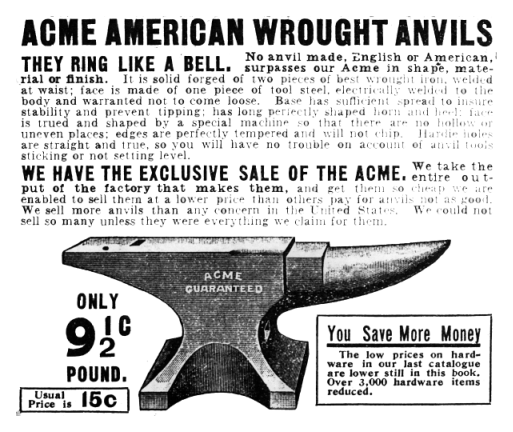
Well, boo-fucking-hoo. Forget Carl Everett. Anybody who clocks Todd Jones with an object thrown from the stands — be it cell phone, beer bottle, surrendered home run ball, bowling ball, tire iron, ACME anvil — wins a free Futility Infielder T-shirt and the replacement cost of the thrown object (valid only with a receipt). Here’s wishing Jones every bit of the success his predecessor in the bigotry department has enjoyed. And here’s where you can open your own can of Whoop Ass on this John Rocker wannabe: tjones@sportingnews.com.

Those Eggheads Have Screwed Me Again

Apparently all of the email over the past 48 hours sent via my jay@futilityinfielder.com address has been bouncing due to overzealous spam filtering on the part of my service provider, Time Warner. While I appreciate their efforts to weed out those offers to increase my manhood, romance barnyard animals, and earn several mil via the son of a Nigerian ambassador, clearly it ain’t working yet.

Hopefully the problem will be rectified over the next 24 hours, but until further notice please email me via jayjaffe@nyc.rr.com, and if you’ve sent me anything since early Monday, please re-send via that address as well. Thanks for your patience while I try to keep mine…

Counting the Cubs

Whether your a fan, analyst, player, manager, or GM, few topics within baseball are as hotly contested as pitch counts. Crusty codgers may sneer about how today’s young whippersnappers are babied with their five-man rotations and specialized bullpens, bemoaning the death of the complete game and the 300-game winner. But the history books are littered with tales of promising pitchers whose careers were cut short by excessive workloads and medieval management techniques. It’s not hard to envision an unsympathetic skipper telling his starter, “We’ll stretch you on the rack until you can throw 160 pitches on a rainy night in early April, then we’ll bleed your arm with leeches.” That’s because — less the Dark Age imagery — the story isn’t so farfetched; Yankee manager Dallas Green (my least favorite baseball personality ever) did exactly that to a young Al Leiter back in 1989, a story recounted in “Wings of Fire,” a recently-collected Roger Angell piece. The pitcher needed rotator cuff surgery later that season, setting his big-league career back about four years.

Organizations differ greatly in their approaches to pitcher handling. Some keep their pitchers on a strict pitch count system, especially in the minor leagues, where they may even so far as to pair starters in tandem. Others run their pitchers’ arms ragged in the name of some macho code, then litter the disabled list with the discarded carcasses of those who aren’t tough enough.

In the analytical community, the past few years have seen an attempt to quantify the impact of pitcher use and abuse. Baseball Prospectus’ Rany Jazayerli introduced a metric called Pitcher Abuse Points in 1998 which focuses on high pitch-count outings and their correlation with both short-term ineffectiveness (following a high-count outing) and long-term predisposition to injury. The metric, which has been refined over the years, has as its basis an exponential relationship between the number of pitches above 100 and an increased injury risk; the current version is called PAP^3 because the relationship is more or less cubic. While there’s plenty that PAP doesn’t measure (such as the type of pitcher, the soundness of his mechanics, and the number of days rested between starts), and plenty of flared tempers over just what exactly PAP does measure, the metric remains the most comprehensive attempt to grasp the subject.

Christian Ruzich, the Cub Reporter, has done an excellent job summarizing PAP and its evolution. With new Cub manager Dusty Baker’s reputation as an old-school hardass when it comes to pitcher management, Ruzich is keeping a close eye on the Cubbies’ precious young arms such as Kerry Wood and Mark Prior. He’s created a small chart in the upper right-hand corner of his blog showing each Cub starter, the number of pitches thrown in their last outing, the average number of pitches per start, and their current PAP^3 ranking. Ominously, Wood and his surgically reconstruced elbow rank 3rd in baseball, with two out of his five starts falling in Category IV (122-132 pitches) where the risk of short-term decline is “significant.” Prior, who’s throwing just 1.2 fewer pitches per outing, is down at 20th place, with no Category IV starts to date. Last year Prior ranked 9th while Wood was down at 44th.

As Ruzich points out, the Prospectus folks have been onto Baker for a few years. Last season saw the Giants with three pitchers in the PAP top 20 (Livan Hernandez 3rd, Russ Ortiz 4th, and Jason Schmidt 18th). And according to Ruzich, the early returns from the Windy City are not good:

So far this year, the Cubs have had four pitchers hovering around the top twenty. While age is no longer an explicit part of PAP^3, lots of earlier research (most notably in Craig Wright’s book A Diamond Appraised, which was the jumping-off point for Rany’s original study) considers age to be a very important part of the equation. Since three/fifths of the Cubs rotation is age 25 or under, I think it’s especially important to pay attention to the workload shouldered by the Cubs’ youngsters.

In a more recent post, Ruzich has some additional input on the topic, including an exchange with BP’s Will Carroll, a quote from Sports Illustrated writer Tom Verducci, who appears to yearn for a return to the Dark Ages, and some serious science from Thomas Kuhn. Definitely worth checking out.

An Overlooked Anniversary

Enshrined writer Leonard Koppett has an enlightening piece about a key rule change which just passed its 100th anniversary. As of the American League’s season opener on April 20, 1903, the first two foul balls hit by a batter counted as strikes. The National League had adopted the foul-strike rule in 1901, but the AL, which was born that year, still clung to the old fouls-don’t-count rule, and it skewed results so much that Nap Lajoie led the league with a .426 batting average. The AL’s adoption of the foul-strike rule was part of its peace agreement with the NL, in which the two leagues agreed to honor each other’s player contracts, coordinate schedules and hold a World Series between the two league champions.

Koppett calls the foul-strike rule “the last fundamental playing rule change baseball made, after many evolutionary changes in the preceding 25 years… the true birth of baseball as we know it.” There’s more:

Changes did come later, like the designated hitter, but that’s a lineup rule, not a playing rule. Adjustments were made about ground-rule doubles and homers, and the height of the mound, and other things of such secondary nature.

But the foul strike — made universal in 1903 — was the final step in completing the truly basic rules of play: nine men, three outs to an inning, three strikes you’re out, four balls for a walk, 90 feet between bases, the 60-foot, 6-inch pitching distance, the size and weight of the ball, nine innings for a complete game and over the fence is a home run.

While many would quibble with Koppett’s classification of the designated hitter (which just saw its own 30th anniversary) as non-fundamental, it’s interesting to view the foul-strike change as sort of a Golden Spike which not only unified the two leagues but also the game of a century ago with the one we know today. But then, that’s why Koppett has earned his tag as “The Thinking Fan.”

• • •

Speaking of great old writers still teaching the kids new tricks, Newsday catches up with 82-year-old Roger Angell, who has a new anthology out called Game Time. The book packages some (but, sadly, not all) of his recent work with pieces dating all the way back toThe Summer Game (1962), including a piece on the writer’s first trip to spring training from which I drew inspiration recently.

The most sorely overlooked Angell piece, in my opinion, is his one following the 1995 postseason, in which he discusses the Mariners’ Randy Johnson coming out of the bullpen in Game Five of the AL Divisional Series against the Yankees (a moment which sitll gives me goosebumps to think about), Orel Hershiser doing the same for the Dodgers in the 1988 NL Championship Series (exponentially more goosebumps there) and the consequences of such heroism on the pitchers’ careers, with the post-rotator cuff surgery phase of Hershiser’s career as illustration.

If there’s anybody out there reading this who clips and files Angell’s New Yorker pieces (like I’ve been doing since ’97 or so) and has that one, I’ll trade you a Futility Infielder T-shirt (which I’ll soon be unveiling) for a copy in either electronic or paper form.