Uh, It’s Friggin’ July

Did I miss something? Did the baseball season end while I went out for lunch? The top story on ESPN.com this afternoon:

Ready for Prime Time? Think back. Remember Dec. 27, 1998? That’s the last time the 49ers won a game against the Rams. St. Louis has beaten San Francisco six straight times. So while they have four prime-time games this season, the 49ers have to get a win over the Rams if they want to be considered one of the NFL’s elite teams, writes John Clayton.

With all due respect to the game of football, Knute Rockne, Jim Brown, Air Coryell, Marshall Faulk, and Bill Walsh, Genius, WHO GIVES A SHIT? IT’S JULY! We’ve got baseball. Balls, strikes, strike zones, strike dates, races, ‘roids, Rose, Bud, Ichiro, Ishii, Izzy, Sori, Manny, A-Rod, Pedro, The Big Unit, The Gambler, The Moehler, Rolen, the Dolans, ERA, OPS, MVP, the frozen corpse of Ted Williams, and a case of Stubby Clapp gone missing.

Any one of these is more interesting than midsummer speculation about upcoming regular-season football games. The only time football should be a top story during the summer is if (God forbid) some poor guy keels over from heat exhaustion and dies, some foreign-born kicker gets caught with a foreign substance, or if some legendary coach or quarterback decides to turn in his playbook. Any other football news should be relegated behind not only baseball, but summer basketball, tennis, soccer, golf, NASCAR, bowling, cockfighting, dwarf tossing, alligator wrestling, and yak racing at this time of year.

Remember December 27, 1998? Neither does Steve Young. Why the hell would I?

Weaver and Lilly

On Sunday I finally had a chance to watch Jeff Weaver, the latest addition to the Yankees’ rotation and ever-increasing payroll. Acquired just prior to the All-Star break, Weaver had made two starts in pinstripes which I’d missed. He didn’t exactly distinguish himself in those outings, giving up his share of runs but being rescued by the turbocharged Yankee offense. His performance on Sunday was no prettier than his previous two. In fact, it was considerably uglier; Weaver blew an early four-run lead and tied a Yankee Stadium record by surrendering five home runs. But the Bronx Bombers again rescued him, rallying to beat the Boston Red Sox for their fifth final-at-bat, come-from-behind victory in the last six games.

Even prior to Sunday’s near-debacle, I had very mixed feelings about the corner of the trade which brought Weaver to New York in exchange for Ted Lilly (who went to Oakland to be their #4 starter behind Hudson, Mulder, and Zito) and two top-notch prospects. The conventional wisdom is that the Yanks upgraded from an unestablished pitcher to a more experienced and heralded one–an ace in the making. But while the evidence doesn’t exactly refute that, it does give enough pause to wonder what the hubbub is all about. First off, Lilly was pitching as well as any Yankee starter this year. Sorting by ERA:

            IP  IP/GS   ERA  K/9  K/W HR/9  WHIP
Pettitte   54.0  5.40  3.50  6.0  2.3  0.5  1.54
Lilly      68.2  6.25  3.54  6.9  2.4  1.2  1.06
Hernandez  71.2  6.52  3.64  7.2  2.9  1.1  1.03
Wells     126.1  6.65  3.78  6.1  2.6  0.7  1.27
Clemens   118.2  6.25  4.02  9.6  3.1  0.8  1.23
Mussina   129.0  6.45  4.40  7.2  3.7  1.3  1.14

These numbers are as a starter only; if we include relief appearances Lilly’s numbers are even better. Still, he ranks 2nd in ERA, 2nd in baserunners per inning (WHIP), and 4th in strikeouts per 9 among the six Yankee starters, and seemed to have shed the knock about not lasting deep enough into games. He threw a 1-hitter at the Seattle Mariners earlier this year, as well as a 3-hit shutout against the San Diego Padres. With a little more run support, his record could have been 6-3, instead of the other way around, prior to the trade. In short, Ted Lilly has shown he’s capable of being a solid-to-excellent big league starter.

Surprisingly enough, Lilly is actually seven months older than Weaver and was drafted two years earlier, as the 23rd round pick of the L.A. Dodgers in 1996 (he came to the Yanks via Montreal, as part of the Hideki Irabu deal). Weaver was the Tigers’ 1st round pick in 1998 (taken 14th, four spots behind Carlos Pena, who was the third principal of the three-way trade; other notable names from that draft include Pat Burrell, Mark Mulder, Corey Patterson, J. D. Drew, Austin Kearns, Felipe Lopez, Sean Burrroughs, and C.C. Sabathia). Here is a comparison of the two pitchers:

          IP    K/9   K/W  HR/9  WHIP   ERA   W-L
Weaver  734.2  6.06  2.31  1.03  1.31  4.44  40-51
Lilly   239.2  8.13  2.36  1.50  1.30  4.87   9-13

Lilly has about one-third of the major league experience that Weaver does, but the rate stats are very comparable, except for two areas. First, Lilly has proven considerably more vulnerable to the longball than Weaver. It’s hard to believe after yesterday, but the former Tiger is actually known for his tendency to avoid the dinger (where have you gone, Comerica Park?). Second, while their control ratios are almost identical, Lilly’s strikeout rate is 34 percent higher than Weaver’s. Strikeout rates are an important yardstick to measure a pitcher by, as they have a great amount of predictive value. As Bill James put it in his New Bill James Historical Baseball Abstract (page 291):

“The influence of strikeouts on a pitcher’s future can be compared to the effect of height on a man’s chances of playing in the NBA… It’s not that ALL seven-footers can play in the NBA, and it isn’t true that height is everything. There are other factors, but if you studied the American male population, you could very easily establish that the percentage of men who play in the NBA increases substantially with each one inch of increase in height. The same is true here: there are other factors in having a long career, but if you study the issue, you can easily establish that pitchers who strike out four men per nine innings last longer than pitchers who strike out three men per nine innings, that pitchers who strike out five men per nine innings last longer than those who strike out four… and so on without end.”

So Lilly’s strikeout rate could be a clue that he’ll enjoy the longer career of the two. Detractors might point out that Lilly’s delivery, though it contributes mightily to his ability to deceive batters, is all arm and no leg and thus may be putting an inordinate amount of strain on his shoulder, posing an injury risk. It should be noted that his arrival in the big leagues was somewhat delayed by a previous arm injury; he had bone chips removed from his elbow prior to the 2000 season.

But if we’re going to speculate about Lilly’s risk of injury, we ought to do the same about Weaver. Baseball Prospectus, which has published a (somewhat controversial) methodology about pitcher workloads called Pitcher Abuse Points (now PAP^3, for those of you scoring at home), said of Weaver in its 2001 edition: “Weaver’s strict pitch counts during his rookie season was a big story in BP2K, and while [then-manager] Phil Garner worked him more aggressively, Weaver had the benefit of an extra year of physical maturity and a season of minimal strain on his arm. As long as Garner doesn’t continue to rachet up his workload, Weaver should stay clear of serious injury.” So far so good, but this year’s edition of Baseball Prospectus was somewhat less sanguine: “… the heaviest workload Garner had placed on a starting pitcher since Cal Eldred’s shoulder broke down in the mid-1990s. The combination of Weaver’s consistent mechanics and a pair of relatively light workloads in 1999 and 2000 should keep him healthy.”

And so long as we’re speculating, one of the things that hasn’t escaped attention is Weaver’s temper. Where Ted Lilly operated somewhere in the vicinity of even-keeled and taciturn, Weaver seems more than a bit high-strung, and has a reputation for getting visibly demonstrative when his fielders let him down. Chewing on the glove or shouting into it, hanging out on the top step of the dugout, he seems more like the second coming of Jose Lima than like a New York Yankee. That shit won’t fly around here for very long. Not that Weaver doesn’t have his upside. He pitched only about 30 innings in the minors before making Detroit’s rotation, learning on the job the pitfalls of being a big-league starter and averaging just a hair under 200 innings per season in doing so. He’s got three and a half years of experience to go with a live arm and a good sinking fastball with late movement. He’s a decent big-league pitcher who could certainly improve with a good team behind him for a change.

All things considered, this deal was about money and perception–the perception that if one has money, as the Yankees do, they ought to shore up any doubt about whether a pitcher can get the job done. Ted Lilly, making something just above the minimum salary ($237,150) and out of options for the minors, apparently wasn’t enough of a proven commodity to be trusted in a pennant race, not when injury-related question marks hung in the vicinity of five of the other six (!) potential Yankee starters. Jeff Weaver, who is making $2.4 million this year and is signed for the next three years at a total of around $20 million, is a much more expensive pitcher who supposedly has the big-league experience and the pedigree to be a top-of-the-rotation starter, a significant consideration when one looks at a future rotation beyond Clemens, Wells and El Duque. As Jim Kaat put it in Sunday’s broadcast, “Weaver isn’t trained to run the Kentucky Derby yet, but I’d like to give him 40 acres and see what he can do.”

Given what I’ve seen, I’d as soon have done the same for Ted Lilly. I don’t think we’ve heard the last from him.

Postscript: The Oakland A’s placed Lilly on the 15-day DL retroactive to July 21 with an an inflamed shoulder. According to manager Art Howe, “The preliminary reports from the medical people are that he just needs strengthening and conditioning in that shoulder, but we’ll know more after the MRI is diagnosed.” And so it goes…

I’ll Trade You A Newton for an Einstein

As we’ve already established, I enjoy seeing an unexpected face turn up on a baseball card, and I’n not above borrowing an old design in the service of same. Lately I’ve been admiring this montage of famous scientests, from da Vinci and Newton to Gould (RIP) and Hawking, given the Topps treatment. Genius comes in many forms.

• • • • •

I was going to write something about how this Yankees page is not one of them–it’s a garish multimedia eyesore done as a part of something called 2002 Magazine. Rainbow colors, throbbing letters, flaming logo,and a giant circle of exclamation points following your cursor around the screen make for an unforgettablably harrowing interactive experience that can probably crash any browser, so be forewarned. But the photos themselves (especially the ones done as Quicktime loops) are pretty decent generic Yankee shots (if a bit heavy on the post-September 11 dramatics). There’s an equally hideous Mets page. Detractors of both teams will get plenty of ammo here.

Cletus, the Slack-Jawed Spot Lefty

Unlike my fetish for sub-Mendoza Line infielders, I have a soft spot for situational lefty relievers which bears no relationship to my own baseball experience–I’m not left-handed, couldn’t top 50 MPH on the gun at last report, and have no idea where the ball’s going when I’m in the middle of my windup. My bizarre attachment is mostly likely related to the endless parade of spot lefties opposing managers have called out of their bullpens to face the meat of the Yankee batting order over the past several years: the lefty Paul O’Neill, switch-hitting Bernie Williams, lefty Tino Martinez and switch-hitter Jorge Posada, usually in that order.

Lefties in general tend to be oddballs, but some of these relievers really stood out. The Indians’ Paul Assenmacher (a/k/a “The Assmaster,” for obvious reasons) was a particular favorite; with his scraggly salt-and-pepper beard and sleepy complexion, he looked like a hobo rousted out of a Night Train-induced stupor to face one batter. Another funny-faced fave is Dennis Cook, the well-travelled Texan referred to in these quarters as “Cletus, the Slack-Jawed Spot Lefty”. Cook, whom I watched a lot during his time with the Mets and previously with the Marlins during their championship run, cocks his head to the side, mouth slightly agape, and squints as he gets the sign from the catcher, as if to say, “Y’all want me to WHAT?” Needless to say, and despite evidence to the contrary, it’s not a look which suggests intelligence, unless we’re talking the intelligence of an iguana.

Cook got some bad news on Monday, being diagnosed with a torn labrum and a partially torn rotator cuff. At 39 and already talking of retirement at season’s end, he may well be done. A similar fate befell fellow well-aged lefty Norm “The Arsonist” Charlton earlier this year, getting me all nostalgic for those 7+ ERAs.

Without wishing to make light of Cook’s situation (I obviously enjoy having him around the game, even if his current gig in Anaheim is well off my radar), the image of Cook which popped into mind was him giving the doctor that same look as he gives the catcher and saying something like: “Doc, the jointy thing whut bends my arm when I throws feels like the time that possum bit me. He sure cooked up real nice, though.”

Sorry. It was enough to keep me laughing an entire afternoon. I know, I’m a very bad man. Get well soon, Dennis Cook.

Newsclicker

In the interest of piling on bells and whistles whose malfunction could take down this site in a New York minute, I’ve added this little scrolling baseball gadget up top there, courtesy of Newsclicker.com. It seemed like a great idea to start implementing at 1 AM on a Sunday night/Monday morning. If nothing else, it’s a pretty quick way to find out scores and the top headlines, though it will probably start to piss me off sooner or later (shaking Homer Simpson-esque fist at scrolling gadget: “You’re on thin ice already, scrolly…”). Feel free to bitch if it’s bringing you down. Customer satisfaction is guaranteed here at FutilityMart, where we always charge the lowest prices on baseball opinions (insert voice of heckler here: “Yeah, and they’re worth exactly what we’re paying!” Thank you, Brett T., wherever you are…).

The idea to add the clicker was ripped off from an excellent Yankee-centric site by a writer named Cecilia Tan. She (yes, she) writes for Yankees Magazine as well as her own site. Her link and several others have been added to my recently revamped links page. Most of the changes have been to the weblog section. Let me know if I’ve screwed anything up or if you’d like to recommend a site for inclusion.

Milwaukee’s Best

Waiting for most of my photos from the All-Star Weekend to be developed, but here are three of the key ones which I mentioned in my earlier writeups. The first is from the FanFest Baseball Card booth. Look out Derek Jeter…

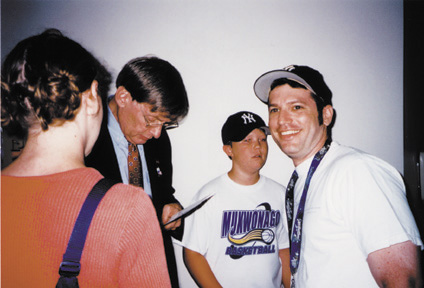
The second may well be the most irony-laden photo I’ve ever been a part of: me standing by as my favorite whipping boy, Bud Selig, signs his autograph. It’s not the most flattering photo any of us have ever taken, but it really was a once-in-a-lifetime shot:

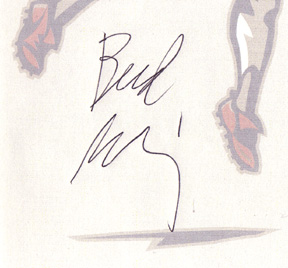
And finally, Bud’s signature. I confirmed via ebay that his penmanship is always this bad. Not that mine’s anything to brag about either…

More to come soon…

The Futility Infielder’s All-Star Weekend, Day 4: The All-Star Game

Well, THAT was weird. On a gala night featuring baseball legends such as Hank Aaron and Willie Mays as well as its brightest stars, in a game which highlighted dominant pitching, clutch hitting and breathtaking defense in its signature moments, all that lacked was a decision as to which team won. And in a no-lose situation borne from providing four memorable days of exhilirating entertainment for baseball fans in his own backyard, Bud Selig found a way to lose.

The Commissioner of Baseball’s decision to call the All-Star Game a tie after 11 innings wasn’t an indefensible one, given that the health of pitchers’ arms was at stake and the rosters of both teams were depleted. But it certainly made for a strange and bitter ending to the night, with a stadium full of people referencing a Bad News Bears movie as they chanted “Let them play!” in unison for several minutes. That is, when they weren’t too busy chanting “Selig sucks!” or showering debris on the field.

We all expected to see winners and losers at the All-Star Game–this isn’t soccer, after all (roll Simpsons clip from episode 5F01… “And ties? You bet!”). The sentiments being showered on Selig weren’t just a reaction to the unresolved outcome. They were ventilation for years and years of frustration on the part of baseball fans with the way Bud has embarrassed the game: the 1994 strike, wave after wave of unnecessary expansion, routine extortion of taxpayers for stadium money (let those whose teams play ball in glass-panelled retractable-roof stadia cast the first stone), this past winter’s contraction fiasco, the impending labor woes, the constant denigration of the product on the field, the perception that steroids are an epidemic-level threat to the sport, and now THIS.

How dumb do you have to be to hold a pregame memorial tribute to a recently-deceased legend, tout the naming of an award after the dearly departed as part of said tribute, and then NOT bestow it to a deserving player or players in its inaugural game? Any one of several players were worthy, and given the situation, even a co-award would have been an acceptable solution. By denying that recognition, Bud panicked and did everything but try to erase the box scores out of people’s programs. To borrow a phrase from Jerry Seinfeld, this is a man who is out of ideas.

That’s my take on it, at least from this very travel-weary vantage point. Up until the end of the 11th inning, I saw a great ballgame last night. Curt Schilling’s pitching, Torii Hunter’s catch, and Barry Bonds’ home run will resonate in my memory along with all the other incredible baseball I’ve been priveleged to witness over the past twenty-five years. If nothing else, I was at a ballgame which will go down in history: the first non-weather-related tie in All-Star Game history. Still, I can’t help but feel that baseball fans and the citizens of Milwaukee deserved better than that.

I’ll be writing up a more lengthy report of the game, accompanied with what I hope turn out to be some good photos of the whole weekend, in the next several days.

The Futility Infielder’s All-Star Weekend, Day 3: Workout Day and the Home Run Derby

Even with two unforgettable days of All-Star festivities already under my belt, a few chapters of my Milwaukee experience remained to be written. For one thing, I’d never participated in a proper tailgate party. My hosts aimed to correct that oversight prior to Monday’s activites.

Undeterred by sweltering 95° heat, our group loaded up a truck with a full-sized grill, a cooler full of beverages, a plastic container of parboiled bratwurst, an appropriate array of condiments (including a jar of sauerkraut and a bottle of Secret Stadium Sauce, a ketchup/BBQ sauce-like wonder), candy, and enough chips to feed a small army. After finding our way to Miller Park, we staked out a spot in the upper parking lot, across the freeway from the ballpark. Not exactly a rose garden, but perfectly acceptable for tailgating purposes.

After setting up some folding chairs and the neccessary accoutrements, grillmaster Matt diligently slaved over the hot coals while Andra, Adam and I broke out mitts and tossed the ball around the lot (with not a scratch or dent to the surrounding cars, I’m happy to report). Eventually, the heat overcame us and we settled down for a round of sodas and waited for our brats. Several other groups of people in the lot were doing exactly the same thing. Matt and Adam explained to me that the need to accommodate tailgaters was the reason Miller Park wasn’t built downtown, where real estate for parking would have been much more scarce. After scarfing down a couple of brats, now I understand this typically Wisconsinite sense of priorities. Never let it be said that they don’t have an appetite for fun around here.

We headed over to the ballpark at 4:30, just as the National League All-Stars were beginning batting practice. Though we’d hoped to wander down close to the field behind home plate, security personnel diligently turned away all but those whose tickets allowed them down to field level. So we wandered around to the outfield bleachers, where throngs of fans armed with mitts hoped to catch balls launched off the bats of Sammy Sosa, Barry Bonds, Vladimir Guerrero and the like. Being of short stature and dripping with sweat, Andra and I soon gave up our vain attempts to retrieve a ball and headed for the air-conditioned souvenir shops to fulfill our gift lists.

We finally found our way to our upper deck seats and joined Andra’s brother Aaron as the last group of American League stars, including Derek Jeter, Alfonso Soriano, Jason Giambi, and Manny Ramirez were batting while other stars milled around the outfield, lackadaisically shagging fly balls alongside their small children. Giambi seemed to be the only one of the group consistently reaching the seats; as I passed this observation along I was told that we’d missed quite a show from the NL sluggers. Oh well. Adam and Matt, who had seats in the deck below us, came up bearing slips of paper for a drawing. With eight of us in our group (spread all over the park), each would draw the name of a slugger and kick in $5 for a pool to be split, $30 for the winner and $10 for the runner-up. As I’d already expressed a prediction that Giambi would fare well in the contest, I winced as I unfolded my slip to find Lance Berkman’s name.

At 7 PM, it was finally time for the Home Run Derby, and the crowd cheered wildly as an overhead shot of Miller Park, with a star mowed into the outfield grass, was shown on the Jumbotron. A buzz filled the air as eight sluggers, four from each league, were introduced: Paul Konerko, Richie Sexson (representing the hometown Brewers), Torii Hunter, Sosa, Giambi, Berkman, Alex Rodriguez, and Bonds.

The rules of the Home Run Derby are simple: batters can take pitches, but any swing that doesn’t result in a home run is an out. Once a batter records 10 outs, his turn is done. The top four of the first round would advance to the semifinals, where they would pair off into two head-to-head matches which would determine the finalists. Ties in the first round would be broken by the number of regular-season homers each player had hit; any ties beyond that would be broken by a swing-off, with each batter’s turn lasting until he made an out.

Konerko opened the Derby and set the pace with 6 homers, mostly to leftfield, before recording his 10 outs. Sexson was next, as the crowd cheered their representative vigorously. The lanky 6-foot-7 slugger struggled to find his swing, making outs on his first four attempts. He looked all but finished when his count stood at 2 homers against 8 outs. But Richie rose to the occasion and began launching some bombs, eventually tying Konerko with 6 and besting him in the long distance category with a 480-foot shot.

The next batter, Minnesota’s Torii Hunter, started off hot, with homers in two of his first three swings. But he soon began spraying ground balls and line drives, eating up precious outs. By the end of his turn, he’d scored only 3 dingers, the longest being a 420-foot shot to centerfield.

Next came Sosa, and the crowd erupted as his name was called. Though his cap was turned backwards, Junior Griffey-style, Sosa gave a look that said he was all business as he stepped into the batter’s box. He took several pitches before launching his first shot, then the oohing and aahing began in earnest. Nothing much, just your run-of-the-mill 480-foot blast. Sosa rattled one that pinballed around the scoreboard scaffolding for a few seconds before finally returning to earth, and hit the roof with another. But he popped up several in a row, and reached a point where he had only 5 homers to 8 outs.

Then Sosa began one of the most amazing hitting displays I’ve ever seen. Six straight swings produced epic home runs which rattled off of the Miller Park furniture, two off of Bernie Brewer’s yellow slide in high leftfield (where mascots from all around the league–the Phillie Phanatic, the Oriole Bird, Youppi, and the Miller Park Sausage Racers, among others–slid down Bernie’s slide after each homer). From our perch in upper right, we had a magnificent view of each blast’s arc. The shortest of the six shots was 496 feet, the rest over 500, the longest a Derby record 524 feet. The crowd gasped each time Sosa launched another moon shot and cheered wildly when the distance was announced. By the time he’d used up his final two outs, he had 12 homers and 40-some-thousand jaws hanging open.

Giambi, who set a first-round record with 14 homers last year, followed Sosa to considerably less fanfare. But the Yankee first baseman quickly got in a groove, lashing several screamers to right-centerfield, nearly hitting one of the $1 million Hit It Here signs sponsored by MasterCard. He ended his turn with a more than respectable 11 dingers.

My money man Berkman, who leads the majors with 29 homers, was up next. But he wasn’t up to the competition. Unlike the big boys, who bypassed several hittable pitches in search of ones they could launch, Berkman began swinging impatiently at nearly everything offered, and he laced a handful of sharp grounders instead. He ended the round managing 1 measly homer, and I shredded my betting slip like a racetrack loser, cursing my luck. Rodriguez came up next and the crowd readied itself for a homer-happy display. But A-Rod never got in the swing of things and ended his round with only 2 homers, though one of them was a 492-foot monster.

Barry Bonds followed, needing 6 homers to reach the finals, as he held the tiebreaker. But Bonds had apparently realized that the hometown favorite, Sexson, was the man on the bubble. After launching a couple of gasp-inducing shots, he began spraying grounders and liners without waiting for the perfect pitch, visibly taking a dive so the Milwaukee faithful would have another chance to cheer their man. Though some of the crowd had to be disappointed that one of the game’s most potent hitters was opting out, it was a classy move by Bonds to yield the spotlight.

Thus the semifinal pitted Konerko against Giambi and Sexson against Sosa. As Konerko’s turn began, the retractable Miller Park roof started to close in anticipation of thundershowers (and yes, it leaked in several spots, all of them apparently over the playing field. Damn it, Bud, get a bucket!). Konerko swatted 6 homers in his round, giving Giambi something to work for. It was all the G-man could do to match his opponent; he stood at 4 homers and 8 outs before dinking one down the rightfield line (which at 345 feet is a considerably longer distance than Yankee Stadium’s short 314-foot RF line). He ended up tying Konerko at 6, necessitating a swing-off. Konerko’s first swing landed short of the wall, while Giambi sent one into upper right, again near the $1 million dollar sign, to win the round.

To swells of cheers, Sexson stepped back in. He got off to a slow start, making six straight outs before managing his first homer. Again, his count stood at 2 and 8, when he made a last stand, finishing the round with 4 homers.

Though he added a bit of suspense by fouling a couple early pitches off, Sosa made short work of the hometown hero. He even hit one literally out of the park, as the ball travelled through the open left-center roof panel and into the parking lot, where a young fan holding a sign that said “hit It Here, Sammy!” retrieved the ball in the rain. With 7 outs (doesn’t that sound weird?), Sosa blasted a shot that everybody in the park knew was gone. Without even following the ball’s trajectory, Sosa flicked the bat with a dramatic flair, the winner of the round.

So the final came down to the ebullient Cubs crusher Sosa against the affable Bronx bomber Giambi. The Yankee went first and hit several into right-center, the longest of which went 492 feet. Again, he teased the $1 million sign as the crowd moaned with mock disappointment. Sosa stepped in, looking ready to take the match. But he fouled a couple of pitches off early and began swinging without his trademark patience, making six outs before recording his first homer. The air seemingly let out of his swing, that was the only one he recorded, making Giambi the Home Run Derby champion. Still, it was tough to be disappointed in Sosa after the unforgettable display he’d provided in the first two rounds.

With the allegations floating around about ballplayers’ steroid usage, some of the luster may have dimmed from baseball’s equivalent to the Slam Dunk Contest. But juice or no, these sluggers made for an awe-inspring night at the ballpark. I challenge anybody to sit through one of these Derbies, even in the sweltering heat, as they watch the graceful parabolas emerging off those thundrous bats, and not grin from ear to ear. It’s a spectacle, not a game, but it sure is spectacular.

The Futility Infielder’s All-Star Weekend, Day 2: Futures Game and Legends & Celebrity Softball Game

After seven hours wandering among the displays and interactive exhibits at Saturday’s exhilirating FanFest, I was definitely in the mood to watch some of the real thing. Sunday at Miller Park offered a double dose off the game–after a fashion. First up was the All-Star Futures Game, a seven-inning minor-league all-star game pitting the brightest American prospects against those from the rest of the world. Immediately following that was the All-Star Legends & Celebrity Softball Game, featuring a handful of Hall of Famers, former Brewers stars, and entertainers.

Our contingent arrived at the ballpark about 90 minutes before game time to soak up the scene, and we were pleasantly surprised to find that we hadn’t missed out on the Ben Sheets Bobblehead giveaway. Sheets, the Brewers bright young hurler, appeared in the Futures game two years ago, hence the promotional tie-in.

Unlike the two parks with which I’m most familiar (Yankee and Shea Stadiums), Miller Park has a concourse which allows one to completely circle the playing field. We made a complete lap around the field, checking out the young players while they took infield lessons from 2002 Hall of Fame inductee Ozzie Smith, as well as the various shops and concessions stands along the way. We hiked up to our seats, which like those for Tuesday’s big event, were nothing spectacular–the lower part of the upper deck down the rightfield line.

The World team, managed by former Cincinnati Reds shortstop Davey Concepcion, featured a trio of mellifluously named Asians–Hee Seop Choi, Shin Soo Choo, and Seung Song–as well as what seemed like an alphabetical catalog of Latino surnames: Alvarez, Berroa, Cabrera, Diaz, Garcia, Lopez, Pena, Rodriguez, Torres. I recognized many of the prospects by name. Wily Mo Pena, a former Yankees farmhand, was traded for Drew Henson. Choi, a native of Korea, is the Cubs’ first baseman of the future. Australian John Stephens, the starting pitcher, has been touted as a future star for the Orioles.

The American squad, managed by former Brewer Paul Molitor (who drew predictably large ovations every time his name was announced), also had some recognizably name-brand prospects. Phillies CF prospect Marlon Byrd, Indians SS prospect Brandon Phillips (the key player the Expos gave up for Bartolo Colon last week), and the aforementioned Yankees 3B prospect Henson stood out on the scorecard. Jays’ second baseman Orlando “O-Dog” Hudson, who made waves back in spring training by bizarrely suggesting that GM J.P. Ricciardi was a “smooth-lookin’ cat ” who “looks like he was a pimp back in the day,” was also in the house. The Brewers were represented by two players, shortstop Bill Hall and first baseman Corey Hart, who immediately brought to mind the eponymous ’80s pop star who had a hit with “Sunglasses at Night”.

Despite my best efforts at keeping score, our seats and the poor sound quality of the Miller Park PA system (geez, Bud, can’t you do anything right?), made us feel somewhat detatched from the game. Half-full stands, especially in the upper deck, added to the disorienting aura.

Tigers CF prospect Andres Torres led off the game with a double, but the USA starter, Jason Young (Rockies) struck out two of the next three batters to avert a threat. Stephens made a great play in the bottom of the inning by spearing a Carl Crawford (Devil Rays) line drive and doubling a runner off of first to end the inning. Unfortunately, just as we got familiar with each pitcher’s stuff, a new one came along to replace him due to a 1-inning maximum per pitcher.

Confusion reigned among our contingent in the second inning. With one out, Miguel Cabrera (Marlins) beat out an infield hit, then took off for a steal of second. USA catcher Kevin Cash threw the ball into centerfield, where Byrd overran it as he attempted a barehanded pickup. Yet somehow, by the time we digested this all, the inning had ended. The batter had apparently struck out, but had Cabrera been nailed at third? The PA and the Jumbotron yielded no clue, and the fans around us were equally baffled.

The World team mounted a rally in the third. Leftfielder Pena (Reds) was hit by a pitch, and shortstop Angel Berroa (Royals) executed a picture-perfect hit-and-run which sent him to third. Torres walked, and second baseman Jose Reyes (Mets) cleared the bases with a triple. At this point, our group was invited to depart the nosebleeds in favor of more advantageous seating. A friend of a friend had access to a luxury box underwritten by his law firm. Andra and her friend engineered a ticket relay which brought us all into the suite, where we began gorging ourselves on an endless supply of sausage, bratwurst, quesadillas, beverages, and more. By the time the dust (but not our stomachs) had settled, the World team had batted around, scoring five runs in the inning. The USA team answered with a run in the bottom of the inning, as Phillips walked and O-Dog doubled into the left-center gap. But Byrd’s sharp liner was speared by third baseman Cabrera, preventing the rally from growing.

At this point the World pitchers began to dominate the USA hitters. Seung Song (Red Sox) and Franklyn “Billy White Shoes Johnson” German (an A’s prospect nicknamed by us because of his obvious attire) each struck out two out of the three hitters they faced, and the USA could manage only one more hit the rest of the way against the next four pitchers, who split the final two tedious innings. The final score was World 5, USA 1. Nineteen-year-old Reyes, who hit the triple, won the game’s Larry Doby MVP award. Note to Steve Phillips: trade Roberto Alomar and/or Rey Ordonez while you still can.

Immediately following the game, yellow-shirted volunteers began erecting a temporary fence about halfway into the outfield for the softball game. Lineups were introduced for the two teams. The Brew Crew, managed by Baseball Tonight’s Harold Reynolds (a former Mariners star), featured Hall of Famers George Brett, Ozzie Smith, and Dave Winfield, former stars Don Mattingly and Ryne Sandberg, fat slob John Kruk (who always looked like a beer-league softball player when he was in the majors), rapper Coolio, skier Picabo Street, a couple of actors from the West Wing TV show, King of Queens actor Kevin James (as big as Mo Vaughn in his Mets jersey), and actress Nadia Dajani.

The Wallbangers (again with the name hearkening back to a better era for the hometown team) were managed by Kenny Mayne, who subversively wore a Seattle Pilots jersey–recall that a certain used car salesman heisted the bankrupt Pilots from Seattle and brought them to Milwaukee just prior to the 1970 season. All of the players were outfitted in replica jerseys provided by Mitchell & Ness, making for a colorful and somewhat insightful peek into the celebs’ loyalties. The ‘Bangers featured legendary Hall of Famer Ernie Banks (who didn’t actually play), former Brewers Paul Molitor, Cecil Cooper, Rollie Fingers, and Gorman Thomas (again, looking like quite the beer-league softballer), Cecil Fielder (who looked ready for a tour on the sumo circuit), race car driver Dale Earnhardt, Jr., football player Howie Long, Olympic speedskater Derek Parra, and singers Meat Loaf and Joy Enriquez, among others.

Ever the intrepid reporter, I actually felt compelled enough to fashion a makeshift scorecard for the occasion. Let me caution the home audience against attempting this in the future. This game featured 13 players per side, not all of whom actually played the field at any given time and many of whom shifted positions every few innings. Additionally, the extra outfielder created a scorekeeping quandary: is a flyout to the left-centerfielder scored a 7.5 and the right-centerfielder an 8.5? I repeat: do not try this at home unless you are an idiot like me.

Since I did actually keep score, I’ll recap the game here. Ozzie Smith homered to left in the first inning off of pitcher Meat Loaf to get the Brew Crew on the board. In the second inning, George Brett starred in a hysterical re-enactment of the Pine Tar Incident, as Mayne and catcher Fielder mounted a protest and broke out a tape measure to giggles all around. Meanwhile, pitcher Dave Winfield held the Wallbangers in check until the third inning, when they mounted a rally which featured two-run shot by the ever-mustachioed Fingers (playing RCF most of the game, between former teammates Thomas and Molitor). Two more runs scored in the inning as actor Tony Todd (who is playing Jackie Robinson in an upcoming movie and bears a striking resemblance which was helped by his number 42 Dodgers jersey) and Stormin’ Gorman laced singles. Mayne lined into a double play to end the inning.

Ryne Sandberg homered for the Brew Crew in the fourth to cut the lead to 4-2. Foolishly, manager Reynolds removed Mr. Loaf from his pitching duties (he was actually dragged off the field by the Italian Sausage mascot, for those of you scoring at home) and replaced him with Fingers. Rollie blew it, however, allowing five runs including a two-run homer by Mattingly and a solo shot by Kruk. He did make a nice Jeter-esque defensive play to tag Coolio out at home plate on a Brett triple (that would be 7-5-1 in your program), but by the time Meat Loaf came back to relieve Fingers, the damage was done and the score was 7-4 for the Brew Crew. The ‘Bangers went down easily in the bottom of the fifth, ending the game.

Despite his role as the goat, Rollie didn’t stop smiling the entire time. He and the rest of the players, as well as the fans, all seemed to enjoy themselves. It was just another great day at the All-Star Game Weekend.

The Futility Infielder’s All-Star Weekend, Day 1: FanFest

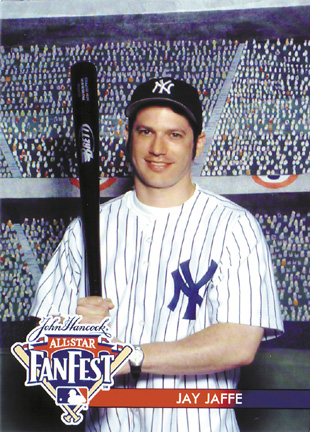
From the time I first held one of those 2.5″ by 3.5″ colorful cardboard rectangles in my hands nearly twenty-five years ago, I’ve fantasized about what it would be like to appear on a baseball card. At Saturday’s All-Star FanFest in Milwaukee, I finally got to find out.

The FanFest is a three-story convention center of overstimulation for baseball fans, featuring interactive booths, exhibits, autograph and photo opportunities, and collectible memorabilia. I spent seven hours at the Fest (held at the Midwest Express Center) on Saturday in the company of my girlfriend Andra, her parents, her siblings Aaron and Adam, Adam’s girlfriend Mai, and their friend Mark. A good portion of our time was spent standing in lines, but in most cases, the payoff was well worth it.

The marquee attraction for me was the FanFest Baseball Card booth. Of course, hundreds of other people had the same idea. Accompanied by Andra and her mother Aune, I stood in a lengthy line as a clipboard-armed volunteer took down our names, hometowns, and positions on a form which was then delivered to a data-entry booth. About twenty minutes later (by which point we were almost halfway through the line), we were handed stickers with that info, along with three lines of flattering but fake statistics for the 1999 through 2001 seasons (my .378 batting average in 1999 was at least third in the league–based on my comparisons to Andra and Aune’s stellar seasons–though I did have 30 HRs, 117 RBI, 110 walks and 88 steals to go along with it, uh-huh). These stickers would become the backs of our cards.

After about 45 minutes in line, we reached the stage, where four sets of photographers and wardrobe assistants dressed us in the uniforms of choice and guided our poses. For the first time in my life I donned a pinstriped jersey with the interlocking NY (to go with the Yankees cap I was already wearing). I suspected, though, that I was in trouble, as both the chatty wardrobe assistant and the bitter old crow of a photographer were both outfitted in Red Sox regalia. At other booths, the photographers allowed participants to reject their first photo in favor of a more flattering one, but the old crow and her minion hurried me off the set. So I’m going to blame them and not my excessive bratwurst consumption on the unflattering, Luis Sojo-esque double chin I’m sporting (I’ll scan the card when I return to New York).

As I waited for my photo and sticker to be married together in holy baseball card matrimony, Andra spotted a small autograph-induced commotion nearby which she directed me towards. Would you believe that my sworn nemesis, the Baddest Rug in Baseball, the Commish himself, Bud Selig, was signing autographs a few feet from me? I pondered my course of action. At point-blank range I could hurl an insult (or my hefty camera) at him, but Andra quickly whipped out a sheet of paper for me to offer instead. In a voice dripping with saccharine, I asked him, “Bud, can I have your autograph, please?”

Without looking up, the Commish dutifully scrawled his signature on my paper as Andra snapped a photo of us. Pondering the beautiful irony of the situation, I thanked him sincerely as an aide handed him an open cel phone (no doubt somebody was on the other line saying, “Watch out for that Jaffe character, I think he’s got it in for you. He has a web site, and he may be armed…”)

That wasn’t the only autograph I got. I stood in line 45 minutes to get a photo and signature with Hall of Famer Brooks Robinson. The legendary Oriole third-baseman was more than gracious as he signed my baseball, and I noticed he wore his 1970 World Series ring. Brett Butler was on the dais next to Robinson, and I had him sign a sheet of paper as well. I didn’t have the patience to stand in an adjacent line for autographs from Rollie Fingers and Dick Williams, and I later passed up the opportunites for signatures from Hall of Famers Tony Perez and Fergie Jenkins, as well as former Brewer Don Money.

One of the other big highlights for me was the This Week In Baseball Fantasy Broadcast Booth, where participants could provide commentary to one of ten great baseball moments and then receive a videotape with their soundtrack overdubbed. I considered Hank Aaron’s 715th home run and Bobby Thomson’s “Shot Heard ‘Round The World,” (which I planned to accompany with a tasteless string of expletives befitting my Dodger loyalties, “$%#%! That &^%^$ Bobby Thomson just hit a *&%$ home run over the $%#% leftfield wall, and the &^%^$-$%#* Giants have won the *&%$ pennant…”). In the end, I chose Kirk Gibson’s 1988 pinch-hit World Series home run off of Dennis Eckersley. With a surprising amount of adrenaline flowing and everybody within 50 feet becoming our de facto audience, I did a relatively straightlaced play-by-play while Andra’s brother Aaron provided hammed-up color commentary. I even snuck in my Jack Buck “I don’t believe what I just saw!” tribute. I think my best line was when Dodger manager Tommy Lasorda came barrelling out of the dugout to congratulate Gibson. I said “Look at Lasorda, he looks as if he’s going to explode out of that uniform. He’ll be drinking Slim-Fast until the cows come home after this.”

I won a few prizes at the FanFest. Every attendee received a plastic prize card encoded with a chip upon entering, and then had three opportunities to swipe the card at various terminals to see if they won anything; I ended up winning an All-Star Game pin with a giant MasterCard logo (practically everything is sponsored at the game), and a mini-frisbee. Mai won the same pin, and Andra won a T-shirt. I won an MLB.com T-shirt and cap for stumping two “know-it-alls” (cough, cough) from Major League Baseball Radio with my trivia question, which was, “Name the two pitchers who threw nine-inning no-hitters in the same game.” The two panelists squirmed while asking for several hints, but they couldn’t even offer an answer (Fred Toney and Jim “Hippo” Vaughn, May 2, 1917, duh). I also “won” a Nextel pin for answering two trivia questions and partaking in a cel phone/walkie-talkie demonstration. Big deal.

I also partook in several interactive exhibits. At the Steal Home Challenge, which was essentially a timed sprint (without slide) between third base and home plate, I clocked a 4.29 second time, nipped at the wire by Andra’s brother Adam (with a 4.22). At the Video Batting Cage, I faced a pitching machine married to a video projection of a pitcher with a hole cut in it, aligned to the ball’s release. From several top-notch hurlers, I chose to bat against Pedro Martinez. I managed only a soft foul tip off of Pedro, but when Adam matched that against Greg Maddux and his friend Mark did the same against Roger Clemens, I didn’t feel so bad. Later, outside the buidling, I pitched to a radar gun. Somewhat spent from my other activities and nursing a stiff back, I’m not sure my speeds were representative. I only clocked 50 MPH on the gun, which wasn’t even as good as the 10- or 11-year old ahead of me, who had the motion down and was clearly Bringin’ It. It didn’t help that I bounced one of my three balls in front of the plate, generating a blank score. Oh well.

I spent a couple of hours roaming around the collectors’ exhibits, receiving a handful of baseball cards (Topps Series 1 Barry Zito, Brent Mayne, and Joe Kennedy; Upper Deck MVP series Curt Schilling, Albert Pujols, Robb Nen, Armando Benitez, and Richard Hidalgo, among others). I purchased a couple packs of the Topps 206 set, which are done up as replicas of the T-206 tobacco cards from early in the century; one of the packs was stacked with Yankees Clemens, Jeter, Soriano and Mussina. I also purchased a couple of gifts for friends and a Jim Bouton-autographed baseball.

It was an incredible, overstimulating day. I’ve never felt more like a sugared-up kid in a candy store. If the rest of my All-Star Weekend is this good, I’m in for a real treat.