Jay Tee Vee

My trip to Boston to appear on the Boston Globe Sports Plus pregame show on NESN went off without a hitch. I spent about eight hours riding the rails through a rainstorm for what turned out to be about 10 minutes of air time with host Bob Neumeier. The performance — my first in-studio TV appearance ever (the other one was a remote setup that was rather disorienting) — went well; Neumeier is a big Baseball Prospectus fan as well as an engaging host, and we had plenty to talk about. Producer Alan Miller chauffeured me from South Station to the studio and made sure a cab was waiting to return me so that I could hightail it back in time for Wednesday night’s game at Yankee Stadium. The only problem, of course, was that the game was rained out.

Still, I think the effort was successful. I spent all day Tuesday doing research for my spot, and I had the heavy machinery of BP at my beck and call. Keith Woolner pulled a complicated data query for me at a moment’s notice. A sleep-deprived Kevin Goldstein called me an hour before his big event of the year, the amateur draft, to brief me on Sox prospects who might be traded this summer; this is akin to receiving a call from Santa Claus as he finishes loading up his sleigh and leaves the reindeer idling in the driveway. Peter Quadrino grabbed a bunch of data for me as I jotted quick player blurbs, built spreadsheets and compiled about 25 pages of printouts on various sabermetric angles related to the Red Sox. I was overprepared; I had about 10 times the material I needed for my segment. I upped that quotient by checking in with my pal Nick Stone back in “the studio” in New York City as I rode up to Boston, asking him to pull a few numbers from updated stat reports for me, and with Will Carroll, asking him about the health of David Ortiz, who has looked uncharacteristically sluggish against the Yanks lately. Tuesday’s solo homer notwithstanding, Ortiz is down 30-60 points in his rate stats and looks as though he’s getting fewer singles, an early warning sign, perhaps, of what I’ll call Frank Thomas Syndrome.

For those who’ve never seen it, Sports Plus is a half-hour pregame show that re-runs after the game as well. The episode’s first guest was Globe writer Bob Hohler, who talked about Tuesday night’s result (about which let me just say, “GOT MELK?”), and then they cut away to my favorite Red Sock and the night’s probable pitcher, Curt Schilling, as he did an interview from Yankee Stadium. Somewhere in the studio, eyes rolled. And not just mine.

I did three segments with Neumeier. Clips of two of them in their entirety can be found at the show’s site. In “Sox lacking in run differential” (as the first one is titled), we kicked around — you got it — the Sox’s mediocre run differential, (+27 runs, compared to +30 for the Cleveland Indians, four and a half games worse in the standings, and +77 for the Yanks). I had a lot of nervous energy going against me, more cups of coffee than hours or sleep the night before. I stammered a bit, plus I wasn’t sure where to look; I finally figured out that looking at the host was a safe bet.

The second segment began with an examination of the lackluster performance of the Sox’s 3-4-5 starters (Josh Beckett — statistically worse than Tim Wakefield by our definitions — Matt Clement, and Lenny DiNardo, subbing for David Wells and lately replaced by David Pauley). The data Woolner pulled was interesting enough to run here:

TEA  GS   ER    IP     IP_ST   ERA    VORP  SNLVAR  E_W     E_L
DET 32 83 194.3 194.3 3.84 46.8 5.65 13.6 9.2
SDN 27 78 176.0 165.3 3.99 30.6 4.11 10.7 9.3
LAN 28 77 161.3 157.3 4.30 19.9 3.21 10.4 8.7
COL 30 94 185.0 185.0 4.57 22.2 1.99 11.2 11.1
NYN 21 57 111.0 111.0 4.62 14.7 2.29 7.1 5.5
OAK 23 82 152.3 138.3 4.84 18.0 2.62 7.6 8.7
SFN 29 92 169.3 167.3 4.89 10.8 1.82 9.9 9.8
CHA 33 115 210.7 210.7 4.91 32.3 3.80 12.4 12.7
SLN 36 123 225.3 225.3 4.91 11.5 2.45 14.0 13.6
SEA 35 117 212.0 212.0 4.97 20.8 3.08 12.4 13.7
ARI 31 96 173.7 171.7 4.98 10.3 2.41 10.5 11.1
WAS 29 99 176.3 176.3 5.05 4.7 1.60 9.5 10.8
NYA 32 107 188.7 186.3 5.10 15.6 2.70 10.5 12.8
MIL 23 77 134.7 134.7 5.15 2.9 1.12 6.5 10.4
ATL 29 92 159.7 154.3 5.19 -7.6 0.55 8.6 12.1
ANA 26 99 169.0 150.7 5.27 8.7 1.01 7.5 12.1
PIT 35 110 187.7 186.7 5.28 -0.6 1.57 10.7 14.5
TEX 27 88 147.3 147.3 5.38 14.3 2.16 8.4 10.9
CIN 27 91 149.3 148.3 5.48 -4.2 0.61 8.3 10.8
CLE 34 118 193.7 193.7 5.48 8.3 1.92 10.4 13.8
HOU 32 126 193.0 184.3 5.88 -5.8 1.55 9.8 13.7
FLO 27 99 147.0 147.0 6.06 -13.2 0.83 7.3 12.4
CHN 22 90 133.0 118.3 6.09 -5.4 0.78 6.1 10.4
TBA 32 119 175.7 173.7 6.10 -1.1 2.33 8.5 14.1
BOS 28 106 156.0 150.7 6.12 -0.3 1.75 8.4 12.6
TOR 31 107 157.3 157.3 6.12 0.1 0.94 8.9 11.9
PHI 30 120 170.3 160.0 6.34 -13.2 0.19 7.6 14.7
BAL 35 143 191.0 190.0 6.74 -20.4 0.02 7.7 16.8
KCA 24 97 117.3 116.3 7.44 -18.9 -0.26 5.8 11.2
MIN 26 121 145.3 138.3 7.49 -24.7 -1.04 4.5 15.3

The statistical categories, left to right: Games Started, Innings Pitched, Innings Pitched in Starts, ERA, Value Over Replacement Player (in runs; this includes all of these pitchers’ innings not just starts, hence the two inning categories), Support Neutral Lineup Adjusted Value Above Replacement (in wins), Expected Wins and Expected Losses.

Through Beckett’s pummeling on Monday, the Sox contingent ranks 25th out of 30 in ERA, 19th in VORP, and 16th in Support-Neutral Yadda Yadda. As I pointed out on the show, those starters’ ERA is nearly a run higher than their Yankee counterparts, and they combine for just a 40 percent expected winning percentage (the Yanks are at 45 percent). That’s just not getting it done, and the Sox will need to hope that Beckett (5.27 ERA and 2.0 HR/9) and Clement (6.68 ERA, 4.75 BB/9) can sort themselves out while the team patches its number five starter spot.

Pauley, who gave the Sox a stellar 6.2 inning performance on Tuesday night, only to make a critical non-play that helped turn the Yankee lineup over and score the go-ahead run (woe to thee who turneth the Yankee lineup over), isn’t expected to be that #5; Hohler poo-pooed that notion in the segment preceding my appearance. The theory Kevin Goldstein fed me is that Pauley’s being showcased for a summer trade because the Sox don’t want to lose their top prospects such as Jon Lester and Dustin Pedroia. The fact that many of their top prospects are 2005 draftees who can’t be traded until a year after they signed — Craig Hansen among them — means that the team has to find viable talent they can afford to part with.

As to who they might acquire, I broke the pitchers into three categories: pending free agents on contenders, pending free agents on non-contenders, and non-free agents. The first group consisted of Barry Zito, Jason Schmidt, and Andy Pettitte, none of them guaranteed to be available but all of them with reasons they could be. My pet(titte) theory is that with the Astros now on the hook for $12 million or so for the freshly-inked Roger Clemens, and staring at the possibility of no relief on the Jeff Bagwell insurance claim, they may be looking for ways to shed salary if they fall out of the running. On the previous episode of Sports Plus, Neumeir had been pimping the pipe-dream that Clemens would be traded to Boston, but I think the ‘Stros might try to move Andy Pettitte and some of his $17.5 million deal. Pettitte isn’t pitching well (6.03 ERA, 1.5 HR/9) in part due to bad luck (.359 BABIP) and he may not be ideal, but he’ll be a name that’s out there, and the dude has some big game experience under his belt.

For pending free agents on non-contenders, the big name out there was Greg Maddux, who’s suffering through a Cubs deathmarch that now includes “The Keystone Combo That Hell Forgot” (as I called it in this week’s Hit List) of Tony Womack and Neifi Perez. If he’s willing to be traded (he doesn’t have a no-trade clause, but the Cubs would almost certainly extend him the courtesy of deciding his fate), he’s the biggest name of the bunch. The Dodgers are rumored to be warm for his form, and if it comes to that they’ve got a passel of prospects the Sox simply can’t match. I offered the names of some bargain basement guys who come with question marks, including oft-injured former Sox prospect (and former Yankee draft choice) Tony Armas Jr., now pitching for the Nationals, and pitching well (3.34 ERA, 16.9 VORP, the latter 33rd in the majors).

The third group, non-free agents, included the Marlins’ Dontrelle Willis, who got off to an awful start due to mechanical problems but has recently righted himself, and the Nats’ Livan Hernandez, who’s not pitching so well (5.16 ERA) but has a proven big-game pedigree. Willis, if you believe the Marlins brass — and lord knows, why would you? — is supposedly not available despite the team’s fire sale from last winter. Hernandez will almost certainly be available in the Nats’ midsummer swap meet.

(Of that whole block, from the 3-4-5s onward, only the pending free-agent contender portion made it up onto the website — via the “What pitchers might be available?” link — because video footage of various pitchers was interspersed, footage Sports Plus doesn’t have the right to redistribute on the web. Hopefully I’ll be getting a copy of the show so I can see how it came out and perhaps share with those interested.)

The show’s final segment (“Sox face 54.5 percent playoff odds” on the web) was a look at Baseball Prospectus’ Postseason Odds report, which on Wednesday morning showed the Yankees with a 77 percent chance of making the playoffs and the Red Sox with just a 54.5 percent chance, still making them the Wild Card favorites. Neumeier asked me to explain this, and after mentioning run differentials and the Yanks’ 1.5 game lead, I made the mistake of trying to explain the damn report, which is done by running a Monte Carlo Simulation of the rest of the season one million times. When I broke out that term, Neumeier gave me a ya-gotta-be-kidding-me ribbing, something about how it’s only a half-hour show and we don’t have time to explain the nuts and bolts of it, kid. D’oh.

In any event, the show was fun as hell to do, even if I did spend a total of 13 hours door-to-door in the service of just 10 minutes of air time, a good chunk of it I’ve yet to see. Thanks again to NESN, Neumeier, and Miller for having me on, and to my BP team and Nick for all their help in making me look much smarter than I am.

Hey, New England!

I missed the heavy damage the depleted Yankees inflicted on Josh Beckett and the Red Sox last night, forced to follow the game via ESPN GameCast and then the radio while I finished this week’s Hit List and endured my wife and her friend watching the series finale of “Everwood.” By the time I made my way to a bar to escape the teen drama treacle, the Yanks were silently putting across the last of their 13 runs, and it wasn’t until the postgame show where I got to see and hear about the big blows.

Speaking of which, it was most gratifying to see the two Yankee rookies I highlighted in this week’s Hit List continuing to contribute; the Yanks have now won 10 of their last 13 at a time when players are dropping like flies. First, the increasingly lovable Melky Cabrera (hitting a downright useful .295/.380/.364 since being recalled) scored the game’s first run on a play straight out of Little League. In the first inning, the Jason Giambi shift was on with Cabrera on first following a fielder’s choice. Beckett threw a wild pitch which Sox catcher Jason Varitek hurriedly threw into right centerfield. Cabrera hauled ass for third base, and when he realized Varitek was covering the bag in the absence of any other soul on that side of the diamond, beat him home in a footrace to give the Yanks the early lead.

In the second inning, Andy Phillips blasted a three-run homer to put the Yanks ahead 4-2 and start off their seven-run frame. Phillips hit .462/.448/.731 last week and has now racked up 14 hits in the last seven games, including homers in three of the last four. In the face of the likely end of Gary Sheffield’s Yankee career, his productivity enables the Yanks to keep the DH slot open for Jason Giambi while shunting Bernie Williams to rightfield, where for the short term he’s at least preferable to the execrable Terrence Long.

Here’s what Will Carroll had to say about Shef in yesterday’s “Under the Knife”:

The injury to Gary Sheffield is devastating. I dug and dug to get the information on what was actually going on with Sheffield, knowing that while the Yankees were not lying about the injury, they weren’t giving anyone the whole story. Just as I was putting the pieces together, having two of my best advisors pointing me in what was the correct direction, Sheffield’s wrist made my work moot. Sheffield’s injury was not a bruise or a fracture, but a soft tissue injury. The torn ligament and translocated tendon have only an outside chance of repairing themselves without surgical intervention, but the chance that they could — along with the timetable of surgery — means it makes sense to wait. If Sheffield had surgery now, he wouldn’t be back in time for the playoffs and waiting a month just pushes it a bit further into the off-season. Yes, you’ll note that if he waits that will possibly affect him next season, but that’s not really the Yankees’ concern given his contract situation–or is there some handshake agreement that helped Sheffield stay patient on the chance he gets better? We don’t know. Sheffield has a small chance of avoiding surgery, so adjust your expectations accordingly.

Ugh. The Yanks simply won’t be the same without the Bad Mofo in the #3 slot, threatening to kill Larry Bowa with every swing of the bat.

A quick note to those of you who can get the New England Sports Network. Via my Baseball Prospectus connection, I’ll be on the Sports Plus pregame show for Wednesday evening’s Red Sox-Yankees game (I think it airs at 5:30 and then again at 11:30, if I’m looking in the right spot on the website and you may even be able to see it through the miracle of the Internet). Rumors that I’ll be reading my epic poem “1,918 reasons I Hate Curt Schilling” while scratching myself like an ape are totally unfounded; I’ve been asked to prepare some talking points regarding starting pitchers the Sox might trade for to prop up their shaky rotation. I’ve prepped my list of about a dozen, including the big names like Barry Zito, Greg Maddux and Dontrelle Willis, but I’m interested to see if you readers might toss me a name I hadn’t considered, so please feel free to brainstorm in the comments section.

I’m taping the show in the early afternoon, then hauling ass back to New York because I’ve got a ticket to the Wednesday night game. Barring a rain delay I won’t make first pitch, but I’ll be in the House That Ruth Built to cap a whirlwind day. Should be exhausting, but a ton of fun!

Back In Blue

The thing about Barry Bonds that I absolutely hate so much I want to chew out his eyeballs… oh, wait, we’re retiring that meme for another 39 home runs. Rats…

Instead I’ll turn my attention to a team I haven’t had much time to write about this year, the Dodgers. I did a little thing on them for today’s Prospectus Notebook. They’re currently 31-23, a half-game out of first place in the surprisingly strong NL West, where all five teams are above .500; recall that last year, the Padres won the division with an 82-80 record while everybody else finished below .500. What a difference a year makes.

I was surprised to find that the Dodgers — despite all their injures, the latest of which claimed Jeff Kent — are leading the NL in scoring (5.49 runs per game; all stats through Wednesday), On Base Percentage (.359), Equivalent Average (.276) and run differential (+61). One of the keys has been the contributions of their rookies, particularly catcher Russell Martin (.253/.345/.387 after a slump), Willy Aybar (.327/.448/.491, reprising his hot cup of coffee last September), Andre Ethier (.324/.395/.577 for the bounty of the Milton Bradley trade) and Jonathan Broxton (16 IP, 1.13 ERA, 11.25 K/9). My notebook piece focused on what they’d done and where they fit in with the team’s future.

One interesting facet that I neglected to mention is that of that quartet, only Aybar has more than about a month of Triple-A experience. That speaks to how little was expected of them this year, and it also points to one thing I’ve been harping upon: the team needs to get its Triple-A club out of Las Vegas, because the Coors Field-type environment does their prospects no favors. Paul DePodesta aside, the Dodgers never appear to have been particularly savvy when it comes to sabermetrics; even the basics of adjusting for park have seemed beyond them when it comes to a legacy of failed prospects who put up hot stats in Albuquerque (Greg Brock, Franklin Stubbs… don’t even get me started). As it is, the crown jewel of the system, pitcher Chad Billingsley, is faring reasonably well in Vegas. He’s got a 4.22 ERA but has struck out 68 hitters in 59.2 innings, while allowing just seven homers. That’s pretty impressive, considering how often balls fly out of the yard.

Watching a bit of the Dodgers’ 7-2 win over the Phillies last night, I got glimpses of two more of their vaunted rookies, neither of whom I could squeeze into the piece before it ran. Matt Kemp, up from Double-A since the weekend, pounded his first major-league home run in the second inning, a shot off the leftfield foul pole. That was just before I tuned in, but I did see the highlights several times. Later in the game, Joel Guzman (promoted that day to replace Kent on the roster) made his major-league debut, grounding into a double play in his only at-bat. Guzman, a 6’6″ behemoth, was converted from shortstop to leftfield this spring, and some of the shine has come off of his prospect status. Lately, the team has been trying him out at third base and first, two positions he’s dabbled at in winter ball and in the minors. He’ll see some time at the hot corner, with Aybar, who had been subbing for Bill Mueller, shifting over to second. That could mean a team with as many as five rookies among their eight position players.

All in all, it’s an impressive troupe that’s quickly making the Dodgers one of the best stories of the season. It’s possible that the crown jewel, pitcher Chad Billingsley, will get his shot soon as well. New GM Ned Colletti will get the credit if they win, just like Paul DePodesta got credit for winning in 2004 with a team largely built by his predecessor, Dan Evans. But the real star is Logan White, the team’s Director of Amateur Scouting. Aside from Ethier, who came from the A’s system, these rookies are his babies.

Not that Colletti’s job should be overlooked. He’s gotten some stellar contributions from a few of the free agents he signed over the winter. Not so much from others, but none of them broke the bank:

                   AVG   OBP   SLG   EqA   VORP
Rafael Furcal .260 .339 .335 .246 2.3
Nomar Garciaparra .360 .421 .625 .336 20.6 (#1 on team)
Kenny Lofton .312 .377 .420 .289 12.5 (#2 on team)
Bill Mueller .252 .357 .402 .268 1.5

IP ERA SNLVAR VORP
Brett Tomko 63.7 4.38 0.9 5.2
Aaron Sele 32.7 2.20 1.4 13.3 (#3 on team)

Yes, that’s the official Yankee whipping boy, Aaron Sele. In the latest sign of the apocalypse, he’s given the Dodgers six straight quality starts and a microscopic ERA. It probably won’t last — we’re talking about a guy whose past three ERAs are 5.77, 5.05, and 5.66 — but he’s given the team a big boost while Odalis Perez has earned a trip to the bullpen.

Some late info pertinent to the injury situations which put these rookies on the hot seat comes from the team’s official site:

More injury update: [Manager Grady] Little said Mueller is healing “slowly” from May 16 right knee surgery, which can be interpreted to mean the five-week prognosis for his return might have been overly optimistic. Mueller, 35, has had three operations on that knee. Mueller, who has been recovering at home in Arizona, is scheduled to have the knee evaluated by Dodgers doctors Friday.

Catcher Dioner Navarro began hitting off a tee Thursday with his healing bruised right wrist, but outfielder Ricky Ledee had a “setback” with his pulled groin muscle and will receive a cortisone injection Friday. Jason Repko still has a sprained ankle in a cast, so he’s probably a month away. And Little said there was nothing new with Werth. “

The biggest injury-related news for the Dodgers yesterday, bigger than Kent even, was the activation of Eric Gagne. He didn’t pitch, but when Tim Hamaluck began frittering away the team’s 7-0 lead in the ninth, the goggled one began warming up, and you could see that the focus of the remaining fans shifted from the field to the bullpen. Nobody knows what Gagne has in store after 16 months of elbow woes that included two surgeries and just 13.1 innings pitched, but it was a true blue goosebump moment nonetheless, and I’m glad I got to see it.

Back (I hope) with something on the Yanks tomorrrow…

Kiss My Asterisk

I missed Barry Bonds’ 715th home run on Sunday, and not by a little. In fact, I was just about as far away as can be while remaining in North America, out on Prince Edward Island, some 3,600 miles away from the action at [Insert Phone Network Here] Stadium in San Francisco. I didn’t even find out until about 1:30 AM Atlantic Daylight Time (an hour ahead of Eastern) Monday morning, when I flipped on the tube after prolonged attempts to fall asleep. Rogers Sports Network (no ESPN under the maple leaf, or at least on the P.E.I. cable package) showed Bonds’ homer from three different angles in the show’s intro, then buried the story behind the Edmonton Oilers’ unlikely run to the Stanley Cup finals, the spectacularly tight finish at the Indy 500, Patrick Roy’s Central Hockey League champions (!), and at least three other nonbaseball things. Unsure whether I was lingering on the channel because I actually wanted to see more coverage or if I merely wanted to see the story buried, I finally said to hell with it and flipped over to “The Simpsons,” figuring it was less likely to get my blood boiling — further preventing me from sleep — at that ungodly hour.

So Bonds passed Babe Ruth on the all-time home run list and the world didn’t end. The Bambino didn’t open up the skies to smite his successor, Bonds didn’t confess to any wrongdoings, and because he hit his homer in front of the hometown fans, he received a decidedly warmer reception than he has for many of his other homers this year. Still, I didn’t see too many folks turning cartwheels by the time I arrived home some 16 hours and one news cycle later. The barrage of controversies surrounding Bonds and the protracted end to his chase of Ruth — his last three homers separated by three weeks — have served to dampen the celebration outside of the Bay area. Even his own teammates shied away from the spotlight. Interesting.

A reader left several Bonds-related questions for me in the comments section of my previous post. Based on their tone, the lack of an email address and perhaps a touch of my own paranoia, I initially took the comments as trolling. I still think they might be, but I also think those questions have enough merit to be worth the trouble of a response so that I can clarify my position. So here goes…

[D]o you think that by promoting use of the asterisk to mark what you consider illegitimate records you might be opening the door to marking up all historical records that were gained under other types of unique or questionable circumstances that gave a player a specific advantage? Is that something you would like to see? Or would it be just for alleged cheaters?

First, I haven’t used an asterisk to mark anything besides the single-season home run record in a few instances within my own writing here and at Baseball Prospectus. It’s my form of protest, a reaction to a very specific combination of events and a great deal of evidence indicating wrongdoing. It isn’t a quest for an official action on the part of Major League Baseball; it’s more of a grassroots effort to acknowledge the dubious context under which Bonds hit his 73 homers in 2001. I’m not so naive as to think MLB will come knocking to ask me for advice as to how to handle its record books any time soon, so I’m not too worried that I’m opening the door to anything (except maybe the refrigerator, because that’s where the beer is).

Would I advocate the usage of an asterisk in other instances? I would be thoroughly entertained if other writers and fans keep referring to 73* or 715* or 756* (or wherever Bonds winds up) as a form of popular protest, to remind us why we’ve lost the opportunity to celebrate those particular feats without the shadow of doubt. On that note, I’m fond of a couple of paragraphs from Joe Sheehan’s BP column on Monday. Sheehan and I don’t particularly see eye to eye on the Barry Bonds situation (a topic the two of us discussed via email this past week), but he eloquently captured some of my reservations about this debacle:

What has been taken away from us, as baseball fans, is the ability to enjoy the moment with no reservations. Even for someone like me, who’s criticized the process and who thinks Bonds has been given something less than fair treatment, it’s clear that his last six seasons have occurred at the intersection of ability and something else, something of dubious legality or morality…

I’m someone who wants to celebrate the greatness of baseball and its players, and whatever Bonds has or has not done, he’s taken that away from me. I’m left with a choice between ignoring everything, cheering and feeling a little bit like a sycophant, or snarling at the feat and pointing to a hardcover book and reams of media coverage. Neither is satisfying.

As for taking the asterisk beyond Bonds, that would depend on the record and the weight of the evidence; I don’t see a need to go tacking on asterisks willy-nilly to career totals that we know are tainted (say, Jose Canseco’s homer total based on his own admission of steroid usage, or Gaylord Perry’s win total, which I’ll discuss further below) because really, they don’t mean much in the grand scheme.

Maybe it’s silly, but I think there’s something about the home run records (single season and all-time) which transcend the sport. For the past eight and a half decades, a great deal of the popular appeal of baseball has centered around the home run and its surrounding mythology. Even the terminology far outdistances the sport, finding usage in a wide array of contexts, some of which would make Babe Ruth roll over in his grave. Numbers like 60, 61, 714 and (someday) 755 hold a romance to those who knew them as records. They’re just numbers, but they’re numbers that act as a point of entry to new fans, are recognized by even the most casual fans, and have remained touchstones though the ages because they’re so rarely attained.

Should Gaylord Perry’s place on all-time lists be annotated due to his admitted cheating?

First of all, Perry has already done us that service by titling his autobiography Me and the Spitter and publicizing his transgressions. He isn’t the single-season or all-time record holder for anything I’m aware of, except perhaps unofficially for the most spitballs (or Vaseline balls, etc.) thrown, most public discussion of spitballs thrown, and most gestures indicating he might throw a spitball. Even at the tail end of his career, he was a riot to watch when he pitched. Wiping his jersey, running his fingers through his hair, rubbing the bill of his cap, tugging at his sleeves — it was all a shell game, designed to put the idea in the batter’s head that a doctored pitch was coming. If Perry had loaded up as often as we imagine, he would have been a breeze to catch, but he understood that the spitball’s potential use was every bit as potent a weapon as its actual use.

The first big difference between Perry’s spitballs and Bonds’ steroid usage is that Perry’s actions weren’t in violation of any laws, just Major League Baseball’s rules. Baseball outlawed the spitter in 1920, grandfathering seventeen pitchers, the last of whom (Burleigh Grimes) retired in 1934. Bonds’ actions did violate several laws as well as MLB rules, albeit laws and rules that weren’t always particularly well-conceived and were often poorly enforced. Congress made the usage of steroids without a prescription a crime back in 1991, and that same year baseball created a policy which applied to all illegal drugs, including steroids and other drugs used without a proper prescription. As we’ve seen, that was only paying lip service to the problem of steroids, but it does prevent Bonds and others from hiding behind that excuse.

Another big difference between Perry’s spitballs and Bonds’ steroid usage is that Perry’s actions were taking place on the field of play, in plain sight of the players, coaches, fans and umpires. Savvy umpires, particularly at the behest of the opposing manager, certainly could have pressed harder to stop Perry by searching his uniform or more diligently inspecting the baseball. In actuality, Perry wasn’t ejected from a major league game for throwing a spitter until 1982, his 21st season in the majors. Why not before? I suspect that has to do with the fact that doctoring the baseball was (and still is) a very simple method of gaining an edge, and a time-honored method that pitchers too numerous to count have employed in the decades since the pitch was outlawed. Legal or not, it’s been part of the culture of the game for over a century, as have various other forms of gamesmanship that include bat corking, sign stealing, and field doctoring. The general dialogue surrounding such actions is usually one of a smile and a wink, whether it’s discussing the 1951 Giants’ elaborate scheme for sign-stealing, Buck Showalter showing us how to cork a bat on “Baseball Tonight” in the wake of Sammy Sosa getting caught, or the recollections of some ancient groundskeeper when it came to the height of the mound, the length of the grass, or the watering of the area in front of home plate.

I suspect that if you polled players, you’d find very few who objected vehemently to a pitcher doctoring the ball. The most vocal critic I can recall is former Houston Astro Bob Knepper, whose moral objections to his teammates’ (including Mike Scott) alleged doctoring of baseball was documented in Mike Sowell’s One Pitch Away. Unless I’m mistaken, Perry didn’t draw much ire from opposing hitters for his actions, likely because such hitters were protecting their own pitchers’ dabbling in the black arts. Opposing pitchers could pay Perry a handsome sum for a tutorial on how to throw the spitter.

As for steroids, you’ve got numerous players who’ve recently spoken out against their usage, and as Howard Bryant explores in Juicing the Game, the rank and file of the Major League Baseball Players’ Association was generally against steroids because players felt they’d be compelled to use them to keep up. Whether or not that’s true, what’s undeniable is that the union opened the Collective Bargaining Agreement not once but twice to redraft steroid policy, which is unprecedented in the annals of the their history. That speaks volumes about the difference between the distinction between spitballs (or corked bats) and steroids.

Also, when you say that Bonds did things nobody else has done at his age, couldn’t you say the same thing about Babe Ruth in his time?

Absolutely, but there are two main distinctions to be drawn. First, Ruth’s achievements were based on his pioneering a new style, the uppercut swing, which gave the ball tremendous loft and sent it great distances. Once that style began to be copied to a greater or lesser degree, other prodigious sluggers — Jimmie Foxx, Lou Gehrig, Hack Wilson, Hank Greenberg — came along and produced seasons which approached Ruth’s numbers. To my knowledge Bonds didn’t produce any innovations on the field of play which would explain his late-career power surge.

Second, to the best of my knowledge nobody, whether in his day or since, has made a credible accusation that Ruth was doing anything outside the rules of baseball. Recently Greg Spira called my attention to a claim that Ruth may have used a primitive steroid, sending me the following paragraph, which comes from a May 8 article in The Nation by Dave Zirin:

According to The Baseball Hall of Shame’s Warped Record Book, by Bruce Nash, Allan Zullo and Bob Smith, the Bambino fell ill one year attempting to inject himself with extract from a sheep’s testes. This effort by more than a few athletes of his era to seek the healing and strengthening properties of testosterone prefigured the craze for steroids. When Ruth fell ill from his attempted enhancement, the media was told that Ruth merely had “a bellyache.” This was believable since Ruth was a glutton, famed for eating eighteen-egg omelets.

I haven’t read the book cited by Zirin; in fact, I’d never heard of it before this. That’s not to discount Nash, Zullo and Smith’s claim outright, but I’ve yet to seen what documentation they produce to back that claim. Ruth was certainly no saint, and many other explanations have surfaced for “The Bellyache Heard Around the World,” including the Babe’s notorious gluttony, his binge drinking (especially during Prohibition, when outlawing alcohol made it even more dangerous due to the lack of oversight in its production), or a sexually transmitted disease. Any of them seem more likely than the Nash/Zullo/Smith explanation, but even if the authors are right, what Ruth was doing wasn’t against either baseball’s rules or the country’s laws. As for the alcohol, Prohibition banned its manufacture, sale and transport, but not its possession or consumption, so trying to draw a parallel there doesn’t work.

What if Pujols slugs .750 at age 39, will that change the way people think of Bonds’s career?

As great as Pujols is, he’s never slugged higher than .667 for a season. He’s currently at .783 on the strength of 25 homers hit in 50 games, but there’s a long way to go before he even can pull off .750 over a full year, let alone 13 years down the road. Even then, that .750 would only be one point higher than the lowest of the four slugging percentages Bonds posted from 2001-2004 when the best evidence available tells us he was using various illegal performance enhancers. So in the extremely unlikely event Pujols can pull that off even once, he’ll call attention to the fact that Bonds’ performances under those circumstances (advancing age and unfavorable park) were exponentially more unlikely.

Speaking of Pujols, Friday saw the publication of a quick article I wrote for the New York Sun about last week’s series between the Cardinals and the Giants, contrasting Bonds’ quest for 715 with Pujols’ potential challenge of the single-season record. “The Chase is on for 73*” is the article’s title, the asterisk waved through by the Sun‘s editors but otherwise unmentioned in the text. In the original version article, I drew a comparison between the allegations concerning Bonds which are contained in Game of Shadows, the unsubstantiated charges that Pujols has lied about his age, and the loopholes in MLB’s steroid policy (the lack of a test for Human Growth Hormone, and the likely existence of other undetectable designer steroids) which prevent us from knowing whether anyone is clean. The Game of Shadows graf was cut, likely for space reasons (trying to limit myself to 1,100 words is an exercise in futility). Here’s how it reads, with the excised text bracketed:

But the press attention still focuses on Bonds. Though he’s still 41 homers behind Aaron, passing Ruth — the outsized folk hero who singlehandedly made the home run fashionable in the early 1920s — rates as a spectacle, in part because of Bonds’s own stated desire to “wipe out” the Bambino’s feats, accomplished during an era when the game was racially segregated.

[Intensifying the scrutiny is Bonds’ alleged use of steroids, which may have aided his climb up the home run charts. In March, San Francisco Chronicle reporters Mark Fainaru-Wada and Lance Williams, who broke the story of Bonds’ connections to the Bay Area Laboratory Co-Operative, published Game of Shadows, a book offering the most compelling evidence of Bonds’ usage. Using grand jury testimony, a slew of court documents, and interviews with more than 200 sources, the authors portrayed a supremely talented slugger who so resented the adulation afforded Mark McGwire upon his 1998 shattering of the single-season homer record that he doped up by any means necessary to steal the white slugger’s thunder.]

Bonds’s protracted march has given players, fans, and the press a chance to vent their frustration with a steroid-fueled era featuring juiced-up hitters producing inflated home run totals. Prior to number 713, Philadelphia fans greeted Bonds with an oversized banner: “Ruth did it on hot dogs and beer. Aaron did it with class. How did YOU do it?” In Houston after his homerless homestand, Bonds was drilled by a pitch from journeyman Russ Springer, drawing an ovation from the hometown crowd along with an ejection and subsequent four-game suspension. Meanwhile, nearly every sports section in the country finds writers taking aim at Bonds. He’s become the perfect symbol of how the steroid era has cost baseball its most hallowed records.

Continuing onto the Pujols segment:

Pujols, by contrast, makes an appealing icon for a post-steroid era. He wants no part of the controversies surrounding Bonds, and though he’s told the press to “give the guy a break,” he’s otherwise studiously bland. “I don’t want to be the next Barry Bonds,” he’s said. “I want to be Albert Pujols and that’s it.”

Nonetheless, Pujols hasn’t escaped suspicion. From the moment he reached the majors, he carried himself with the air of a veteran star, and produced like one as well. Maybe a bit too much; critics have questioned the validity of his January 16, 1980 birthday. The annals of baseball are full of falsified birthdates, particularly among Latin American-born ballplayers who lower their ages, suggesting to scouts that they have more time to reach their peaks. It would shock no one if the Dominican-born Pujols were among those ranks.

But since September 11, 2001, the U.S. Immigration Service has required real birth certificates in order to obtain work visas, resulting in dozens of ballplayers outed as being up to six years older than first believed. Pujols was not among them, however, and the intervening years have produced no evidence suggesting he should have been.

Major League Baseball’s steroid policy has enough holes that Pujols can’t escape suspicion on that front, either. Experts believe undetectable designer steroids such as the ones Bonds allegedly used are still in circulation; “the Clear”0 and “the Cream,” substances central to the BALCO case, are just the tip of the iceberg when it comes to flouting the rules. Moreover, no urine test exists for the naturally-occurring Human Growth Hormone, another performance enhancer which Bonds and other sluggers, such as Jason Giambi, allegedly used. Even if Pujols never fails an MLB-administered steroid test — as the Giants’ series dawned, he announced he’d passed three so far this season — he has no way to prove his innocence to a skeptic.

From there I moved on to placing the first five years of Pujols’ career in the context of other great starts, using data compiled by Jonah Keri for a previous BP article:

In any event, with Bonds’ 715th homer, we can now turn our attention away for awhile, lest the spectacle of Bonds suddenly attempting to cast himself as kinder and gentler Barry nauseate us to the point of skipping meals. I’m looking forward to that, and a chance to give my inner Howard Beale a well-deserved rest.

• • •

Kudos to Marc Normandin on a fine job of pinch-hitting on this week’s Prospectus Hit List in my absence. As it turns out, we’ve got a nice little series between the top two teams (the Tigers and Yankees) in our midst. I caught a few late innings of last night’s 11-6 Yankee win, and I’m especially looking forward for the chance to watch Justin Verlander pitch on Thursday. I’m also ready to start a Melky Cabrera fan club; the little dude (5’11” my ass) is hitting .328/.406/.410 through 61 at-bats and was a homer short of the cycle last night. Back with some stuff on the series later this week.

Hey Chatter Chatter

Tuesday afternoon’s BP chat was a big success; despite very little promotion on my part, I received over 70 questions and answered more than 40 of them over the course of three hours. Among the teams I covered were the Yanks (their decimated outfield and beleaguered pitching), Red Sox (their rotation and Manny Ramirez’s place in history), Dodgers (their rookies and Odalis Perez’s forwarding address), Mets (Aaron Heilman and Jose Reyes), Twins (their awful defense), White Sox (lucky?), Royals (their awfulness), Tigers (can they hold on?), the game’s top GMs, its worst regulars, the fantasy realm and so on. The chat had something of a European flavor; judging by the bylines, I got questions from France, Germany, Italy, and Spain, and I can vouch for at least two of those as legit. It’s very cool to have an international following.

A few of my better exchanges:

sanchez (santa barbara): When will Grady Little figure out that Jonathan Broxton is his best reliever? The big kid with the upper-80’s slider shouldnt be pitching to the bottom of the order.

Jay Jaffe: I watched Broxton pitch last night against the Rockies and wow, that guy’s slider IS nasty, plus he can flat-out Bring It.

It’s very clear to me that Little likes Broxton, but it’s important to remember that the kid has just 24.2 innings of big-league work under his amply-sized belt. What’s impressive, even given the small sample sizes of this year’s stint in LA and last year’s is that he’s not having the control problems he did in ’05: 14/3 K/BB compared to 22/12 last year.

It’s also important to remember that the last time the Dodgers got excited about a young reliever, they pitched his arm off. Yhency Brazoban is out with Tommy John surgery after less than two years in the bigs. I don’t think the team wants to repeat that mistake.

The bottom line is that Broxton is on his way to being one of the Dodgers’ go-to guys, and likely Eric Gagne’s heir apparent. I think he’ll be a part of whatever setup crew the team has going forward this year.

Zach Tavlin (Essex, Vermont): When is the Randolph/Minaya tag-team, in their infinite wisdom, going to wake up and move Heilman to the rotation? I guess it’s sometimes hard to wrap your mind around the idea that having your good pitchers pitch more innings at the expense of bad ones leads to an increase in the number of wins attained. Heilman’s peripherals indicate that he’s the third-best starter on the Mets. Do you see this as a potential Ishii situation that will go on for far too long, or is this just another bout of easily corrected “Mets logic”?

Jay Jaffe: Multiple Heilman questions here. In fact, I think “Why isn’t Aaron Heilman in the Mets rotation?” might be the most popular question in Big Apple baseball right now given the team’s depleted starting corps.

The answer, as best I can tell based more on the opinions of others and less on having seen him pitch (I’ve only seen him for a few innings here and there), is three-fold:

1. The Mets have consciously built their bullpen into a strength by keeping Heilman in place.

2. Heilman’s results as a starter (4.71 ERA, 7.3 K/9 last year) were inferior to those as a reliever (2.18 ERA, 9.2 K/9).

3. Heilman’s repertoire isn’t deep enough to withstand facing a hitter multiple times. He’s got a decent, above-average fastball and changeup, but his split-finger has been described as “iffy,” and his slider isn’t loved by many. Given that a reliever can gain a few MPH because he doesn’t have to pace himself as much, the fastball/changeup combo works well for Heilman as a reliever, but if he had to take a few MPH off he’d have less contrast in changing speeds, and diddn’t have other effective pitches to fall back upon, that performance wouldn’t carry over.

The bottom line, I think, is that Heilman has to show Randolph and Minaya that he’s got an above average third pitch before they consider him for a rotation slot.

Nick (Currently Berlin, but back home to the EV soon): How likely is Pujols to snag the triple crown this year? What about breaking 73*?

Jay Jaffe: Berlin! I’m telling you, I’m HUGE in Europe.

I think Pujols has a better shot at 73* than he does at the Triple Crown; he’s got substantial leads in homers and RBIs but his average is already outside the top 10, and that’s tough ground to make up, particularly if you’re less than 100% healthy and aren’t likely to leg out too many infield hits.

I’d love to see him top 73*, of course, but that too requries staying healthy, and he’s already had some back problems. That simply doesn’t bode well no matter what kind of pace he’s on.

On that latter question, Pujols’ chase of the single-season home run record is the topic of a piece I’m working on for the New York Sun. I caught flak from one rather annoyed reader for affixing an asterisk to the number 73 (which I also did in this week’s Hit List), but I’ll maintain that the gripe is misplaced. I didn’t put that asterisk there, Barry Bonds did. Bud Selig did. The owners and MLBPA did. It may be the major league baseball record for home runs in a single season, but the circumstances surrounding it are tainted enough by the weight of evidence that’s been offered that I feel quite justified in referring to the record as a sham. Three quick points on this topic, then I’m back to work:

A) You’ve got a hitter who laid total waste to the record books between the ages of 35 and 39, a time when most ballplayers are in serious decline. Slugging .809 for four-year stretches (as Bonds did from 2001-2004) isn’t only unprecedented, it’s pretty much impossible given everything we know about baseball players and aging, particularly within the context Bonds did it, which included a ballpark which depressed homers by about 15 percent during the timespan in question.

B) You’ve got a warehouse full of evidence that Bonds used illegal performance-enhancing drugs (IPEDs), including leaked grand jury transcripts, taped answering machine messages, and the testimony of his ex-girlfriend. The evidence suggests he used them deliberately with the intent to undermine major league baseball’s rules (however weak they were at the time) and federal laws.

C) Research that has been done (including my own) suggests that while IPEDs may not have had a huge impact on the statistics of the game during a time of rapid change that included new ballparks, expansion into more favorable hitting environments, interleague play, better conditioning, significant turnover in the ranks of umpires, and changes in the process of ball manufacturing, they very clearly might have had an impact in individual cases, particularly in the shattering of decades-old records that had withstood numerous challenges before such drugs appeared on the scene. None of the three sluggers who surpassed Roger Maris’ record of 61 homers in a season during the 1998-2001 timespan has escaped speculation that they used IPEDs, but the one on whom we have the hardest evidence is the one still playing. So long as he holds the record, it’s 73* to me.

Anyway… would that I had the time to lay out my notes from the past five Yankee games, including the Subway series and the first two games against the Red Sox at Fenway; I’ve also got a stack of notes regarding the Freeway Series, which the Dodgers swept from the increasingly inept Los Angeles Angels of Ineptitude, I mean Anaheim. With my Sun deadline and a long weekend trip looming, it looks as though I’ll have to stash those notes for a rainy day.

For now, I leave you with a plaintive wail at the thought of ever having to watch Terrence Long play the outfield for any team I’m rooting for. In a discussion with a friend shortly after Hideki Matsui went down, I jokingly included Long among the worst-case scenario names the Yanks might obtain, but I was hardly surprised when the team inked him to a minor-league deal, then promoted him in short order. Like Jay Payton and Timo Perez (other names I inserted in this discussion), he’s one of the least instinctive players I’ve ever seen, and his mental mistakes are impossible to forgive. Who can forget his misplay in the deciding game of the 2000 Divisional Series between the Yankees and A’s, helping the Yanks to a 6-0 first-inning lead they narrowly maintained to advance? Long didn’t drop any fly balls in his Yankee debut, but he made adventures out of fielding base hits and throwing to the wrong bases on Tuesday night, and I was relieved to find Bernie Williams playing the Green Monster last night. Yes, it’s that bad.

Chat Today

Just dropping a quick note to say that I’ve got a chat today at Baseball Prospectus, starting at 1 PM Eastern and probably running for a couple hours (though not the 3+ I’ve done before). Stop by and ask a question — Hit List, JAWS, Yankees, Dodgers, your favorite futility infielder, whatever — or submit one beforehand.

Hopefully, I’ll be back later to discuss this week’s Hit List and some of the great (and not-so-great) baseball I watched over the weekend.

Clearing the Bases: Be-Bop-Posada-Hey! Edition

So much to write about, so little time…

• A reminder that I will be making an appearance out on Long Island at 7 PM on Friday evening, though my Baseball Prospectus colleague Steven Goldman, has had to cancel due to health woes:

Guest speakers Jay Jaffe and Steve Goldman, contributing authors of Baseball Prospectus (www.BaseballProspectus.com) will present “Baseball for Freethinkers,” an overview of Sabermetrics, the scientific approach to baseball. Jay will challenge the common wisdom or “religion” of baseball strategy and touch on the history of baseball mathematical analysis from Bill James to “Moneyball.” This is not your parent’s baseball discussion! At the Plainview-Old Bethpage Public Library, 999 Old Country Road, Plainview, Nassau County, NY. For info call 516 742 1662 or email LISecHum@aol.com.

If you’re in the area, I hope you can make it. For more details, see here.

• This week’s Hit List has Detroit ranked first for the third non-consecutive time this year. If it were the Indians, we could call them the Grover Cleveland Indians, or something like that, but the Tribe — who finished last season at the top of the Hit List — is too busy letting teams like the Tigers and the Royals (!) walk all over them.

The Yanks were number two on the list, mainly owing to the fact that their offense has fallen off considerably since Hideki Matsui broke his wrist against the Red Sox. Including that game (since Matsui didn’t hit), the Yanks scored only 10 runs in their final four games of the week, just 2.5 per game, whereas they had been averaging an impressive 6.23 per game.

• The Yanks did break out for 14 runs on Tuesday, in one of the most incredible games of the Joe Torre era. Shawn Chacon and Aaron Small spotted the Texas Rangers a 9-0 lead in the first two innings, but the Yanks, playing without Matsui, Gary Sheffield (still on the DL due to a wrist injury) and Jason Giambi (out of the lineup with a neck strain sustained while diving for a ball on Monday night) clawed their way back.

I flipped the game on in the bottom of the second when the score was 9-1 and swore a blue streak that caused leaves to fall off one of the nearby houseplants. I kept the game on while I worked on the computer and then went to join Andra in watching an episode of Lost when the score was 10-3. Taking a break midway through the show, I came out of the bedroom where we were watching and realized that I’d left the TV on, with the score now 12-11. I quickly started recording the game, grabbing the half-hour worth of action in the buffer as well. The TiVO had picked up right after Derek Jeter’s three-run homer in the sixth inning cut the score to 10-8. I missed that, as well as the play where Jorge Posada held onto the ball in a collision with Mark Teixera at the plate, but there was still plenty of action to come.

The Yanks actually took the lead in that sixth inning, with Bernie Williams lashing and RBI double and Miguel Cairo (playing first base, ugh) a two-run single. But they couldn’t hold the lead. An obviously gassed Scott Proctor — his velocity was about 5 MPH short of his usual mid-90s heat, and his command was a mess — walked the first batter he faced, Kevin Mench, then immediately yielded a two-run homer to Brad Wilkerson. He scuffled his way through the rest of the inning, and the Yanks tied the score in the bottom of the seventh on an error, a Jeter bunt single, a feeble Alex Rodriguez groundout, and a Posada sacrifice fly.

The eighth inning passed without incident, and in the ninth, Mariano Rivera came on in relief of Kyle Farnsworth, who’d struck out Teixeira and Hank Blalock in his scoreless frame. Mo got into trouble by yielding a single to Mench, a sacrifice, a walk, and then an RBI double from Rod Barajas, the Rangers #9 hitter and their last to get a base hit, to make the score 13-12 Rangers. D’oh!

In the home half of the ninth, facing Texas closer Akinori Otsuka, Johnny Damon reached on an infield single. Jeter and A-Rod both made outs, the former advancing Damon on a grounder and the latter lining out sharply to centerfield, taking the Yanks down to their final out. Up came Posada, already with three RBIs on the night as the lineup’s cleanup hitter in the wake of the injuries. He got ahead in the count 3-0, then took a strike, and on his next pitch he launched a ball about four rows deep into the rightfield bleachers for the Yanks’ first walk-off win of the year. The Yankees win! Thhhhhhhhhhhhhhhhhhhe Yankees win!

The YES broadcast — mercifully just Ken Singleton and Jim Kaat, thank you Lord — of the homer and its aftermath was priceless. Only after his teammates had mobbed him at home plate and every player and coach on the bench had hugged, bumped, high-fived, or patted Posada did he emerge from the dugout for a curtain call to acknowledge what remained of the 40,000+ fans in attendance. The camera stayed on him as he returned to the dugout following his well-deserved ovation; he was the last man around, and the shot showed him quietly gathering his catching gear. Even the heroes pack their own bags on the Yankees.

Posada was extremely photogenic on this night. Several times YES cut to the play at the plate, where he took 220 lbs of a full-bore Teixeira setting his shoulder just as he received the ball. After the ump called the out, Posada sat on the ground, legs outstretched, and half-dazed, looked at the ball with pride, as if to say, “Yeah, I held onto that one, suckers.” A priceless moment for the mental scrapbook.

• There wasn’t much that could top Tuesday night’s game, but the good feelings were still in the House That Ruth Built on Wednesday, when I went to the game in the company of my wife Andra (if you read the Hit List, you’d know that we celebrated our one-year anniversary on Monday, May 15). Replays of the comeback were running on the Yankee scoreboard, and Posada drew a standing ovation when he came to bat in the bottom of the first. Facing Kameron Loe, he promptly blooped an RBI single down the leftfield line, scoring Jeter and giving the Yanks a 1-0 lead.

Facing Chien-Ming Wang, the Rangers drew even in the fourth on a messy series of events that included an error on a potential double play by Robinson Cano and a 7-5-6 putout at second base on Mench, who had just driven in the tying run. I had gone for a beer run and was standing in line as this happened. Andra couldn’t even begin to recount the sequence of events for me, so I had to fill in my scorecard using the play-by-play when I got home.

The Yanks broke the tie in the bottom of the fifth with five consecutive two-out base hits. Giambi, back in the lineup, started things off with a double into the left-center gap, went to third on an infield single by A-Rod (his second of the night and the Yanks’ third), and scored on a shot up the middle by — guess who? — Posada. Cano atoned for his error by driving in Rodriguez, Bernie slapped a single to left to score Posada, and suddenly it was 4-1.

Wang took a four-hitter into the eighth inning, having thrown just 71 pitches. He got one out, then yielded a double to Gerald Laird, and on the next pitch, Gary Matthews Jr drilled a homer to rightfield to cut the score to 4-3. He went 2-0 on Michael Young and I expected Joe Torre to come out of the dugout, but he retired Young on a grounder, and escaped the inning by getting Teixeira to ground out as well. Mo came in and closed the deal in the ninth, wrapping up the game in a neat 2 hours, 34 minutes. Gotta love it.

• Turning my attention away from the Yanks, I am LOVING the long, drawn out Barry Bonds deathmarch to 714. Bonds hit homer number 713 on May 7, his fifth homer in a 15-game span. He’s been stuck on that number for 10 days now, and managed just a 1-for-18 showing during a week-long homestand. Better still, he didn’t tally number 714 against the Dodgers, who held him hitless in eight at-bats over the weekend as they took two out of three.

The delay as Bonds attempts to tie and pass Babe Ruth on the all-time homer list has given fans and writers that much more time to vent their frustrations regarding the cloud under which he’s reached this pinnacle. Give him a break? Why the hell should we? As the Washington Post‘s Tom Boswell wrote on Tuesday:

For the past week, at home in San Francisco, the left fielder finally looked his age. For six games, he was naked before his enemies, even though he was playing before friends. Every time Bonds popped up or struck out, and even when a well-hit ball ended up in the glove of Juan Pierre inches above the center field fence, the expression that played on his face ranged from disgust to frustration to something akin to athletic fear.

Suddenly, as Bonds is on the verge of passing Ruth, the pertinent question is no longer whether Bonds can overtake Hank Aaron’s total of 755 home runs next season. Now, after one single in 26 plate appearances in that whole homestand, a slump that left Bonds with a .217 batting average, the issue has become, “Is the end in sight for Barry?”

…Throughout his career, Bonds has played with a chip on his shoulder and a mask on his emotions. He has wanted to appear invincible and untouchable. Outs were a mistake, home runs an inevitability. Now, his facade has cracked wide open. When Bonds hits a routine fly ball, he often smacks the barrel of his bat in anger before he even begins the obligatory jog out of the batter’s box. When Pierre robbed him of what would’ve been homer No. 714, Bonds waved his arm disparagingly, dismissively at Pierre as if his excellent play in a close game were disgusting, an affront. How dare you?

But that’s the point. Now, when it comes to Bonds, everyone dares, even Joe Beimel. In the wake of BALCO, the exhaustive exposé “Game of Shadows,” an official MLB probe into steroids and the possibility that Bonds may have committed perjury before a grand jury, Bonds is now fair game for anyone. The New Yorker magazine recently ran a cartoon on its cover with normal-size baseball players at each position — except in left field, where one gigantic man stands wearing No. 25. If that isn’t evidence of an irreparably ruined athletic reputation, then it’s close.

Bonds will now face a week on the road with No. 714 and 715 in sight — what he didn’t want. Perhaps only Bonds, often motivated by hostility and isolation, could respond well to the prospect of visiting cities where fans treat his arrival as a civic theme contest. So far, Philly is winning: “Ruth Did It With Hot Dogs and Beer. Aaron Did It With Class. What Did YOU Do It With?”

…As Bonds rounds the bases for No. 715, don’t feel guilty if a clap of the hands escapes you, an appreciation of the difficulty of what he did, even if he shouldn’t have been able to do it quite so well. As he touches the plate in what may be his last truly historic baseball moment, try to appreciate the one harsh certainty about the remainder of Bonds’s life. Whatever he did, the penalty he will pay — in a multitude of forms — will surely fit the crime. And probably much more.

Things came to a head Tuesday evening in Houston, when reliever Russ Springer drilled Bonds after throwing one behind his back and four inside pitches, the last of which hit Mr. Potato Head in the shoulder as he turned away from the pitch. Springer was ejected, but he drew a standing ovation from the 35,286 fans at Minute Maid Park as he departed.

It was a bush league spectacle, and in the words of Chris Rock, while I don’t condone it, I understand it. Springer, who has a lifetime ERA of 5.05 to show for a 15-year career — a pretty impressive record of futility, especially for a righthanded reliever — was little more than a Tie Domi to those of us who loathe Barry Bonds with every ounce of our being, a common hack of a thug summoned to deliver a message: FUCK YOU, BARRY!. To borrow another favorite phrase, one from the movie Coup de Torchon, it’s a dirty job, and we deserve all of the dirty pleasure we get out of it. Any joy Bonds might expect to get in passing Ruth appears to have been completely drained, and in fact Bonds sounds like he’s cracking under the strain:

After Bonds went homerless on the homestand, was there still an urgency to hit his 714th homer and catch Babe Ruth? Maybe it’s more than that.

“This thing, it’s like chasing two ghosts, you know?” said Bonds, referring to Ruth and all-time leader Hank Aaron. “I can imagine what Roger Maris went through. … Babe Ruth, I think he just kind of hovers over people a lot.”

Yeah, ask the Red Sox about that ghost sometime. Ask baggage regarding the Bambino is biting him in the ass.

Anyway, Springer’s probably facing a suspension for his actions, not that he’ll be missed all that much. But his actions definitely provided a focal point to some of the anti-Bonds sentiment out there, and so long as Bonds remains in this tortured limbo, I’ve got no problem with that.

Notes from a Lost Series

The rollercoaster Yankees-Red Sox series ended on a grim note as well as a bum one for the Yanks. With some breathing room to write it all down — I haven’t had much time to comment on the team at length lately — here are my notes from the three games.

• • •

For better or worse, I honestly missed the worst part of Tuesday night’s debacle because I let my wife — a freak for teen shows — record the season finale of Gilmore Girls. My first TiVO clip ended with the two teams knotted at two, with the Yanks striking first on a two-run Jason Giambi homer — his 38th in a 105-game span dating back to last July 4 — and the Red Sox in the midst of a three-run rally keyed by a two-out error on Alex Rodriguez and a wild pitch from Randy Johnson. The second clip picked up an hour later with the score 10-2 and the game essentially shot to hell, Johnson having taken an early exit after walking five hitters and allowing (to that point) five runs and Aaron Small finishing the damage with a little help from a wind-aided Melky Cabrera error.

I watched most of the rest of the game on fast-forward, which made Tanyon Sturtze’s late inning collapse — three more runs to throw on the fire — less painful if no less bearable. Sturtze has been a rancid form of stinkin’ awful since exactly that aforementioned July 4, having allowed 10 homers and 34 earned runs in 46.1 innings, a 6.60 ERA to go with an unimpressive 29/27 K/BB ratio. That he was pitching garbage-time innings was somewhat appropriate; frankly, he doesn’t even belong on a big-league roster anymore and his leash is getting shorter. Over the weekend, in another of his ineffective outings, Sturzte compounded his pitching woes with a lunkheaded defensive play, and following the game, Joe Torre admitted, “I wanted to wring his neck.” And we want to wring yours for even bringing him into a meaningful situation, hoss.

Johnson’s performance was the real bad news, however. Since leaving his third start of the season against the godforsaken Kansas City Royals after just 87 pitches, he’s had one good start out of five, tossing just 26.2 innings, allowing 21 earned runs (and five unearned from last night) for a 7.09 ERA with a 16/14 K/BB ratio. His problems appear to start from the ground up, with his bad knees. As Will Carroll observed:

From the very first pitch, Johnson was not extending, appearing instead to shorten his stride to reduce stress on that damaged front knee. Watch Johnson’s leg–it’s nearly straight. He’ll either “pop up” on his follow-through, getting taller, or rotate to the third base side. Both actions take the energy that normally heads to the plate in a delivery and redirects it. While this is taking some of the pressure off the knee, it’s taking velocity off of the ball, and adding stress to the elbow and rotator cuff. Adding insult to literal injury, Johnson’s changed mechanics are also inconsistent, leading to his newfound control problems. It’s notable that his release point seems to change, at least according to the MLB.com video. Video obtained from scouting sources and then seen through the Dartfish program makes this even clearer. Johnson’s release point is more than inconsistent–it’s almost random, adding stress to the shoulder. Fastballs from the normal slider release point and sliders from a higher 3/4 point are consistent only in their ineffectiveness.

The key here is the knee. Johnson isn’t complaining about it, but it seems that Johnson is either due for a refill on his Synvisc, or the treatment is no longer effective enough to keep him effective. He’s too crafty and talented to write off without another couple of starts, but you don’t have to be an expert to see when Johnson’s on. You probably saw it last night in your own way, but I’ll give you an easy key–watch the front of his jersey. When it pops out hard, as shown on the cover of “Saving The Pitcher,” Johnson is okay. Surprisingly, the gloveside shoulder seems to be okay, despite previously reported problems. The Yankees went ahead and had an MRI on Johnson’s pitching shoulder yesterday to make sure everything was fine, meaning something was bothering him physically. Johnson says that he wants to “put his best foot forward” in his next outing. He’ll need to make sure that’s done in combination with a solid knee, good hip turn, and proper energy transfer.

The sad fact of the matter, for the Yankees, is that even with the infamous Mel Stottlemyre now departed, they’re one of the least likely teams to be able to sort out the Big Unit’s ugly mechanics, apparently preferring the Celebrity School of Pitching Coaches Who Pat You on the Ass and Say “Get ‘Em.” Time will tell, of course, but right now Johnson looks even older than 42, and if I had to guess, he’ll walk away at the end of this year and say “See you in Cooperstown” despite a $16 million contract for next year. Fickle Roger Clemens he ain’t when it comes to the spotlight.

Johnson’s opposite number, Josh Beckett, came into the game needing to sort out some issues of his own. Through his first three starts in a Red Sox uniform, Beckett allowed three runs in 21 innings, but over his next three starts, he was ripped for 17 in 16 frames. Having not seen him pitch but looking at his splits, I noted the following in an email:

Beckett K/BB ratio platoon split: 16/3 vs. righties, 7/13 vs. lefties, also lefties slugging .516 against him in nearly as many ABs as righties. My guess without having seen him throw one pitch this year is that he’s struggling with command of one of his pitches, probably his 2-seam fastball, which should run in on lefties. Thus it’s either staying out over the plate and getting crushed, or worse ending up outside the strike zone. Might be a grip thing, the way he’s compensating to avoid blisters.

Beckett didn’t appear to have such trouble on Tuesday; the homer he allowed to Giambi was on a pitch that was up and slightly inside, but aside from that he did very little wrong. Staked to the big lead, he threw strikes (68 out of 100 pitches) and lasted seven innings, yielding just one more run. So maybe he’s off the schneid.

Anyway, the only other point about the game worth remarking upon was that Cabrera, run out of town after just a week of playing centerfield for the injured Bernie Williams last summer, having demonstrated an eight-year-old’s grasp of the concept of playing the position (try not to get hit in the head by the ball, and pick it up when it stops rolling), was playing for Gary Sheffield, who’s been sent to the DL due to a sprained wrist dating back to a collision with Toronto’s Shea Hillenbrand on April 29. Sheffield refused a cortisone injection — insert BALCO joke here — and should apparently be gone only the minimum, having sat the better part of a week save for one start and one rally-triggering late-inning appearance. On the first batter reliever Aaron Small faced in the fourth inning, Cabrera dropped a wind-blown fly ball in the fourth inning which took the score from 5-2 to 7-2. Grrrr.

• • •

Moving on to Wednesday night’s game, at about 7:20 PM, my phone rang, and my friend Brett, a Red Sox fan, was screeching on the line: “How can you tell me that’s not clutch! David Ortiz is clutch! I want to talk to the guy who wrote that article saying that David Ortiz is not clutch!”

I was fumbling to get ready to meet Andra for dinner when he called, so I was totally off guard. I wasn’t sure exactly what he was referring to in the immediate tense; of course it was Ortiz’s two-run, first-inning homer off Mike Mussina. But as for the “clutch” element, Brett was referring to Nate Silver’s ESPN excerpt from Baseball Between the Numbers analyzing Ortiz’s via the Win Expectancy framework. To backtrack a bit, recall that one big element of last year’s AL MVP debate hinged on some work done by James Click showing that with regards to the change in game state (inning, score margin, outs and baserunners), Ortiz had a greater impact than any other player in the majors, totaling 7.3 added wins. Alex Rodriguez was third in the AL with 4.7.

In his BBTN chapter, Silver laid out the methodology behind Win Expectancy (a concept that’s been around since the Mills brothers in 1970) in more detail and came up with a “Clutch” metric, essentially his marginal Win Expectancy total (the gap between his Win Expectancy total and what he could have been expected to produce given his overall performance as a hitter). Despite Ortiz’ 2005 performance, where he was 3.83 wins beyond what could have been expected, Ortiz’s only other season — regular season, not postseason — above 1.0 was 2000, when he was +1.48 for the Twins. For his career he was at +5.16, or 0.94 wins per 650 plate appearances, second among 25 “famous clutch hitters” listed in BBTN and with a score that would have been good for #11 on Silver’s 1972-2005 chart if Ortiz had 5,000 plate appearances (he had just 3,584).

Examining the year-to-year variations in the clutch rates (per 650 PA) among players with at least 2,500 PA since 1972, Silver found a .33 correlation between even and odd-numbered seasons, suggesting that “10 percent of clutch-hitting performance can be explained by skill, with the remaining 90 percent a matter of luck. That’s a much higher skill quotient than other studies have identified. But to paraphrase Bill James, the observation that clutch hitting performance is random is more true than false.” Anyhow, not all of this actually made it back to the ESPN excerpt, which may mean that Brett’s take is likely somewhat skewed because Silver’s Top 25 chart of career clutch ratings didn’t include Big Papi, who nonetheless has a World Series ring and a nation of eternally grateful fans to show for some exceptionally timely hitting.

So when he declared that Ortiz’s two-run first-inning homer was clutch, I had to roll my eyes. The essential concept in Win Expectancy is that what happens in the late innings, when the outs are dwindling, is much more influential on the game’s eventual outcome than what happens in the beginning. This isn’t a new finding, and it’s essentially been in use via the concept of leverage for several years now; you can see it employed in BP’s Reliever Expected Wins Added stats. A 2-0 score after half an inning isn’t a high-leverage situation because there’s a lot that can happen; teams score somewhere between 4.0 and 6.0 runs per game these days, so knowing who scored the first two doesn’t predict a whole lot.

In the comparison between A-Rod and Ortiz, the case for the latter as MVP was rationalized via his clutch performance, with the former’s hits not only slightly less meaningful but that notion conflated — by Red Sox fans, natch — into the moral inferiority of the game’s highest-paid player. To be sure, Rodriguez has some high-profile low moments against the Sox, who tried in vain to trade for him before the Yanks got their grubby mitts upon him — early failings in a pair of 2004 series, the slap incident in the Bloody Sock game and a general disappearance in the latter part of that ALCS, and then a pair of critical errors on Tuesday night which drew George Steinbrenner’s ire. But he did hit .271/.363/.571 with six homers against the Sox last year, an OPS a mere five points lower than what Ortiz managed against the Yanks, and he capped that with a 4-for-5 performance in Fenway on October 1, the game in which the Yankees clinched the AL East tiebreaker. It didn’t end up meaning much in terms of playoff opponents or home field advantage, but it did force the Sox to use Curt Schilling in Game 162 to avoid losing out on the Wild Card, thereby slotting the Tubby Bitch for a turn against the White Sox that never came. But ask a Red Sox fan to acknowledge the difference and you may as well be arguing politics with the vehemently and execrably right-wing Schilling. There’s simply no buying the rationale for some people.

Bringing it back to the ballgame at hand, while Ortiz’s two-run homer got the Sox off to a good start, it didn’t stand up. And the beautiful irony — we’re talking Uma Thurman as Venus in The Adventures of Baron Munchausen beautiful, which is about as good as it gets — was that Rodriguez got the tiebreaking blow off of Schilling in the fifth inning, sending a high fastball 436 feet into leftfield. Prior to that, the Sox had stretched their 2-0 lead against Mussina, who’s been pitching fabulously this year due to his ability to change speeds, to 3-0 on a Mike Lowell solo shot in the second inning. The Yanks scored their first run when Jorge Posada, who’d doubled, was brought home on a Bernie Williams sac fly. They had tied the score on another two-run shot by Giambi (39th in 106 games) in the third.

Rodriguez’s blow was followed in short order by a walk to Hideki Matsui and then a two-run blast by Posada, the third homer yielded by Schilling on the night but just the seventh on the year. That would be Schilling’s final inning, and as soon as it was done I noted an interesting split. Through Schilling’s 133-pitch game on April 25, he’d allowed a 2.60 ERA in 34.2 innings, but since then he’s allowed a 6.00 ERA in 18 innings. That’s not enough to prove much, but anytime the Sox want to empty the Tubby Bitch’s tank with a high pitch count in a relatively meaningless game, it’s OK with me.

The Yanks added a run in the sixth against reliever Mike Holtz thanks to a Williams double (just his third extra-base hit on the year, pathetically enough), a sac by Melky Cabrera and a Johnny Damon single, his first hit against his old team. They dodged a bullet half an inning later when Scott Proctor, coming on in relief of Mussina and lefty specialist Mike Myers (who yielded a tough infield single to David Ortiz, a damn sight better than the three-run jack — a true clutch hit — he gave up last week) struck out Manny Ramirez (or was that Ziggy Marley?) with runners on first and third and two outs.

Proctor has quickly become the bullpen’s new golden child and the apple of Joe Torre’s eye. Through Wendesday he’d yielded just a 1.25 ERA in 21.2 frames, scored upon only twice since taking the loss in the season’s second game, a situation which called for Mariano Rivera. With the wheels coming off of Tanyon Sturtze’s wagon, Proctor is emerging as the team’s number three reliever behind Mo and Kyle Farnsworth, laying claim to the middle innings. It’s worth noting that he’s been doing so primarily in low-leverage situations; as calculated by BP his Leverage figure has been just 0.73, meaning situations less important than the start of a game with respect to his team winning (mopping up in a blowout). Still, it beats getting kicked in the head as he was last year (6.05 ERA and a whopping 10 homers in 45.2 innings).

Proctor cruised through the eighth on just 11 pitches before yielding to Rivera, who in Torre’s belt-and-suspenders fashion was called upon to protect a four-run lead (comparing the two non-save situations: tie game in Oakland, Proctor pitches and loses; four-run lead in da Bronx, Mo pitches and finishes. Hmmmmm…). In any event, Mo got the job done, knotting the series for the Yanks with a most satisfying win and setting up Thursday’s rubber match.

• • •

I had made plans to meet Bronx Banter‘s Alex Belth and Cliff Corcoran and Yanksfan vs. Soxfan‘s Mark Lamster to take in the game, and Sports Illustrated’s Jacob Luft joined us as well. Our intial plan was to enjoy burgers at the White Horse Tavern in the West Village, but as it was overrun by happy-hour denizens, we couldn’t get a table with a view of the game. We called an audible and headed to a place called Walker’s in Tribeca, but the best we could get was an obstructed view; two-thirds of my behind-the-back view of the screen was blocked by a light fixture, and I was reliant on Cliff for the play-by-play.

We arrived in time for first pitch, and by the time our beers had arrived, we were taking in the grisly sight of Hideki Matsui writhing in pain from what turned out to be a broken wrist after he landed on his glove hand in an attempt to catch a blooper off the bat of Mark Loretta. So long to that 1,768 consecutive game streak dating back to his career in Japan, and perhaps to him for the next three months, judging from the news.

As we chattered amongst ourselves over any one of a number of things baseball — a critique of the BP annual, discussion of Lamster’s and Belth’s books, Willie Randolph’s managerial strengths and weaknesses, the Marlins’ fire sale (Luft is from Miami and follows the team particularly closely), and various sabermetric hot-button issues — the game took on a distant, surreal feel. The Yanks scored two runs off of Tim Wakefield in the bottom of the first… digging through the play-by-play to compensate for my lack of recall… on a Derek Jeter single and steal, walks by Alex Rodriguez and Bernie Williams (who entered the game as Matsui’s replacement), and a two-run Jorge Posada single.

The Sox scored a run off of Shawn Chacon in the third thanks to a leadoff double by Loretta and then a wild pitch and a groundout, but the Yanks escaped further damage when Bubba Crosby robbed Mike Lowell of a two-run homer. Chacon’s bacon was temporarily saved again in the fourth when Johnny Damon brought down a Doug Mirabelli fly ball that would have hit the top of the centerfield wall and scored another run. Instead the Yanks added another run when Crosby (who had already tripled to no avail) singled, stole second, and scored on a Jeter single.

We missed that run, however, as we’d gone in search of a venue where all of us could see the screen. Luft peeled off to return to Hoboken, while the rest of us wandered lower Manhattan — none of our posse’s home turf — frantically in search of a bar with a TV. We finally arrived at an appropriately named spot, Mudville 9, where dozens of screens showed the Yanks game, the previous night’s Mets game (the current one delayed by rain), and an NHL playoff game. As we arrived, Chacon had worked his way into trouble in the fifth, loading the bases with two walks (bringing his total for the night to five) and a single. To that point he’d thrown 104 pitches, but just half of them for strikes. He gave way to bullpen hero of the moment Scott Proctor, who retired Mirabelli on a fly ball. Whew.

The Sox chipped away, scoring a run in the sixth off of a trio of singles against Proctor. He gave way to Mike Myers, who finally set down David Ortiz, by things got hairy when Tanyon Fucking Sturtze — against my odds of him ever climbing out of the Jay Witasick Memorial Rumble Seat reserved for the most blown-out ballgames — was allowed to issue a walk to Manny Ramirez to load the bases. Fortunately Ron Villone, the fourth pitcher of the inning, got the final two outs to preserve a precarious 3-2 lead.

Villone found trouble in the seventh when Mirabelli singled and Williams, nobody’s favorite outfielder these days, overran a wind-blown Alex Gonzalez fly ball, misplayng it into a ground rule double. Yet another misadventure in rightfield in Gary Sheffield’s absence. That misfortune was compounded when Loretta — the game’s Zelig — grounded to Jeter in the hole and the Yankee shortstop uncorked a throw from his knees that pulled Miguel Cairo (don’t. even. get. me. started…) off of the bag at first base, scoring both baserunners and giving the Sox the lead.

That was the ballgame. Jeter singled and stole second to no avail in the seventh, as Jason Giambi (enduring a miserable 0-for-5, silver sombrero night) and Rodriguez both struck out against reliever Mike Timlin (another log on the clutch fire for A-Rod, no doubt). Williams doubled off of Keith Foulke to lead off the eighth, making it to third with two outs, but Jonathan Papelbon came on to blow away the overmatched Cairo (must. resist. urge. to. overturn. table…) to close the inning. Mariano Rivera gave up a run in the ninth, and the Yanks, despite getting the tying run to the plate in the form of Giambi, went quietly.

Losing the series was a minor blow compared to losing Matsui, whose own injury paled in dramatic comparison to the clip of Philadelphia’s Aaron Rowand running full-speed into the centerfield fence and breaking his nose, a highlight we saw looped about 50 times during the Mets’ eventual rainout on the screen adjacent to the Yankee game. The Yanks, thanks to the sentimentality shown in their re-signing of Bernie (who after doubling on back-to-back days is hitting all of .258/.299/.315), were already hopelessly thin in the outfield before Sheffield’s injury; neither Williams nor Crosby is a suitable fourth outfielder, and for that matter, neither is Melky Cabrera. The 21-year-old is off to a .385/.430/.566 start at Triple-A Columbus, but there’s nothing in his track record which says he can sustain that. He hit .275/.322/.411 in 463 PA at Double-A Trenton last year, .248/.309/.366 in Columbus, and 4-for-19 (all singles and no walks) in pinstripes. He’s got room to grow — PECOTA puts him at a serviceable .281/.330/.435 — in 2010.

Brian Cashman says the Yanks will fill from within with the above to get through, but the likes of Kevin Thompson and Kevin Reese make for slim pickings in the company of the aforementioned trio. Here’s how they stack up according to PECOTA:

           AVG   OBP   SLG   MLVr
Cabrera .267 .309 .393 -0.078
Williams .261 .335 .384 -0.050
Crosby .249 .303 .382 -0.114
Thompson .263 .333 .426 0.000

MLVr is the number of additinoal runs per game a player will produce given an otherwise league-average offense. Note that it’s actually Thompson, the guy still in Triple-A, who rates as the best immediate solution; Reese wasn’t deemed worthy of a PECOTA forecast, though he did hit .276/.359/.450 (a .242 EqA) as a 27-year old in Columbus and did make a brief cameo in pinstripes last year.

In any event, it seems pretty obvious that Cashman needs to find this year’s David Justice two and a half months ahead of schedule, and while names like Torii Hunter, Shannon Stewart, Reggie Sanders, Bobby Abreu and even Alfonso Soriano have already popped up, the team isn’t exactly dealing from strength. They’ve got some intriguing low-level prospects, but nobody who’s really major-league ready, and given the obviousness of their situation and depth of their coffers, nobody’s likely to cut them a bargain anytime soon. At best they’ll wind up with — and here I’m taking a wild-ass peek into my crystal ball — something like Jay Fucking Payton for J. Brent Cox, adding another hopelessly incomplete player to the outfield ranks for a promising arm.

The Yanks entered the season as a team projected to top 900 runs thanks to a modern-day Murderer’s row. But with Sheffield down and Matsui’s season in jeopardy (and Damon now playing through pain), that number is now considerably less attainable. In conjunction with Randy Johnson’s woes and the uncertainty elsewhere on the staff (Sturtze, Aaron Small, Carl Pavano, Jaret Wright), the Yanks are in for some rough sledding in the coming weeks.

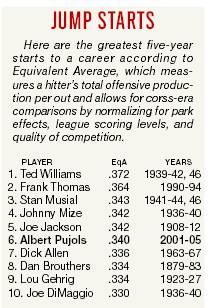
The Skinny

The latest Prospectus Hit List went up on Tuesday, and for the second time this year, the Yankees have taken over the top spot. Over the past two weeks (through Sunday, not including last night’s debacle), the Yanks had gone 9-3, elevating them to a much more representative record than the 9-8 anomaly via which they topped the April 23 list. They’re followed by last week’s #1, the Tigers, then the White Sox, and the Mets.

Those four, each with a Hit List Factor of at least .626, are head and shoulders above the other 26 teams; the #5 Cardinals are at .591. Move down another 35 points (the difference between the Mets and Cards) and you’ve a cluster of six teams, with a couple more not far off that pace. What’s even weirder is that the area around .500 is a virtual no-man’s land; from the Rangers at #14 with a .542 HLF, we drop to the Dodgers at .502, and then the Padres at .486, starting another cluster of four teams. Very strange.

Anyway, I’m much happier with this week’s effort than last week’s; we’ve got Old School, Young Frankenstein, The Facts of Life, Alfred Hitchcock, a $7,500 baseball card, two shots at Jason Kendall (new rule: if you can’t slug .350, you don’t get to charge the mound, ever), and a gratuitous Simpsons reference that was impossible to resist: a link to the most recent episode’s clip where Homer randomly celebrates the 1974 Oakland A’s as the greatest team ever. A fun one to write up.

• • •

From Terry Forster to Fernando Valenzuela to Livan Hernandez to David Wells, some of my favorite pitchers have been on the chunky side of things. As pointed out by Will Carroll, the Columbus Dispatch recently ran an article featuring a couple of the game’s noted medical experts, who agreed that too much fuss is made regarding pitchers’ waistlines:

“We put too much emphasis on how they look in their uniforms,” said Dr. Tim Kremchek, medical director of the Cincinnati Reds. “We stereotype them by their waist size, but sometimes they are the best athletes on the team.”

Kremchek has looked for a link between waist size and injury, as part of a larger look at pitching injuries and how to prevent them, and he found no correlation. He is not alone.

Glenn Fleisig, chairman of research for the American Sports Medicine Institute, works closely with Dr. James Andrews, a noted orthopedic surgeon, and said their studies also found no correlation between weight and risk, or even between weight and effectiveness.

…If a pitcher has the arm strength to generate sufficient energy, the coordination and flexibility to transfer that energy efficiently through multiple stages of a delivery, and the stamina to maintain that energy and efficiency for the duration of his outing, Fleisig said, it should not matter if he has a few extra pounds around the midsection.

It is why golfer John Daly can be among the longest hitters on the PGA Tour and why Cecil Fielder could have a long career as a power hitter while a muscle-magazine coverboy such as Gabe Kapler has 62 home runs in nearly 800 career games. And it is why pitchers from Mickey Lolich to Rick Reuschel to Fernando Valenzuela to David Wells have hung around the big leagues for years, despite a little flab hanging over their belts.

…”I call it the David Wells rule,” Kremchek said. “There are a lot of guys you could point to who look fat but have successful careers. You don’t want to change that too much. A lot of them are more durable and more effective at a certain body type.”

Fascinating stuff; I’ve always enjoyed the fact that baseball attracts a far more diverse selection of body types than other sports; even the greatest player in the history of the game (no, not this assclown) was known for his corpulence.

The article, which was written in connection with the return of C.C. Sabathia from the disabled list, is also somewhat timely in terms of the names it drops. Valenzuela, who 25 years ago set the game on its ear with an incredible run of success to open the season (8-0, 0.50 ERA with seven complete games and five shutouts), was recently elected to the Baseball Reliquary’s Shrine of the Eternals. The Reliquary is an L.A.-based grass-roots museum devoted to the more esoteric corners and characters of the game, and the Shrine is its Hall of Fame. Valenzuela joins Negro League catcher Josh Gibson and Japanese-American baseball pioneer Kenichi Zenimura in this year’s class. Last year’s class included Jackie Robinson, Rod Dedeaux, and Lester Rodney; prior inductees include Dick Allen, Jim Abbott, Moe Berg, Ila Borders, Jim Bouton, Roberto Clemente, Dock Ellis, Mark Fidrych, Curt Flood, “Dummy” Hoy, Shoeless Joe Jackson, Bill Lee, Marvin Miller, Minnie Minoso, Satchel Paige, Jimmy Piersall, Pam Postema, and Bill Veeck — “individuals… who have altered the baseball world in ways that supersede statistics,” as the Reliquary’s site states. A cool crowd.

Meanwhile, Cyril Morong of Beyond the Box Score has an interesting piece on Rick “Big Daddy” Reuschel (not to be confused with Cecil “Big Daddy” Fielder), looking at how he fares relative to many Hall of Fame pitchers at Chicago Sports Review. The answer is that he holds his own by Morong’s methodology, something not too surprising given that he’s got a JAWS score that’s not too far off of the average Hall of Fame pitcher. Not as good as when I first studied him, since the methodology has changed — he’s now about four points below the HOF average, but that still means he scores better than many enshrined pitchers.

One more note on the rotund: he’s not a pitcher, but bad-body catcher Jeremy Brown of Moneyball infamy (listed at 5’10”, 210 lbs, and definitely not selling any jeans) is hitting .333/.400/.507 and throwing out 50 percent of baserunners for Oakland’s Triple-A affiliate in Sacramento, according to Kevin Goldstein. Maybe he’ll end up with Kendall’s job sooner or later.

• • •

After all that, including a slew of dictionary definitions showing that death wasn’t a necessary element in the definition, the guy still can’t use the word right? Unfrigginbelievable. The Bush administration would do well to find him a spot as a spokesman.

Bereaved

I’m wearing a black armband today. My grief is unshakeable. After some five years of on-and-off subscription, I’ve been thrown off of Lee Sinins’ Around the Majors mailing list for taking issue with his complaint regarding the loopholes in MLB’s bereavement list:

3) The Dodgers called up P Aaron Sele, placed P Odalis Perez on the we feel like getting an extra roster spot list and moved P Yhency Brazoban from the 15 to the 60 day DL.

Officially, Perez is on the “bereavement list.” But, someone needs to buy MLB a dictionary, or at least tell them about www.m-w.com. Bereavement means mourning over death. In the past week, Blue Jays P Scott Downs mourned over the “death” of his daughter, who was merely sick, before her “dead body” must have come back to life. Now, Perez is “mourning” over the “dead body” of his mother, who is merely in the hospital.

There is a reason why there are different words for “dead child” and “sick child” and “dead mother” and “sick mother.” Sometimes, there are different words because there are merely synonyms. But, it is often the case that there are different words because they are antonyms. This is clearly a case of the latter.

There is a very simple way to eliminate this mockery. Require actual mourning. Force the team to get a casket, put the “dead” child into it, put it into the middle of the clubhouse and force him/her to sleep in it for a full day while everyone else in the room acts as though it was a wake. Make it very clear–if you want your player to “bereave” then make him bereave and you’ll instantly put an end to this.

Pretty tasteless, huh? I guess Sinins has never had to ask for time off from his job due to a death or serious illness in the family because it might affect his job performance. A couple of funerals for grandparents aside, neither have I, thankfully. But why shoot fish in that particular barrel? Does he really think that the hospitalization of Downs’ infant daughter due to a respiratory virus was something that was worth making light of to his readership? Should we somehow have less sympathy for Perez because his mother hasn’t seen fit to shuffle off this mortal coil yet? Does MLB need to amend the Basic Agreement to call the list “Bereavement and Family Leave” before Sinins is satisfied? Is this the dumbest thing I’ve ever blogged about (wow, that would take some doing)?

I sent Sinins an email to complain — “Stick to baseball instead of your lame attempt at humorous social commentary, or unsubscribe me from the list, please,” I wrote, managing to leave out four-letter words and ad hominem attacks — and was rewarded with a very terse dismissal from his “list of meaningless crap” (his words, not mine). I’ve publicly taken issue with the way he’s handled former player deaths in his daily and weekly reports before, so I’m really not surprised to be given the boot.

But WHATEVER. The Around the Majors list is dead to me. I’ll probably survive, so please, no grieving.