Chatterbox

This week’s Prospectus Hit List is here. Given the short week following the All-Star break, I decided to shake things up a bit, stepping back to look at the list from a few different angles rather than another 30-team roundup. A remix, if you will.

I took a look at how the AL’s big advantage in interleague play has shaken out on the Hit List, broke down which divisions are the strongest and weakest according to the Hit List, compared this year’s list to last year’s final and to our preseason rankings. Here’s the division breakdown:


----2006---- ----2005----
Division Avg RK HLF Avg RK HLF
AL Central 10.6 .531 14.0 .500
AL East 12.8 .524 14.0 .508
AL West 13.0 .511 12.0 .521
NL West 15.2 .503 24.4 .443
NL East 19.0 .482 13.2 .522
NL Central 25.0 .461 14.8 .508

Driven by the Tigers and White Sox (#1 and #3 on this week’s list), the AL Central is riding high. The NL West has gone from by far and away the worst to middle-of-the-pack respectability, while the NL Central has crashed through the basement floor thanks to the Cubs and Pirates. More good stuff after the jump, as they say…

• • •

I’ll be making another TV appearance this week, my second of the summer thanks to the good folks at the New England Sports Network. I’m headed to Boston on Wednesday to tape another episode of the Boston Globe’s SportsPlus for the NESN. Unlike last time, host Bob Neumeier is currently covering the Tour de France, and Eric Frede will be filling in. The episode will air at 5:30 and 11:30 PM. Anybody out there who wouldn’t mind taping the show and slapping it on a VHS for me? You’ll be amply rewarded for your efforts. Inquire within.

• • •

I’ve got my next Baseball Prospectus chat on Thursday at 3:00 PM Eastern. Drop by to say hi or submit your questions ahead of time.

Another road trip on tap this coming weekend, then maybe I can clear this backlog of incomplete blog entries and article ideas I’m accumulating…

Pass the Pillow

The All-Star break edition of the Prospectus Hit List is up; here’s my intro:

Don’t ask about the All-Star Game; this scribe boycotted, and it looks like I’ve got seven more years of same ahead of me. Seven more years of treating the game, its surrounding irrelevant contests, and the inane selection debates with all the consideration of the Simpsons’ take on the Grammies. A pox on the houses of both MLB and Fox for their continued efforts to turn the national pastime into grotesque spectacle replete with annoying sound effects, blatant pandering and sheer contempt for its audience’s intelligence… And now–swoosh! clank!–let’s get that perspective with our new Poxcam. Wow… pus!–swoosh! boom!…

That last line (save for a bit of onomatopoeia) was stolen lock, stock and barrel from Christina Kahrl’s response to my “poxing” on Baseball Prospectus’ internal mailing list. Mad props to her.

I stayed true to my word and didn’t catch a single lick of the game or any of its accoutrements. The news that Fox and MLB chose the occasion to announce a new seven-year contract was enough to quash any last-second impulses I might have had to at least check in. Seven years? Damn, what mirror did I just break?

As it was, technical difficulties with my computer earlier in the day — for awhile it looked like 2/3 of a completed Hit List was completely down the drain — forced me to work though the game anyway. From the commentary at BP, both internally and on the site, it sounds like I didn’t miss much. Sure, Will Carroll had a great time, but he was in Pittsburgh, and carrying credentials, and thus didn’t have to actually watch the damn thing on the tube. As my World Baseball Classic, Olympic and All-Star Game experience reminded me, there’s a huge difference between being at the Big Event and enduring its endless, overblown coverage on TV.

More instructive was curmudgeonly Joe Sheehan, a selection of whose lines from an All-Star Diary I’ll excerpt liberally for effect at the expense of context:

The home-field-in-World-Series gimmick is a tacit acknowledgement of the game’s diminished stature, while doing nothing to address the causes of its decline… Brad Penny vs. Kenny Rogers. It’s not often you get to see the sixth- or seventh-best starters in each league go after each other. Imagine if it didn’t count… They didn’t just turn a David Wright profile into an ad for “24,” did they?… I just got nine e-mails, seven of which said something bad about Fox or a Fox broadcaster. I just report this stuff, folks… I don’t get it. How do you make a big deal about “This Time It Counts,” and then let one of the managers go on TV and basically wash his hands for the night? Either the game is critical or it isn’t; the relentless mixed messages are tiring… I’m sorry…ceremony? What ceremony?… The fifth inning will start after 10 p.m. EDT, thanks in part to a 10-minute interruption so that Fox could get an extra commercial break during the game. Cynical? Me? Just wait until we get some mid-inning pitching changes late in the game for no reason whatsoever… I genuinely don’t know how you could watch this game and buy into any tiny fraction of the ideas that 1) the All-Star Game should “count” or 2) the game can tell you anything about the relative strength of the two leagues. I saw spring-training games in Phoenix in the first week of March, and they had a comparable level of intensity… I think if you add defensive innings played and at-bats, you’ll find that Gary Matthews Jr. and Matt Holliday led this game in playing time. Draw your own conclusions… One last Ozzie note: he used two of his manager’s selections on Mark Buehrle and Bobby Jenks, then didn’t put either into the game, while at the same time using the best pitcher on a division rival who started and went seven on Sunday. I’m just saying.

Sounds like hella fun, especially if you like yelling at the TV. And Joe’s somebody who professes to actually enjoy and care about the All-Star Game, spending hours writing about who should on the team; sitting next to him at Dodger Stadium last Saturday, he suggested that my beef is with Fox, not with MLB. But really, the roster rules, selection compromises, fake injuries, conflicts of interest, and total capitulation to the network make it impossible to absolve MLB of blame. Ultimately it’s their fault the ASG is so broken that it’s not worth fixing anymore.

Salon’s King Kaufman feels my pain:

Baseball’s All-Star Game needs fixing. The Midsummer Classic, renewed Tuesday night in Pittsburgh, is stuck in limbo. It’s part silly exhibition, part deadly serious decider of postseason fates.

The two parts don’t mix. And if the All-Star Game isn’t already a joke, it’s getting very close. Want to elicit derisive snorts among baseball fans? Use “This time it counts!” as a punch line. It never misses.

This is the first year I’ve seriously heard a commentator compare baseball’s All-Star Game to the NFL’s, the Pro Bowl, and I have to say the comparison sounded pretty fair to me. It’s a rule of life as crucial as not playing poker with guys named Doc: Don’t let anything you care about get compared to the Pro Bowl.

Thanks mostly, but not entirely, to historical factors beyond the control of mere mortals, the All-Star Game was already well on the way to irrelevance in 2002 when the dreaded tie game forced commissioner Bud Selig to make a decision, which is never a good thing. He made a typically Seligian move by declaring that to fix the All-Star Game, he would change the way the World Series works.

Selig’s the kind of guy who fixes his muffler by getting a louder stereo.

Kaufman was back again today:

“You’re stuck!” taunted Joe Buck jokingly as he and Tim McCarver announced Fox’s new TV deal with Major League Baseball. “You’re stuck with us for the next seven years!”

Thanks for understanding, Joe. That’s exactly how it feels.

…Fox dropping half of the League Championship Series is good news because, really, isn’t anybody better at broadcasting baseball than Fox? I tried to think of a network that was more annoying in its coverage than Fox during the 43-minute wait for the game, but failed.

…Fox hates baseball, and if it could figure out a way to broadcast baseball without showing any actual baseball, if it could all be sappy music and slow-motion highlights somehow, like that by-the-numbers review of Pirates history, it’d probably pay twice as much for the privilege.

Yeesh. Some party I missed. I’m sad to see the All-Star Game go; I remember it fondly from my youth, caring who won the game and the MVP awards (I can still tell you that Steve Garvey won in 1978, Dave Parker in ’79, Tim Raines in ’87, Derek Jeter in 2000, Cal Ripken in 2001…). And while I do enjoy a break from baseball now and then, even in summer, three straight days without it is an eternity when there’s so much ersatz baseball going on in its place.

Rather than rail against this any longer, I’ll simply invoke the final scene of One Flew Over the Cuckoo’s Nest when the Chief smothers the lobotomized McMurphy, as my metaphor. The All-Star Game used to be a lot of fun, but it will never be the same so long as Fox has it in its clutches, and it looks like awhile before they let go. Say your goodbyes and pass the pillow.

Time Won’t Let Me

So much to write about, so little time, but it will all have to wait until the All-Star break edition of the Hit List is finished…

• I planned to give this more of a buildup, but like the song goes, time won’t let me. I’m boycotting the All-Star Game and have been all season: no voting, no roster-checking, no selection debates either here or in the Hit List, no Home Run Derby, no Futures Game, no links, no nothing. To hell with it. Beyond this mention, the closest I’ll get is mentioning the All-Star break and related performance splits at the Hit List.

The reason I’m boycotting it is because of Fox, whose shoddy treatment of the game last year infuriated me while helping the game slide towards complete irrelevance. The most egregious offense:

…I did see the travesty that took place in the bottom of the third, when Joe Buck and Tim McCarver — without a trace of guile in their voices — gave airtime to a large Corvette advertisement hanging in the outfield as if it were the handmade work of some fan. “Welcome back to Detroit,” remarked Buck. “A lot of banners and signs around the ballpark. No surprise there. Somebody just unfurled a big banner behind left field.”

Uh-huh. Of course, this was a premeditated advertising opportunity of which Buck and McCarver were fully aware. “Buck might have been saying that tongue in cheek,” Fox Sports spokesman Dan Bell told The Register, a UK tech publication which carries syndicated news feeds. “For sure, it was planned. It’s not like we didn’t know about it. Both parties knew about it.” As the Register‘s Ashlee Vance reported:

Buck certainly did not sound “tongue in cheek” to us at all. Both he and McCarver sat there debating the sign like marketing automatons, wondering if it was real and how much time some true fan of baseball spent hammering it out. They most certainly wanted all the saps watching to believe in the sign’s authenticity and go hunting for this mysterious website. “Yet another Chevy ad” probably would not have worked as well.

Blech. If you listened carefully enough, you could hear Jack Buck, Joe’s Hall of Fame-honored father, spinning in his grave. His son has long since barreled through any line between reportage and corporate prostitution via the Budweiser “Leon” commercials. Now he’s added to that distasteful legacy.

Look, I realize this isn’t first-degree murder, or even all that surprising; I expect no better from Fox with all of its tacky lasers and sound effects and the entire network’s complete abdication of journalistic integrity. Baseball and advertising have gone hand in hand since the early days of radio. But it’s one thing for a radio announcer to read promos between innings, quite another for a pair of TV announcers to pass themselves off as innocents as they shill. So it’s with more than a little glee that I note that Fox’s broadcast set a new ratings low for the second year in a row. The people have spoken, and no sir, they don’t like what Fox does to the game. As [Salon’s King] Kaufman put it, baseball fans “get slapped every time they try to tune in to Fox, the network with a contract to broadcast the biggest events of a sport it hates…”

Enough is enough, so I’ve decided to give the All-Star Game the Star Wars treatment, at least for one year: I wash my hands of the entire franchise. I won’t watch next year’s game, I won’t write about it, I won’t vote, and I won’t give a shit who makes the team. To Fox Sports, Buck and McCarver and anyone else involved in this charade, I say, “This time it’s FUCK YOU.”

So there.

• I had a blast on the rest of my west coast trip, remaining in Seattle for three more days after the SABR convention, then heading down to LA. Anyone waiting for the final piece of my SABR writeup should check out the work a couple of my Baseball Prospectus colleagues. Dan Fox did a very nice job of summarizing a handful of the presentations we both saw, some of which I covered from Thursday, some of which will go in my belated Saturday wrapup. Here’s Part 1, covering the Chris Jaffe and Sean Forman presentations (the latter of which won the Doug Pappas Research award as the convention’s best presentation. Part 2 covers the Jeff Angus, Vince Genarro and Jonah Keri presentions. Dan’s also got more of a day-by-day at his blog: 1, 2, even more 2, more 3, and finally 4. Maury Brown has a nice multimedia presentation over at his blog, featuring photos, audio interviews.

Not to slight the non-BPers… over at The Hardball Times, Aaron Gleeman does his usual thorough job. Mike Carminati goes 1-2-3 over at Mike’s Baseball Rants.

I’m not sure how much I’ll have left to say about SABR beyond those, but all in due time…

• On the day of July 4, my aunt Kim was scheduled to attend a game with Sharon Hargrove, wife of Seattle Mariners manager Mike Hargrove. They know each other via my uncle Harold, who is the Diamond Club Concierge Captain at Safeco Field, his post-retirement job where he gets to hobnob with the high rollers. Kim had some amusing stories about Ms. Hargrove she shared over dinner, while Unca Harold brought me a goodie bag that included M’s programs, Ichiro and Richie Sexson bobbleheads, some baseball cards (including a Topps Felix Hernandez that might fetch a pretty penny some day), and a calendar. Good stuff!

• Dodger Stadium — wow!!! My first trip there after nearly 30 years of being a baseball fan, catching Friday night and Saturday games against the Giants. Still trying to process it all, but I’ll say this: Dodger Stadium kicks Yankee Stadium’s ass based merely on two features: grilled hot dogs (mmm, Dodger Dogs), and Vin Scully’s broadcasts piped into the restroom so you won’t miss out on the action. I’ll have a thorough writeup and some pics (not of the restroom, fortunately) soon.

Great article about one of the original Futility Infielders in today’s New York Times, Wayne Terwilliger. The 81-year-old “Twig,” in his 57th year in baseball, is coaching first base for the Fort Worth Cats of the independent Central Baseball League, and he’s now sporting some bling. Twig has been a feature in two of my favorite baseball books; his card adorns The Great American Baseball Card Flipping, Trading, and Bubble Gum Book, by Brendan C. Boyd and Fred C. Harris, and he’s a coach of the St. Paul Saints in Slouching Towards Fargo, by Neal Karlen. He also was a coach on the Twins’ two World Championship teams. Apparently he’s got a memoir out, Terwilliger Bunts One. Like white on rice, I’m on it.

Hit List, here I come…

Rattling SABRs in Seattle — Part II

continued from here

Friday
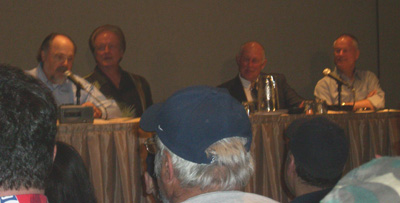
…to hit the convention’s highlight, a Seattle Pilots panel featuring Jim Bouton, Steve Hovley, Mike Marshall, and Jim Pagliaroni, and moderated by ESPN’s Jim Caple. Even with an ungodly early 9 AM start, the panel had the ballroom packed with a few hundred people ready to hear the story of Major League Baseball’s short-lived foray into the Emerald City and the reminiscences of these four iconoclasts. The Pilots, though they lost 98 games, survive in the popular memory due to Bouton’s classic diary Ball Four, a book named by the New York Public Library as one of the 100 most important of the 20th century; Caple told the crowd that even that distinction sells the book short. Bouton’s observations — about the ride from being a former star at the end of the four-decade Yankee dynasty to a fringe major leaguer barely hanging onto a job with a terrible team, learning the game’s most difficult pitch and living during a time of social upheaval — are of course the stuff of legend. The bawdy “tell some” tales of hard-drinking, skirt-chasing, greenie-popping athletes using four-letter words were seen as scandalous at the time, but today they’re revered for their candid glimpses into the lives and psyches of major league ballplayers. Caple drew one of the morning’s biggest laughs when he said that every time he reads the book, he understands at least one more sexual reference than the last time.

Bawdiness and four-letter education aside, the Pilots hold a special place in my life beyond Ball Four (which I first read when I was nine). I was born in Seattle in December 1969, so my mother was carrying me during their lone season. Until I moved to New York City in 1995, that’s the closest I got to living in a big league city. Kind of cool.


panelists Hovley, Pagliaroni, Marshall and Bouton

The panelists had the crowd in stitches for an hour and a half. Bouton described his Pilots teammates as characters out of a novel (quotes cribbed from the Seattle Post-Intelligencer):

“That was the beauty of the Pilots. They were older guys and every one of them was a great storyteller. Here they were playing together for the first time, getting to know each other through the exchange of stories.

“I caught lightning in a bottle. It was as if the baseball commissioner had put this team together thinking, ‘Hey, they might not win many games, but if anybody writes a book, it’ll be a hell of a story,'”

Such a viewpoint helped Bouton appreciate even old adversaries such as former Yankee teammate Fred Talbot. Particularly amusing was his re-telling of the Talbot home run incident (my favorite story from the book, and one I’ve had the fortune to hear him relate before in a command performance), in which the Pilots pitcher pounded a grand slam that won a lucky fan $25,000 (the amount seems to increase every time). Bouton and his teammates conspired to send a fake telegram offering Talbot a portion of the prize, with much hilarity ensuing.

Not everything Bouton said was rehashed; he also revealed that manager Joe Schultz’s catchphrase, “Pound that ol’ Budweiser” was rooted in the fact that Schultz had previously been a St. Louis Cardinals coach and thus, as an employee of Gussie Busch, owned stock in that particular brand. He brought the house down by singing verses of “Proud to be an Astro,” a ditty (written by Houston teammate Larry Dierker) which he learned after being traded late in the 1969 season.

Marshall made quite an impression as well. A pitching coach, former player representative, Ph. D in kinesiology, Cy Young winner, and the holder of the single-season record for relief appearances (108) and innings (206), he’s every bit the iconoclast that Bouton is, if not more. Marshall came off as particularly opinionated about today’s game, both with regards to player salaries (they should be dividing a bigger piece of the pie) and pitcher injuries (much more money should be going towards prevention, and of course his teaching methods would also prevent most of them). Marshall revealed that he and his teammates were aware of Bouton’s literary aspirations:

“It wasn’t a secret [that Bouton was writing a book]… I read it in its rawest draft. I thought it was a celebration. I thought it was funny. It made us look a lot better than we actually were.

…”I’m proud of the book. I was proud of it when I first read it… You could write the same book about your co-workers… but who gives a damn?”

Hovley, a reserve outfielder on the team, had the least to say of any panelist, but he did explain what it was like to be identified as the team’s designated Dostoevski reader: “I was a jock in college, then I was an intellectual on a baseball team. I had all this free time and had a book in my hip pocket. It was not only noticed by my teammates, but immortalized in print.”

Pagliaroni discussed the difficulties of catching Bouton’s knuckleball, recalling Bob Uecker’s advice (wait until it stops rolling, then pick it up) and sharing memories not just of the Pilots but of his entire major league career. A Bonus Baby with the Red Sox, Pags was in the on-deck circle for Ted Williams’ home run in his final at-bat. “I dropped my bat and cried,” he told us. “I shook his hand as he crossed home plate.” Pags followed that with a single, according to Retrosheet.

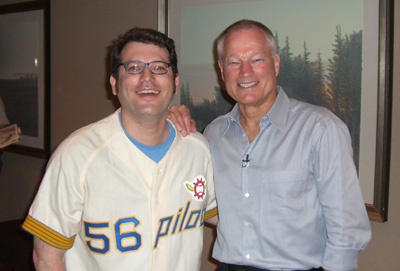
Following the panel, Bouton sat to sign copies of his classic’s 2000 edition, Ball Four: the Final Pitch. I had the pleasure of meeting Bouton back when the book was released; later that night I ran into the woman who’s now my wife, a story I told here upon my engagement and which I related to Bouton when I had him sign Armour’s Rain Check article. Bouton seemed genuinely touched, and posed for a photo of me wearing my Pilots #56 throwback jersey (there were two other Pilots jerseys in the audience, one #21 for Tommy Harper, the other #2, which I think was for Schultz):

Bouton was also on the menu as the keynote speaker for the afternoon’s Awards Luncheon, but at $50 or $60 a ticket, I decided to forego the rubber chicken. I had planned to sneak in after the meal to hear the speech, but after grabbing a sandwich with a few other guys (Mike Carminati, Anthony Giacalone, Ben Jacobs, Chris Jaffe), I returned and quickly became involved in a heady discussion with Stu Shea and ESPN’s Gary Gillette, for whom I’d done some design work a couple years ago. Gillette and I chatted at length about the ailing Peter Gammons (later I scored a copy of Gammons’ out-of-print book, Beyond the Sixth Game), then I picked his brain about some of this year’s surprises, including the Tigers, Dodgers, and a handful of rookies. Somewhere amid the conversation, Pete Palmer — Gillette’s partner in compiling The ESPN Baseball Encyclopedia — dropped by, giving me the chance to meet and chat with a bona fide legend not just in the field of sabermetrics but in the dissemination of baseball statistics, period. A serious goosebump moment for me.

From outside the ballroom, I did catch the tail end of Bouton’s keynote speech, which sounded some of the same themes as his appearance on the Pilots panel, right down to another verse of “Proud to be an Astro.” Je ne regrette rien…

I spent much of the rest of the afternoon in the hotel bar, less to pound the ol’ Budweiser than to get acquainted with my new BP cohorts, Maury Brown. and Dan Fox. Dan told me of his work datacasting Rockies games for MLB.com’s Gameday. Maury was working on a piece about the esoterica found in player contracts. We kicked that topic around, talked about the SABR Business of Baseball committee he co-chairs (along with Gary Gillette), and discussed rumors of new steroid-related revelations. We also shared a good laugh about some correspondence he’d had with Stan Kasten. The Nationals’ president, whom he interviewed recently, solicited him in search of a sabermetrically-minded underling for GM Jim Bowden, who is miraculously going to keep his job, and apparently needs all the help he can get. Insert punchline here.

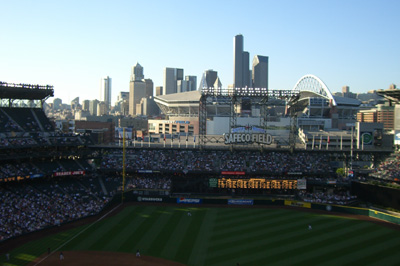
Around 5:30, most of the conventioners either headed out to catch a bus to the Mariners/Rockies game at Safeco Field or to walk (all of about a mile) to the field; I lingered another half-hour in the lobby, waiting for Bryan, my brother, to join me, then we strode down there as well. This was to be my first game at Safeco, and my 10th major-league stadium overall (Yankee, Shea, Fenway, Tiger, Wrigley, Jacobs Field, Camden Yards, Miller Park, and RFK are the others, with Dodger Stadium on deck next weekend). Arriving at the ballpark, we bumped in to Dave Eskenazi, whose memorabilia we’d soon be admiring on the ballpark’s murals. Bryan and I scouted out potential food options, settling on Porter’s BBQ on the 100 level. I got a tall beer and something called the Porter Special — a hot link covered with a huge pile of pork — then gingerly ascended to my seat in the upper deck, praying that I wouldn’t spill anything on my Pilots jersey.

We joined Stu Shea, Cecilia Tan and their s.o.’s (Cecilia and Corwin, respectively) up in section 320, row 19, high up on the first base side, and I quickly removed the jersey and immersed myself in meat. I’m not sure I really attempted to follow the game until about the third inning; no scorekeeping for me, as I forgot my scorebook in New York City, but the only tally that really mattered — besides the out-of-town scores which Bryan filled us in on via info culled from his Blackberry — was no sauce on the retro jersey. In any event, the third frame arrived rapidly. Neither the Rox nor the M’s seemed intent on taking many pitches, and both Josh Fogg and Jamie Moyer mowed through the opposing lineups in short order, relying mainly on their changeups.

The Rockies finally broke through in the fifth inning, when Moyer yielded a leadoff walk to Brad Hawpe, who advanced to second on a sacrifice and to third on a groundout, then scored on a single by Jamey Carroll. Hawpe belted a solo homer to centerfield in the seventh, and that was it for the scoring. Fogg went the distance with a shutout, tossing just 91 pitches while facing the minimum number of Mariner hitters; the two hits and one walk he yielded were erased via double plays, and the game was over in an astounding 1:52 — the shortest contest in Safeco history. Cecilia and I joked about the fact that we’d seen Yankees-Orioles games which lasted twice as long.

Though it was barely 9 PM as the game wrapped up, my SABR day was done; I needed to rendezvous with Andra (my wife), who was flying in from New York. Bud would have to be pounded elsewhere… to be continued

Rattling SABRs in Seattle — Part I

I had a genuine blast during my three days at the SABR Convention in Seattle — the first I’ve ever attended — spending hours talking baseball with other likeminded nuts, listening to presentations and panel discussions, and even taking in a ballgame. Most of the people I met were familiar names if not faces; it was as though my bookshelf, email box, and bookmarks lists sprung to life with an outstretched hand: “Nice to finally meet you!” I doubt I can do justice to the richness of the experience or the sensory overload of being among so many friendly, intelligent, enthusiastic folks, but what follows here and in the next couple of posts are some of the highlights.

Thursday
I’d already registered and picked up my packet of goodies on Wednesday afternoon, getting the lay of the land by taking a bus downtown from my brother’s place out in Tangletown after lunching with Bruce Taylor of Fantasy Baseball Index, the magazine I wrote for back in December and then again during spring training. I’d slept in, missing the Opening Ceremonies, but arrived in time for the Poster Presentations, in which 10 different members presented charts, graphs, photos and such on various topics.

Still a bit groggy and reserved, drinking the worst hotel coffee available in the entire Pacific Northwest, I was pleased to start my day with a few familiar faces. Mike Carminati of Mike’s Baseball Rants, whom I’ve met a few times between New York and Philadelphia, had a series of graphs on the Hall of Fame entitled “Like School on Saturday: Reviewing the Hall by Class.” Mike’s work examined the Hall’s standards from a historical standpoint, using Win Shares to trace the valuation of the average Hall of Famer and how the institution’s standards have evolved over time. Sean Forman of Baseball-Reference.com presented information on the Wikipedia-like B-R.com Bullpen, “A Collaborative Enyclopedia of Baseball History.” Familiar with that portion of the site, I spent more time catching up with Sean and discussing the awesome stat site’s success and the possibility of designing a new banner for it (I did the old Babe Ruth one, which now survives as a link banner). I also met Sean’s lovely wife and infant son. Greg Spira, who doggedly convinced me to join SABR a few years ago, was nearby, and we spent a good chunk of time re-connecting and talking about various projects and SABRs past.

One of the most interesting poster presentations came from a trio of gentlemen I didn’t know beforehand, Steve Weingarden, Christian Resick and Daniel Whitman (I met two of the three but can’t remember which ones). Titled “Why is THAT Executive a Hall of Famer? Have You Seen His Leadership Stats?” the authors attempted to assess and quantify the accomplishments and leadership attributes of the dozen or so team-related execs in the Hall, including Bill Veeck, Branch Rickey, Warren Giles, and George Weiss (pioneers and commissioners who never worked for a team weren’t included). I can’t recall who came out on top; Veeck was fairly high, Negro League founder Rube Foster even higher, and George Weiss was by far the lowest-ranked. I spent a few minutes with one of the authors discussing where Walter O’Malley would rank were he enshrined (Maury Brown made the case for the oft-vilified O’Malley over at Baseball Prospectus recently; more on him later).

From the posters I toured through an exhibit of Pacific Northwest baseball memorabilia (not just the Pilots, but various Seattle, Tacoma, Vancouver, and Spokane teams from the past century-plus, but alas, no Walla Walla Padres) curated by Dave Eskenazi. Later during the convention I was tipped off to look out for the semi-obscured bogus Seattle Pilots business card of Allan “Bud” Selig, next to a real business card of another Pilots exec. Selig’s job title: “Franchise Thief.” I nearly doubled over laughing, and so did the other guys to whom I showed it.

After grabbing a quick bite for lunch, I met a handful of bloggers whose names are familiar: Aaron Gleeman and Ben Jacobs of The Hardball Times, Matt Rauseo, Joe Dimino of the Hall of Merit, and my namesake, Chris Jaffe (no relation; the creator of the now-defunct Run Support Index blog). Soon we were watching Chris’ presentation: “Evaluating Managers: Which Men Get the Most and Which Get the Least Out of Their Players.” Chris used five different means of exploring that question, comparing Pythagorean records versus actual, and the performances deltas of hitters and pitchers under said managers. As with most of these presentations, I can’t do it justice with my spotty memory, but I recall Joe McCarthy coming out on top by a wide margin, that both Casey Stengel and Connie Mack were hampered in the overall rankings byong, unproductive stretches fo their careers (Stengel scored well with the bad Braves and Dodgers teams but lousy with the Mets; Mack simply had too many years where winning was a secondary goal) and that the managers with the longest careers (2,000 or more games) tended to have the largest per year impacts (on the order of 1-2 games), while managers with the shortest tenures (less than 500 games) had the least (the paper on which Chris’ presentation is based starts here).

Following a break for some liquid refreshments (a bit early at 1:30 PM, but when in Rome…) we returned for Anthony Giacalone’s account of the creation of the Mariners, “‘Let the bleeps talk to me. I’m a seller, too!”: Relocation, Expansion and the Battle to Bring Major League Baseball Back to Seattle.” His was a complex narrative involving Charley O. Finley’s Oakland A’s, the Chicago White Sox, the Messersmith-McNally decision, Bill Veeck, Bowie Kuhn, Congress, and the rivalry between the two leagues; Giacalone followed the tale’s twists and turns an engaging fashion.

More refreshments, then back for Vince Genarro’s well-polished “The Dollar Value of the Last Piece of the Puzzle,” a look at the economics of the player who puts a team over the top. Like Nate Silver in Baseball Between the Numbers‘ chapter, “Is Alex Rodriguez Overpaid?” Genarro noted that within a very narrow range, the value of an additional win increases disproportionately due to the postseason revenue at stake, such that a team on the cusp of making the playoffs has the most to gain.

Following that, I sat through three presentations in a row. “Double Duty” Carminati served up “Welcome to the Halls of Relief: An Historical Review of Relief Pitching” which, in addition to throwing an overwhelming blur of data at the audience, concluded with a fantastic suggestion that the Hall create a special committee to review the cases of various relievers throughout history and select qualified oness for induction (screw the BBWAA and their inability to get it right on Rich Gossage). Phil Birnbaum asked “Do Players Outperform in Their Free-Agent Year?” (no, not to any great extent). Maury Brown and Dan Fox — two of the newest Baseball Prospectus authors — presented “The 2006 CBA and the Battles Within It”, reviewing the various potential sticking points in the upcoming labor negotiations and concluding that this time around, there’s a slimmer chance of a work stoppage than ever. The gregarious Brown did all the talking, actually, while the quiet Fox worked behind the scenes for a fine presentation.

With enough PowerPoint under my belt for the day, I retired to the bar, where I met up with fellow New Yorker Mark Lamster, whose Albert Spalding book I’ve been touting in this space. We caught up on the Yankees, bemoaning the state of their rotation and injured outfielders, he introduced me to Brown, and then we headed down to an author signing at Elliot Bay Bookstore by way of a reception at Ebbets Field Flannels.

The Elliot Bay event was a highlight, with the following panel:

Jeff Angus, offering up Management by Baseball, a book presenting lessons from the national pastime and their applications in the business world. Even to somebody like me, whose eyes glaze over at the thought of working in some corporate cubicle or attending a management seminar, Angus is an engaging, accessible and persuasive speaker. He had the audience eating out of the palm of his hand as he described his a-ha moment of combining baseball with his consulting skills: an unsuccessful steal of second base bay the Mariners’ lumbering Jeff Burroughs as ordered by the worst manager in the history of history, Maury Wills. Watching him, I had the vision of a man quite capable of convincing the Eskimos to diversifying their ice-based economy by applying lessons learned from the 2005 White Sox. Or something like that.

• Mark Armour and Dave Eskenazi, presenting Rain Check, their convention-related history book covering Pacific Northwest baseball. Armour, the co-author of the award-winning Paths to Glory: How Great Baseball Teams Got That Way, edited the collection and wrote a terrific perspective piece on the hoopla surrounding Jim Bouton’s Ball Four. Eskenazi’s photos and memorabilia gave the book its visual punch; Safeco Field even has murals of his treasures.

• Rob Neyer, speaking about his Big Book of Baseball Blunders. As he’d done in New York a couple weeks ago, the immodestly modest Rob went straight into Q&A mode instead of touting his book.

• Jonah Keri, flying the Baseball Prospectus flag for Baseball Between the Numbers, which he edited. Jonah focused on BBTN’s most provocatively-titled chapter (one of two he wrote for the book), “Why Doesn’t Billy Beane’s Shit Work in the Playoffs?”

Following the panel discussion and book signings, I joined all of the authors except Angus in heading to a nearby restaurant for burgers, onion rings, and other fried goodies. Also joining us was Armour’s co-author on Paths to Glory, Dan Levitt. The most memorable portion or our conversation was Armour relating the sad tale of a SABR member attempting to enter by hand over 100 years of baseball data in the service of his own particular (and understandably unfinished) encyclopedia. Brutal.

Back at the hotel bar, Armour and I joined a group that included Stuart Shea, who edited my stuff for Fantasy Baseball Index and who wrote Wrigley Field: The Unauthorized Biography, Cecilia Tan, author of The 50 Greatest Yankee Games and The 50 Greatest Red Sox Games, and their significant others. I’ve corresponded with both Stuart and Cecilia, the latter for several years, but this was the first time I’d met them too. No problem; I instantly felt at home bending elbows around a table that included six of us drinking for the cycle — beer, port, scotch, brandy, chocolate martini, and wine. Somehow our conversation turned to an All-Ugly team (current players only) and when we tired of that, an All-Domestic Violence team. Sadly, the latter took us hardly a couple of minutes to fill.

I hung out at the bar until about 1 AM, cracking the game with my new friends for a couple of hours, overwhelmed at all the people I’d met and hung out with in just one day at the convention. Finally, I excused myself and grabbed a cab back to my brother’s place, where I caught a few Z’s before rising early… to be continued

Heavy Thoughts from a Different Time Zone

Things to write when you find yourself awake before 8 AM due to the time zone difference…

• I’m far from being the world’s biggest Peter Gammons fan, but my thoughts and best wishes go out to Gammons, who underwent surgery for a brain aneurysm on Tuesday.

At 61, Gammons is no spring chicken, no matter how many attempts to be hip he makes by throwing rock references into his ESPN columns. I have no wish to kick the man while he’s flat on his back, so I hope that this critique of him is taken in the positive spirit with which it’s intended. My main issue with Gammons is that aside from pioneering the “Sunday notes” column format as a writer for the Boston Globe — an innovation that’s deservedly included in his J.G. Taylor Spink Award bio for the Baseball Hall of Fame — he hasn’t produced much work of lasting substance.

Gammons published a book, Beyond the Sixth Game, back in 1986. It’s supposed to be a very good book, but it’s out of print, and 20 years out of date. I’ve never read it and I bet you haven’t either, but you’ve read Gammons’ notes columns and watched him monger rumors on behalf of anonymous GMs on TV and in pixel form. The man loves the game and has his finger on its pulse, certainly, and he’ll win any popularity contest among baseball writers in a landslide. But from where I sit he seems addicted to access, more interested in feeding our short attention spans by acting as a mouthpiece and a pawn for front office thought balloons, or simply stringing together tidbits from a notebook than as somebody who genuinely advances our baseball knowledge with his considerable talents.

I’m certain that were Gammons to take a break from the yenta hotline, he could produce a book — an in-depth look at the state of the game or a particular aspect of it, a memoir of his life and times within it, what have you — that would explain to people 50 years from now why the man was so highly regarded within the game. Buster Olney’s got one, and even Bill Plaschke collaborated Dick Williams’ memoir, fer chrissakes. This week’s scare should serve as a reminder that Gammons may not have forever to do that. I’m reminded of a “Pinstriped Bible” column my good friend Steven Goldman — himself a man who’s had to meditate on mortality — wrote two years ago on the sad occasion of the passing of Baseball Prospectus author Doug Pappas, who was just 43:

Last week, my colleague, and, as George Harrison once said of Bob Dylan, “a friend of us all,” Doug Pappas passed away. For those readers of the Pinstriped Bible who have not heard of Mr. Pappas, he was our preeminent writer on the business of baseball. His deconstructions of baseball’s often nefarious financial practices brought new transparency to the game. That he accomplished this from the outside, in the face of opposition from the game’s management speaks to his intelligence, perceptivity, and diligence.

Doug made himself available to most anyone who wanted to tap his tremendous reservoir of knowledge, and his work was one of the direct inspirations for Michael Lewis’ Moneyball, one of the most important baseball books of the last twenty years. For those who try to understand baseball in all of its compelling facets, not just the athletic and the strategic but also the economic and the political, the loss of Doug is an irreparable blow.

Doug Pappas was just 43. Lou Gehrig was not quite 38. Thurman Munson was 32. Addie Joss, the four-time 20-game winner for the Cleveland Indians, was 31. Ross Youngs, the great Giants outfielder, was 30. I am 33 and am a cancer survivor. The thing about being a cancer survivor is that it’s not necessarily a permanent distinction. I hope to be able to wear that badge for a long, long time, but you never know. Sometimes the doctors say encouraging things about that, sometimes not.

We make our long-term plans and we hope for the best, not really knowing whether we’ll be able to follow through. Doug thought he was going on vacation. Gehrig suited up for that last game on May 2, 1939, but he didn’t get to play. In the end, not even he could count on that.

Work while you can, gather ye rosebuds while ye may, and never turn down a time at bat, for the night comes, and in this game, they don’t play night games.

Goldman has since published a book on Casey Stengel, Forging Genius, and he’s edited a couple more for Baseball Prospectus. He’s the hardest-working writer I know (so hard that I even forgive his email lapses) as well as the standard-bearer for a generation of Internet-groomed baseball writers, and a genuine inspiration on both a personal and professional level. No matter what endeavor you choose, his words should be taken to heart.

I don’t know if Peter Gammons has the faintest idea who Goldman is; I suspect he might, given that he’s touted BP on a number of occasions (and don’t think I don’t appreciate how that’s trickled down to help me). I wish him a quick recovery and more than anything else, a chance to heed Steven’s words.

• I railed at the Philadelphia Phillies in this week’s Hit List, and with good cause:

Brett Myers is arrested for beating his wife, but he can’t beat the Boston Red Sox lineup he faces a day later. In putting the team’s interest ahead of other concerns by allowing Myers to pitch, the Phils send a disgraceful message that trivializes a problem all too common among professional athletes, one that does far more harm to society than performance-enhancing drugs. Seriously, here’s hoping the fine fans of Philadelphia shower Myers and the organization with the scorn and abuse they deserve, and that both Major League Baseball and the criminal justice system bring down the hammer on this thug.

The last line of what I wrote for this entry was understandably left on the cutting room floor: “Until they do that, the Phillies can phucking rot.” Sorry to enter yet another soapbox derby, but this is an issue I feel very strongly about. More than any other transgression involving athletes — steroids, hard drugs, even drunk driving –domestic violence gets short shrift; the police blotters are dotted with wife- and girlfriend-beatings on an annual basis, yet justice is rarely served because often these incidents take place without witnesses. Critics of my bitter obituary of Kirby Puckett liked to point out that Puckett was never convicted of a crime, but it’s clear from his rap sheet that the man displayed a pattern of behavior in his private life that contradicted — and to me, completely devalued — his cuddly public image.

There were apparently plenty of witnesses to what Myers did outside of his hotel, allegedly hitting a woman half his size in the face with his fist two times and dragging her by the hair; charges were filed by the police, not the victim, meaning that this isn’t going to fade away the way so many other domestic violence cases do.

I’m gratified to see the consensus among baseball writers is that Myers and the Phillies shit the bed on this one, big-time — yes, their conduct is as foul and graceless as that metaphor. My Hit List entry linked to well-written columns by a pair of writers I normally disdain, the Boston Globe‘s Dan Shaughnessy and the Philadelphia Daily News’ Bill Conlin. Shaughnessy pointed out a useful precedent, citing the Sox benching and subsequent release of Wil Cordero, who hit his wife with a telephone, in 1997. Conlin wrote of the legacy of numerous Phillies players’ brushes with the law that were ignored by the team: “No Arrest + No Witnesses + No Media = It Never Happened.”

Another Philadelphia-based writer, ESPN’s Jayson Stark, knocked the ball out of the park:

It’s now four days since the arrest of Brett Myers after one of the most public, most witnessed and — if all those witness accounts are accurate — most reprehensible examples of spousal abuse I can ever remember an athlete being accused of.

But I’m still waiting (as is the rest of the planet) for some evidence that it has dawned on Myers, or anyone on the Phillies, exactly what a horrendous job he and the team have done of handling everything — everything — related to this incident since.

It seems clear now that Myers, who already has made one start since his arrest, is going to make his second Thursday in Baltimore. Bad idea. Really, really bad idea.

Yes, Brett Myers has legal rights, as a citizen and as a baseball player. Yes, his team and his sport have an obligation to let the legal system play out before they discipline this man.

But somebody needs to take charge of this situation. Somebody needs to sit down with Myers and make him understand the gravity of this mess.

Somebody needs to make him comprehend the irreparable damage he has a chance to do to his career if he really thinks the only thing he needs to say to the public is: “I gave it my all.”

And once that sinks in (if it ever does), somebody needs to make him understand that he needs to miss a start — or five — to get his life together and to work on what really matters:

Demonstrating that he’s a civilized human being who believes in treating the female half of the species with proper respect and decency.

Myers finally agreed to take a leave of absence through the All-Star break to deal with his situation, but the damage has been done. The Phils took four days to reach a conclusion that the rest of us reached in four seconds, reacting only when they were being all but burned in effigy. They get no points here.

And, on that note, neither do the Detroit Tigers, who are allowing Dmitri Young to proceed with a rehab assignment in Florida despite an outstanding warrant for his arrest in Michigan for failing to appear in court in conjunction with a domestic violence case of his own (he’s “accused of choking a 21-year-old woman from Toledo on April 14 at a suburban Detroit hotel”, according to the article). The two cases aren’t parallel, but the Tigers appear to have their heads just as far up their asses as the Phillies do: “[Young’s] lawyer, William Swor, and the Tigers have declined to comment about Young’s whereabouts. Team president and general manager Dave Dombrowski has said the arrest warrant would not affect Young’s status with the team.”

Dombrowski has done an admirable job of turning the Tigers around; they’re atop the Hit List yet again this week. But his handling of this situation is giving the team, and the game, a black eye. Young shouldn’t be allowed back on the field until his legal situation is sorted out, and the Tigers should be held accountable by the criminal justice system and Major League Baseball for failing to comply with that. If Bud Selig can be bothered to speak up about Ozzie Guillen’s running off at the mouth, he should have the sense to confront a much more serious issue where The Right Answer is glaringly obvious.

• Mea culpa: I’m not sure what I was thinking when I wrote this week’s Red Sox entry for the Hit List and counted David Ortiz’s homer off of Tom Gordon in the 2004 ALCS as a walk-off. He did end the game with a walk-off hit, of course, but it was a single off of Esteban Loaiza. Consider me punch-drunk on that particular matter, I guess.

You Know It’s a Long Road Trip When…

You know it’s a long road trip when you pack multiple throwback jerseys; I’ve got my Fernando Valenzuela Dodgers #34 and my Seattle Pilots Jim Bouton #56 in the suitcase as I light out for Seattle and L.A. for the better part of the next two weeks. Hope to see some of you at SABR!

The Hit List is here. I’ll try to carve out some time for a few posts from the road…

Flipping Channels

It’s been a busy couple of weeks here at Futility Central as I try to wrap up a major design project as well as keep up with my usual Baseball Prospectus writing flow before heading out of town. I leave on Tuesday for Seattle, where I’m spending a week centered around the annual SABR convention.

This will be my first one; I entertained the notion of going in years past, but with this one taking place in a city where my brother, two sets of aunts and uncles, and my wife’s best friend and her family are all in the area, it made sense to turn it into a full-on vacation. The fact that Jim Bouton is the keynote speaker only adds to the reasons to go; it was on the same night I met Bouton five and a half years ago that the gal who’s now my wife first staked her claim on my heart. Anyway, if any of you are going to SABR, I hope we can meet up. Look for the guy wearing the replica Pilots #56 jersey (Bouton’s uni circa Ball Four). Email me for further details.

From Seattle, I’m headed down to Los Angeles, where, for the first time in my 36+ years, I’ll finally get to attend a game in Dodger Stadium — two in fact, courtesy of Dodger Thoughts’ Jon Weisman, who’s been clutch with the tickets. The Dodgers are playing the Giants, which means I’m packing my leather lung to scream tasteless epithets at Barry Bonds as women and children cower in fear. It may be L.A., but I’ll show him the Bronx (just kidding, Jon — I’ll be on my bestest behavior).

So anyway, it’s been ages since I rapped at ya, going all the way back to last Wednesday, just before I headed up to the Yankees-Indians game, where I missed the signature moment of Randy Johnson’s ejection while making a beer run. Johnson came inside against nemesis Eduardo Perez a half-inning after Jorge Posada was plunked by Jason Johnson. He didn’t hit him, but since both benches had apparently been warned, the Big Unit and Joe Torre got to take a powder. I heard the roar of the crowd as I was purchasing beers; by the time I got to the field, players, coaches, and umps were milling around on the field, sorting things out, and the crowd was chanting “Randy! Randy!” as if they were finally on the disappointing (5.32 ERA) Johnson’s side. As I noted in this week’s Hit List, the Yanks have been out-plunked by 14 hitters, the second-largest margin in the majors. With the lineup already decimated by injuries to Hideki Matsui and Gary Sheffield, and Derek Jeter having missed several games due to being hit on the hand, the Big Ugly finally stepped up to protect his teams. No beef there.

A few other moments stand out from the Yanks’ 6-1 win. First was the dramatic contrast in treatments by the official scorer on potential hit/error rulings for Derek Jeter and Alex Rodriguez. In the fourth, with Jeter at third, Jason Giambi on second and none out, A-Rod grounded to shortstop Jhonny Peralta. He looked to have beaten the throw, which was a bit high, but first baseman Ben Broussard bobbled it. Jeter scored easily. “Watch, they’ll screw him,” I said to my friend Nick about the decision on whether Rodriguez, in the midst of a 6-for-40 slump, would get a hit. Nope.

Jeter, on the other hand, reached on ball Broussard bobbled in the seventh. “How much you want to bet that’s a hit? It’s the Jeter Rules,” I said to Nick. Sho’ nuf, that’s the way the official scorer saw it too. I’ve heard from numerous sources — those in the press boxes, and those who work for teams — that the Yankee official scorers are regarded as among the worst in the majors, and here was vivid proof. Pure horseshit.

Also, Andy Phillips seemed to be around a few big plays. In the third he hit a ball into the right-center gap, but Cleveland centerfielder Grady Sizemore laid out for it and made a beautiful diving catch to take away a sure double. In the sixth, Phillips exacted some revenge with a two-run homer to expand the lead to 6-3 shortly after Posada was hit. And in the ninth, Phillips dove over the rail, into the stands to nab Victor Martinez’s pop foul ball for the final out — one of the best game-ending defensive plays I’ve ever seen.

Johnson, of course, drew a five-game suspension for his efforts. That paled in comparison to his opposite number, Jason Johnson. Ineffective since being signed as a free agent this past winter (the loss took him to 3-7 with a 6.00 ERA), Johnson was designated for assignment following his next start, where he surrendered six runs (three earned) to the hapless (28th in this week’s Hit List) Chicago Cubs. The Tribe subsequently traded him to Boston for a bucket of tobacco spit said to have been produced by Luis Tiant, if I’m not mistaken. Given the Red Sox’s back-end problems, this could work out nicely for the Yanks.

• • •

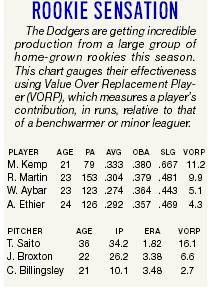
Anyway, the aforementioned Hit List found the Tigers back on top, the Yanks third, and the Dodgers ninth. The latter are the subject of a piece I wrote (PDF here) for today’s New York Sun about the influx of rookies that’s arrived ahead of schedule to keep the team in the thick of the NL West race:

In early May they recalled Andre Ethier (acquired from Oakland for the controversial Bradley) to man their decimated outfield and Russell Martin to fill in for injured catcher Dioner Navarro (who, at 22, was starting his first full season). Both quickly made impacts. Ethier homered in his second big-league game, and a day later Martin stroked an RBI double in his debut, setting off a streak in which the Dodgers won 16 of 18 with him catching.

A week after Ethier’s homer, a knee injury to Mueller forced the recall of Willy Aybar, who spent most of last season in Triple-A before hitting a torrid .326 AVG/.448 OBA/.453 SLG as a September call-up. This year, Aybar picked up where he left off, hitting safely in 20 of 21 games. By the end of May, the Dodgers promoted another outfielder, Matt Kemp; within a week of arriving, he’d homered in his first three games at Dodger Stadium, and through his first 18, had gone yard seven times.

The bullpen, where the once-elite Gagne has been sidelined again, has also been shored up by rookies. Gasthrowing, 288-pound Jonathan Broxton has become one of manager Grady Little’s key setup men, while 36-year old Japanese League veteran (technically a stateside rookie) Takashi Saito is now closing due to Baez’s struggles.

Even the rotation has gotten a shot in the arm, with Chad Billingsley, considered the system’s crown jewel, debuting on June 15 with a 5.1-inning start in which he he allowed two runs while dazzling the Padres with a 96 mph fastball and a curve thrown for strikes when behind in the count.

The rookies are a big reason why the Dodgers are even contending in the NL West. Collectively, only the surging Marlins – amid a fire sale-induced youth movement that’s seen as many as seven rookies playing at once – have gotten more production out of their freshman class. According to Baseball Prospectus’s Value Over Replacement Player (VORP) metric – which measures a player’s offensive or pitching contribution in runs relative to that of a freely available minor-leaguer or benchwarmer – Marlins rookies have accounted for a collective VORP of 106.4 runs, split about evenly between pitchers (57.3) and hitters (49.1). Dodger rookies have totaled 51.0 VORP (33.2 for hitters, 17.8 for pitchers), albeit in considerably fewer plate appearances and innings; only four other teams have topped 30.

The piece was accompanied by a table showing the contributions of the aforementioned rookies:

While I’m dishing out the numbers, here’s the complete chart of the team-by-team rookie VORP totals referenced in the article; pitchers’ hitting was not included in the offense totals, and a bug in BP’s stat reports required me to add about a dozen rookies who recently debuted to the ones the database flagged. Numbers through Wednesday night, when I stayed up late to watch Chad Billingsley’s start against the Mariners, hoping he’d live up to his debut and keep his VORP in the black. Billingsley had a so-so night. The M’s fouled off numerous pitches, elevating the kid’s pitch count; they walked four times and struck out only once but managed only two runs. The first came on a delayed double steal; Richie Sexson whiffed on a beautiful curve ball, but Russell Martin was completely buffaloed by Raul Ibanez bolting from first base, forgetting that Adrian Beltre was scampering off of third. Rookie mistakes. The second run was also odd. Mariners catcher Kenji Johjima hooked a ball down the leftfield line; the announcers (a Seattle crew, not Vin Scully) and cameramen thought it was a foul ball and cut away, only to be surprised when the ump signalled for an equally surprised Johjima to circle the bases for a solo homer. Raw deal. Anyway, the data:

Team   Hit  Pitch  Total
FLO 49.1 57.3 106.4
LAN 33.2 17.8 51.0
DET -4.8 54.7 49.9
PIT 10.7 27.2 37.9
TEX 10.5 24.7 35.2
MIN 4.1 27.5 31.6
WAS 4.0 22.1 26.1
SDN 7.0 16.8 23.8
MIL 21.3 2.3 23.6
BOS -2.3 24.6 22.3
SLN -2.1 23.5 21.4
ATL 10.8 5.5 16.3
COL 1.4 13.7 15.1
ANA 3.8 9.2 13.0
HOU 0.0 12.8 12.8
TBA 0.0 12.2 12.2
ARI 2.6 8.8 11.4
TOR -1.3 12.2 10.9
BAL -12.2 20.8 8.6
KCA 2.0 6.6 8.6
NYN -5.9 10.6 4.7
SFN -3.0 7.5 4.5
CLE 0.1 4.2 4.3
CIN 1.4 1.7 3.1
OAK 0.0 2.2 2.2
NYA -1.0 3.1 2.1
CHN 1.1 -1.6 -0.5
CHA -8.2 6.6 -1.6
PHI -3.5 0.5 -3.0
SEA 1.3 -4.7 -3.4

Notice that the Yanks have fallen below replacement level in the hitting department. Our new best friend Melky Cabrera fell on hard times in the form of an 0-for-14 slump, and is down to hitting .254/.355/.328 even after a couple of key hits in the Yanks last two wins over the Phillies. His VORP stands at -2.4; Phillips’ is at -1.0 due to a putrid .278 OBP which offsets his marginally useful .431 SLG.

• • •

Weird night for flipping channels. I just missed Roger Clemens’ season debut against the Twins and rookie sensation Francisco Liriano, tuning in right as Justin Morneau greeted perpetually craptastic Houston reliever Russ Springer with a 439-foot solo shot on his third pitch in relief of Clemens. So I turned over to the White Sox-Cardinals game, where rookie Anthony Reyes had taken a no-hitter into the seventh inning against a Sox team that had rolled up 33 runs in its previous two games against the Cards. Jim Thome came to the plate just as I arrived and on the first pitch he saw — BOOM! — 428 feet (you must check out the awesome Hit Tracker site, which logs the distance and conditions for every homer, and links to MLB.com video). Bye-bye no-hitter, bye-bye shutout, bye-bye baseball. That was the only hit the Sox got, and it was enough for a 1-0 victory behind some pretty spiffy pitching by Freddy Garcia.

But I didn’t stick around to watch much more of that, instead heading over to the Dodgers-M’s game with Felix Hernandez on the hill for the latter. After a sensational debut as a 19-year-old (!) last year (2.67 ERA and 77 K’s in 84.1 innings), “The King” has struggled this year to the tune of a 5.10 ERA. The Hardball Times’ David Cameron pointed out a few weks ago that Hernandez has had some rocky beginnings due to a tendency to come out of the gate throwing nothing but fastballs; even with his 95-97 MPH heaters, he’s been getting raked.

That wasn’t the problem last night, but getting strike one was. Hernandez threw first-pitch strikes to the first four hitters, struck out J.D. Drew, Jeff Kent and Russell Martin in the second, and held the Dodgers scoreless through four innings as the the Mariners took a 2-0 lead. But he started falling behind hitters by the fifth and sixth; actually, after the first four, he’d thrown first-pitch strikes to just five out of 12 entering the fifth. The Dodgers rapped out three singles in the fifth, on 2-2, 2-0, and 1-0 pitches, then put together three more runs in the sixth courtesy of singles on 1-1, 0-0, 3-1, 1-1, and 1-0 pitches. In all, Hernandez managed just 13 first-pitch strikes to 29 hitters (counting Cesar Izturis, who was at the plate on an inning-ending caught stealing in the fourth and subsequently led off the fifth). That’s not enough to get the job done. I wasn’t keeping close track, but the guys at U.S.S. Mariner counted only two changeups in the fifth and sixth, and the aforementioned Felixologist, Mr. Cameron, logged this for how the Dodgers reached base:

Ethier, E-5, Fastball
Izturis, Single, Fastball
Lowe, Single, Fastball
Etheir, Single, Curveball
Martin, Single, Fastball
Furcal, Single, Fastball
Drew, Single, Fastball
Etheir, Single, Fastball
Izturis, Single, Fastball
Martin, Single, Curveball
Furcal, Single, Fastball

Can you spot the trend?

Cameron also noted that according to the TV radar guns, Hernandez never threw harder than 94 after the fourth. “He was sitting 93-94 in the 5th and 6th. Last year, he was consistently 96-98 even late in games. He rarely, if ever, hits 97 or 98 anymore.”

It goes to show that just like the pretty girls at that age, young pitchers will break your heart.

Clearing the Bases — Booked Edition

This week’s Prospectus Hit List went up yesterday, with the Big Apple holding the top two spots. Fresh off a 6-1 week that included a four-game sweep of the Diamondbacks by a combined score of 37-9, the Mets top the list while the Yanks, who lost four straight from Thursday to Sunday, still had enough mojo to edge the Tigers for second.

The Diamondbacks are one of baseball’s big stories right now, though not for on-field matters. Saving myself the trouble of rewording and relinking, I’ll just pull from the Hit List:

Grim Reaper: a BALCO-related federal raid on the home of Jason Grimsley leads to the journeyman pitcher’s admission that he used performance-enhancing drugs, highlighting loopholes in the current policy such as the lack of a test for Human Growth Hormone and setting the stage for a new phase in baseball’s drug scandal. The news rocks the baseball world, particularly because Grimsley reportedly revealed to the feds names of other players who used (pdf); if the pattern holds, those names will soon be leaked to the public. Grimsley requests and receives his release as the Diamondbacks decide to withhold pay.

Grimsley, of course, is a former Yankee; he played on the 1999 and 2000 World Champions. But his time in New York is best remembered for a story he told New York Times beat writer Buster Olney about pilfering Albert Belle’s corked bat from the umpires’ dressing room while a member of the Cleveland Indians in 1994. At least superficially, the link between that incident and this is that it paints an image of Grimsley as a brazen journeyman willing to do just about anything to keep himself in the majors, whether or not the rule book allows it.

What’s shocking isn’t that Grimsley was using, however; of the 12 major leaguers who tested positive last year, six were pitchers and none of them stars. No, what’s shocking is that he named names of other players he believed were using or supplied drugs. Those names were redacted in the affidavit that’s circulating on the Internet, but given how consistently every other redacted name has been leaked to the media, it won’t be long. Some big ones have already been bandied about, and I’m hearing even more jaw-dropping ones through the grapevine. You can bet that not only will Grimsley’s names be out there, but also the names of the five to seven percent of players (60 to 84, by my math) who tested positive during the so-called anonymous survey testing from 2003. Those identities, which were supposed to be confidential, have long since been matched up with their samples.

Those names could come from all over the game; ESPN’s Jayson Stark paints a chilling picture merely by retracing the pitcher’s steps:

He connects the late 1980s, when steroid use was just getting trendy, to the post-testing age we now live in.

He played with the Phillies of the early 1990s, with a bunch of players who went on to become a major part of the worst-to-first saga of their 1993 World Series runner-up team.

He played with the Indians of the mid-’90s, on a team of mashers that eventually grew into the only club in the past 70 years to score 1,000 runs in a season.

He played with the Yankees of 1999 and 2000, teams that won back-to-back World Series.

And he played with the Orioles of 2004-05, with guys named Rafael Palmeiro and Sammy Sosa.

Not to mention the ’96 Angels or the 2006 Diamondbacks, or the three teams (Astros, Tigers and Brewers) that dumped him without bringing him back to the big leagues.

So Grimsley’s All-Teammate Team would go on longer than his federal affidavit. It would be a roster hundreds of names long — many of them really famous names, players who have never been associated with any kind of drug use.

All in all, this is Bad News for baseball. Whatever the motivations of the media following the story, the rumors flying around indicate that the game is headed for another black eye and another public pummeling.

No matter where you stand on the issue of steroids within the game, you probably exhaled a sigh of relief when Barry Bonds hit his 715th home run, hoping that the soapboxes could be put away for awhile. Now, the issue will be with us right up through the negotiations of the next Collective Bargaining Agreement after the season. Any time that’s brought up, we’ll be reminded that the Players’ Association will be pressed to make further concessions, to find a way to prove their members aren’t using despite the fact that there’s currently no reliable urine or blood test available. To prove the unprovable, in other words.

Congressmen and media will bloviate that Something Must Be Done. And they’re right. If Congress wanted to do something about the issue rather than simply score points in the public while dodging the real needs of its constituency, they’d pour a reasonable amount of research money into the creation of a reliable test for HGH, and they’d force Major League Baseball to step up to the plate, too. Olney pointed out that MLB has committed only $450,000 over three years to finding such a test; relative to the industry’s revenue, that’s a pittance he likens to the price of a Happy Meal for someone making $30,000.

But no matter how much money is thrown at the issue, there won’t be a test anytime soon, and holding the samples for later testing isn’t going to edify anyone. Which means it’s clear that the game is at something of a dead end when it comes to the issue. Some folks might downplay the problems in the sport and point to the steps that have been taken, but consider this: for whatever advances baseball can claim in the reduced number of positive tests (from that 5-7% of players in 2003 to 96 players in 2004 to 12 in 2005), the scandals that are rocking the sport center on the use of substances — including designer steroids and HGH — chosen to circumvent those tests. You can’t count what you can’t catch, and it’s quite possible that there are dozens of players who’ve switched over to undetectables for every one who’s been caught.

The unruly and often counterproductive noise that’s emanating from so many fronts is in part a reflection of the frustration and powerlessness people feel as that likelihood dawns on them while they watch the sport take hit after hit. In the words of James Brown, “People it’s bad.”

• • •

Speaking of steroids, yesterday brought the news that Will Carroll’s book, The Juice: The Real Story of Baseball’s Drug Problems, was one of three books to receive The Sporting News-SABR Baseball Research Award to honor “those whose outstanding research projects completed during the preceding calendar year have significantly expanded our knowledge or understanding of baseball.” I contributed a chapter to the book, and I’m delighted to be associated, even tangentially, with such an honor.

Carroll was in town on Monday, and in between entries for the Hit List, I spent about 90 minutes catching up with him while on a barstool at Mesa Grill; he knows one of the restaurant’s co-owners, and the three of us were gabbing about the Grimsley news, player injuries, food, business and gambling for a nice, well-liquified little late-afternoon spell. He didn’t receive the SABR news until he returned to Indianapolis, so I didn’t get a chance to raise a toast then. I’ll hoist one at Yankee Stadium tonight if it doesn’t rain.

• • •

Continuing the Page Six theme, Carroll wasn’t the only writer I caught up with recently. On Saturday, Andra and I dropped by Coliseum Books on the Forty-Deuce to see this month’s installment of the SABR Baseball Book Club Meeting. Up first was Alex Belth, discussing Stepping Up: The Story of All-Star Curt Flood and His Fight for Baseball Players’ Rights. Alex gave a well-polished 20 minute presentation on the book, tracing the narrative arc of Flood’s career and his legal battle to challenge baseball’s reserve clause. He did a great job of bridging the gap between Flood’s unsuccessful Supreme Court case (filed early in 1970 and decided in ’72) and the landmark “Messersmith-McNally” arbitrator’s decision which opened the door free agency in 1975. The key, as former Executive Director of the Players Association Marvin Miller pointed out to Belth a few years ago was the education of the players and the creation of that impartial arbitrator position in the 1970 Basic Agreement; prior to that, players had no avenue for their grievances to be heard.

Following 15 minutes of Q&A, Belth yielded the floor to ESPN’s Rob Neyer, in town to promote his Big Book of Baseball Blunders. Neyer, whom I’d met in the moments prior to Belth’s presentation, seemed somewhat nervous as he took the stage; unlike Alex, he didn’t have a structured presentation planned, so he simply jumped to the Q&A, where he quickly gained comfort. I can relate to that; as somebody who has shown a tendency to overprepare when I’m giving a speech, responding to questions almost automatically enables me to simplify my answers in a way that an audience can connect with much easier. Anyway, Neyer did a very good job fielding the questions; he comes off as very intelligent and genuinely confident without being full of himself. I don’t read Neyer as often as I used to (he doesn’t write as often as he used to), but there’s little doubt in my mind I wouldn’t have started this blog without him. His work at ESPN back in the late ’90s brought me back to my Bill James days and pointed me over to Baseball Prospectus, and I’ve got a massive amount of respect for the way he was able to educate a generation of Net-savvy baseball fans to go beyond the AVG-HR-RBI triumverate when it comes to evaluating baseball statistics.

The event drew several other writers, many of whom I had the pleasure of chatting with afterwards. Baseball Prospectus’ Rany Jazayerli, who has had a long-running dialogue with Neyer on the state of the Kansas City Royals, just happened to be in town this past weekend and dropped by. This was my first chance to meet him, and we talked about the year-long series of studies he did regarding baseball’s amateur draft. My BP cohort, Steven Goldman, was in the house, as was SportsIllustrated.com’s Jacob Luft; carrying over a discussion from the night Hideki Matsui got hurt, we talked about a research idea he suggested on the recent futility of the Designated Hitter and the latest chapter in Josh Beckett’s struggles (Luft linked my Beckett-related data for a recent SI.com piece; thanks, Jake!). Another participant in that ill-fated Matsui gathering, Yanksfan vs. Soxfan‘s Mark Lamster, was also in attendance, giving me the opportunity to congratulate him on a nice review in The New York Times for his book, the wonderful Spalding’s World Tour: The Epic Adventure That Took Baseball Around the Globe — and Made It America’s Game. Lamster and I pledged to bend elbows at the SABR convention in Seattle later this month.

Neyer introduced me to Josh Prager, who in a Wall Street Journal article five years ago set the baseball world on its ear when he revealed that the 1951 New York Giants’ miraculous comeback which culminated in Bobby Thomson’s famous home run was fueled by an elaborate system of stealing signs (Neyer covered the revelation back then for ESPN). Five years later, Prager finally has a book, The Echoing Green: The Untold Story of Bobby Thomson, Ralph Branca and the Shot Heard Round the World, due this fall. Prager, Neyer, Luft, Goldman and I were part of a group of ten people who went to John’s Pizzeria after the event, where I sat next to Scott Gray, author of The Mind of Bill James, a book I’ve heard about but have yet to lay my hands on.

Anyway, it was a hell of a time talking to all of these writers, and it reminded me more than ever that I’ve got to get my act together and work on getting a book of my own out there. Once I clear my plate of the big design project I’ve been filling my days with, I may have to carve out a chunk of time even if it’s at the expense of this blog. Because damn it, some day I want to be the guy on that stage at Coliseum Books; I’ve been there and done that as part of the BP team, but a book of my own is the next frontier.

"They Buried Me on That Game"

Yesterday an article of mine on the untimely passing of former MLB ump Eric Gregg — who died Monday at the age of 55 following a massive stroke — went up at Baseball Prospectus. I’d written a short paragraph about Gregg in this week’s Hit List, but when my editor, John Erhardt, suggested cutting a couple of lines because I didn’t have room to expand on a particular assertion, I offered to bang out a quick piece once I got back from my Boston trip.

Gregg, of course, was the instantly recognizable, ebullient but grossly overweight National League umpire who became the men in blue’s biggest celebrity. His struggles with obesity transcended the sport. Unfortunately, they can also be seen as part of the undoing that led to him losing the job he loved so much.

The assertion in question was that it can be argued that Gregg and the rest of baseball might have been better off if Game Five of the 1997 National League Championship Series hadn’t occurred. That’s the game where Gregg’s extra-wide strike zone helped Marlins rookie Livan Hernandez strike out 15 Atlanta Braves, many on pitches that appeared six inches off the plate. The Marlins’ saga, from their unlikely championship run to their first fire sale to the protracted stadium battle which still hasn’t been resolved might have unfolded differently; for all we know the Expos might still be in Montreal and the Red Sox still without a championship if owner Wayne Huizenga hadn’t sold out to John Henry the following year.

Furthermore, Gregg, already on thin ice due to his high-profile (or some would say wide-profile) weight issues, wouldn’t have had such powerful ammunition to be used against him when he played a part in the ill-fated umpire resignation of 1999. Fifty-seven umpires resigned on the advice of Major League Umpires Union president Richie Phillips, and while most quickly rescinded their resignations when MLB called their bluff, Gregg’s was accepted. Nine out of 22 umps whose resignations were accepted were rehired after an arbitration process; he wasn’t among them, nor was he rehired via a later settlement. He did belatedly receive $400,000 worth of severance pay and health benefits, but only after five years of sporadic employment and a bit of public ridicule for his inability to move on with his life.

The Marlins’ component of the argument is admittedly a bit of a stretch, but the link between that fateful game and Gregg’s demise seems pretty clear. In a Players’ Association poll the next year, Gregg finished second-to-last among NL umpires in an eight-category poll of players, coaches and managers. “They buried me on that game,” Gregg would later say, and this week those words took on a chilling weight of their own. My first reaction was to recall “the enduring image… of Gregg punching out a seemingly endless succession of bewildered hitters while hamming it up like Leslie Nielsen behind the plate in The Naked Gun,” as I wrote in the article.

Here’s the piece’s conclusion:

From a public standpoint, Gregg never did get a chance to write another chapter to his short life, so we’re left with an image of a man who struggled with his weight, wasn’t particularly good at his job, received some terrible advice from his boss and lost that job, never got back on his feet, and died young — a grossly unfair reduction. Reading various obituaries, one comes away with the impression that Gregg’s peers–fellow umps, players, managers (even Cox)–held him in high esteem, and his family loved him dearly. Son Kevin Gregg (not the pitcher), in talking about his father as his inevitable final hours unfolded, painted a portrait of a hard-working, well-liked man who overcame many obstacles as he rose from humble origins to make the major leagues, a success story just like many a ballplayer.

As fans, we sometimes have a tendency to reduce players players to the sum of their stats and forget the human side, but as often as we bust on the incompetence of Neifi Perez or Aaron Small, we’re not impugning these players’ personalities, just their performances. Umpires don’t have stats (well, they do, but parsing them is another story) and there’s a temptation to see them as interchangeable, particularly with the amount of turnover seen in recent years. They’ve become anonymous autocrats, and we gripe about their performances even as technologies like Questec squeeze their authoritah. Many of them are still just as belligerent as the rank and file appeared to be when Phillips marched them like lemmings into the sea. For whatever his shortcomings, Eric Gregg was different than that. Rather than being buried for his role in one game, he should be remembered as the all-too-human face of the men in blue.

As testament to the positive aspects of Gregg’s life, the man was remembered on Friday in an upbeat memorial service in Philadelphia:

Bill White, the former major-league player who was NL president during part of Gregg’s 23 years as an umpire, called Gregg a pioneer in the game.

Gregg, known for his rotund build and his big laugh, umpired his first major-league game in 1975, becoming the third African American to do so.

“I’ve been to a few celebrations of life,” White said. “Jackie Robinson, Elston Howard, Junior Gilliam, John Roseboro, Curt Flood, Larry Doby. They were all pioneers. And we’re here today to celebrate another pioneer. Eric Gregg wasn’t the first black umpire, but he was the most flamboyant.”

Marty Appel, the former New York Yankees public relations executive who cowrote Gregg’s autobiography in 1990, described Gregg as the “most famous umpire in baseball history.”

“Eric saw baseball the way it’s supposed to be, in its truest form — fun and entertainment,” Appel said. “He never lost that spirit, whether he was dancing with the Phillie Phanatic or going toe to toe with Tommy Lasorda.”

…Everyone had an Eric Gregg story. White told of how he entered the umpires’ room shortly after an earthquake hit San Francisco before Game 1 of the 1989 World Series. He looked around the room and saw just five of the six umpires.

“Where’s Eric?” White asked.

Someone pointed downward.

“Eric was under the (buffet) table, and every few minutes this big hand would come up and grab a shrimp,” White said.

It’s certainly sad to see the man go, but I’m gratified he got the sendoff he deserved. He truly was larger than life.