Blue Movies Trivia Answers

Congratulations to Justin Liu, Schuyler Dombroske, and Lance Golden on winning the Dodger World Series DVD sets reviewed here. Here are the answers:

1. Several Dodgers won multiple World Series rings as a member of the club, but only one player appeared in four of the team’s winning World Series. Who is he?

Jim Gilliam appeared in the 1955, 1959, 1963, and 1965 World Series victories for the Dodgers (and the ’53, ’56, and ’66 defeats). Sandy Koufax and Johnny Podres both played for all four editions of those champions, but Koufax didn’t appear in the ’55 Series, and Podres didn’t appear in the ’65 Series.

Gilliam wasn’t much of a hitter; his .265/.360/.355 career line plays out to a .266 Equivalent Average, so he wasn’t a total liability thanks to his speed. But he was an incredibly versatile player; from 1953 to 1966, he served as the Dodgers’ equivalent of Tony Phillips or Chone Figgins, slotting in mainly second base, third base, or leftfield. In 1962 he made 113 appearances at second base, 90 at third, and 11 in left — an average of 1.34 positions per game.

Gilliam served as a Dodger coach after his playing career ended, but in that capacity he’s mostly remembered because he collapsed and died on the eve of the 1978 World Series. The Dodgers wore black patches on their sleeves for the Series, and team captain Davey Lopes, who hit two homers in an emotional Game One victory, dedicated his performance to Gilliam (you can read Thomas Boswell’s fine Washington Post writeup of that game in a PDF here). Just eight years old at the time, I remember Lopes saying as much in a TV interview, and if I’m not mistaken, that soon followed with a lesson from my Dad about Jackie Robinson and his role in baseball history.

As I learned from Jon Weisman and Rich Lederer when I attended a game at Dodger Stadium earlier this summer, Gilliam is the only Dodger with a retired number (#19) who’s not in the Hall of Fame.

2. Everybody remembers Bob Lemon’s decision to pinch-hit for former Dodger Tommy John in Game Six of the ’81 Series, but what other dubious decision did he make in that series regarding John?

In the seventh inning of Game Four, with the score tied 6-6, bases loaded, and nobody out, Lemon summoned John (who was on his throw day between starts) instead of Goose Gossage to replace George Frazier. The Yankee manager could have been looking for the double play, since John was an adept groundball pitcher, or he could simply have been looking to get the platoon matchup with lefty Mike Scioscia, who was due up next.

Either way it was an odd choice to tap John instead of Gossage, who in addition to being used to working out of the bullpen, was much more likely to get a strikeout and hold the runners in place. Tommy Lasorda countered Lemon’s move by pinch-hitting for Scioscia with righty Steve Yeager, who broke the tie with a sacrifice fly. Steve Howe (RIP) sacrificed the remaining runners to second and third, and Lopes drove in another run before John could get the final out of the inning. Had Lemon simply called Gossage’s number, he might have fared better than John, who allowed two out of the three inherited runners to score.

3. Which former World Series MVP comes off the bench to play a key role in one of these World Championships?

1983 World Series MVP Rick Dempsey was Scioscia’s backup on the ’88 team. Scioscia had to leave Game Four of the series after hurting his knee on a stolen base attempt that was the result of a busted hit-and run (batter Danny Heep took the pitch). Dempsey caught the remainder of the series for the Dodgers, hitting an RBI double in the decisive Game FIve.

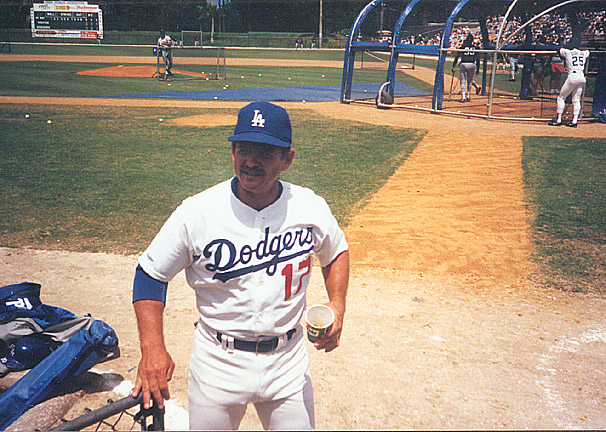
Dempsey (shown there in a picture I took at Vero Beach in 1989) was already a favorite of mine when he came to the Dodgers; his rain-delay antics were legendary and his postseason performances totally clutch (.303/.370/.515 in six series, including the MVP award), so I loved that the Dodgers picked him up as a backup. I always thought of him as the exemplar of the light-hitting, defense-first catcher and am still surprised he never won a Gold Glove despite throwing out 40 percent of baserunners.

I’m even more surprised Dempsey’s not managing a big-league club today. He’s currently the Orioles’ first base coach — one of the team’s few tangible links to the Earl Weaver era — and has served as their third base and bullpen coach as well. He also coached the Dodgers for a couple of years and even managed in their system, winning a PCL title at Albuquerque in 1994. He may well be the heir apparent when Sam Perlozzo finally gets put out of his misery, but c’mon, the guy deserves better than the decrepit franchise the O’s have become.

Speaking of which, my weekly whipping of the O’s is up at Baseball Prospectus, along with the rest of the Hit List.

Clearing the Bases — Junk Drawer Edition

From the junk drawer of my mind…

• The Dodger DVD contest is still on; thus far one of the three sets remains unclaimed, and can still be won for answering this:

Everybody remembers Bob Lemon’s decision to pinch-hit for former Dodger Tommy John in Game Six of the ’81 Series, but what other dubious decision did he make in that series regarding John?

• Alex Belth invited me out to Shea Stadium for Wednesday night’s Mets-Padres tilt, and we were treated to quite a scene. Pedro Martinez was totally in control of the Padres, with one exception. Mike Piazza, playing in his first series at Shea since departing in the offseason, homered twice off of Pedro, who gave up just one other hit in 7.1 innings. Piazza received a standing ovation from the crowd prior to his first at-bat; he even stepped out of the box to doff his helmet before striking out.

As he came up for his second at-bat in the fourth inning, Alex and I were headed to gather some refreshments, but we stopped behind home plate when we realized who was up. On the third pitch of the at-bat, Piazza drilled one to rightfield. Alex had his hand on my shoulder and was jumping up and down like a little kid as soon as the ball left the bat. The Mets still led 4-1, and perhaps with that score not seeming threatening, the crowd not only gave Piazza another standing O, but even a curtain call — as a visiting player. I’ve never seen that before.

Piazza came up again in the sixth, and this time he drilled Pedro’s first pitch over the leftfield wall to cut the score to 4-2. The applause and reaction was considerably less enthusiastic, except where Alex was concerned; again he was jumping up and down as he grabbed my shoulder, like a sugared-up kid. Just before he came up for his final at-bat, with the score 4-3 and two men on, manager Willie Randolph pulled Martinez and replaced him with Aaron Heilman. Piazza, now being booed, nearly jerked Heilman’s first pitch out, instead sending a ball to the left-centerfield warning track as the crowd of about 50,000 held its collective breath.

In the end, the Mets preserved that slim margin. Belth — like any good writer rooting for the story as much as any particular team — wrote up the game for Baseball Prospectus:

Still, for one night, Piazza was the Prince of the City again. He admitted to being nervous before Tuesday’s night’s game, but seemed completely at ease last night. He appeared genuinely humble, smiling easily, at the reception he got. Piazza was clearly touched, if slightly uneasy with all the attention.

“Being on the home field,” he told Jay Greenberg of the New York Post after the game, “the last thing I want to do is show up the other team, but the bottom line is that this game is nothing without the fans. So when they ask you to go, you hope [the Mets] understand. I had so much history with those fans.” It was a virtual Love-In, with one joyous moment after another, and it was endearing to see the locals show their appreciation so effusively.

I’m still shocked that an AL team like the Angels, Blue Jays, or Twins didn’t sign the free agent Piazza to DH and catch occasionally; had the Twins reached out for him instead of the vulture-pecked remains of Rondell White, they’d probably be in the catbird seat vis-à-vis the Wild Card):

         AVG   OBP   SLG  HR RBI
Angels .275 .334 .462 19 69
Twins .284 .336 .389 5 46
Piazza .299 .355 .542 18 51

Consider that Piazza plays in the very pitcher-friendly PetCo Park and has about 100 less at-bats than those two teams’ DH slots, and that the Twins’ stats are distorted by a 23-for-46 (.500) showing from Joe Mauer on his off days from squatting. Even with Mauer, the OPS of Twins’ DHs is 13th out of 14 AL teams. Consider that Piazza signed a one-year, $2 million deal with incentives that will still keep it under $3 mil, and that next year he’s got a mutual option of $8 mil with a $0.75 mil buyout. There are a lot of teams that slept through that while making much worse signings.

• Oh, and thanks to the Mets sweeping the Pads in three games, the Dodgers have retaken first place in the NL West for the first time since June 26. Woohoo!

• Belth, Joe Sheehan, and Steve Goldman each make cameo appearances in Eric Neel’s fine ESPN piece on America’s hatred of Alex Rodriguez, a topic I can’t really find the breath to waste on:

“He’s held to an impossibly high standard,” [Yankee broadcaster Michael] Kay says. “I really believe they expect him to get a hit every time up. The guy gets his temperature taken every single at-bat.”

And he’s found wanting. Every single time. Every single time he collects a check. Every single time Jeter makes a play or Papi goes deep. And every single time he takes his shirt off in the park. It’s all fair game.

What’s often lost in this game is the fact the guy is ridiculously good. Once-in-a-generation good. “He can only be compared with some of the best infielders in baseball history,” Baseball Prospectus’ Joe Sheehan says. “We’re talking about someone who’s already one of the top 25 players ever, and who will probably end up as one of the 10 best.”

Will we ever come around to him? A world championship ring or some dramatic October heroics would go a long way, no doubt. We’ve seen big-time transformations in the past. Before winning his first Wimbledon, Andre Agassi was an image-conscious punk. Until the Bulls beat the Lakers in ’91, Michael Jordan was a me-first highlight reel who didn’t make the players around him better. Not until his Masters victory in 2004 did Phil Mickelson begin to shed his reputation as an empty talent who couldn’t handle the big moment. Before his back-to-back Super Bowl titles, John Elway was a gunslinger who couldn’t truly lead.

But although a ring would put A-Rod in a familiar category, the more interesting, and more likely scenario (the Yankees are an aging, pitching-weak team) is that things continue on the track they’re on now. He’s only 31, and we’ve had Bonds and Clemens to concentrate on these past 10 years, but if A-Rod stays healthy and productive in the years to come, it will become increasingly clear that he is hands-down the best player in the game, and is very likely the best all-around player any of us will ever have the privilege to see in person. Even without a title. Even with what we think is a sensitive heart. Even with what we perceive to be a scripted tongue.

I’m going to skip all of the emotion-based BS surrounding this and simply note the following AL Third Basemen Team Aggregate Stats from ESPN:

RK  TEAM         HR   RBI   BA    OBP   SLG  OPS
1 NY Yankees 23 81 .290 .390 .501 .891
2 Chicago Sox 25 80 .297 .338 .529 .867
3 Kansas City 15 69 .292 .366 .494 .860
4 Toronto 28 88 .256 .355 .498 .853
5 Tampa Bay 18 68 .300 .350 .493 .843
6 Boston 17 60 .285 .342 .491 .833
7 Texas 16 80 .303 .365 .465 .829
8 Detroit 21 63 .256 .313 .478 .791
9 Baltimore 12 65 .286 .355 .407 .763
10 Seattle 13 54 .258 .327 .425 .751
11 Minnesota 7 49 .263 .345 .396 .741
12 LA Angels 12 46 .261 .321 .404 .725
13 Oakland 17 58 .222 .331 .390 .722
14 Cleveland 6 46 .239 .304 .342 .645

In other words, even in a down year, Alex Rodriguez and your mother have combined for the top OPS among AL third basemen by a good 24 points, and they’re among the league leaders in HR and RBI. Also:

NAME            TEAM   MLVr   VORP
Troy Glaus TOR 0.193 29.6
Alex Rodriguez NYA 0.166 27.6
Joe Crede CHA 0.194 25.3
Mark Teahen KCA 0.129 17.4
Nick Punto MIN 0.103 16.9
Mike Lowell BOS 0.056 12.6
Melvin Mora BAL 0.007 11.7
Aubrey Huff TBA 0.066 8.9

A-Rod’s prodction via VORP, while still below his usual standards, is still second-best among AL third basemen, though admittedly, it’s just third according to the per-game Marginal Lineup Value Rate, the number of runs per game a player adds to an otherwise league-average lineup. For the grief Rodriguez is receiving, mainly due to his performances in clutch situations, you’d think he was selling poisoned milk to schoolchildren. The numbers don’t match up to the salary at the moment, but they’re hardly shameful.

• Speaking of emotion-based arguments, more than a week after the trading deadline, people are still talking about Yankee GM Brian Cashman’s beatdown of WFAN mouth Chris “Mad Dog” Russo. Cashman nearly does for Russo what Jon Stewart did for Crossfire: humiliate a total asshole in front of his own audience in devastating fashion and practically raze the whole enterprise.

Cash calls the rabid Russo on his dismissal of Chien-Ming Wang, defends his acquisitions of Bobby Abreu, Kyle Farnsworth, Cory Lidle and other players Russo trashes by calling on good ol’ facts and stats (such as the poor performance of the team’s fifth starters) instead of the emotional “I-just-know” bullshit that Russo traffics. When Russo tries to harangue Cashman over the fact that Abreu’s teams have never won anything, Cashman plays the sainted Don Mattingly card, reminding Russo that his teams never won anything either, and that whatever feelgood stories (Melky Cabrera, Bernie Williams) are swept aside by the deadline moves, the championship is what the Yanks are playing for, dumbass. I can’t imagine Russo actually giving the Yanks a pass, as he says they would have received, without those moves. Somewhere in the future he’d be ranting about how, injuries or no, a $200 million payroll doesn’t excuse not winning.

I’ve said it before: guys like Russo are the polar opposite of the type of analysis Baseball Prospectus — or any reality-based stathead anywhere, really — strives for. A total pleasure to hear him have his ass handed to him. Do not miss hearing this gem (scroll down to July 31).

• Speaking of must-hears and Michael Kay, check out Yankee play-by-play blowhard going off on some caller on his radio show who criticized him for using the words “perfect game” while one was in progress, violating “baseball etiquette.” Kay goes thermonuclear and loses all sense of proportion, invoking slavery, the Nazis (hellooooo, Godwin’s Law), and his own uncertainty about the existence of God (followed by some serious dead air). Amazing.

Blue Movies

The 2006 Dodgers are certainly taking their fans on a rollercoaster ride. Having lost their first 13 out of 14 after the All-Star break, they won 11 straight to nearly even the score before losing last night. Key contributions from deadline acquisitions Greg Maddux (who tossed six no-hit innings in his Dodger debut) and Wilson Betemit (three homers and a .306/.359/.611 line in his first nine games since being traded) have made GM Ned Colletti look pretty smart lately, though that’s balanced out by the lack of wisdom and foresight shown in the Mark Hendrickson trade from late June. All in all, Baseball Prospectus’ Postseason Odds put them at a 50 percent chance of making the playoffs, up from the 43.1 percent cited in this week’s Prospectus Hit List, now up at BP.

If you’ve got the Dodger blues and need a reminder of the good times for a team that’s won just one postseason game in the past 17 years, A&E Home Video and Major League Baseball have teamed up to release a collection of vintage World Series highlight films for the L.A. club’s five World Championships in a snappy two-disc set. Why the team’s lone championship as the Brooklyn Dodgers (1955, of course) isn’t represented here is a very good question, but for the $24.95 this costs at A&E’s online store, it’s still worth the money. Stay tuned and you could even win one of three sets that A&E has provided me.
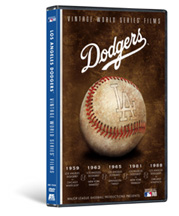

World Series films are a curious genre unto themselves. Slicing and dicing highlight footage from each year into a package of around 40 minutes, they don’t offer the heft or time-machine caliber immersion of catching a game on ESPN Classic, and they certainly don’t bottle up every precious moment of a championship season the way an avid fan would like. But the films do offer a generous supply of nostalgia for those teams — sweet memories of the 1981 and 1988 squads, the two of my lifetime — as well as a window into the times when they were created. And for Dodger fans, the range of favorites covered in these victories from 1959 to 1988 — from Gil Hodges and Duke Snider to Sandy Koufax and Don Drysdale to the Longest Running Infield, Pedro Guerrero and Fernando Valenzuela to Orel Hershiser and Kirk Gibson — simply can’t be beat.

Over the course of the 29 years spanned by this set, we also see the state of the art in covering sports advance rapidly. Take the 1959 footage of the Dodgers battling the White Sox; the Series had only been broadcast in color since 1954, and the footage from this matchup hasn’t aged particularly well. It’s not very sharp, the camera angles are relatively limited, there are no closeups of action, and instant replay hadn’t even debuted; for key plays, the footage (some of which is in slow motion) is just freeze-framed when the ball hits (or misses) a fielder’s glove. Longtime Dodger announcer Vin Scully does the narration, but he hadn’t come into his own yet either. His voice, deeper and less mellifluous than it is now, his tone and pace like that of a generic newsreel narrator. In this early footage, Scully offers very little beyond the play-by-play, often even dispensing with batters’ first names.

None of which is to say that it isn’t still fun to watch. We see plenty of 23-year-olds Drysdale and Koufax working against the Sox, along with some late-career footage of Boys of Summer Hodges, Snider, Carl Furillo, Jim Gilliam and Johnny Podres. This was just the Dodgers’ second season in L.A., the team was still an odd mix between old and new, and Dodger Stadium hadn’t even been built. Instead the Dodgers played in the enormous, awkwardly configured L.A. Coliseum (251 feet down the leftfield line with a 40-foot high screen, and a huge half-circle of foul territory running from pole to backstop), where they set World Series attendance records with crowds of more than 92,000. Hodges, highly underrated second baseman Charlie Neal, and reliever Larry Sherry (who earned two wins and two saves out of the bullpen to garner MVP honors) led the way in the 4-2 Series win. For the Go-GoSox, we get to see the keystone duo of Nellie Fox and Luis Aparicio, sleeveless Ted Kluzewski and beer-soaked Al Smith, who got doused in one of the more memorable World Series photos of all time. At the close of the series footage, a message exhorts the viewer to “See a ball game often. It’s fun and excitement for the entire family!” Wohoo!

By 1963, the presentation in this set is upgraded considerably. Even with footage that’s occasionally noisy, the color is much more vivid, with both legendary Yankee Stadium and still-new Dodger Stadium (which had opened the previous season) looking particularly lush. There’s even instant replay, the new kid on the TV block, but the old freeze-frames are still used as well. Scully is again at the mic, and despite a rather poor audio quality (sounding a few generations removed from the source) his voice has grown more distinctive, his pace a bit more relaxed even if the script carries odd details like him noting the arrival of the colorguard and the pregame umpire huddle.

The Series opens with a for-the-ages matchup between Sandy Koufax and Whitey Ford, with Scully building the tension as Koufax sets a Series record with 15 strikeouts. Packed with 69,000 fans, Yankee Stadium is a star unto itself, the distinctive white facade of the upper deck, the trio of monuments (Babe Ruth, Lou Gehrig, and Miller Huggins) in play, 450 feet deep in centerfield along with the flagpole, with the plaque of GM Ed Barrow looming on the wall behind them. “The Subway Series has gone transcontinental!” remarks Scully as the action shifts to Dodger Stadium, with shots of L.A.’s freeways (oh, the irony!) celebrated as progress, along with the newfangled ballpark. It’s all Dodgers in this series, as they swept the Yanks, holding Mickey Mantle, Roger Maris, Yogi Berra and company to the grand total of four runs. Dodger pitching carried the day, with Koufax hurling two complete games; in the second, we see fantastic slow-motion footage of his delivery. Don Drysdale and Johnny Podres each pitched well, and in fact the Dodgers used just one reliever, Ron Perranoski, for a grand total of 2/3 of an inning in the entire series. The Dodger championship ends on a weird note, the team storming out of the dugout before an ump’s call on a force play at second base is reversed, keeping the Yankees in business for one last out. It hardly mattered.

By the 1965 film, the visuals have improved even more; the colors are even richer, the shots closer and with more variety. But this seven-game epic between the Dodgers and Twins is missing something, namely Games Two and Four, and with a running time of just 31 minutes (the shortest of the bunch by about seven minutes), that’s downright inexcusable. It should be noted that’s the original producer’s fault, not A&E’s — they’re not adding outtakes or even commentary tracks to these films, just batching them together and presenting them in a bare-bones format.

So after the Twins, led by four RBI from MVP shortstop Zoilo Versailles, beat Don Drysdale in Game One in Minnesota, the second game (also won by the Twins) is absent except for the game’s defensive highlight, a diving catch made by Minnesota leftfielder Bob Allison. And after the Dodgers work their way back into the series via a Claude Osteen shutout in Game Three, the Dodgers’ Game Four win (behind Drysdale and a three-RBI day from Ron Fairly) is summarized with a 15-second montage and a couple sentences from Scully. Grrrrr. Nonetheless, when what remains centers around prime Sandy Koufax, it’s tough to complain. As with the absent Game Two, Koufax is paired up with Jim Kaat in both Games Five and Seven. He stifles the Twins on four hits in the former, though perhaps the most memorable footage is of Dodger Willie Davis tripping on the basepaths during a steal attempt and crawling to second base safely. Great comic relief. Still, even with plenty of Koufax in Game Seven — before the game, chatting with reporters and posing for the obligatory photo op with Kaat, then running through the Twins lineup like a hot knife through butter — this is the least satisfying of the batch.

The Yankees are back at the start of the set’s second disc, matching up for the third time in five years in the 1981 World Series. This film starts with a brief montage of the two teams’ highlights from that year’s strike-created, three-tiered playoff system, so even before the opening credits have rolled, we’re treated to Blue Monday, and Reggie Jackson admiring a towering home run. In fact, this film is full of montages which offer plenty of spectacular plays without context or narrative, a common sight now, but still jarring compared to the Al Gore-stiff linearity of the earlier World Series films here. There’s also some of that funky NBC Sports theme music, great period stuff sure to take anyone back to the day. And yes, Vin Scully is still on board.

The 1981 Series featured many of the same characters from the two teams’ 1977 and 1978 matchups: the Longest Running Infield (Steve Garvey, Davey Lopes, Bill Russell and Ron Cey) and Dusty Baker for the Dodgers; Reggie, the fearsome Goose, Ron Guidry, Graig Nettles, and Lou Piniella on the Yankees side, and Tommy John crossing the divide via free agency. Managers Tommy Lasorda and Bob Lemon, a study in contrasts if there ever was one, also return. But this time there’s a difference. After the Dodgers lose the Series’ opening two games in the Bronx (with a few sparkling plays by Nettles conjuring up an ominous sense of déjà vu with its echoes of 1978), they stay alive via a gritty performance from 20-year-old rookie phenom Fernando Valenzuela. The young screwballer tops 140 pitches while allowing 16 baserunners, and while that might not have been in his best long-term interests, it makes for great theater, particularly when a miked Lasorda visits the mound to offer bilingual encouragement straight out of the Slap ‘Em on the Ass School of Pitcher Management, as the Dodgers hang on to win. Amid the comeback, in which the Dodgers took the final four games, we also see Cey getting drilled in the helmet by a fierce Gossage fastball, one of the scariest beanings in World Series history. The only thing missing from this triumph is any mention of George Stienbrenner’s dubious claim of a scuffle with two drunken fans in an L.A. hotel elevator, and his apology to New York fans after the Dodgers clinched on their turf.

In the set’s finale, Scully is joined by NBC cohorts Bob Costas and Joe Garagiola as the team battles the Oakland A’s in the 1988 World Series, the most unlikely of these Dodger championships. If the recent past has colored our view of the A’s, led by Bash Brothers Jose Canseco and Mark McGwire, as juiced-up wonders, then it’s only fair to admit that after watching this, one comes away with the sense that the Dodgers weren’t skimping on the pharmaceuticals either. They look greenied to the gills from the moment Steve Sax, after getting drilled in the back by fearsome A’s hurler Dave Stewart, sprints to first base in the home half of Game One’s first inning. Indeed, what looked like a mismatch on paper between the heavily favored A’s and the underdog Dodgers turns out to be one going in the opposite direction because of the super-energized play of Dodger scrubs such as Mickey Hatcher (who runs the bases with abandon, arms aloft, after homering) covering for the absence of injured Kirk Gibson.

But the Dodgers couldn’t have won without Hershiser, who after tossing a record 59 scoreless innings to close the regular season, yielded just five runs in 42.2 postseason frames. Hershiser’s memorable save out of the bullpen in the League Championship Series is featured here (along with my favorite Dodger home run of the season, Mike Scioscia’s game-tying ninth-inning dinger off of Dwight Gooden) prior to footage of the series proper. Before we get to see him continue his dominance, we get one of the most memorable moments in World Series history, Gibson’s game-winning pinch-homer off of Dennis Eckersley. Nearly every pitch of the at-bat is here, along with intercut talking-head clips of Lasorda and Gibson, and of course Scully’s classic call. It simply doesn’t get any better.

Hershiser’s talking-head clip, discussing his Game Two pitching, hitting, and aggressive baserunning as the highlights intercut, is a real hoot; he looks like a grown-up Opie, but on the mound he’s all business as he clamps down on the A’s. Even with Oakland taking Game Three on a McGwire walkoff and the final two games decided by a total of four runs, this Series wasn’t even close. Willed on by the ebullient Lasorda, guys like Hatcher, Mike Davis, John Shelby and Franklin Stubbs (nearly justifying six years of disappointment as a Dodger with a 5-for-17 performance) ran roughshod over Tony LaRussa’s smug superstars in five games, even as Scully and Costas marvelled at the Dodger lineup’s obvious weakness.

Amid the rout are two nice featurettes which round out this film to about an hour, by far the longest in the set. The first flashes back to the two teams’ prior World Series meeting in 1974; we see a green-and-gold Reggie and Rollie Fingers along with a youthful (and equally ebullient) Lasorda, then the Dodger third-base coach, and one hell of a throw by Dodger rightfielder Joe Ferguson to kill a run at the plate. The second is a memorable three-minute tribute to director Harry Coyle, a 36-year-veteran of the World Series at the controls for his final Fall Classic. The segment flashes back to such Coyle-directed moments as Billy Martin’s famous grab of Jackie Robinson’s bases-loaded pop-up in Game Seven of the 1952 World Series, Carlton Fisk’s home run, Bill Buckner’s error and Gibson’s homer.

Such touches make this by far the most accomplished of the World Series films here, and help the set wrap on the highest of notes. There’s really no better way to soak up so many great Dodger moments across the eras than these two discs.

• • •

Now, as for the the chance to win one of these sets, please email answers to the following. The first correct answer to each question wins a set.

1. Several Dodgers won multiple World Series rings as a member of the club, but only one player appeared in four of the team’s winning World Series. Who is he?

2. Everybody remembers Bob Lemon’s decision to pinch-hit for former Dodger Tommy John in Game Six of the ’81 Series, but what other dubious decision did he make in that series regarding John?

3. Which former World Series MVP comes off the bench to play a key role in one of these World Championships?

I’ll be back with a review and similar promotion of a five-disc Yankee World Series set, hopefully next week.

Clara Gottfried Jaffe (1912-2006)

This week’s Trading Deadline Extravaganza Hit List is up at Baseball Prospectus. Rather than delve into its baseball content — it’s all free there, if you care to read it — I’ll skip to the dedication at the bottom:


This week’s column is dedicated to the loving memory of Clara Gottfried Jaffe (11/2/1912-8/1/2006), wife, mother, grandmother and so much more to three generations of baseball fans

My paternal grandmother — the last of my surviving grandparents — passed away in the early hours of Monday morning in Walla Walla, Washington. She was 93, and her death wasn’t a surprise; my family had been bracing me for this inevitability for about a month. She’d been moved to the “maximum security” portion of her assisted living facility, had stopped taking her medication, and “wasn’t really there.” So it goes.

My grandmother led a remarkable life, and I spent a good deal of time on Monday revisiting that via a taped interview I did with her from 2003. She was born in 1912 in Buchach, Ukranian Galicia, a region that was at the time part of the Austro-Hungarian Empire, but at the end of World War I became part of Poland. At that point, her family — she was the only child — took her to Vienna, where she grew up and got her education. She graduated from the University of Vienna School of Medicine in 1937, a year ahead of my grandfather, Bernard Jaffe.

Bernard, a graduate of the University of Maryland, had saved up money working as a pharmacist and hustling pool in Baltimore to attend medical school, a remarkable story in and of itself. Unable to afford the exorbitant cost of attending med school stateside and stymied by the quota system which limited the number of Jews, he managed to start his studies in — of all places — Hitler’s Germany, at the University of Göttering. He didn’t know German when he came over, but he learned the language by reading newspapers and walking the streets. He somehow managed to wrangle a ticket to the 1936 Olympics in Berlin, where he saw Jesse Owens show up Hitler by winning four gold medals.

After a year at Göttering, he was advised to leave, and he transferred to the University of Vienna. The story goes that he met Clara (who was a year ahead of him) one Saturday night while she was studying for an exam in a coffee house; he was playing pool, saw and recognized her, and offered to walk her home. They married in Vienna on March 29, 1938, and with the situation there worsening vis-à-vis the Nazis, began planning their exit. When he finished his studies, Bernard didn’t even wait around to receive his diploma; a classmate named Dr. Samuel Schoenberg picked it up along with his own, and escaped by walking over the Alps into Switzerland.

A cousin of Clara’s father named Marcus Helitzer had come over to Austria to help her obtain a visa to travel to the U.S.; the visa was granted when he opened an American bank account in her name with $1,000. They booked passage on a ship and arrived in the U.S. on July 15, 1938. But Clara never saw her parents again. Her father, Lazar Gottfried, who worked in the wheat industry, was stuck in Romania when the Russians occupied it. Clara recalls that the last time she saw her dad, it was when he’d come home to spend Passover: “It was my intuition. I ran to the window, called his name, waved to him. He turned back and waved, and that was the last time we saw each other.”

Declared an enemy alien, Lazar went into hiding, but was pinched when he got fed up with his confinement and went out for a pack of cigarettes. He is believed to have died in a labor camp. They managed to obtain a visa for her mother, Josephine Fenster Gottfried, and bought her a ticket on an Italian ship, but when Mussolini and Hitler strengthened their ties the ship’s voyage was cancelled, and alternate plans fell through as well. She was still in Vienna during Kristalnacht, and was eventually sent to a concentration camp. She perished in the Holocaust, as did nearly all of my grandmother’s relatives.

Stateside, my grandparents settled in New York City. Bernard got an internship at Brooklyn Lutheran Hospital (and continued his affair with the Dodgers, which had begun, so the story goes, when he saw Babe Herman get hit on the head with a fly ball). He lived on hospital grounds while Clara lived out on Long Island with the Helitzers, and they saw each other on weekends. She got a job working as the physician for a girls’ camp in Liberty, NY, and soon earned enough money to get an apartment of her own on 86th street. He entered the Army Reserves in 1939, and she took over his internship, having passed her medical boards in April. She credits this to her partially photographic memory which allowed her to visualize and remember her texts.

When Clara completed her internship, Bernard asked her to join him down in Asheville, North Caroina, where he was the physician at a Civil Conservation Corps base. In those uncertain times, he wanted her to settle down. “I enjoyed medicine,” she recalled. “I was good at it, I had a potential, I was pretty smart, and I had a good memory. But I was an old-fashioned girl in those days. Marriage came first, and when he could make a living, I decided I should follow him.”

He got his first position in Hot Springs, NC, outside of Asheville. When the Reserves called him up for active duty, he failed his physical. The story goes that he’d been playing tennis (he was a hell of an athlete, and was said to have been offered a pro baseball contract by the Washington Senators) and not having a car, had to run several miles to the offices. When he arrived, he was sweating profusely. The doctor asked if this happened often, and when he said yes, the doctor feared he had a cyst. He was turned down for active duty and sent to Augusta to train for the Veterans Adminstration hospital. There, my father was born in 1941.

They bounced around — the life of an Army doctor — and finally settled in the farming town of Walla Walla, Washington in 1944; they had another son, Bob, in 1946. While my grandmother adapted to life as a homemaker, m grandfather made his practice as an otolaryngologist (ear, nose and throat doctor), and practiced at the VA hospital there until his retirement in 1973. Upon leaving the VA grounds, they bought a house at 1966 Scarpelli, and lived out the rest of his life there; he passed away in November 2000.

I spent many a wonderful summer day with my grandparents, who came to be known as Nan and Pop. They would come down to Salt Lake City, and after a visit of about a week, they’d drive us back to Walla Walla; he’d do the whole thing in one 12-hour day, and we’d stop for dinner at Sizzler about an hour or so outside of town. We’d stay in Walla Walla, sometimes for as long as three weeks, then my parents would meet us there or we’d rendezvous at a family reunion on the Oregon coast or at the Black Butte Ranch near Sisters, Oregon.

While at my grandparents’ house, my brother and I were in baseball immersion camp. Pop found time to play with us every day, pitching from behind home plate as we’d smack balls, five a turn, into a backstop where one rung meant a single, two a double, three a triple, and over the backstop a home run. We’d also play catch in his endless backyard; he’d throw long balls and we’d chase after them, laying out for “spectacular catches,” the name we gave that particular drill. We’d play in his huge garden; while he would spend endless hours picking enormous raspberries (which Nan would turn into delicious jams), we’d throw the various fallen fruits and vegetables into an oversized barrel of dirt and compost which we called “elephant stew.” In the evening we’d watch baseball on his new-fangled cable TV system, which included the fledgling ESPN station. Nan was just as much a part of those endless summer days, feeding us, taking us to the swimming pool or to rendezvous with her friends’ grandchildren, indulging us with shopping trips for toys and baseball cards, joining us on the golf course (though when I grew frustrated with the game, I usurped her cart-driving duties), and making sure we spent time reading. Both of my grandparents were avid readers and firm believers in intellectual pursuits.

In retrospect, I realize how lucky my brother and I were to share so much time with my grandparents; my cousins, who are five and seven years younger and lived much closer in Seattle, didn’t get the same mass quantity of quality time, didn’t know them in the same way. I’ve written before about Pop’s impact on my love of baseball and the Dodgers, but Nan figures into the story as well. I inherited her near-photographic memory, and it’s served me well in my baseball fandom when it comes to remembering stats or recalling where I read something.

Pop’s hearing seriously declined in the last decade of his life and he never really adjusted to wearing a hearing aid, often turning the damn thing off and missing out on a lot of conversation. The same thing eventually happened to Nan, I think, but she retained her mental acuity well into her nineties, and up until a couple years ago, we could still carry on a lengthy conversation. She was a sharp, funny woman, with a strong sense of what was right and wrong in the world.

Pop had always discouraged Nan from talking much about her life before coming to the U.S. because it would upset her so, and it wasn’t until his passing that we finally got the full story of their escape from Vienna and the fate of her parents. She had come down to Salt Lake over Labor Day weekend when I was there, and at some point, said she wanted to “tell it all.” I didn’t give her much chance to reconsider, running out to buy a microcassette recorder even when I had two sitting in my desk drawer back in New York City. I interviewed her for about an hour, and while we occasionally had to pause for some chronological corrections from my dad, we got her amazing story in about as much detail as we ever would. I’m incredibly grateful for that, and extremely proud that she was able to pass it on — even moreso as I prepare to say goodbye to her.

So long, Nan, and thank you for all of the wonderful years you gave us. We love you and will miss you, and we’ll always remember you.

Slam Dunk

Nothing to say but WOW as to the Yankees’ acquisition of Bobby Abreu and Cory Lidle from the Phillies for four Yankee minor leaguers, none of them top-shelf,, the most familiar of which are C.J. Henry, the team’s #1 pick in 2005, and 27-year-old LOOGY Matt Smith, who hadn’t allowed a run in 12 innings while riding the Columbus shuttle eleventeen times. For whatever his power outage — he hasn’t homered since June 13 and has just eight on the year — Abreu carries a career .412 OBP (31 points higher than Bernie Williams, the man whose at-bats he’ll be usurping in the short term). That will fit in marvelously with the Yankee offense, no matter what kind of logjam it creates when (if?) Hideki Matsui and Gary Sheffield return (the latter can kiss his chances of having his option picked up by the Yanks goodbye, but that’s a story for another day).

The real slam dunk for the Yanks is that they dodged having to pick up Abreu’s $16 million option for 2008, something Abreu’s agent said would likely be necessary to waive his no-trade clause. The Phillies bought out Abreu’s no-trade for the meager sum of $1.5 million, with the understanding that the Yanks aren’t picking up the option and will instead pay his $2 million buyout. Pennies on the dollar, kids.

The other major facet of this trade is that no matter how mediocre Cory Lidle is (and he’s the dictionary definition), he’s replacing a four-headed hydra of Sidney Ponson, Shawn Chacon, Kris Wilson, and Aaron Small who allowed 38 runs in 30 innings over eight starts in June and July. That’s less than four innings a start, a lot of mopup for a bullpen that’s often had to turn to whichever of these guys hadn’t already blown them out of the game, with similarly harrowing results.

A few quick takes from my Baseball Prospectus colleagues with whom I’ve been discussing this deal over the past day:

Nate Silver ran through various permutations matching up several teams with the potential acquisitions of Alfonso Soriano, Carlos Lee and Abreu to see which ones improved which team’s Postseason Odds the most (nice visuals of the day-by-day Odds change by a BP fan here). Conclusion: the Yanks’ addition of Abreu was a 14.2% upgrade — the largest bump possible of the 21 scenarios he evaluated (he neglected to include Texas, whose chances with Lee must have jumped 10-12 percent) and that’s without considering the effect of Lidle.

Christina Kahrl:

Similarly, the rotation finally has a fifth man who doesn’t automatically make you wonder who’s available for a multi-inning middle-relief gig. Consider the combined performances of Shawn Chacon, Sidney Ponson, Aaron Small and Kris Wilson:
Pitcher   GS Tm W/L    IP   H  BB   K HR   R   R/9 QS
Chacon 11 5-6 52.0 62 30 28 8 42 7.3 3 (none after May 6)
Small 3 1-2 12.0 23 4 6 6 13 9.7 0
Ponson 2 1-1 9.0 10 6 10 3 10 10.0 0
K.Wilson 1 0-1 2.2 5 2 4 1 3 10.1 0
TOTAL 17 7-10 75.2 100 42 48 18 68 8.1 3
Lidle 21 10-11 125.1 132 39 98 19 74 5.3 14

That’s three games that Chacon provided that most teams with a normal offense can win, none since May 6. Now, admittedly, I’m fudging something with Lidle, in that I’m counting two more quality starts than other sources, but that’s because he lost two quality starts in the seventh inning, after he’d already given the Phillies the standard six innings while allowing three or fewer runs. (I refer to those as Blown Quality Starts, or BQS, probably my first and only contribution to the universe’s statistical alphabet soup.) So, to give Lidle his due, the man has pitched winnable ballgames in two-thirds of his starts despite having a hitters’ park as his home, and despite having to pitch 13 of his 21 starts in said bandbox. Now, even if he’s “just” a six-inning starter, and even if he’s just a 75-pitch starter, he’s giving his team outings they can work with to win. Sure, he’ll have to face the DH instead of the pitcher’s slot, and he’ll probably also have to face the Yankees’ tough opponents in the East. Even so, he won’t be pitching in Philadelphia. As long as somebody gives Joe Torre a good set of instructions on how to operate his shiny pre-owned fifth starter, the Yankees have themselves a major upgrade in the rotation that’s almost as significant as Abreu will be in the lineup.

My WAG? The Yankees probably just added four wins in the final 60 games, with Lidle probably being every bit as responsible for that as Abreu. That’s not just an upgrade, that’s a massive difference, and a reflection on what’s being replaced. This doesn’t simply help the Yankees keep up with the competition, they now have a much better shot at winning not merely the wild card, but their own division, and they can better withstand an injury in either their rotation or lineup than before.

Joe Sheehan:

It’s more apparent what this deal does for the Yankees: it scares the hell out of the Red Sox. Set aside Abreu’s power outage and Lidle’s averageness, and consider the playing time the two will be assuming. Aaron Guiel (.214/.290/.536) and Andy Phillips (.242/.276/.406) will be sitting down so that Abreu’s .277/.427/.434 can play, with Bernie Williams (.280/.326/.428) losing some playing time now and the rest when Hideki Matsui returns. It’s 100-150 points of OBP; if Abreu doesn’t hit another homer and plays right field like Jim Leyland after two packs, he’s still worth two wins between now and October.

It breaks my heart to say this—I’m the guy who calls the 1996-2000 Yankees not the “Derek Jeter” teams but the “Bernie Williams” ones—but Williams isn’t a useful player any longer, recent hot streak notwithstanding. I was wrong about his career path; if you look in the BP annuals, you’ll see frequent references to how Williams could add power late in his career, especially once he left center field. That never happened; Williams just dropped off at 34 and then again at 36, and he’s now not even an adequate extra outfielder. Objectively, Guiel—with lefty sock and good corner defense—has more on-field value to this team. That’s not how it will play out, but it’s a damning criticism of the player Williams is today.

…All through July, I stood to the idea that the Yankees wouldn’t be able to make a major acquisition because Brian Cashman was committed to keeping Philip Hughes and Jose Tabata in the organization. Without those guys as chips, I didn’t see the Yankees as having enough to acquire a player like Abreu, especially with teams like the Dodgers and Angels, with deep farm systems, on the prowl. Well, Cashman did it, and he didn’t even trade away the next group of guys, like Steven White or Eric Duncan. Instead, he leveraged the Yankees’ cash reserves and negotiated a terrific deal for his team, one that should make them a favorite to reach the playoffs for the 12th straight season.

Mmmm-mmmm, good.

• • •

Meanwhile, held over from Friday due to the Floyd Landis doping scandal is my latest piece at the New York Sun, which examines the MVP races as the season’s 2/3 mark approaches, using BP’s Wins Above Replacement Player and Win Expectancy metrics to sort out the real impact players. The conclusion? In the NL, it’s Albert Pujols (7.7 WARP and a league best 6.81 Wins Added), with Carlos Beltran (6.9 WARP prior to yesterday’s grand slam — his third of the month — and a distant 10th at 2.48 Wins Added) and Brandon Webb — that’s right, a pitcher — at 6.7 WARP and 5.78 Wins Added (via Support Neutral Lineup Adjusted Value Above Replacement, the awkwardly-named pitching counterpart). In the AL, it’s the year of the pitcher:

n the AL, the MVP award is up for grabs, and if WARP rankings are taken to heart, the field is dominated by pitching. Hurlers on contenders occupy six of the top seven spots; the Twins’ Francisco Liriano (7.4) and Johan Santana (7.3) lead the pack, followed by Boston’s Jonathan Papelbon (6.6), who like Liriano is a rookie.Leading the WARP chase among hitters is Cleveland’s Grady Sizemore (6.0), but with the Indians — a hip preseason pick to win the AL Central after a near-miss last year — now 12 games under .500 and 25.5 out, he doesn’t belong in this MVP discussion. A hair behind him is among hitters is the Twins’ Joe Mauer (5.9). He’s hitting .371/.443/.525, topping the league in batting average and helping his team charge into the Wild-Card picture with a 42–19 record since May 19. Not coincidentally, that date marks when Liriano, who leads the league in ERA at 1.96, entered the rotation.

…No MVP discussion is complete without Boston’s David Ortiz, who leads the majors with 35 homers thanks to a spree of 17 in his last 36 games. Ortiz, runner-up to Alex Rodriguez in last year’s MVP voting, weighs in at an unremarkable 4.6 WARP; as a DH, he’s not adding any defensive value. But true to his reputation as a clutch hitter, he leads the AL in Win Expectancy Added with 4.15, well ahead of closest pursuers Jeter (3.40) and Dye (3.28), not to mention Mauer (2.53). Pitchers Papelbon (5.86) and Santana (5.27) trump that total, however, as do fellow hurlers Justin Verlander (5.22 from yet another rookie) and Roy Halladay (4.65).

You can check the rest of the piece here (PDF). I’ll have more commentary on deadline deals tomorrow; for now, the Hit List awaits.

JAWS bites ESPN

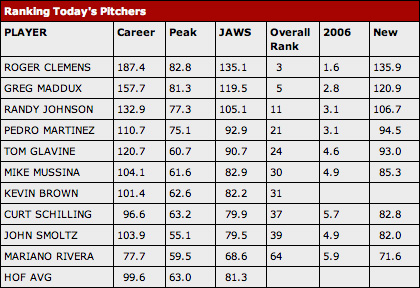
A big welcome to those of you reaching this site from ESPN, where Jonah Keri (in his new digs at Page 2) used the Jaffe WARP Score methodology in a piece today to examine the Hall of Fame cases of John Smoltz and Curt Schilling. Even better, Keri gave extensive play to JAWS’ take on several other active pitchers, and generously included a link to this site.

A Baseball Prospectus metric called JAWS tries to fill the breach. An acronym for Jaffe WARP Score — named by its creator, Jay Jaffe — JAWS measures a player’s combination of career and peak production against those of Hall of Famers at his position. By this method, peak is defined as a player’s seven best seasons according to another BP stat, Wins Above Replacement Player (WARP). The player’s JAWS score, then, is a simple average of those seven peak seasons and his career WARP total.

WARP is itself a measure of a player’s offensive, defensive and/or pitching contribution above what a freely-available minor leaguer or bench player could produce. With the Hall of Fame’s ranks diluted by dubious Veterans Committee selections, the goal of JAWS is to identify players who would be above-average Hall of Famers. They help raise the bar for future generations. There’s plenty that JAWS doesn’t consider — awards, postseason play, hitting or pitching milestones, league-leading totals, and character among them. But JAWS does a good job of weighing the meat-and-potatoes contributions of each player in a Cooperstown context.

JAWS is expressed as the total number of wins a player contributes above your typical scrub. Strip out batting average, ERA, OPS and every other stat and you’re drilling down to the core of a player’s value: how many ballgames he wins for his team.

The average Hall of Fame pitcher accumulated 99.6 career WARP and 63.0 peak WARP (an average of 9.0 per year), for a JAWS score of 81.3, or 81.3 wins more than your typical Gerald Williams-type player. Before this year, both Schilling and Smoltz were closing in on that level. Schilling stood at 96.6 career/63.2 peak/79.9 JAWS, Smoltz at 103.9/55.1/79.5. Those aren’t the top scores among active and recently-retired pitchers (those who have yet to appear on a Hall of Fame ballot). Schilling and Smoltz rank eighth and ninth among active pitchers, and 37th and 39th all-time.

But with good 2006 seasons to date under their belt, both Schilling and Smoltz have crossed the gauntlet. If the season ended today, Schilling would wind up at 82.8, Smoltz at 82.0, clearing the 81.3 threshold for the average Hall of Fame pitcher. Both Smoltz and Schilling are also within a couple of wins of placing this season among their seven best of all-time, which would further enhance their candidacies by elevating their peak scores.

Among the other cool things about the piece — besides the fact that it marks my first time my name has been on the ESPN site, which is a thrill even given how critical I am of the so-called “Worldwide Leader in Sports” — is that Clay Davenport supplied me with a fresh set of WARP data to recalculate the JAWS scores, something I’ve wanted to do for a few months now (just about every article I’ve mentioned JAWS it’s been with the caveat that the numbers are slightly outdated). I recalibrated pitchers for this, and I’ll be getting some new scores together so that anyone who wants can see the updated scores for the other positions.

I also supplied Keri with this Top 10 of active pitchers:

Note that the besides Schilling and Smoltz, the JAWS scores of some of these pitchers will increase even more if their 2006 totals wind up among their seven; in fact, here’s where the bar lies for each of them:


Clemens 10.7
Maddux 10.1
Johnson 10.3
Martinez 8.2
Glaving 7.2
Mussina 7.6
Brown 7.9
Schilling 6.9
Smoltz 6.5
Rivera 7.3

Schilling (1.2 wins shy), Rivera (1.4) and Smoltz (1.6) would seem to have the best shots at bettering their cases; at the very least they will knock Brown down to ninth on this list with one more solid start from Smoltz.

Anyway, thanks to Jonah for inviting me to contribute to his piece, and thanks to Clay for his fine work with WARP and all of the other BP stats that make JAWS possible.

Reynolds Rap

Harold Reynolds is out at ESPN, fired after 11 years. If the rumors are true, the reasons may be rather unsavory. I bring this up not to dwell on the speculation, to fan the flames, or to mourn the passing of an era. Frankly, though I kind of enjoyed Reynolds’ squeaky on-air persona (and his presence in some pretty entertaining promos), I found his analysis — when it extended beyond the mechanics of playing — pretty crap.

In fact, I stopped caring about the entire Baseball Tonight franchise the last time I endured one of Reynolds’ rants a little more than two years ago, one about how overrated on-base percentage is. That rant spurred one of my all-time favorite posts here, called “The Flat Earth Society.” So today I’m amused and surprised to find that said post currently ranks second on seach.msn.com for “harold reynolds fired” despite the fact that it has nothing to do with the current news cycle. Anyway, welcome to you readers coming here via that link; I hope you find reasons to stick around despite my crass exploitation of this little traffic bubble.

Jay Tee Vee Too

I haven’t seen the results (they air Friday evening, when I’ll be on an airplane) but my second NESN appearance on the Boston Globe’s SportsPlus certainly felt like a success. I was on for one nine-minute roundtable-style segment with fill-in host Eric Frede and Boston Globe columnist Nick Cafardo; last time I did three shorter segments one-on-one with host Bob Neumeier, who’s currently covering the Tour de France. This time around, I felt more comfortable; no deer-in-headlight moments, no endless rambles, no trying to work the definition of “Monte Carlo simulation” into my final 30 seconds. The conversation felt natural, with both Frede and Cafardo giving me room to answer questions in detail. If I had a regret, it’s that the other 45 minutes I enjoyed talking baseball with the two of them and producer Alan Miller leading up to the show didn’t make it on; it was fun swapping perspectives.

There’s a dark irony that I have to travel all the way up to Boston, to the “enemy territory” of the Red Sox network to get on TV, when Steve Goldman can’t even crack the YES studio despite being the most talented writer covering the Yankees anywhere. But really, that’s nothing new. The John Henry/Theo Epstein regime has, by virtue of its success and the very visible employment of Bill James, created an audience that’s receptive to the likes of Baseball Prospectus, and this isn’t the first time I’ve benefitted from that.

Anyway, on the air I was able to make a good number of the points which I’d researched the day before. But some of the more interesting stuff got swept aside, so for the benefit of those interested Sox and Yankee fans, I decided to present my outline here. All stats through Tuesday unless indicated.

Part I: Red Sox vs. Good Teams — the Red Sox simply haven’t been very strong against other quality AL teams.

• BOS vs. .500+ AL teams (CWS, DET, MIN, NYY, OAK, TEX, TOR): 18-24 (.429)

• NYY vs. .500+ AL teams (BOS, CWS, DET, LAA, MIN, NYY, OAK, TEX, TOR): 24-20 (.545)

• Boston went 16-2 vs. NL in interleague play. Against AL they’re only 40-34 (.541). Take out Baltimore (8-1) and they’re 32-33 (.492)

• NYY went 10-8 vs. NL. Against the AL, they’re 45-28 (.616)

Part II. Coco Crisp vs. Kevin Youkilis in the leadoff spot

• When the Sox lost Johnny Damon, they traded for Coco Crisp with the idea that he’d be their leadoff hitter. But after a broken finger sidelined Crisp in the first week of the season, the team moved Kevin Youkilis there. They restored Crisp to the leadoff spot when he returned six weeks later, but when he struggled there, they returned to the Youkilis leadoff lineup.

• Here are their stats leading off and elsewhere in the lineup:

#1          PA    AVG    OBP    SLG   BB/PA   K/PA    R/G
Crisp 107 .242 .299 .303 .075 .187 5.14
Youkilis 322 .287 .391 .451 .140 .171 5.82

Elsewhere PA AVG OBP SLG BB/PA K/PA
Crisp 111 .304 .360 .490 .081 .127
Youkilis 88 .286 .409 .443 .136 .193

• Youkilis doesn’t fit the profile of a leadoff hitter; i.e., he’s not fast, whereas Crisp is. But Youkilils has been getting on base at a considerably better clip than Crisp, and the team has been scoring considerably more runs with him atop the order. He’s shown more power and more patience, and he’s even got five steals to Crisp’s nine. Overall, he’s a Wade Boggs-type leadoff hitter, and the benefits of having a guy like that at the top of the lineup far outweigh the costs.

• Crisp has hit well lower in the lineup; he may be pressing out of the leadoff spot (note increased K rate as well as depressed rate stats), and he may still be dealing with issues related to his broken left index finger.

• The Sox got off to a good start with Youkilis in the leadoff spot; they struggled a bit (6-7) since going back to that because Youkilis has struggled (.137 in July), but they’ve done a nice job of sticking with this plan overall despite its relatively unorthodox nature.

Part III: Why are the Yankees ahead of the Red Sox in postseason odds? [note: not anymore, since the Yanks lost two straight]

• The reason is that the Sox aren’t outscoring their opponents by nearly as wide a margin as the other three teams at the top of the AL East playoff chase; particularly, the margin is only about 2/3 what the Yanks’ is.

Team       --PLAYOFF ODDS--   -RUNS PER GAME--
Div WC TOT RS RA Dif
Tigers 71.5 18.3 89.8 5.25 3.80 1.45
Yanks 52.1 14.6 66.7 5.67 4.70 0.98
White Sox 26.7 37.5 63.9 5.85 4.85 1.00
Red Sox 40.2 17.4 57.6 5.57 4.90 0.67

• However, the remaining schedules of the Red Sox and Yankees suggest that the Sox may have a considerable advantage:

Remaining (thru Tuesday 7/18):
BOS: 38 home, 32 road; NYY: 34 home, 39 road

Strength of Remaining Schedule: BOS: .506; NYY: .513

Games vs. .500+ Teams:

Bos: 1 TEX, 3 ANA, 3 DET, 5 NYY, 4 TOR, 3 CHW, 3 MIN
6 @ OAK, 3 @ ANA, 4 @ NYY, 4 @ TOR
TOTAL 39 (22 H, 17 R)

NYY: 6 TOR, 4 ANA, 3 DET, 3 MIN, 4 BOS
7 @ TOR, 3 @ TEX, 3 @ CHW, 3 @ ANA, 5 @ BOS
TOTAL 41 (20 H, 21 R)

Key differences:

• NYY has 13 games left vs. TOR, BOS has only 7
• NYY closes season vs. TOR, BOS closes season vs. BAL
• NYY travels to CWS, BOS hosts CWS
• NYY travels to TEX for 3, BOS hosts TEX for 1 makeup
• BOS has one more home game than Yanks in head-to-head
• BOS has two West Coast roadtrips, NYY has one

Part IV: Statistical comparisons

• Starting pitching: slight edge to the Yanks but both need help; these rotations are only three deep in terms of above-average pitchers at the moment.

       BOS    NYY
ERA 4.53 4.27
7th 4th-T (AL rankings)

RA+ 102 104
9th 4th

Adjusting for park and ignoring the relatively trifling distinction between earned and unearned runs (on a team level, they’re still runs allowed), the Yanks are allowing runs at a rate four percent better than league average, the Red Sox two percent better than league average (100 = average).

SNLVAR  9.5   10.0
9th 5th

Support-Neutral Lineup-Adjusted Value Above Replacement (SNLVAR) is an insane mouthful as an acronym, but what it expresses is the number of wins above replacement level added by a starter’s performance given league-average offensive and bullpen support.

EWP   .457    .491
12th 10th

Expected Winning Percentage for the rotation based on how often a pitcher with the same innings pitched and runs allowed in each individual game earned a win or loss historically.

VORP  114.3  121.2   (total staff)
9th 4th

• Relief pitching: thanks to Papelbon’s incredible performance here, the Sox pen looks pretty good — one of the best in the league, in fact — but who knows when the bubble (3 ER in 49 IP) will burst?

WXRL  7.616   5.381
3rd 9th

ARP 19.3 22.5
8th 7th

FRA 4.95 4.77
8th 5th

Adjusted Runs Prevented (ARP) is a measure of the number of runs a relief pitcher prevented compared to an average pitcher, given the Base/Out state (the combination of runners on base and the number of outs) for which he entered and left each game (adjusted for park and league). In other words, it uses play-by-play data to assess the responsibility for fractional runs prevented based on the run expectancy of a given situation, instead of charging the runs scored by inherited runners solely to the previous pitcher. Fair Run Average (FRA) is ARP’s cousin; it uses those fractional runs (due to letting inherited runners score) to recalibrate a reliever’s “true” ERA.

The Yanks have a slight advantage in these numbers, but that’s negated by the fact that the Red Sox have pitched better when the stakes are higher, which is what WXRL (Reliever Expected Wins Added) reflects. WXRL measures win expectancy based on the game state (inning, score margin, baserunners, outs); it combines the ability to assess fractional runs with the context of how close the game is. Jonathan Papelbon leads the majors in WXRL with 5.113, nearly a full win ahead of the next pitcher, BJ Ryan. Setup man Mike Timlin is 15th at 1.919, and Manny Delcarmen is 22nd at 1.060. For the Yanks, Mariano Rivera is 7th at 3.397, but their next-best pitcher is Ron Villone at #27 (.935), followed closely by Kyle Farnsworth at #29 (.929) and Mike Myers (30th at .910). Dragging the Sox down are Rudy Seanez (-1.019) and Julian Tavarez (-0.553).

• Offense: slight edge to Yankees, mainly in converting offensive events to actual runs. When they get Matsui and perhaps Sheffield back, margin could widen unless Sox improve (Crisp and Varitek in particular) or make trade.

        BOS    NYY
R/G 5.57 5.67
3rd 2nd

Actual 506 509
Proj. 524 505
Dif. -18 +4

The Sox haven’t been as efficient in scoring runs, they’re nearly two wins short of their projected totals.

EqA    .281   .283  
4th 3rd

Equivalent Average is a measure of total offensive value per out, expressed on a batting average-like scale and adjusted for park and league scoring levels and quality of competition.

VORP  157.6  167.8
5th 4th

Outside of the playoff odds, I’m not sure any of the Prospectus-brand stats actually made it into the conversation, but the discussion was certainly informed by it, and some of that stuff will probably be used in the graphics for the show. The one additional point I made was that the Sox have done a nice job of working their youngsters (Delcarmen, Papelbon, Jon Lester, Craig Hansen) into their staff when injuries and ineffectiveness have left them no better options, and the kids have delivered, with Papelbon and Lester doing so big-time (Lester’s combined one-hitter against the Royals the previous night had the green room buzzing). Anyway, those of you with interest in this will hopefully get to see it on NESN when it airs Friday and Saturday at 5:30 PM Eastern, or when the segment goes up on the SportsPlus site. Special thanks to Alan Miller for inviting me back, to Baseball Prospectus for picking up the tab, and to Nick Stone for standing by with stat updates while I was in transit.

Doner Than a Pot Roast in a Burning Whorehouse

My latest chat at Baseball Prospectus went two-and-a-half hours, neither my longest nor my most prolific. Frankly, given all of my travels this week (roundtrip to Boston in a day and a cross-country weekend trip looming), I was pretty cooked. It would have been my preference to reschedule. I didn’t have quite my usual joie de vivre or my arsenal of Simpsons jokes (I even passed up a Simpsons question, now that I think about it. D’oh!) — but I took the ball when it was handed to me, got to re-recycle my favorite Scribbly Tate quote (“doner than a pot roast in a burning whorehouse”), and in the end it was pretty damn fun. There are far worse ways to kill a couple hours than talking baseball with BP readers.

The chat featured a ton of JAWS questions; I had 10 JAWS-related answers and still left another 10 questions of similar nature in the queue. A few of my better exchanges of the non-JAWS nature:

thecoolerking (New York, NY): Considering how often one hear’s TINSTAAPP around these parts, I was pretty surprised that to hear Felix Hernandez anointed the “King” after half a season. What gives? I only saw him pitch once, but I saw a guy with awful mechanics who had some trouble locating his pitches. A serious talent, sure, but raw enough to make one wait a couple of years before coronation. What gives? I know BP writers aren’t all of one mind, but this struck me as borderline fanboy wishcasting, the very thing BP isn’t about. Was I missing something? And when do we start singing down with “King Felix, Long live Emperor Francisco (Liriano)” ;-) Barring injury, is Liriano this good? Or will he be more human when the league catches up. Is he the next Santana, or better?
Jay Jaffe: Felix Hernandez was anointed “King” before he even threw a pitch in the majors based on the high opinions of scouts and prospect mavens, and the stats an certainly supported the idea that this was a special talent — 263 K’s in 218 IP, through his Age 18 season (!), without being allowed to throw his slider, which is believed to be his best pitch, due to fears for what it might do to his tender young arm. If you think BP was excited about him, read what the competition had to say; he was 1, 2, or 3 on every Baseball America bigwig’s Top 50 list in the 2005 Prospect Handbook for example.

I think it’s far too early to cut bait on him, despite his struggles at the major league level. Not every fantastic pitching prospect turns into Dwight Gooden or Francisco Liriano overnight, but so long as the arm is still healthy — the real goal here, as the Mariners aren’t playing for a championship as they’re currently configured — he’s got a shot at meeting that potential. If it takes until he’s 25, that’s still no shame.

As for Liriano, he’s been everything anyone could have asked for, and he’s certainly a more polished pitcher today than Felix is. He’s also 2.5 years older, with 2 more pro seasons under his belt, and coming out of an organization with a much stronger track record of developing young pitchers. Right now he’s outpitching Santana, and while I’m not sure if he can keep that up, I certainly think that the possiblity exists that he could surpass his teammate.

• • •

alan (pomona, ca): Jayson Stark is reporting that the Mets and Phillies are talking about a deal invlolving [Bobby] Abreu and [Lastings] Milledge. Assuming Abreu would only waive his no-trade status if the Mets picked up his $16M 2008 option, this would be a pretty short-sighted move, no?

Jay Jaffe: I’m not incredibly sold on Milledge myself; we’re talking a guy who drew 33 walks in 477 PA as a 20 year old last year and 1 UIBB in his first 94 big-league PAs this year. That’s downright Francoeurian. I’m a bit nervous about Abreu’s power outage (.455 SLG in Citizens?), but the guy has 87 BB in 90 games, and has drawn over 100 walks seven years in a row while maintaining a lifetime OBP of .413. Yes, he’s 32, and I’ve always been a little wary of what I see as a bit of a thick body type. But just compare his PECOTA stars and scrubs card with Milledges and notice how much more green there is for Abreu; it’s not even close. The Mets have a legitimate shot at a championship, and I think taking on Abreu even at that price is justifiable.

• • •

Nicky (Bronx, NY): Are there any circumstances in which you’d be all right with the Yanks trading Phillip Hughes this year?

Jay Jaffe:: Well, if the Twins offer Francisco Liriano or Johan Santana, or the Rays offer Scott Kazmir, I’d take a flyer on that.

Seriously, I’d rather see the Yanks miss the postseason with what they have than trade Hughes and not get an extremely lopsided deal in their favor. If you’re a Yankee fan and think otherwise, you’re being greedy and shortsighted, because that team needs to start learning how to develop quality arms from within.

• • •

TH1964 (new york) I disagree with the thoughts that the Yankees shouldnt trade Hughes. If they can get a Soriano or a Willis, someone they can lock up long term, they should take it. Yankee prospects are typically overhyped, and I would take bird in hand.

Jay Jaffe: As likeable and useful as those two players are, I wouldn’t want either of them long term, and if you’re a Yankee fan, neither should you at that cost. Soriano is a useful player, but he’s also 30 right now, and the holes in his game are well documented. Willis has bad mechanics and a lot of mileage at age 24.

It’s certainly true that Yankee prospects are overhyped, but the consensus that Hughes is something special goes far beyond what the organization is saying; there’s a reason every single team asks about him in a trade demand. 115 K, 26 BB, 74 hits in 107 IP this year, just 5 HR allowed.

It’s a nonissue anyway. I’ll bet my Yankees cap Hughes is still under NYY control on August 1.

Catch the rest of the chat, including plenty more on Milledge, the Red Sox, Angels, Dodgers, Blue Jays and the Hall of Fame cases for Manny Ramirez, Jeff Bagwell, Sammy Sosa, Roger Clemens, Mike Mussina, Nomar Garciaparra, and Chicken Stanley (wait…) at the link atop the article — you can’t beat the price.

• • •

Score That E-6: in this week’s Hit List, I booted my calculation of the average rank of the NL Central, dividing the division’s cumulative ranking by five teams instead of six (as one astute reader pointed out, though I could argue that counting the Pirates as major league is debatable). Here is a corrected version of the chart:

            ----2006----    ----2005----
Division Avg RK HLF Avg RK HLF
AL Central 10.6 .531 14.0 .500
AL East 12.8 .524 14.0 .508
AL West 13.0 .511 12.0 .521
NL West 15.2 .503 24.4 .443
NL East 19.0 .482 13.2 .522
NL Central 20.8 .461 14.8 .508

Also, I claimed that the AL Central had four of the eight top-ranked teams, when in fact it was four of the top 11. Apologies for any confusion this has caused.