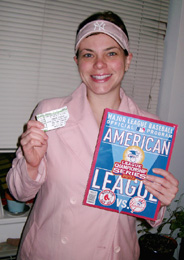
Best. Wedding. Ever.

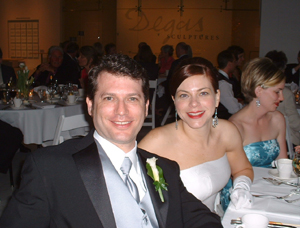
Our wedding at the Milwaukee Art Museum on Sunday, May 15 was a smashing success. As we’re embarking on the honeymoon in about five hours, there’s simply no time to do it justice with words except to say that it was every bit as beautiful and special as we had imagined it. When we weren’t choking back tears at how moved we were, we were grinning ear to ear. My bride, Andra, was stunning, the venue was spectacular, the food was great, the guests were amazing. Towards the end of the night I even got up and belted out a rendition of “Ring of Fire” with the band.

One picture, a thousand words:

I’ll return to my usual blogging sometime Memorial Day weekend.

Now It Can Be Told (an encore presentation)

As I write this, I’m only a couple of hours away from departing for Milwaukee and the beginning of my wedding festivities, starting with a marriage license appointment this afternoon. Since it will be awhile before I get to post anything else here, I’ve decided to re-run what I wrote upon my engagement to Andra last summer. The following was originally published on August 2, 2004, three days after I popped the question.

Thursday was already shaping up to be a banner day by the time I walked out the door. Not only was I hotly anticipating the publication of my latest piece at Baseball Prospectus, in a matter of a few minutes I’d come up with another blog entry that ended up getting linked via Baseball Primer’s Clutch Hits Baseball Think Factory’s Newsblog. But all of that was small potatoes compared to what came later in the day.

At 6:30, my girlfriend Andra came home with the exciting news that she had been approved for a major promotion at work, an event which had been in the offing for several weeks and which at one stage found her the focal point of a nice little bidding war. After passing her background check and signing the appropriate paperwork, she’s officially the Graphics Manager at Hanes New Ventures Causal Wear, a mere three years after dropping the curtain on a career in film production, and it’s something of which she’s deservedly proud.

Andra wanted to take me out to dinner to celebrate, but I had made even bigger plans, and dinner was only a part of them. I’d spent all day sweating over those plans. In some way, I’d been waiting my entire life for them. My vision of the evening was going to trump hers, and for that I would make no apology.

At 8 PM, Andra walked out onto the lower roofdeck of our apartment, freshly showered after a quick swim, greeted by the sight of two wine glasses, a bottle of Veuve Cliquot, a plate of cheese and crackers, and a boyfriend grinning like a cat who’d just eaten a canary. She smiled at me and said something along the lines of, “Just what are you up to?”

I answered by pulling a small velvet box out of my pocket. “Honey, will you marry me?” I smiled, looking right into the beautiful blue eyes which had melted my cold, broken heart some three-and-a-half years ago. I showed her the diamond ring I had designed with the help of our friend Danielle, based on some preliminary specifications from Andra — she had known this was all coming, she just had no idea when. “Of course,” she replied, hugging me for an eternity before we shared a long, passionate kiss.

I don’t even think she’d looked at the ring yet. Finally, after our smooch, she looked at it, a stunning concoction that had taken my breath away earlier that day upon picking it up from the jeweler, a 1-carat emerald cut centered around 40 tiny little diamonds embedded in a detailed platinum band. “It’s perfect,” she smiled, and kissed me for even longer than before.

• • •

As I’m fond of saying, the events inside a two-week period in the fall of 2000 are the reason for this site’s existence. On October 26, in Shea Stadium, a frumpy but amiable reserve infielder named Luis Sojo delivered a single which drove in the World Series-clinching run for the New York Yankees and made Sojo a minor celebrity. Two days later, still quite heavy-hearted from a recent breakup, I went to a Halloween party in Brooklyn. Sweating quite a bit beneath a yellow Devo radiation suit, I chatted for the better part of an hour with the pink-wigged pal of my friend Brandi, who had invited us both along.

Six days after that party, on November 3, my pal Nick and I went to the Bradlee’s on Union Square to meet Jim Bouton, the author of Ball Four, my all-time favorite book. Bouton was doing a signing to promote the 30th anniversary edition of his classic diary, and as the first to arrive, we had the honor and pleasure of talking to Jim about the book, baseball, and life in general for 45 minutes. Jim even listened intently to my still-unpublished treatise, “Graphic Design as a Form of Pitching.”

Still abuzz after our conversation, Nick and I went for a Thai dinner and then headed for a quick drink before our scheduled connection with our friend Julie. We stumbled into a bar called Scratcher, and to our surprise, there was Julie, along with Brandi and the other gal from the Halloween party, this time wearing a winter cap instead of a pink wig. We sat down, and I somehow ended up next to that gal (whose name I couldn’t quite remember) and ended up talking with her for hours. She listened to me blather about Bouton and Ball Four, and as it turned out, she knew a bit about baseball herself, having grown up in a rabid sports-fan family with a brother who’d worked for the Milwaukee Brewers and once got to be Bernie Brewer. She knew about Stormin’ Gorman Thomas and Harvey’s Wallbangers, and had even helped to film a series of Brewer promos starring Robin Yount, Paul Molitor, and Bob Uecker. We talked of several other things — consumerism and capitalism, butter burgers and cheese curds, film and graphic design — but much of the conversation revolved around baseball.

We left the bar together that night, much to the amazement of our friends. And except for a brief time-out early on, we’ve been together ever since. Last April, we moved into a tiny one-bedroom apartment in the East Village, and besides the occasional dispute over the division of labor as it pertained to the bathroom’s upkeep, it’s been a dream come true, more laughs and hugs and fantastic meals and good times than I could have hoped.

• • •

To say that this blog would not be possible without the love and support of my gal Andra is a gross understatement, something on the order of saying, “Babe Ruth played baseball for the Yankees.” This blog, this website, this whole enchilada of sharing my unquenchable passion for the game with thousands of readers each week would be downright inconceivable. Back when our relationship was in its shaky infancy, Andra was the one who pushed me to start doing this, who gave me the space to follow my muse, and who showed me how being true to that muse and investing in myself made me somebody that she could love all the more. For that I am eternally, incredibly, staggeringly grateful.

Andra is the one who told me it was acceptable to come home from a hard day’s work in front of one computer and sit down in front of another one, crunching through numbers and clicking through links until I found something I wanted to share with the tens, hundreds, or thousands of eyeballs who might read what I thought about baseball on a given day. She’s the one who suggested we go back to Milwaukee for the 2002 All-Star Game, and she’s the one who demanded I tell Alex Belth “yes” in response to his invitation to attend the Winter Meetings in New Orleans.

Our relationship, of course, goes far beyond her support of my writing. We’ve gone through our ups and downs against the backdrop of major career changes, supporting each other emotionally and financially without ever looking back to wonder if we’d made the wrong moves. We’ve endured the terror of our city under siege, realizing that what mattered most to us was the other’s safety and well-being. We’ve gone to the Louvre to appreciate the classic works of European art, and we’ve run around our little apartment like demented, giggling four-year-olds. We’ve enjoyed aquavit and pickled herring at fine restaurants as well as hot dogs and beer at no fewer than six ballparks. And we’re only getting started.

For whatever predictions I may offer here — the Yanks will win, the Tigers Pirates Devil Rays Diamondbacks will lose, and Enrique Wilson will never hit big-league pitching well enough to carry Luis Sojo’s jockstrap — I don’t know what the future holds any more than you do. But I know I’ll have Andra by my side, loving me with as much passion as I love her, and for that I feel like the luckiest guy in the world.

Hit and Run

This week’s Prospectus Hit List, now in play at BP, has a new leader atop the rankings. The Chicago White Sox have stormed to the number one spot on the strength of a 24-7 record founded on surprisingly good starting pitching (including a couple of last year’s Yankees) and excellent defense (a majors-leading Defensive Efficiency Ratio of .726). The Dodgers have leveled off down at number seven, though they’ve had the nice developments of getting Hee Seop Choi and Jason Phillips involved in the offense, and a makeshift bullpen that’s passed nearly every test in the absence of closer Eric Gagne. The Yankees have inched up to number 20 thanks to an opportune visit from the punchless A’s (slugging .339 and last in the bigs in Equivalent Average).

Since the big shakeup, the Yankee defense, while remaining the worst in baseball, has raised its DER by 10 points to a still-pathetic .661 — a figure that if it held would be the worst in all of baseball since 1972. The Mel Stottlemyre-must-go meme I wrote about ten days ago gained some traction in the mainstream media, with George Steinbrenner firing volleys at the embattled Yankee pitching coach and Joe Torre loyally standing by his man. Steven Goldman and I had planned a back-and-forth volley at his Pinstriped Blog, but events seem to be getting in the way of that taking place in a timely fashion.

The main event standing in the way of that (and the reason for the relative scarcity of my postings here lately) is my impending wedding, which is this coming Sunday, May 15 to the lovely Ms. Andra Laine Hardt at the spectacular Milwaukee Art Museum. We leave for Milwaukee on Wednesday morning and while I might check in now and again over my morning coffee from Milwaukee, chances are I’ll be a bit scarce between now and the return from my honeymoon (Florence and Venice, Italy) on May 29. I haven’t done too much thinking about that trip, but I’m excited for the wedding weekend — bringing together so many friends and family members — with absolutely no reservations about moving forward into the next phase of my life with Andra. We’ve been a couple for four and a half years, living together for the past two, and we’ve been though our share of ups and downs, our bonds growing stronger and closer through it all.

I’ll have at least one more post before I head out….

It Gets Late Early Out There

Anyone banking on a quick turnaround by the Yankees after their shakeup got some sobering news on Tuesday, not that they shouldn’t have seen it coming. With the new Bernie Wiliams-free lineup taking the field behind him, Kevin Brown once again soiled his diaper early against the Tampa Bay Devil Rays, allowing six runs in the first inning, and the Yanks lost, 11-4 to drop their record to 11-16. Meet the new dross, same as the old dross.

Brown has now allowed 12 first-inning runs in his four starts (and four in the second inning of one start), putting the Yanks into the position of being blown out early. Worse, over his last nine starts since making his hand into a maraca (including the postseason, where he cost the team its season by taking the ball in Game Seven when he was physically unfit to do so), he looks as cooked as a pot roast in a burning whorehouse, to borrow a wonderful phrase from my BP colleague Jim Baker. Brown has pitched 39 innings over those nine starts to the tune of a 8.08 ERA, a record of 1-7, and a batting average on balls in play of .395, a figure which has more to do with his leaving balls up in the strike zone where they can be smashed for line drives than a particularly shoddy defense behind him.

With the Yankee rotation already in a patched-up state with rookie Chien Ming-Wong subbing for injured Jaret Wright for the foreseeable future and fellow rookie Sean Henn taking Randy Johnson’s start today, the team’s lack of depth in that department is suddenly glaringly obvious. With no El Duques rehabbing in Columbus or Sterling Hitchcocks biding their time in the pen (not that that scenario worked out so well), they have little margin for error. With Brown bearing a $15 milllion price tag, the durability of a Fabergé egg, and a disposition only slightly sunnier than Joe Stalin after an all-night vodka binge, they have no takers for his services and few options but to either let him pitch, force him to rehab in Tampa, or sink the cost.

Steven Goldman suggested to the BP internal mailing list that a trade to the Mets for Tom Glavine might make sense as a salary dump for the Flushing franchise (Brown comes off the books this winter, while Glavine’s got another year). While I think the Yankees would take a random bucket of putrefying roadkill procured by Cletus the Slack-Jawed Yokel if it would get Brown further from their sight, Glavine and his low K/high ball-in-play rates are just what the doctor ordered — if that doctor is named Kervorkian. Pass. My personal preference would be to hack off either two or seven of Brown’s fingers, as it worked for his namesake, Mordecai Peter Centennial Brown roughly a century ago. I suspect the line of fans who would be willing to perform such radical surgery on Brown would circle Yankee Stadium several times.

The Yankees’ record is now 11-16, and while based on their track records there’s enough talent on hand to turn it around, the news is bleak when one studies the probabilities for success of teams in that position. A couple of years ago Rany Jazayerli of Baseball Prospectus studied the season-opening records of nearly seventy years’ worth of teams and found that the die is cast very early on.

Keeping in mind that the baseline for this period was at 15.2 percent of the teams in the study making the playoffs (that’s my calculation, not Rany’s), after 10 games, a team with a 4-6 record such as the Yanks held has an expected winning percentage of just .484 for the rest of the year and a mere 5.2 percent chance of making the playoffs. At 20 games, the chances of an 9-11 geam of making the playoffs are the same, 5.2 percent. At 30, a point three games down the road, here are the expected winning percentages for the rest of the year and the playoff odds for the various combinations of records open to the Yanks:

        EWP   Playoff
14-16 .494 5.0%
13-17 .473 2.2%
12-18 .469 1.8%
11-19 .438 1.5%

To borrow a line from Yogi Berra, it gets late early out there; one month into the season, it’s pretty much win-or-else time for the Yanks according to this logic. Of course, the Yankees are not just any team, they’re a team which has won over 100 games three straight times. In his further research Jazayerli found that there is actually a quantifiable relationship between a team’s previous records and their predicted one from an early-season start:

P = .1557 + (.4517 * X1) + (.1401 * X2) + (.0968 * X3)

where P is the projected record, X1 is last year’s winning pct., X2 is two years ago, X3 three years ago. Then the final winning percentage, Y, is

Y = P + ((S-P) * (.0415 + (.0096 * G)))

where S is the team’s current winning percentage and G is their number of games played. Run the numbers for the Yankees and you get a predicted winning percentage coming into the season of just .587 (since even the best teams tend to regress to the mean) and based on their current record, an even less rosy .533 for the year, which projects to 86-76 and in all likelihood a lonely October in the Bronx, followed by several crucifixions.

Here’s Goldman, from his latest Pinstriped Bible:

The saying, “better late than never,” isn’t always true. At times, especially when it comes to aging baseball players, the proper answer is “on time or you might as well not bother.” The calendar turned to May and what had been obvious for more than a year finally dawned on the Yankees. They had an aging team, one where several positions were in need of urgent fixes. For years, strong production at defensive positions — center field, shortstop, and catcher — had sustained the offense despite often subpar performances from the traditional power spots. Bernie Williams had been in decline for a number of years. His glove quit long before his bat did, but after 2002 both had been in question. Rather than pursue the obvious solution, one that was clearly within the team’s financial boundaries as the winter began, the team went in other directions. Months later, they are still paying for that decision.

As has been noted by several commentators, including this author in Tuesday’s New York Sun, very few teams have come back from a start as bad as 10-15 and made the playoffs. Barring a truly impressive winning streak followed by a period of sustained, consistent winning, the story of this season has very likely been written. This will be forever known as “The Year The Yankees Chose Not To Make An Offer To Carlos Beltran.”

That the Yankees could be one of the few teams that could turn it around is reason enough to stay tuned. Certainly their record of the past few years argues that there are untapped resources here. Still, the battle will be fought day to day, with every game counting. The Yankees will need to be honest with themselves in a way that they haven’t been in years. The end of the Bernie Williams era is only the first step. The moves announced after Monday’s game are not guaranteed to have much of an impact. That’s not to say they’re not worth trying, but to expect a sudden turnaround would be premature.

We’ll know a lot more about these Yankees in the next week, but right now it’s shaping up to be a long summer with an unhappy ending for this team.

Shuffling the Deck

This week’s Hit List is up at Baseball Prospectus, with the Marlins retaking the top spot, followed by the surprising Orioles and then the Dodgers, who spent two weeks at number one. The Yankees, who continue to struggle, are down at number 23 after finishing with their first losing April record since 1991, back when Bernie Williams was a rookie. For the week, Alex Rodriguez hit .429/.520/1.190 with 5 homers, while the rest of the Yanks managed a punchless .233/.297/.301 line with one homer, and scored as many runs on A-Rod’s big night (12) as they did in the other five games all week. Pathetic.

I was at Sunday’s debacle and watched the Yanks blow a 6-3 lead, courtesy of their inability to put batters away. The Blue Jays pounded out 16 hits while the Yanks could manage only three strikeouts. Reliever Paul Quantrill, who came on with the bases loaded and nobody out in the sixth, let two batters escape 0-2 counts to reach base, keying a bases-clearing rally from which the Yanks never recovered. Mike Stanton gave up another pair of runs thanks in part to the Jays’ aggressive baserunning on Williams. Ol’ Chicken Arm, never a good thrower in the best of times, is suffering from tendinitis in his right elbow as well as his chronic shoulder woes, and for his part is pretty candid about his condition: “It’s not an issue with throwing. … I could never really throw. It’s not keeping me from playing. … I can play. I’m just trying to play through it.”

Williams’ struggles in the field and at the plate (.247/.324/.312) are part of a larger set of woes that hasn’t gone unnoticed by Yankee brass, and after last night’s game the hammer dropped. Today’s New York Times reveals that big changes are coming as of Tuesday night’s game: Williams is out as the regular centerfielder, with leftfielder Hideki Matsui sliding over to the position he played in Japan. Moving to left is second baseman Tony Womack, who’s never played the position but has 125 games in rightfield, most of them in 1999. Replacing Womack at second base is Robinson Cano, a 22-year old prospect who’s hitting .333/.368/.574 at Triple-A Columbus.

The Yanks will also make some moves on the pitching front. Reliever Steve Karsay, who’s thrown a total of 12.2 innings over the past two-plus seasons, will be designated for assignment, meaning he’s going to be waived, likely claimed, and then traded for a delicious combination of peanuts and bubblegum, with the Yanks footing about $6 million worth of damage and whoever acquires him paying only the prorated minimum. That move is to make room for reliever Tanyon Sturtze, who comes off of the disabled list later this week. Sturtze won’t arrive in time to take a spot start for Randy Johnson, who tweaked his groin (no jokes, please) in his last start and will be held out of Wednesday’s game. Instead that role will go to 24-year-old Double-A lefty Sean Henn, who’s 2-1 with an 0.71 ERA thus far, and it means that, for at least one turn, the Yanks now have two rookies (including Chien Ming-Wang, who was solid in his debut on Saturday) replacing very expensive cogs in the rotation in Johnson and Jaret Wright.

These moves are a lot to digest, even for those of us who saw this coming with the Yankees’ poorly conceived offseason moves, particularly their failure to sign 28-year-old Carlos Beltran to ease Williams out of centerfield. The kicker is that even after eschewing Beltran, the Yanks failed miserably at coming up with a workable Plan B. They traded last year’s “heir apparent” centerfielder, Kenny Lofton (who’s actually older than Wiliams), to the Phillies for Felix Rodriguez (who’s either languishing in their crowded bullpen or else already in the Federal Witness Protection program, having pitched only one-third of an inning in the last nine days) and the only other centerfelder on the roster (besides Matsui) is Bubba Crosby, who hit .151/.196/.302 in limited duty last year.

Basically, the thrust of these moves is to:

• limit the damage playing time of Williams, Jason Giambi (.224/.395/.373), Tino Martinez (.239/.338/.358), and eventually Ruben Sierra (.269/.296/.692 — all of those hits for extra bases) in that they can field only one DH and one first baseman. Players like Gary Sheffield (who struggled through shoulder problems last year and who’s earned the nickname of “Magellan” for his circuitous routes to flyballs) and Jorge Posada might be nice to keep fresh in the DH spot once in awhile as well, but the Yanks now have the deepest DH slot in the league and no real backup rightfielder, since Crosby’s really around as part of the Make-a-Wish foundation and should be limited to pinch-running duty and fetching Bernie herbal tea at best.

• find out whether they can get lucky with Cano, who’s a very limited prospect. BP’s PECOTA system projects him at .254/.297/.389, with enough upside to be a legitimate major-leaguer… when he’s 24 (a weighted mean EQA of .256 for 2007, with .260 being league-average).

• turn YES into the Tony Womack Channel. Womack seems like an amenable sort, but he’s got a surgically rebuilt throwing arm, and as a cornerman, his bat is just one more spot where the Yankee offense will lose ground. The Yanks would do better to limit his exposure as well, rather than turning him into the fulcrum of these moves.

Back at the winter meetings in Anaheim, Joe Sheehan kept harping that the Yanks would be below average offensively at four positions — second base, centerfield, DH, and first base — and these moves touch every one of those positions; with the slight upgrades at CF and DH, the Yanks are at best treading water at second (where Womack is hitting a rather empty .282/.330/.329), and receding in left.

But I don’t think this will do a great job of solving the Yanks biggest problem, which is their wheezing outfield defense. The team’s Defensive Efficiency Ratio, the percentage of balls in play that they turn into outs, stands at .651, the worst in the major leagues by a staggering 20 points, and a good 44 points below league average. Looked at another way, that’s the difference between a .305 hitter and a .350 hitter, and it’s a cost of having a pitching staff that can’t dominate hitters, as I complained in relation to pitching coach Mel Stottlemyre last week.

It’s been suggested by some that the Yanks would have been better off simply swapping Williams and Matsui in the field, but I’m skeptical that would solve anything. Leftfield in Yankee Stadium is abnormally large, and it requires the ability to cover almost as much ground as centerifeld does in most parks. Add to that the requirements of Williams to learn to track balls (never his strong suit) which are coming at him with more of a spin — severely hooking or slicing rather than hit more or less straight — and to manage the foul line and wall and for Matsui to hurdle the language barrier with two outfielders instead of one, and you’ve got a potentially harrowing situation that brings to mind an air traffic controller strike. Here’s what injury expert Will Carroll had to say on BP’s internal mailing list:

The oddball thing is that the Yankees did drill quite a bit with Matsui in CF during spring training. That’s not unusual, he was the clear backup. What’s going to be the interesting part is that he’ll have Womack on one side, who doesn’t have any experience that I can tell. There’s a significant short term increase in injury risk on a position move, usually due to change in conditions. Given the walls and locations in Yankee are pretty safe in left, the rest of the possibilities lie in miscommunication leading to collision. Womack taking out Matsui, Jeter or Rodriguez would lie directly in the middle of comedy and tragedy.

Yikes. While it’s not entirely clear whether this whole scenario will take or whether it’s an intermediate stage preceding a more major trade (the Mets’ Mike Cameron, currently on the DL and former Yankee prospect Wily Mo Pena, now fighting for time in a crowded Cincy outfield, are two names often mentioned), the move out of centerfield for Williams marks the passing of an era, and for his part, he’s handling the demotion with dignity and grace, saying, “At this point, all everyone wants is for us to win games. Pride … all that stuff … that’s out the window. My job now becomes to make myself available to play.” True class.

In case anybody’s wondering, Bernie does have a legit Hall of Fame case according to the JAWS system, with a career WARP of 100.4, a peak of 46.8 and an overall score of 73.6. That’s a few points below the average Hall centerfielder (108.8/46.5/77.6) based on career length, but with four World Series rings and the pinstripe legacy behind him, he’s probably got enough juice to get in.

Back to the Yankees, this team, as I’ve harped before, was poorly constructed in the offseason, but its cracks are showing up even more quickly than even I would have suspected. It might be a bit early to haul out the title of a recent book as a punchline diagnosis — Ladies and Gentlemen, the Bronx is Burning — but it’s clear that change is in the air up at 161st Street. I hope it’s not too late, but with the Orioles off to a hot 17-8 start and leading the AL East, the dawn of a new era — one with the Yanks making tee times in October — may be upon us.

• • •

I finally received my copy of The Juice yesterday. In honor of it, I raised a bottle of my favorite baseball-themed performance-enhancing beverage, Brooklyn Pennant Ale ’55, which commemorates the 50th anniversary of the sole Brooklyn Dodgers championship and is part of a great line of beers from a great local brewery. According to the packaging, $1 from every case will be donatied by the brewery towards a mayoral fund to build a monument to Jackie Robinson and Pee Wee Reese out at Coney Island. I’m flying the flag.

Mystery Stottlemyre Theater

I’ve made the case a couple of times in the past that Yankee pitching coach Mel Stottlemyre has reached his sell-by date in the Bronx. It’s become a topic of frequent conversation among my Yankee-fan friends and fellow writers, and the idea is gaining some momentum in the mainstream.

The other day Alex Belth pointed author Allen Barra, who was in the process of writing this piece on Stottlemyre for the New York Sun (subscription required), in my direction for some support. I’ve had the pleasure of meeting Barra on a couple of occasions, and he of course has popped up here a number of times as a contributor to a wide variety of publications from this blog’s infancy to this past week, so I was flattered for him to ask my opinion on the matter. I chatted with Barra and forwarded him some of my writing on the topic and he ended up quoting me in the piece — another nice little clip for the files. Here’s Barra:

There are a few pitching coaches whose staffs are consistently under the weather, and, considering his team’s natural advantages in wealth and resources, many would argue that Mel Stottlemyre is one of them.

From his 1984 season with the Mets, through April of this year, any positive effect that Stottlemyre has had on his pitchers is difficult to trace. He’s hindered by a penchant for forcing pitchers away from their best power pitch and toward a second pitch that puts more strain on their arms, as well as an inability to correct a troubled pitcher’s mechanics.

Stottlemyre is one of the best-liked men in the Yankees organization, a respected former pitcher with a link to old Yankee royalty and a man who has shown courage in the face of adversity and personal illness. As a pitching coach, though, he is the sacred cow of the Yankees organization, the Teflon man to whom no failure sticks.

This year’s poor start for the Yankee staff aside, this is familiar territory, so much so that I’ve got a handy clip-and-save chart that I’ve circulated a few times. It shows a number of successful pitchers who went to seed on Stottlemyre’s watch, updated through the end of the 2004 season:

                Years   IP  ERA   Car. ERA*
Kenny Rogers 96-97 324 5.11 4.13
David Cone 00 155 6.91 3.27
Denny Neagle 00 91 5.81 4.16
S. Hitchcock 01-03 140 5.84 4.68
Jeff Weaver 02-03 237 5.35 4.20
Esteban Loaiza 04 42 8.50 4.60
Javy Vazquez 04 198 4.91 4.12
* besides listed seasons

Hitchcock and the place-setting that might be reserved for Jaret Wright aside, there aren’t really any health issues here, these are serious collapses of previously effective pitchers. Furthermore, whether it’s incompetence on the part of the team’s player development system or simply an acknowledgment of the organization’s $trengths and weaknesses, the Yanks have almost completely avoided the business of developing pitchers since Stottlemyre’s arrival. Both Andy Pettitte and Mariano Rivera arrived in the majors in 1995, the year before the Torre-Stottlemyre regime did, and while they went on to flourish under Stottlemyre, the only other Yankee product to do so has been Ramiro Mendoza. Every other pitcher of lasting note during Stottlemyre’s tenure arrived in the Bronx a finished product, for better or for worse (the italicized parts are what Barra quoted). Many of them did fare for the worse, and when they did, Stottlemyre was powerless to pull them together. Meanwhile, traded Yankee prospects such as Jake Westbrook, Zack Day, Ted Lilly, and Damaso Marte have been effective and inexpensive (if not always healthy) contributors elsewhere, and after shaky starts, Weaver and Vazquez have shown signs of ironing themselves out in their new environs.

Barra delves back into Stottlemyre’s tenure with the Mets (1984-1993) when he did have some success with youngsters, most notably Dwight Gooden. I don’t agree with the way he tries to blame Gooden’s demise on Stottlemyre, however. Though drug problems limited his innings and doubtless took their toll on him, Gooden was a spectacular-to-merely-good pitcher for the entirety of Stottlemyre’s tenure, rather than a trainwreck on the order of Javy Vazquez or Jeff Weaver. That said, Barra does offer a compelling account for Stotttlemyre’s negative impact on Doc via some quotes from Jeff Pearlman, author of The Bad Guys Won:

“Mel had this stubborn insistence that Doc had to develop a third pitch, a breaking ball, to make him more effective,” Pearlman told me.” ‘He’s striking out too many batters’ was his attitude. He didn’t seem to understand that the breaking pitches put a lot of strain on a very young arm. You could see the difference right after the ’85 season. He was a great pitcher in ’86, but he struck out fewer hitters, gave up more hits and more walks, and his ERA climbed sharply.”

…”Mel had this thing about strikeouts,” said Ed Hearn, the Mets’ backup catcher in 1986. “He wanted Ron [Darling] to throw more breaking stuff. He did, and he was never quite as good afterward as he was in ’86.”

…”Mel just wasn’t very good with mechanics,” said a former Mets reliever who asked not be named. “If you had a problem with your delivery or if you were trying to work things out after being hurt, you were pretty much on your own.”

Those paragraphs should turn the stomachs of Yankee fans, who have seen the team’s strikeout rate plummet dramatically over the past few years, shifting the burden onto a shaky defense whose ability to convert balls in play into outs isn’t so hot. Observe:

       K/9 (rk)   DER (rk)  ERA (rk)
1998 6.67 (5) .713 (1) 3.82 (1)
1999 6.95 (3) .699 (3) 4.13 (2)
2000 6.57 (3) .693 (4) 4.76 (6)
2001 7.85 (1) .684 (10) 4.02 (3)
2002 7.04 (2) .690 (9) 3.87 (4)
2003 6.89 (2) .682 (13) 4.02 (3)
2004 6.60 (6) .688 (7) 4.69 (6)
2005 6.25 (7) .646 (14) 4.80 (10)

The numbers in parentheses are the team’s AL ranking in that category. The pattern that this data shows is that when the Yanks have had a top-notch strikeout staff, they’ve been able to overcome subpar defense to remain one of the top pitching teams in the league. When they had less of a strikeout-oriented staff, they were fortunate enough to have had excellent defense (man, was that a long time ago…). Now, they have neither, and the team’s ERA is suffering for it. If indeed Stottlemyre is emphasizing more of a put-it-in-play approach — and such a notion surfaced often last year in reference to Kevin Brown — it’s a misguided emphasis that’s going to end in tears.

As for the injury and mechanics elements of that above quote, consider that among the starting rotation alone, Brown, the disabled Wright and the decreasingly effective Mike Mussina will all require direction and TLC that Stottlemyre just can’t deliver. Once again, a bulk of innings will be shifted to the bullpen (which logged 105 more innings in 2004 than it did in 2003, about the workload of one and a half good relievers), testing a unit whose cast numbers seven — including the rarely healthy Steve Karsay, the enigmatic Tanyon Sturtze (whose positive ledger rests on a 20-inning spree spread out between last September and early April that may well qualify as an out-of-body experience), the shellshocked Tom Gordon (who hasn’t looked the same since David Ortiz got through with him), and the overcooked Mike Stanton — but appears to be about a mile wide and an inch deep.

The Yanks had the opportunity to nudge Stottlemyre into retirement last fall, but perhaps more out of humanity — this is a multiple myeloma survivor we’re talking about — than rationality, they stubbornly refused to so, though they did position Columbus pitching coach Neil Allen as the heir apparent by promoting him to big-league bullpen coach. But the bottom line is that Yankee fans ought to assume the crash position. When this pitching staff goes over the cliff, don’t expect Mel Stottlemyre to be the one to pull it up to safety.

A Night to Remember

I’ve seen a lot in the ten years I’ve been going to ballgames in the Bronx. Everything from the historic (the 1999 World Series clincher, and a few other Fall Classics) to the spectacular (another Derek Jeter throw from deep in the hole, an improbable late-inning rally) to the heartwarming (the ovation Luis Sojo received upon his return to the Yanks in 2000) to the forgettable (the bombing of Mike Jerzembeck) to the bizzare (a Hasidic Jew falling out of the leftfield stands and onto the playing field). With all of the success the Yankees have had over that timespan, at times I run the risk of feeling a bit jaded.

Tuesday night was not one of those nights.

As my pal Nick and I sized up our seats upon entering the playing area — Tier Box MVP, upper deck between home plate and the Yankees’ on-deck circle, a great view — we recounted one of those memorable games at the Stadium. Bartolo Colon, the Angels’ starter on this night but then pitching for the Indians, took a no-hitter into the eighth inning before settling for a one-hit shutout, the closest I’ve ever been to a no-no among several close calls.

Looking at the stat sheet as the pregame festivities began (something about Randy Johnson and Derek Jeter receiving the Montgomery Burns Award for Outstanding Achievement in the Field of Excellence), I noted that the one Yankee who’d had significant success against Colon was Alex Rodriguez, 13-for-37 with three homers in his career. With this morsel of information in mind, Nick picked apart Joe Torre’s decision to bat Rodriguez fifth in the lineup, down from his usual number two slot.

Yes, officer, I swear this conversation took place.

By the time Rodriguez came up to face Colon in the first inning, the Yanks had two men aboard; Jeter had drawn a leadoff walk, and Hideki Matsui eked a two-out pass as well. Rodriguez went to 2-2 against Colon, then absolutely crushed a ball to left-center for a three-run homer and the obligatory curtain call, a great start to the night. As if he could perhaps will the ball back, Colon stood facing the departure point of the blast for a good thirty seconds before turning around and accepting a new ball from catcher Jose Molina. Meanwhile, Nick and I shared a laugh about the reputed dying words of former Boston Braves manager George Stallings: “Oh, those bases on balls.”

Though the Angels had clawed for a pair of runs off of Carl Pavano in the top of the third, the Yankee crowd was still basking in the glow of that three-run jack when Rodriguez came to bat in the bottom half of the inning. Again, Colon had issued a walk to precede the at-bat, this time to Gary Sheffield, while somewhere Stallings rolled over in his grave. On Colon’s second pitch to Rodriguez, the Yankee third baseman drilled another shot, this time to leftfield. No doubt about it, a two-run homer and another curtain call. Given Rodriguez’s early-season struggles as well as those of the team, it had to feel good.

Rodriguez is a supremely talented player, but he arrived in the Bronx last year carrying more baggage than even most great players can bear, and the Samsonite continues to multiply: the Quarter Billion Dollar Man, averaging 52 homers a year from the comfort of last place in the AL West while his former team rolled to a record-setting regular season the first year he was gone… nearly a Red Sock but for financial complications amid a ridiculously public trade negotiation, enduring a slow start in pinstripes and some early-season failures in the clutch, then the infamous slap in the ALCS Game Six, followed by a winter of having to listen to the sorest winners in baseball history — guys who couldn’t carry his jockstrap if they were cycling on steroids — badmouth him about not being a “true” Yankee… give me a fucking break.

It all sold papers, many of them by a company with a vested interest in the Yanks’ chief rivals…. hmmm. As if Rodriguez’s selflessly yielding his position upon being traded to the Yankees, picking up a new one and playing stellar defense, wasn’t worth something. As if putting up stats that once the desert air was let out of them weren’t too dissimilar from his previous accomplishments, hitting “only” 36 homers to a .286/.375/.512 tune, wasn’t worth something. As if his one-out double, gutsy steal of third base, and heads-up jaunt home on a wild pitch to score the series-winning run against the Twins in the AL Divisional Series wasn’t proof that the man can come through in the clutch.

It’s easy to take the excellence of a superstar like Rodriguez for granted, especially when he’s not shooting exploding fireworks out of his butt while helping little old ladies from burning buildings, hitting 600-foot home runs and diving into the stands to save babies from devouring lead paint. Note the cynicism with which his actual heroism in Boston was viewed. Perhaps that’s why it’s so refreshing to be not-so-subtly reminded of the man’s superstardom with a tour de force performance to such as the one he was already putting up after two at-bats on Tueesday night. On a good day — and this was shaping up to be a very good day so far — Alex Rodriguez just might be the best ballplayer in the world.

“I think Rodriguez’s name is tattooed on Colon’s butt at this point,” I announced as curtain call number two died down. “He owns the guy.” Indeed, everybody seemed to own Colon, who was laboring against practically every batter; A-Rod’s homer came on his 58th pitch of the night, and it was getting late early for him. He walked Jason Giambi after a nine-pitch struggle, but escaped the inning when Jorge Posada went down looking at strike three.

Colon’s defense let him down in the fourth. Second baseman Chone Figgins mishandled a hot shot by Andy Phillips (drawing his second starting assignment in a row and having just missed a home run in his previous at-bat), and after Derek Jeter singled two batters later, Figgins made another error on a fielder’s choice that could have ended the inning with a double-play but instead allowed a run. One out later, Matsui drew another walk, setting the table, and the stage, for Rodriguez.

“What if he hits a grand slam?” Nick asked. “If he hits a grand slam, I’m going home,” I laughed. “I’ll have seen everything.” That was utter bullshit; if he hit a third, we both knew I’d be staying to the bitter end in search of number four.

Colon had thrown 94 pitches by the time he faced A-Rod for the third time, but when he fell behind 3-1 in the count, he mustered every last reserve of oomph and blew a 97 mph heater by Rodriguez. I reminded Nick that Colon was one of the few pitchers who could actually dial it up to triple-digits as Rodriguez fouled one off to run up a full count.

The next pitch will probably be replayed so long as A-Rod’s in pinstripes. Rodriguez drove one to deep centerfield, just to the left of the 408 foot sign as the crowd’s roar reached a crescendo. “Go! Go! Hoooly shit!” I heard myself shouting. Nick was even more unhinged. “Oh my God! Oh my God! Oh my God! Oh my God!” he shrieked, jumping up and down and flailing his arms. It was a sight to behold, and we were hardly the only ones struggling to keep it together. The pandemonium in the stadium hadn’t died down by the time I finished shading in all of them pretty little diamonds on my scorecard. Three homers and nine RBI on the night, and it was only the fourth inning. That was it for Colon, of course, and as he departed, I couldn’t help but feel we’d exacted a bit of vengeance for that evening nearly five years ago. So long, sucker!

With the Yanks now holding a 10-2 lead, the only real suspense was whether Rodriguez could do it again. As Giambi flew out to end the inning, I began counting by threes on my scorecard, then relayed my findings: he’d have one at-bat, of course, but to get a second one, the Yanks would need to put five baserunners on. They got two in the next inning, but one was erased by a double play. The plot thickened.

Around this time, I put in a call to Alex Belth, to whom I’d offered the ticket Nick had used. “You shoulda been here, man,” I told him as he answered the phone, and I could tell the wheels were turning as he tried to place who it was. “Oh, you fucking… you don’t think that I’m not thinking that…” he began, off on a very blue streak. I let him vent, then we had a good laugh and he filled me in on the perspective for the home viewers, reliving the fateful at-bat. He’d missed the third curtain call, as it coincided with the pitching change, but I assured him that the Yankee Stadium crowd had shown the love, even chanting “A-Rod! A-Rod! A-Rod!”

A-Rod got his fourth chance an inning later, coming up with one out and men on first and second. We’d been hoping it would be with nobody on, giving him a shot at what I termed a royal flush — homering with nobody, one, two, and three on base. “If he homers, I’m gonna go streaking in a conga line,” one of the two guys behind me said to a fellow fan. “Count me in,” I declared, sure that this threat was even more idle than the last one.

Also Sprach Zarathustra (the 2001: A Space Odyssey theme) preceded the at-bat, and the crowd gave Rodriguez a standing ovation as he stepped into the box. He didn’t homer, but down 0-2 in the count, he lined one sharply up the middle for an RBI, his tenth on the night. No shame there, and an impressive save of an at-bat to boot. When Giambi walked immediately following (the generous Angels’ staff handed out seven passes on the night), it clinched one more chance for a fourth home run, though throngs of fans made their way towards the exit, unwilling to wait it out in this 12-3 laugher.

He didn’t get it, of course, lining out to centerfield to lead off the bottom of the eighth and receiving yet another standing ovation from a thinning but nonetheless grateful crowd. From there the only suspense was whether rookie reliever Colter Bean, who’d pitched a shaky but effective 1-2-3 eighth inning as his major-league debut, would return for the ninth. He did, allowing a run and prompting considerable activity in the Yankee pen, but the young sidearmer survived walking the first two hitters to strike out two of the final three to cap things off.

Rodriguez became the first Yankee to drive in 10 runs or more in Yankee Stadium, and only the 11th major-leaguer to do so anywhere, a single RBI off of fellow Yankee Tony Lazzeri’s AL record and two off of the major league record, held by Jim Bottomley, circa 1924, and Mark Whiten, circa 1993. His three-homer night, not to mention his box score line (5 3 4 10) was something I’ve never seen, sweeping aside any trace of ennui I had brought to the Bronx and giving me yet another set of special memories. Damn, I love this game.

Today Quick Hits

• This week’s Prospectus Hit List has the Dodgers holding onto the top spot, with the Marlins a close second and the White Sox, who ran the table at 7-0 last week, in a surprising third place. I have to admit that I’m really enjoying the process of compiling these, though they are a lot of work and at this point in the season, very volatile. Since the rankings are driven by run differentials (runs scored and runs against), even a day’s play can mean the difference between several spots. Case in point: on Sunday morning, the Mets were as high as fourth, and the Nationals 21st. By the end of the day, when the Nats beat the Mets 11-4, the Mets fell to eighth and the Nats rose to 13th. The biggest jump for the week belonged to the Cardinals, who rose from 24th to fifth, more or less swapping spots with the Blue Jays, who fell from fourth to 23rd. I’m going to have to come up with some special notation for teams like that — maybe an anvil and a rocket.

• I’m headed up to Yankee Stadium tonight to see the Yanks take on the Honky Tonk Angels of Bakersfield, or something like that. While the Yanks haven’t exactly been a pleasure to watch thus far, their current situation with injuries to Jaret Wright (torn scar tissue) and Ruben Sierra (torn biceps) has finally opened up opportunities for the few meager prospects they hold. Andy Phillips drew the start at first base on Sunday and responded with an RBI double and a three-run homer which drew him a curtain call and delivered the coup de grâce to the Rangers. Sidearming reliever Colter Bean was recalled to take Wright’s place on the roster until Chien-Ming Wang arrives to start on Saturday.

As risky as this might be for the listless Yankees, who at 8-11 hold an identical record at this point to last year’s 101-win team, frankly, it shouldn’t hurt them all that much. Wright’s been a disaster thus far, with an ERA of 9.15, while Sierra, though slugging a robust .692, was only getting on base to the tune of .296 — all seven of his hits were for extra bases, an unsustainable ratio. They could do worse than cultivate their organizational depth this early in the year.

Phillips is a 28-year-old with some pop; PECOTA projects him at a weighted mean performance of .263/.326/.456, and he can play either second base or first. He homered on the first major-league pitch he saw in a game against the Red Sox last year, and is now batting .333/.333/1.000 over the course of his 14 at-bats in the show.

The 28-year-old Bean, though not a heat-thrower, struck out an eye-popping 109 hitter in 82.2 innings last year at Triple-A Columbus, while walking only 23 and posting a 2.29 ERA. For the Yanks to ignore a performance like that by not giving him at least a shot in the big-league pen is inexcusable. PECOTA agrees, projecting him at a 3.50 ERA with better than a strikeout per inning; in other words, this guy has big-leaguer written all over him.

Free Wang! The 25-year-old product of Taiwan put up a 3.50 ERA in 149.1 innings split between Double-A Trenton and Triple-A Columbus, striking out 7.5 per nine innings with a 3.7 K/BB ratio and only nine homers allowed. He also pitched for the Taiwanese Olympic team, beating the eventual silver medalists, the Australians. The word is that he’s got a 92 MPH fastball that can hit 96 at times, as well as a slider, changeup, and “devastating” splitter. PECOTA has him slated for a 4.68 ERA which given the rotation’s current struggles (a cumulative 5.32 ERA), doesn’t look too bad right now.

The best thing about this move, in my view, is that it makes the team a lot more watchable. Though there’s plenty of unpredictability and even occasioanl grief to be had along the way since, as Joe Sheehan put it, there’s no such thing as a pitching prospect, it’s exponentially more fun to watch young players develop then to watch overpaid aged mediocrities fill space in the lineup. At the very worst, the nearly bone-dry Yankee system can spotlight a few potential bargaining chips for the trading deadline, and at best, this grizzled $200 million behemoth has some cheap and talented solutions at its disposal.

Cliff Corcoran has a lot more to say about the injured bodies and their able replacements over at Bronx Banter.

• One of the first posts I did for this blog concerned good-hitting pitchers, and at the top of the list was Earl Wilson, who hit seven homers in 1966 and 1968 (the Year of the Pitcher) and topped five homers four times en route to 35 round trippers in 740 at-bats for his career, second only to Wes Ferrell’s 38 jacks. Sadly, Wilson passed away recently at the age of 70. In tribute to Wilson, you could do worse than peruse his career line and remember a time when men were men and pitchers didn’t hit like little girls.

Thee Premiere Statisticiane?

In a very favorable review of The Juice in the Denver Post, Will Carroll dropped my name in an interview with columnist Mike Klis, showering me with hyperbole:

Although Carroll’s readers will be far more educated on steroids, the book’s sale receipts will probably show America would rather be entertained. While [Jose] Canseco made the sensational claim that Jason Giambi is “the most obvious juicer in the game,” Carroll wonders how anyone can look at the substance-abusing brothers of those two players – Ozzie Canseco and Jeremy Giambi – and believe steroids have a significant impact on baseball performance.

After connecting his research of steroids with the home run boom from 1996-2001, Carroll returns to the theory espoused before the BALCO scandal broke in 2003 – the No. 1 factor was a juiced baseball, followed by hitter-favorable ballparks, bat composition, nutritional/strength training enhancement and then, steroids.

“Jay Jaffee [sic], who I think is the premier statistician in the game, the one thing he keeps pointing to is the ball,” Carroll said. “Every time somebody wants to look at the ball, they clam up. They won’t let you test it, they won’t let you look at the factory. I’m not saying steroids don’t help, but there are so many other things.”

While I certainly appreciate the mention and the kind words from Will (and the misspelling recalls all the elementary school-era snappy answers to stupid questions of whether I’m related to MAD magazine’s Al Jaffee), I will be the first to say that any claim of “premier statistician” is more than a tad overblown. For what it’s worth, Will recalls “one of” being part of the original quote.

Lest anyone require clarification, the stat-crunchers who form the backbone of Baseball Prospectus — Clay Davenport, Keith Woolner, Nate Silver and James Click — are far more adroit and creative than I am, to say nothing of folks outside of BP from Bill James to Voros McCracken to Tangotiger to Mitchel Lichtman, many of whom get paid by actual teams for their statistical acumen. If I am anything in this conversation, it is an adept user of the fine tools created by those people and others, one who tries very hard to translate complex concepts like DIPS, WARP and PECOTA to a broader audience. Those men are the A-Rods, Derek Jeters, Miguel Tejadas and Vlad Guerreros of the field (we’ll avoid tainting anybody with a Barry Bonds comparison), while on a good day I’m closer to Melvin Mora or Chone Figgins — a versatile contributor of increasing profile if not a heavy hitter. Still, there are worse things to be called, and to shift the focus back onto the book, it’s nice to see it generating positive press already.

• • •

Speaking of Davenport, he draws a mention in Sunday’s New York Times Magazine piece by Moneyball author Michael Lewis about the influence of power hitting on evaluating a prospect’s chances, and the way that steroids has clouded analysts ability to do so:

Of course, there’s now some sketchy evidence that steroids have contributed mightily to the power surge. Clay Davenport, who studies minor-league players for the Web site Baseball Prospectus, has found that three of the four players with the most remarkable midcareer power surges in the last two decades are now famously linked to steroid use: Barry Bonds, Mark McGwire and Jason Giambi. (Giambi has gone from hitting 10 home runs in his entire college career to hitting 43 home runs off major-league pitching in a single season.) Ron Shandler, who has worked as a statistical analyst for the St. Louis Cardinals and publishes Baseball Forecaster, an annual survey of major- and minor-league players for fantasy leaguers, expresses his suspicions another way: he flags players who acquire power the same season that they’ve come back from vacation 20 pounds or more heavier. For instance, Shandler has noted that last season Adrian Beltre, in his final year with the Dodgers before becoming a free agent, reportedly showed up 20 pounds heavier than the year before. Beltre, whose career up to that point had been a story of unfulfilled promise, blasted 48 home runs, 25 more than he had ever hit in a single season — for which he was rewarded, by the Seattle Mariners, with a new five-year, $64 million contract. (When a Tacoma, Wash., reporter asked if he had used steroids, Beltre laughed in denial.)

…But the ambiguity of steroids’ effects may have, in an odd way, increased their grip on the game. Unable to parse the statistics and separate natural power from steroid power, the people who evaluate baseball players for a living have no choice but to ignore the distinction. They’ve come to view the increase in the number of young players without power who become older players with power as a new eternal truth about the game. “Good hitters become power hitters, power hitters don’t become good hitters” has become a kind of cliche for baseball’s more statistically minded general managers. Power is now understood as less an innate gift than a gettable skill — more like speaking French than being 6-foot-3. Which is to say that steroids may have changed not only the way the game is played but also the way the game is understood. They have given birth to a big, beefy idea from whose side-effects no player is immune.

Now here is where a premier statistician, one with a full command of the history of major league baseball at his fingertips in the form of a database, could weigh in with a discussion of power development in prospects. Perhaps it would be something as simple as a graph plotting isolated power (SLG – AVG) against age to show that there is indeed a natural developmental curve with regards to how power develops. I’ll eagerly await Davenport, Silver, or another heavy hitter doing so.

Suffice it to say that since Lewis’ last two Times mag pieces turned into books (Moneyball and the forthcoming Coach) it’s a safe assumption that this piece, which catches up with a pair of players taken in Oakland’s now-infamous 2002 draft, is part of the forthcoming Moneyball sequel, and an even safer one to say that it’s essential reading. Go!

The Futility Infielder Book Rodeo Continues

I’m doing a bit of housekeeping around FI.com, promoting The Juice on the home page (and I’d appreciate it if you use that link to purchase a copy, as I get a small referral fee that helps pay the bills around here), and contemplating even bigger design changes to the site. From the traffic stats, it seems that an increasing share of my audience is viewing this site on monitors that will accommodate a wider page size (and therefore less scrolling), so that’s at the top of the list. Should I happen to kick up any dust in the process that renders this site missing in action or askew in its presentation, rest assured that it’s merely a temporary glitch that will be ironed out.

I also wanted to follow up the The Juice-related link with a couple of other pertinent book mentions. First off, my pal Steven Goldman’s book on Casey Stengel, Forging Genius, is now headed for a May 6 ship date, It’s been receiving some very positive reviews lately. Allen Barra has written glowingly of it here, here, and here. Says Barra, a fine author in his own right:

“Forging Genius” isn’t so much a biography as a study of how three-quarters of a century of baseball wisdom came to be encapsulated in one of the game’s classic eccentrics. “Is this serious? Are they really going to put a clown in to run the Yankee operation?” asked a New York sportswriter when told that Stengel had been chosen to manage the Yankees in 1948. That’s how Stengel was regarded by those who had not studied his minor-league record carefully or who hadn’t paid sufficient attention to how he got the most out of a ragtag collection of misfits with the Brooklyn Dodgers.

The combination of Stengel’s unorthodox behavior — on a tour of England, Casey, dressed in full baseball uniform, stepped right up to shake hands with King George V — and bold tactics took even veteran baseball writers by surprise. Taking his leave from McGraw, he perfected “platooning” — pitting right-handed hitters against left-handed pitchers and vice versa, employing relief specialists and using veteran role players to supplement young starters.

“Because I can make people laugh,” he once said, “some of them think I’m a damn fool. … But as a player, coach and manager, I have been around baseball for some thirty-five years … I’ve learned a lot and picked up a few ideas of my own.” And along the way, he did more than any other manager to create the modern game.

Steven Goldman has looked over a well-traveled road and found in it new directions. “Forging Genius” is that rarest of baseball books: respectful toward tradition and irreverent to perceived wisdom. The greatest of American sportswriters, Red Smith, once wrote that it was necessary to reintroduce Stengel to readers “at least once a decade.” Goldman’s “Forging Genius” ought to do for at least a century.

Meanwhile, Salon’s King Kaufman had some kind words as well, calling it “Best book about a baseball manager this year,” not that there’s much competition besides Buzz Bissinger’s Tony LaRussa book, Three Nights in August, which frames itself as an anti-Moneyball screed while hailing the “genius” responsible for twelve-man pitching staffs and third LOOGYs. Not exactly coming soon to a bookshelf near me, at least on my dollar.

Back to Goldman, a recent Pinstriped Blog entry (scroll to Thursday, April 21) amusingly describes his travails editing the forthcoming Baseball Prospectus book on the Red Sox, Mind Game, to which I contributed two chapters:

“Mind Game” … started out last winter as a quick six- or eight-week project with eight chapters and just a few writers, then mushroomed into a magnum opus of more than 25 chapters and a cast of thousands. It has had the gestation period of a blue whale without the second trimester euphoria. I have watched suckling babes age and wither during the construction of this intended bauble. Mighty trees have fallen. Epochs of fashion and morals have passed. I was young and sprightly when I began, now I am stooped and mumble.

….With a month of convalescence somewhere like Baden-Baden (Who am I kidding? I’ll never go to Germany) I might even live to see it published later this summer. I even think that it just might turn out to be a swell book about a team that took a rational approach to team building, even if it did reach out of its mother’s womb and try to strangle Daddy on the way to the delivery room. It certainly reads faster than we put it together, and that’s a good thing. We’ve crammed it full of tasty goodness, like literary foie gras.

As much as the next man, I wish Mind Game was already on the shelves, but its delays have been caused by the need to keep BP’s customers happy with the timely delivery of the annual book as well as regular web content, not to mention keeping the staff, and particularly cleanup hitter Goldman, sane. Additionally, the virtue of its late publication is that it aspires to be a measured, nonpartisan, timeless evaluation of Sox history and the arc of the Henry/Epstein regime rather than a quick reaction to the marketplace such as the slew of King/Shaughnessy/Montville tomes — not that those don’t hold their virtues for diehard Sox fans, I’m sure.

I’ve got review copies of a couple of Yankee-related baseball books in my pile. Continuing with the book theme, I’ll hit those sometime in the next several days, and continue to discuss the Carroll and Goldman books as I lay hands on my own copies.