The Juice Is (Almost) Loose

As the games on the field begin captivating our attention, we’ve hit a brief lull in the steroids furor, at least where baseball is concerned (football is another story). So far three players — Alex Sanchez, Jorge Piedra, and now Agustin Montero — have been suspended due to positive tests. None fit the profile of the musclebound slugger that drives the mainstream media bloodlust on this issue; not even Sanchez, the most well-known of the three, could hardly be considered a household name. Collectively the results have been greeted with a giant yawn.

But that doesn’t mean I haven’t been thinking about steroids. In particular, a recent email exchange with a friend gave me the desire to clarify my position on a couple of issues, even at the risk of wandering into quicksand at a time when I’d rather write about something else. The charge my friend made, echoed in comments by a couple of readers recently, is that the sabermetric community is somehow out to disprove the impact of steroids and would rather place the blame anywhere but on the players who used them. Having written a chapter for a forthcoming book — Will Carroll’s The Juice: The Real Story of Baseball’s Drug Problems, which hits the streets later this month — somewhat along those lines, that charge hits close to home, hence my motivation to consider it.

Inasmuch as sabermetrics as defined is the search for objective truth about baseball, I think it’s only fitting that wild claims as to the impact of steroids on baseball are greeted with some skepticism. We don’t have the kind of double-blind testing that would give us a more definitive picture, but we know they have some physical effects with regards to strength and speed, and that some of those effects may aid in baseball-specific tasks of increasing power, bat speed, and even foot speed.

What we most definitely don’t know beyond a handful of players implicated via leaked BALCO testimony and others who have come forward is who’s doing or has done them. We can guess, we can point to circumstantial evidence such as Jose Canseco’s allegations, Mark McGwire’s marble-mouthed Congressional appearance, and the fact that power-spiking Rafael Palmeiro wound up as a Viagra pitchman, we can theorize that it’s the skinny middle infielders who are the most likely dopers because it makes a certain kind of sense, but really, that’s all pretty shoddy. If we’re going to hold the game to high standards in cleaning itself up, we need to keep our own standards high as well.

I am uncomfortable with the idea of ballplayers using steroids, yes. And I do believe that the millions of dollars they make as athletes/public personalities/entertainers gives them some obligation to live up to standards as role models whether they want to be such or not. Any player that doesn’t want to be a role model should give back the licensing money they receive from MLB Properties, should forego all endorsement opportunities, and should demand that their contracts be negotiated without consideration to those revenue streams’ effect on a team’s bottom line. Of course, there isn’t a chance in hell that’s going to happen.

That said, I’m uncomfortable that ballplayers suspected of using steroids are somehow less entitled to due process and rules of evidence than other citizens. I’m equally uncomfortable with the tendencies of the mainstream media and many fans to attempt to convict players on sight and innuendo. With the tiny soapbox I have, I feel an obligation to counter that urge to grab the nearest pitchfork and torch. We didn’t have testing until 2003, and we’re never going to have much proof with regards to the culprits prior to that. We do have testing now, and the testing appears to be having an impact: a decrease in the number of positives from 96 in 2003 (6.7 percent of major league players) down to 12 in 2004 (1.1 percent). Of course, those positives don’t include anyone who may be using the latest generation of undetectable designer steroids or human growth hormone, which requires a blood test to detect. It’s a start.

While I think the penalties are too lax (30 or even 60 days for a first offense would be a lot better than 10), I feel even more strongly that we’ve just got to move on with the new program without encouraging assclowns like John McCain, Henry Waxman, and Christopher Shays to grandstand. If anything, we should be asking Congress tough questions such as why a dietary supplement called DHEA, which converts to a steroid in the bloodstream, ISN’T classified as a controlled substance and in fact enjoys a special exemption thanks to a bit of pork-barrel legislation on the part of the esteemed senator from my home state, Borin’ Orrin Hatch. As the linked New York Times article asks, why hasn’t Congress finished the job of writing zero-tolerance to steroids into federal law?

Further, I do think — and I believe many other statheads feel this way — that we ought to attempt to evaluate the statistical evidence with regards to various steroid allegations with the same kind of care we use when evaluating any other sabermetric question. For example, one thing that the media constantly harp on is that ballparks are smaller, which is aiding the rise in homer rates. In fact (and I’ve mentioned this already) with the wave of building since the early 1990s — which has seen 18 new parks created — the average outfield fence is further away than before, though seating capacities are typically smaller (Jacobs Field’s 43,000 or whatever versus Municipal Stadium’s 70,000). Now, that may actually work in favor of “these guys must be juiced because they have to hit it further” but at the very least, somebody needs to do the work rather than making unsubstantiated claims and pulling random numbers out of their ass. I’ve tried to do some of that in my chapter in The Juice, for which I’m currently trying to arrange an excerpt.

Speaking of Juice excerpts, there’s one in the current issue of Sports Illustrated (the April 25 issue with Shaquille O’Neal and Amare Stoudamire on the cover; the link is available online to subscribers). It’s from the chapter on Carroll’s meeting with the creator of THG, the undetectable steroid at the center of the BALCO scandal. The chapter itself is jaw dropping, dynamite stuff, almost cinematic in its vivid description of the tension around this covert meeting with a man who wished to retain his anonymity. The excerpt is a merely an hors d’oeuvre, but it should do the job of whetting the appetite:

I asked how he created THG. He explained that it is a substance that is chemically similar to Gestrinone (an infertility drug) and Trenbolone (an anabolic steroid), and that it had been around since the late 1990s. While Dr. X wasn’t the first to make it, he refined the process and was one of the few who could produce and distribute the substance. He’d get Gestrinone by sending women to a fertility specialist “who’d write the pass [prescription], and we’d pay cash. Doctors love that, man. We’d spend a couple hundred, spin it [mix the components] and sell it for a couple thousand.

He said there was a lot of cheap “gear” (the term insiders use for steroids) on the market, made for “pathetic losers looking not to have sand kicked in their faces. The world-class athletes who use my stuff can afford good gear” — the kind impossible to detect.

…The leagues, he said, were overmatched. The metaphor I’d heard was that tests were like looking through mug shots; if the shot wasn’t already in the book, you couldn’t identify the perpetrator. “Exactly!” he said. “If the NFL wants to test for every known steroid, that’s more than 100 tests per player — 32 teams, 53 players, 100 tests; and they aren’t cheap. And that’s for known substances. I know there’s 10 they don’t know about.”

Ten currently undetectable steroids — that’s a chiller. Are they being used by baseball players? I don’t know, and most likely, neither do you. We can hope that these drugs haven’t filtered in, and we can hope that the current testing programs prevent most of those players who would dope from doing so. Most importantly, we can hope that MLB, perhaps even with the help of our assclowns government, puts serious money into researching better methods to test for these drugs. Until then, they’re sure to lose this cat-and-mouse game, forever three steps behind the Dr. X’s of the world.

I’m eagerly awaiting the arrival of my Juice copy. I’ve discussed several parts of the book with Will, but I’ve only read the Creator chapter and my own, and I look forward to learning more. We’ve all got plenty to learn about steroids, and I’m pretty certain that Carroll’s book is going to be a giant step in that direction.
Double Dipping, Dodger-Style

I’ve got two freebies up on Baseball Prospectus today: my latest Triple Play of Dodger, Giant, and Twin nuggets, and this week’s Prospectus Hit List. Oddly enough, according to the Colonel’s Supersecret Ranking Recipe (derived from several measurements in Baseball Prospectus’ Adjusted Standings through the close of play on Sunday), the Dodgers are in the top spot thanks to their scorching 9-2 (now 10-2) start. The Yankees are at the other end of the spectrum, ranking 27th this week, ahead of only the Pirates, Royals and Rockies, and with nowhere to go but up.

I have to admit that having watched several Dodger games, I’m developing a serious mancrush on Jeff Kent, who’s hitting .370/.482/.739 (I devoted a segment of the PTP to his Hall of Fame chances). He’s not the only Dodger who’s making me swoon; even Jeff Weaver and Derek Lowe, both of whom twirled shutouts this weekend, have it going on as well. Meanwhile, Mad Bad Milton Bradley is hitting .362/.392/.702, with four homers in his past four games (two on Sunday) and looking like a man finally able to harness his inner demons to inflict punishment on the rest of the league, à la Gary Sheffield (though without the menacing bat waggle).

The team’s hot start is matched only by the 1955 and 1981 squads, both of which won the World Series, and while it’s too early to start making plans for October, it’s nice to contemplate how many mainstream media flacks might be munching crow if this team can deliver on its early promise (SI.com’s John Donovan sets the table here). I’m going to enjoy keeping a close eye on this team.

If When You Build It…

This weekend, the New York Daily News broke the story that the Yankees are near an agreement with local officials that would give the Bombers a new home in the Bronx — just north of the current stadium — in time for Opening Day 2009. The new ballpark will hearken back to the original House that Ruth Built, according to the News:

• The stadium will be comprised of two separate structures: one, the exterior wall, constructed to replicate the original Yankee Stadium, built in 1923, and the other the interior stadium itself, rising over the top of the exterior. From the outside the structures will look like one building, almost identical in materials and design to the original stadium. There will be a “great hall” between the exterior wall and the interior structure, featuring five to six times more retail square footage than the current stadium.

• The signature frieze, the lattice work that once rimmed the original stadium roof and was recreated in the outfield of the current stadium, will be added to the new stadium’s roof. The frieze (commonly but incorrectly known as “the facade”) was painted white during the 1960s, as it now appears above the outfield. But the new stadium will return to the original copper.

Of course it sounds wonderful, but what’s the price tag? It’s actually not too bad for the taxpayers, as stadium deals go:

• the stadium itself is funded by the team to the tune of $800 million

• the city and state will pitch in $300 million for a new commuter rail stop, waterfront parkland, and better parking facilities, which they will control, “a cash cow for taxpayers,” according to the article.

In keeping with the trend of new parks that’s swept the majors over the past two decades, the new stadium will have a smaller seating capacity (50,800) than the one it’s replacing (57,748), with plenty of luxury suites (50 to 60) for corporate clientele. That smaller capacity is sure to drive up demand for a team whose attendance set a team record last year with 3,775,292 spectators, probably pulling the team’s ticket price much closer to that of the Red Sox, the majors’ most expensive ticket by a wide margin.

Neil deMause, who’s co-written the definitive book on stadium building (Field of Schemes) and keeps abreast of developments in that department with a blog of the same name as well as occasional articles for Baseball Prospectus, notes that while the current park features 30,000 seats in the upper deck and 20,00 below, the new stadium will reverse that:

Since it’s nearly impossible to fit 30,000 seats on a single deck without resorting to Woodrow Wilson-era seat widths, presumably this counts all the luxury and club-seat levels as “lower-deck” — which means the cheap seats in the upper deck would effectively be cut by more than a third.

Furthermore, deMause frets that the close-to-the-action upper decks — where I sit, and my favorite view of the park — will doubtless be more distant in the new venue. Hmmmmm…

In one of his BP articles, deMause pointed out that with the $800 million the Yankees are kicking in, the team is exploiting a major loophole in MLB rules:

According to Article XXIV, Section a(5) of the 2002 collective bargaining agreement, teams must make revenue-sharing payments on all baseball revenue, but can deduct “the ‘Stadium Operations Expenses’ of each Club, as reported on an annual basis in the Club’s FIQ [Financial Information Questionnaire].”

That’s all it says. But according to baseball sources, teams have been quietly allowed to count stadium construction debt as “stadium operations expenses,” thus claiming it as a deduction against revenue sharing.

A few moments with a calculator — and a copy of Andrew Zimbalist’s May the Best Team Win, which lays out the details of the new revenue-sharing plan starting on page 99 — reveals the impact of this clause on George Steinbrenner’s stadium plans. The Yankees currently pay a marginal revenue-sharing rate of about 39% of local revenue. (Low-revenue teams, interestingly, pay an even higher marginal rate, which may help explain why teams like the Twins are seemingly so disinterested in such aspects of the business as, oh, selling tickets.) Taking a deduction for $40 million a year in stadium bond payments would thus earn the Yankees a $15.6 million-a-year write-off on their annual revenue-sharing obligations. Over time, about $300 million of the House That George Built would be paid for by the other 29 teams.

In other words, the Yanks would be able to reap the benefits of the revenue-sharing money — $48.8 million for 2003, over $60 million last year — that they’ve been kicking in to the other teams.

I have to admit mixed feelings about the proposed park. On the one hand, the little kid inside of me would love to see the new park, and I applaud the team’s desire to create something which connects fully with the team’s rich history. On the other hand, I’ll be sad to see the current stadium, which is as hallowed a parcel of land as any in the world of sports, with a connection to Babe Ruth, Lou Gehrig, Joe DiMaggio, Mickey Mantle, Yogi Berra, Whitey Ford, Reggie Jackson and other Yankee greats, fall by the wayside. I’m fearful that the smaller capacity will drive up costs to customers and make the crowds more exclusive and less diverse. The stereotyping of Yankee fans as some faceless corporate class simply isn’t true; go to any game and sit somewhere besides the field boxes and you’ll get a rainbow of people that’s as colorful as on any city subway car.

Furthermore, I’m wary of the trend that has turned baseball’s stadiums into mallparks. The current Yankee Stadium, which was renovated in 1974-75, is somewhat spartan in its facilities by comparison to the Jacobs Fields and Camden Yardses. If you’re there, you’re there to sit on your ass and watch a damn ballgame, not to wander the concourses on a shopping spree or, God forbid, take a dip in some centerfield wading pool like you can at Bank One Ballpark in Phoenix. While the post-renovation park lacks the grandeur of the original, it’s refreshingly bullshit-free compared to most other venues.

One thing I detest about Milwaukee’s Miller Park, which I’ve visited several times, is the way pumped-in sound surrounds you anywhere you sit. While Yankee Stadium hasn’t been able to avoid the canned music craze that’s swept ballparks over the past two decades, at least all of the sound comes from that pillar of speakers in centerfield. The antiquated sonic delivery system makes p.a. announcer Bob Sheppard’s booming voice sound like the proclamation of a deity from high on the mount: “Now batting, Der-ek… Je-Ter!”

In any event, the plan’s nuts and bolts have yet to receive a public airing, something that will happen once the team and the city complete their “memo of understanding” and free the details from the exclusive control of the Yankee PR machine. The team claims that there’s “no significant opposition” to the plan, but you can bet a few wrenches will be thrown into the works before too long.

• • •

On the subject of Yankee dollars, the latest Forbes,com annual evaluation of MLB’s finances — essential reading — has been up for a couple of weeks. Forbes’ independent audits value the Yankee franchise at a whopping $950 million, nearly 70 percent more than the number two team, the Boston Red Sox. That value is up 14 percent over last year, outpacing the “huge rally” which baseball finances had this past year. According to Forbes:

• attendance was up 8 percent last year

• sponsorship revenue rose 13 percent

• the average operating income of teams was $4.4 million, the first time in three years it’s been in the black and the highest since Forbes started tracking team finances seven years ago.

Forbes points out the way that Yankee and Red Sox dollars are driving the game’s economy:

The Yankees and Red Sox are often maligned by the other owners for bloated payrolls. Rivals should pay homage instead: The two teams contributed 39% of the $261 million transferred to low-revenue teams as part of baseball’s revenue-sharing plan. Also, attendance was higher (Yankees, 34%; Red Sox, 18%) when these teams visited other cities. The Yankees and Red Sox accounted for 47% of the merchandise revenues shared among all teams. While the rest of the league earned $180 million, the Yankees and Red Sox lost a combined $48 million last year. But so what? The owners use their teams largely as loss leaders for their sports channels.

On a side note, I do believe they’ve reversed the data in the columns following that paragraph, because the Yanks paid more in revenue sharing and luxury tax (a combined $85 mil) than the Sox ($45 mil) and produced a higher road attendance.

Anyway, there are plenty of nuggets to be found amid Forbes’ report, and I can’t recommend checking it out enough. If you’re a consumer of major league baseball, you ought to be an educated one, period.

Celebrating Jackie Robinson

Friday was Jackie Robinson Day, the 58th anniversary of Robinson crossing baseball’s color line, a move which profoundly affected the course of the rest of the century not only with regards to baseball but to civil rights in this country.

The Los Angeles Dodgers paid tribute at Friday night’s game, though they made something of a hash of it. 6-4-2 blogger Rob McMillan has an excellent post on his night at Dodger Stadium, celebrating Jackie but taking the team to task for rather half-assed festivities:

Bill James wrote, “Hero worship for Jackie Robinson is virtually an industry”. He’s broadly right, but there’s more to it than mere commerce; the charged rivers of emotion surrounding him bring it nearly to the level of a priestly order, fueled in part by baseball’s need for a saint among its all-too-clayfooted modern practitioners. Every few years, when baseball reaches back to recollect something good about the game, when it needs a Field of Dreams to atone for the less-than-heroics on the field, it rattles through the dusty attic of its own memory and pulls out Robinson.

Do not cast me into the cynics’ camp. Knowing what he accomplished, the strides he made by putting cleats, sweat, and deeds into the words “all men are created equal”, it’s hard, at times, to avoid breaking into tears. Robinson was bigger than baseball, and Branch Rickey knew it. The platform Jackie had and the herculean self-restraint it required of him (can anyone imagine, say, a Gary Sheffield under those same circumstances?) led to his transformation into a kind of Ghandi figure, a cross between Washington and St. Francis, a man whose moral dimensions leap to the mythic. When Douglas Adams wrote that the ultimate answer to the ultimate question was 42 (Robinson’s now-retired Dodgers number), he was closer to truth than he knew.

…Yet for all its high moments and the concerted effort to remind everyone of history and the Dodgers’ place in it, the video montage on Dodgervision was an inexcusable disappointment. Sure, a few stills and a couple bits of old Jackie footage came on the screen, but… does anybody think Jackie made it possible for Cal Ripken to make it in the majors? Pictures of almost everyone, anyone besides Jack Roosevelt Robinson flashed on the display. During the ceremonies, they mentioned an exciting play Jackie made coming to home plate, barely missing Yogi Berra’s tag; surely they had some archival footage of that? But no, it was one big general baseball-fest, with plenty of modern players — not a few of them white — mixed in with old stills of Jackie. Why not, at least, focus on the Dodgers, and in particular, African-American Dodgers? Jim Gilliam, Johnny Roseboro, Don Newcombe, Tommy Davis, Maury Wills… there’s a good start right there. All those guys were All-Stars in their day; it’s flabbergasting that the Dodgers didn’t create something better than that flabby, slapdash presentation. What could have been a highlight reel moment instead turned as bland as a MasterCard ad.

Ouch. As one 6-4-2 reader points out, the Dodgers even made a mess of the team’s attire for the evening. The players wore replica jerseys that said “Brooklyn” across the front, an anachronism since A) they never wore Brooklyn on their home jersey; and B) they stopped wearing Brooklyn on their road jerseys in 1945, two years before Robinson’s arrival. Oops.

While Robinson’s courage, perseverance and role in changing the course of American history are justifiably celebrated, too often it’s forgotten what an absolute hell of a ballplayer he was. The man hit .311/.409/.474 for his career, with outstanding defense at multiple positions (15 runs above average per 100 games at third base, according to Baseball Prospectus’ numbers), and it’s no coincidence the Dodgers dominated the National League during his career, with six pennants in ten years. Though Robinson didn’t reach the majors until age 28 — missing nearly half a career — the Jaffe WARP Score system (JAWS) shows him at 69.9 WARP, only about 4 wins lower than the 74.1 WARP average for all hitters. That’s because his five consecutive year peak is fantastic 55.0 WARP, a figure good enough for 35th all-time, but within three wins of 20th on a closely-clustered list.

Former teammate Duke Snider said that Robinson was “[T]he greatest competitor I’ve ever seen. I’ve seen him beat a team with his bat, his ball, his glove, his feet and, in a game in Chicago one time, with his mouth.” Rival Ralph Kiner called Robinson”[T]he best athlete ever to play Major League Baseball.” Manager Charlie Dressen exclaimed, “Give me five players like (Jackie) Robinson and a pitcher and I’ll beat any nine-man team in baseball.” GM Branch Rickey declared, “There was never a man in the game who could put mind and muscle together quicker and with better judgment than (Jackie) Robinson.”

Scribe Red Smith remembered him as “[T]he unconquerable doing the impossible.” Wrote Roger Kahn in The Boys of Summer, “Robinson could hit and bunt and steal and run. He had intimidating skills, and he burned with a dark fire. He wanted passionately to win… He bore the burden of a pioneer and the weight made him stronger. If one can be certain of anything in baseball, it is that we shall not look upon his like again.”

Perhaps those accolades aren’t as important as the higher-minded ones about the changes he wrought on this country (AL president Dr. Gene Budig: “He led America by example. He reminded our people of what was right and he reminded them of what was wrong. I think it can be safely said today that Jackie Robinson made the United States a better nation.”). But such observations, along with his playing record, are absolutely nothing to sneeze at. They don’t overshadow the magnitude of his accomplishments on and off the field, they complete the picture. As we celebrate Robinson’s arrival and what it meant to baseball and this country, his absolute talent as a ballplayer is well worth remembering.

Rough Time in the Olde Town

As might have been predicted back when the American League schedule was first released, the Yankees had a rough four days up in Boston this week. While they tried to roll through it with their dignity intact, in the end, they came up short.

The Yanks lost two out of three to the Sox, but the results of the games will hardly be remembered for what took place around them. Monday’s game was preceded by a moment Sox fans have waited for (what was that number again?) 86 years: the presentation of World Series rings to their players and the raising of a World Championship banner. That the festivities were done with the Yankees in the house, of course, made it all the sweeter for Sox fans.

While there had been hemming and hawing from the Yankee side that due to the timing of the ceremony, most players would likely be inside the clubhouse changing from batting practice garb to game uniforms, in the end the Yankees did the classy thing. They stood on the top step of their dugout and watched respectfully. Manager Joe Torre tipped his cap to Sox manager Terry Francona, closer Mariano Rivera absorbed the Boston crowd’s sarcastic ovation with a smile and a wave. As captain Derek Jeter later explained, “I’m probably a little jealous, but they deserve it… You have respect for what they accomplished, because you know how hard it is to do.” Even the Sox idiots were appreciative and gracious. Said Johnny Damon, “I don’t know how they did it for all that time, but that shows they’re all about class over there… For them to respect everything we did means a lot.”

Would that the rest of the series had gone as well for the Yanks. In the afterthought of a ballgame on Monday, they rolled over for the Sox, losing 8-1. Once again Tim Wakefield’s knuckelball was a riddle the Yank hitters couldn’t solve, and they managed only five hits and an unearned run while looking flatter than ginger ale I couldn’t stomach after puking that afternoon.

The Yanks followed that off day with a day off, then returned for their one shining moment of the week, outlasting Curt Schilling in his return from the DL. In classic form, the Yanks wore down Schilling, whose stigmata wounds had finally healed, taking him deep into counts and fouling off 11 two-strike pitches in the first three innings alone. Leadoff hitter — yes, it’s come to that — Tony Womack drew the sole walk issued by Schilling, but that walk came amid a rally that put the Yanks ahead, foreshadowing the rusty Boston ace’s hard luck on the night.

Schilling had thrown 94 pitches through five frames, not an unusually high amount except for his fresh-from-rehab status. But when Francona sent him out for the sixth inning, the Yankees busted out the whupping sticks. Following a one-out single by Jorge Posada, Jason Giambi crushed a 2-1 slider that didn’t slide for a two-run homer to rightfield to give the Yanks a 4-2 lead. Francona stuck with Schilling, and two batters later Bernie Williams made him pay for that decision with a solo homer, Bernie’s first on the year. Batting ninth for the first time in a decade, Williams finally pumped some life into his batting average, racking up three hits including a double and a late single from the other side of the plate off of sidearming southpaw Mike Myers.

Yankee starter Jaret Wright was shaky, especially during an interminable third inning in which he struggled with his command, walking three. A fine Derek Jeter play on an Edgar Renteria grounder — moving to his right, charging a soft-roller on the infield grass and firing to first on the run — enabled him to escape a bases-loaded jam. Following Wright was Tanyon Sturtze, who has apparently usurped Paul Quantrill’s role as the first righty out of the pen. His cut fastball mojo working, Sturtze tossed two scoreless frames at the Sox, allowing only one hit in his fifth appearance of the season (Quantrill, by comparison, seems headed for a milk carton near you; he has only two appearances after racking up a whopping 86 last year, his fourth season above 80 in a row). Refreshingly, the Yanks capped the game with a save from Mariano Rivera, who received another derisive ovation from the Fenway faithful but shut them up and the Sox hitters down to break his string of four “consecutive” “blown” saves against them.

With that feather in their caps, the Yanks had to like their chances in the rubber match, with Randy Johnson going to the hill against Bronson Arroyo. But the Big Unit was the Big Ugly, yielding a two-run homer to Jay Payton in the second (probably getting back at me for my smack-talk last week, the fantastically untalented Payton was). Renteria, who’s looked like a $40 million bomb thus far this season, followed by crushing a hanging slider for a two-run jack over the Monster in the third.

But the Yanks came right back against Arroyo, who appeared to have little of his usual frustrating arsenal at his disposal. A single and three walks, the last to Gary Sheffield with the bases loaded — leading to the ejection of Sox hitting coach Ron Jackson, who went postal — netted one run, Hideki Matsui singled in two more to tie the score at four, and then Alex Rodriguez, the latest lightning rod in this rivalry, blooped an RBI single to rightfield to put the Yanks up 5-4.

The lead didn’t last long, as Johnson grooved a pitch to Jason Varitek that got lost on Landsdowne Street a mere two batters later. That was Johnson’s last mistake of the night, as he gritted his way through the seventh without allowing another run.

The bottom of the eighth inning will forever be consigned to the uglier pages of lore in this rivalry, and not just for Tom Gordon’s shaky performance. Gordon yielded a leadoff single to Johnny Damon on an 0-2 pitch, then gave up an RBI double to Renteria. He sandwiched an intentional walk of nemesis David Ortiz between two flyouts, then fell behind Varitek 2-1. On the fourth pitch of the at-bat, Varitek lined a ball down the righfield line. It caromed around the corner and when Sheffield attempted to field the ball, he was apparently grazed by a Sox mook — recall that the wall in rightield is less than four feet high in some parts. In mid-play, Sheffield came up with the ball, lunged at said mook, sending beer a-spilling, before firing the ball back to the infield. Two runs scored as Varitek took third, as Sheffield turned back to the crowd. He threatened a punch but didn’t throw it as Fenway security quickly leapt in. The Yankee bench cleared, play was delayed, and chaos reigned for several minutes. Explained Sheffield of the play:

“I just felt something hit me in the mouth… It felt like a hand hit me in the mouth, but I have to look at the tape.

“I don’t know if it punched me or not, but it felt like it. I thought my lip was busted. I continued with the play, then I thought about it and didn’t react. It could have been worse if I didn’t hold my composure. I almost snapped. I thought about the consequences.”

Sheffield’s mid-play reaction was, alas, somewhat ‘Blauch-headed, though the umpires should have ruled the play a ground-rule double for fan interference, preventing Ortiz from scoring. Sheff did manage to exercise some restraint in the post-play confrontation, later invoking the negative memory of Ron Artest, the Indiana Pacer who gave the entire sporting world a black eye when he retaliated against a Detroit Pistons fan last November, drawing a suspension for the balance of the season.

It was an ugly incident all the way around. The Yanks already have a legacy of tangling with Fenway fanatics; recall the altercation in the 2003 American League Championship Series involving Jeff Nelson, Karim Garcia and a partisan groundskeeper. Bosox fans have made an increasingly routine habit of interfering with balls down the rightfield line; the night before they prevented the speedy Womack from trying for a triple, though if memory serves, souvenir hungry kleptos-in-training also grabbed at Sox hits. Yankee fans can hardly take a high road in terms of fan interference, as one needs only remember Jeffrey Maier’s grab of a Derek Jeter fly ball in Game One of the 1996 ALCS against the Orioles.

But it was the fan’s contact with Sheffield, whether inadvertent or not, which escalated the situation. Sheff looked ready to crack skulls and skip the name-taking, and really, who could blame him? Not even the Sox players. “I can understand why he got mad,” said Johnny Damon. “He did a good job of restraining himself.” It will be interesting to see whether Major League Baseball mandates tougher security, particularly closer to the field of play, for the next round of matchups — perhaps to the point of keeping those close-to-the-field seats empty — but given Bag Job Bud’s closeness with Sox owner John Henry, Yankee fans shouldn’t hold their collective breath.

Nonetheless, the damage was done, and the Yanks had a three-run hole for themselves to dig out of in the ninth. They made a tantalizing effort, with Sheffield — funny how that worked out — narrowly missing a home run off the Green Monster to lead off the inning against Keith Foulke, who’d already thrown 18 pitches in working the eighth inning. Matsui followed with a walk to bring the tying run to the plate with no outs in the form of A-Rod, but the Yankee third baseman continued his tormented legacy of clutch woes by flying out. Posada popped out and Giambi worked a walk before Torre called on his favorite low-OBP pinch hitter, freeswinging Ruben Sierra, to hit for rookie Andy Phillips. After drawing a ball, Sierra popped up Foulke’s second pitch into foul territory. It almost escaped the field of play, but a hustling Varitek ran it down to seal the victory and chase the Yanks out of town.

The two teams have now split the pair of season-opening series, and really, is that any surprise? This is a heavyweight matchup that will likely go the distance, and anybody thinking it will be decided on a frigid April night has less sense than the Sox fan who took on Sheffield. The fracas in rightfield will continue to elevate the rhetoric, hype, and scrutiny for this matchup beyond the tolerance of all but the face-painted set, and that’s no surprise either. But let’s hope that the fans’ part in the playing of these games has drawn to a close with this early-season exchange. This rivalry is intense enough, these teams well-matched enough, these games important enough, that there’s just no need for such bush-league bullshit, either at Fenway or Yankee Stadium.

As for the Yanks, nine games into the season, they’re still searching for a groove. They’ve lost two series out of three and have been outscored on the season. The facelifted starting staff holds a mediocre 5.13 ERA and is averaging only 5.3 innings per start (even allowing for Carl Pavano’s liner-aided departure they’re under 6.0). Most ominously, the pitching staff yas yielded a scorching .342 batting average on balls in play, or a woeful .658 Defensive Efficiency Rate, if you prefer to look at the half-empty glass from another angle. It’s a small sample size with a high percentage of games in Fenway, but those numbers don’t say nice things about the team’s defense, particularly underscoring the fact that they should have nabbed the nimble Carlos Beltran when they had the chance. That’s a dead horse that will continue to be worth flogging. Stay tuned.

The Whirlwind Week That Was

Whew! It’s been a whirlwind week here at Futility Central, a week that’s seen me:

    • attend my first ballgame of the year, last Wednesday’s Yankees-Red Sox matchup, a/k/a Mariano’s Meltdown

    • drive up to Boston to be a guest speaker at Tufts University’s class on baseball stats

    • celebrate this site’s four-year anniversary

    • get in my first game of catch for the year

    • leave the Mets’ home opener in the sixth inning with flu-like symptoms and wind up in the Beth Israel emergency room system for the better part of the next day

    • publish my second Prospectus Hit List feature at BP, now with an enhanced design and Pythagenport-based rankings

That’s a pretty full seven days. Fortunately, I made copious notes along the way, so just to recap a few thoughts here before they become completely irrelevant…

• First, the anniversary. It’s tough to believe that much time has passed since I penned this tribute to Willie Stargell and registered a domain name that had been rolling around in my head for a few weeks. Tougher still to fathom that the work I’ve done here would put me on TV or in a college course syllabus. I want to thank everybody — family, friends, fellow bloggers, writers and readers — who has helped me with advice, encouraged me to keep going, or showed up to read what I have to say day after day. Building and running this site has changed my life in ways I never imagined it would, and for that I’m eternally grateful.

• The weather couldn’t have been more perfect for my first ballgame of the season, a Yanks-Red Sox matchup to boot. As the Yanks clawed back from a 2-0 deficit to take a 3-2 lead in the bottom of the eighth before summoning Mariano Rivera, the completion of a perfect afternoon was within reach.

By now the outcome — five runs by the Sox, resulting in Rivera’s second blown save in as many days and, technically speaking, fourth in as many appearances against Boston — has been picked apart, so I won’t belabor it too much. But it was hell to sit through, as Rivera threw 38 pitches (20 of them balls) before departing. He’d have gotten out of his bases-loaded, one-out jam had it not been for Alex Rodriguez’s error on an easy grounder that could have either generated a forceout at home plate or a game-ending double-play. But the ball was bobbled, all hands were safe, and from there the wheels fell off, resulting in a round of sky-is-falling pronouncements from all corners.

As bad as the performance was, perspective is sorely needed. Rivera didn’t throw during the offseason, and had been bothered by bursitis in his elbow during spring training. He’s obviously not in his usual midseason form, but that hardly means the end is nigh. Baseball Prospectus’ Joe Sheehan had a very reasonable take:

Let’s not kid ourselves. This is being blown out of proportion in part because Rivera was facing the Red Sox. Had he blown back-to-back saves against the Devil Rays in June — or to the A’s and Rangers in August, as he did back in 2003 — there wouldn’t be headlines like “Time to panic in the Bronx?” or lines like “Has he lost it?” working their way into coverage. Because Rivera’s failures this week came against the Red Sox, six months after he was credited with two blown saves against them in the ALCS, there’s a rush to pass some kind of judgment based on a vanishingly small sample of events.

First of all, the “four straight blown saves” is overstating the case. It was two games last year and two games this year, and drawing a line connecting to the two is horribly misleading. Moreover, Rivera hadn’t even pitched poorly until yesterday.

Sheehan runs down the four games, noting particularly that his second blown save of the ALCS was hardly a fair designation:

[D]inging Rivera with a “blown save” in this [Game Five] situation doesn’t remotely reflect his performance. He came in with the tying run on third, another guy on first, no one out. The Yankees were playing the infield back. Rivera faced seven batters and retired six, the other reaching on an infield hit. The “blown save” designation comes from the fact that the first out he got was on a fly ball that was deep enough to score the tying run. He pitched wonderfully, and lumping this in as a failure ignores the difficulty of the situation into which he entered.

…Save yesterday’s outing, Rivera hadn’t pitched poorly, and in fact, had pitched very well in at least one of the games, blown save or no. The common thread isn’t failure by Rivera; it’s that the Yankees asked him to protect four one-run leads. Certainly in the ALCS, the Yankees’ failure to capitalize on late-game situations was as much a factor in their losses as anything Rivera did.

For what it’s worth, the run expectancy in that two-on, no out situation is 1.854 runs, meaning that Rivera actually did an above-average job in keeping the Sox from taking the lead.

Enough about Rivera… the best moment at the Stadium came in the bottom of the fifth. With their team leading 2-0, a sizable contingent of Red Sox fans was especially vocal in the upper deck behind home plate. Some Sox-jersey-wearing chowdahead was waving a large red sign at a section of Yank fans as he paraded up and down the aisle. Finally one Yankee partisan snatched the sign away, crumpling it up to the crowd’s delight. A scuffle ensued and security was summoned.

Right as that was happening, Yankee first baseman Tino Martinez solved the riddle of Tim Wakefield’s knuckleball and drilled a floater over the rightfield wall to tie the game. Standing to celebrate Martinez’s first home run since returning to the Bronx, the home crowd was riled up, jeering the pair or Sox fans escorted away by security and bestowing a hearty ovation on the departing Yankee mooks just after showering Tino with love.

Alas, that Martinez blast was the third and final Yankee hit off of Wakefield for the afternoon. Only the wildness by Sox reliever Mike Timlin — who hit Derek Jeter with a pitch that laid the Yankee captain out and walked two other batters as well — aided the Yanks taking the lead before it all crumbled apart in the ninth. Still, the outcome was disappointing only in the context that it prevented a season-opening sweep by the Yanks over the Sox, and it served notice that these two teams may well be continuing their back-and-forth scrapfest through the rest of their 16 — or perhaps 23 — remaining matchups.

• On Thursday, I put the pedal to the metal and drove four hours into the heart of Red Sox country to drop in on Tufts University’s course on baseball stats (The Analysis of Baseball: Statistics and Sabermetrics), where after discovering a few weeks ago that my DIPS page was on the syllabus, I’d been invited as a guest speaker. According to that syllabus,

This course will teach Tufts students the fundamentals of Sabermetrics, the analysis of baseball through objective evidence. It will cover the important concepts in statistics needed to perform sabermetric research and analysis. Students will design and implement their own sabermetric research study. We will discuss baseball not through conventional wisdom and consensus, but by searching for the truth of baseball performance using baseball statistics. Hitting performance, pitching performance, defensive performance will all be analyzed and better understood by looking at and analyzing current and historical data from baseball.

Renowned books such as the New Bill James Historical Baseball Abstract and Moneyball dot the syllabus, as do several Baseball Prospectus articles including Nate Silver’s introduction to PECOTA in BP2003.

Prior to the class I spent an hour and a half talking baseball and Napoleon Dynamite with professor Andy Andres over Mexican food (Andres had the dang quesadilla). According to Andres, the Tufts class is the first of its kind, and this is the second semester he’s taught it. While he holds a Ph. D in Nutritional Biochemistry and Physiology and his main gig is teaching an introductory biology course at Boston University, Andres has his baseball-stat cred as an analyst for Ron Shandler’s BaseballHQ fantasy website. With his background, he’s particularly well-versed in the physiological effects of steroids, and so we spent a good deal of time discussing Will Carroll’s forthcoming book, The Juice.

We made our way over to the classroom via the softball field, where we were joined by assistants Morgan Melchiorre and David Tybor, the former a cigar-smoking Mets fan and the latter a wiry White Sox supporter. The trio of instructors are teammates on Jumbo’s Peanut Surprise in the university’s softball league, with Melchiorre the team’s big basher (.826 AVG, 1.826 SLG, if the stats page is to be believed). As the class assembled, it was discovered that one of its participants had chosen to remain at practice rather than come to the lecture. Busted!

The class consisted of 16 students, four of them women. After a round of introductions and some baseball banter, we began with each student discussing the topic of his or her class project. The range of topics wouldn’t seem out of place on a typical week’s worth of Baseball Prospectus:

    • An analysis of free agent market efficiency, comparing the 2000-2002 and 2003-2004 classes in search of variables which best determined player salary

    • A look at whether power or finesse pitchers have more effect on batting average on balls in play (BABIP)

    • Questec-related park effects on strikeout, walk and home run rates

    • A search for the existence of “clutch pitching” in closers

    • Weather effects on Boston pitchers’ performances

    • A study of Fenway’s park effects on lefty and righty hitters and pitchers

    • A search for the stolen-base break-even point using data from the last ten years

    • An examination of the hitting stats of middle infielders over the past several years, in seach of clues as to the impact of steroids

Following that, we engaged in nearly an hour of freewheeling discussion covering steroids, DIPS, JAWS, Ultimate Zone Rating, and a multitude of other sabermetric concepts, with some of the aforementioned projects working their way back to the discussion. Yankee-Red Sox comparisons came up often, peppered with commentary on the Mets and White Sox as well. We discussed the impact of park effects — particuarly Fenway Park — on pitchers as varied as Derek Lowe and David Wells. The students were enthusiastic both in discussing their own work and in inquiring about the state of sabermetrics in general. All in all, it felt very similar to the Prospectus Bookstore events I participated in recently — an inquisitive audience asking intelligent questions.

After my time was up, we were joined by a second guest speaker: Zack Scott, a baseball operations assistant for the Boston Red Sox. Scott, in his late 20s, gave the students a glimpse into life in a particularly progressive — and very successful — front office. He emphasized that the Sox strive to get as full a picture from both qualitative and quantitative analyses as possible, that they favor players who control the strike zone both as hitters and pitchers, and that GM Theo Epstein isn’t shy about seeking out the multitude of voices within that office. Scott described how, as a humble intern last summer, he was asked by Epstein to debate the “pro” merits of trading Nomar Garciaparra to the Cubs in a 2-for-2 deal that, while it didn’t materialize, led to the big four-way deal soon afterwards. In one of his more candid comments, he admitted that any Pedro Martinez fastball thrown in Fenway was bumped up to a minimum 87 MPH reading on the stadium’s scoreboard.

One of the students in the class, Jessica Genninger, doubled her participation by reporting on the class for the Tufts Daily. She gave a thorough airing of Scott’s comments, so I’ll skip over most of them in favor of her report for the sake of brevity.

A recurring theme of Scott’s segment was roster construction, and towards the end of his spot he and I compared the makeup of the Sox bench, which stresses skills complementary to the starters (better speed, better defense, more contact oriented, better dollar value) to that of the Yankees (um, proven veteranitude, worldseriesability, sitnexttoJoeness, and shutupandplayballitude?). From where I sit, and I’m not alone in this regard, the Sox biggest edge on the Yankees comes in the composition and usage of those bottom spots of the rosters. That said, I had a fun time picking apart his team’s acquisition of Jay Payton, whose strike zone judgment and general scarecrow-headed play would seem to fall outside the team’s modus operandi.

Though the class’ energy seemed to flag a bit during his presentation, Scott was witty and informative while maintaining a general air of humility, an impression that he sustained when the class broke and the instructors took us for dinner and drinks. I had to depart early to make my way to a friend’s place in Providence, but I had a blast BSing with him as well as the course’s instructors. Thanks to all of them for making my trip up to “enemy territory” worth my while.

• As to the general picture of my health, the surgically-repaired shoulder and still-needing-medical-attention glove both held up fine during my game of catch. The rest of my body had a rather unfortunate 24 hours during which nearly all of my bodily fluids came up for discussion. After my night of feverish sleep, Andra decided to take me to the ER under the fear of appendicits or kidney stones, and while both of those were eventually ruled out — probably just a virus — I now have a better understanding of the miracle of intravenous rehydration and medication delivery. I feel a hell of a lot better this morning than I did 24 hours ago, and once again I’m reminded what a lucky guy I am to have such a caring gal in my life. With our wedding just over one month away, it’s full steam ahead.

Oh and man, what better way to convalesce on the couch than with the soothing sounds of Vin Scully calling yesterday afternoon’s come-from-behind Dodgers victory in their home opener against the hated Giants? My stated goal from my hospital bed was to be home in time for the 4 PM EST game, and let me tell you, my $150 Extra Innings TV package was worth it just for the joy it brought me yesterday. Down 5-0 in the first thanks to Jeff Weaver’s lack of anything resembling stuff, and then down 8-3 in the third, the Dodgers clawed their way back thanks to shoddy defense — four errors, three on Giants outfielders including one Pedro Feliz misplay that recalled Barry Bonds’ crucial error in Game Six of the 2002 World Series, ha-ha, and one on the game’s final play — and rang up four runs on closer Armando Benitez. Good for what ails, I tell ya.

Clearing the Bases — Protracted Opening Day Edition

Still catching up on my reading from having been gone this weekend…

• Dodger Thoughts blogger supreme Jon Weisman scored a real coup with this interview of Dodger GM Paul DePodesta. The young GM has spent the better part of his tenure walking around with a target on his back because mainstream media types, particularly some of the more witless Los Angeles Times hacks can’t be bothered to move past their knee jerk anti-Moneyball reflexes.

While DePo has made some head-scratching decisions that haven’t been popular with fans — trading Paul Lo Duca, leting Adrian Beltre depart as a free agent after a monster season, signing Derek Lowe — he’s showing an ability to combine the analytical perspective he honed as an assistant GM in Oakland under Billy Beane with the strengths of the Dodgers’ resources — an excellent player development system and scouting department, an open-minded manager, and deeper coffers than he had as an A. He’s taken a lot of flak for his approach, but last season the Dodgers reached the postseason for the first time since 1996 and won their first playoff game since the 1988 clincher, shedding some rather large monkeys from their back. For whatever it’s worth, the Dodgers are the Baseball Prospectus staff pick to win the NL West.

Cherrypicking a few choice quotes from Weisman’s DePo discussion…

On the stats vs. scouts divide:

“I don’t think all of us have to be versed in objective and subjective analysis, but we at least have to appreciate that both exist and will be pieces of the puzzle. Our professional scouts have asked me, are there (particular) statistics you want me to look at? I said, ‘No, we can do that in the office. Your job is to add texture to those numbers.'”

On losing Adrian Beltre and signing J.D. Drew:

“Our biggest fear was being left standing without a chair when the music stopped.”

On evaluating the organization’s top prospects:

“We’re trying to predict the performance of human beings in special situations… We’re never going to be right about that. We’re going to try to build a decision-making process where we’re right more often than we’re wrong. We know we’re not going to be right all the time.

On being linked with Moneyball:

“I was small enough in the book that it hasn’t affected me at all… But people who, for whatever reason, were offended by the book or what it posits, definitely would like to see the people in the book fail – that became pretty clear through the course of last year. It hasn’t necessarily changed my day-to-day.”

Excellent work from Weisman, and kudos to DePodesta for granting the most astute man covering the Dodgers some quality time.

• Speaking of the Dodgers, one of the more controversial decisions made by DePodesta and company was letting starting pitcher Jose Lima, who won their lone playoff game in flamboyant fashion, depart for free agency. While the decision may have been difficult from a sentimental standpoint, the analytical red flags were all there: his 4.07 ERA was nothing special in the context of the pitcher-favoring Dodger Stadium, his success was founded on a low .268 batting average on balls in play, his homer rate was a ghastly 1.7 per nine innings, while his K rate of 4.9 per nine was well below league average.

Lima’s Opening Day start in Royal blue appeared to validate that decision. He was bombed for five runs in three innings by the Detroit Tigers, yielding three homers, two by Dmitri Young, who scored a rare Opening Day hat-trick, and one by Brandon Inge. Lima Time was not a good time yesterday.

• From the Controversial Departure/Bombed on Opening Day files, here’s the line of former Yankee Javier Vazquez in his debut for the Diamondbacks: 1.2 IP, 10 H, 7 R, 7 ER, 0 BB, 2 K, 37.80 ERA, L, 0-1. Wow, turn off the ugly. While I somehow ended up with Vazquez on my fantasy team, it wouldn’t surprise me one bit if a few more outings like this elicit revelations that something is amiss in his shouler or elbow.

• MLB’s revised steroid policy has claimed its first victim, but it’s hardly the marquee name one would have expected. Former Tiger centerfielder Alex Sanchez, now with Tampa Bay, received a 10-day suspension for testing positive, a result Sanchez claims was produced by use of over-the-counter supplements. Aided by whatever juice he was on, the 5’10”, 180-pound Sanchez walloped two homers last year and slugged .364. We’re still waiting for congressional blowhards such as Henry Waxman, Christopher Shays and John McCain to pass a bill requiring him to be burned at the stake, with all four of his lifetime homers expunged from the record books.

Baseball Prospectus’ Nate Silver weighed in with an excellent look at some of the numbers behind the power surge of the last two decades, testing what he called the Steroid Gap Theory:

Suppose that the predominant media opinion on the subject of steroids is correct: a substantial number of players are using steroids, and steroid use results in substantial and bifurcating improvements to player performance. We will call this the Steroid Gap Theory. What would we expect the corresponding impact on the game’s competitive ecology to look like?

It might be the case that offensive levels would rise, if more hitters than pitchers were using steroids, or if the benefits of steroid use were more profound for hitters than they were for pitchers. But this would not be the distinguishing mark of steroid use; offensive levels cycle upward and downward all the time, and they have since the very origin of the game. Rather, the distinguishing mark would be that variance in player performance would increase. If some players, be they hitters or pitchers, were gaining a new and substantial competitive advantage, while others were remaining in place, then we’d expect a greater amount of differentiation between the best-performing players and the worst-performing players….

Silver compared the standard deviations in home run rates between two eras, 1961-1992 (exlcuding the ’81 strike season) and 1996-2004 (excluding the transitional ’93 season as well as the strike-marred ’94 and ’95 campaigns). His findings ought to surprise the mainstream wags who posit that steroids are solely the province of the musclebound big bashers:

As it happens, not only has the increase in the standard deviation failed to keep a proportionate pace with the increase in home run rates, but it has actually decelerated. That is, while offensive output has increased substantially, the playing field has become comparatively more level. Last season, for example, about 19.3 home runs were hit per 650 plate appearances in the National League, with a standard deviation of 11.9. Compare that to 1970, when just 15.6 home runs were hit per 650 PA — about a 20 percent decrease from contemporary levels — but the standard deviation was actually a bit higher, at 12.3.

This is far from a perfect experiment. But at the very least, it is highly problematic for the Steroid Gap Theory. If just a substantial minority were benefiting from steroid use, and the benefit were predictably and markedly positive, then we’d expect the differentiation between the haves and the have-nots to have increased. That differentiation has in fact increased on an absolute level, but it has decreased relative to what we would expect given the overall environmental improvements that all hitters are benefiting from, be those in the form of expansion, a lively ball, a smaller park, the birth of Jimmy Haynes, or what have you.

Silver’s findings mesh neatly with the work I did in contributing a chapter to Will Carroll’s forthcoming book, The Juice: The Real Story of Baseball’s Drug Problems, which hits the shelves in a couple of weeks. In my work, which analyzed the unprecedented home run rates of the 1993-2004 era, I concluded that while steroids might be playing a part in the increased number of longballs, other factors such as expansion, new ballparks and especially changes in the ball itself are more likely culprits given the broad shape of the trends. One point I’d like to emphasize is that while seating capacities in the 18 new ballparks introduced since 1990 are less than in the previous generation of parks, outfield fence distances themselves are generally further than they were before:

NL       LF    LCF     CF    RCF     RF
1990 331.3 375.8 402.6 375.8 331.0
2004 333.0 375.5 404.5 379.6 332.5
change +1.8 -0.3 +1.9 +3.8 +1.5

AL LF LCF CF RCF RF
1990 327.1 378.1 406.1 374.9 323.1
2004 328.7 377.9 403.3 374.6 324.4
change +1.6 -0.1 -2.9 -0.3 +1.3

At some point in the not-too-distant future, I’ll hopefully be able to excerpt my chapter into a piece summarizing my findings in more detail.

• My steroids chapter will be one of the topics of discussion when I head up to Tufts University later this week as a guest speaker for a class called The Analysis of Baseball: Statistics and Sabermetrics which features my DIPS summary page on its syllabus. That’s just one weird and unexpected place my work has taken me; by the end of this week, I may well have another to report.

• Arn Tellem certainly isn’t George Steinbrenner’s favorite agent thanks to the gag order Tellem placed on his client, Jason Giambi, with regards to addressing steroids-related questions. In a classic case of misdirected anger, the Boss lashed out at Tellem back in February, likely still smarting from the revelation that the Yanks assented to Tellem’s request to omit the word “steroids” from the language of Giambi’s seven-year, $120 million contract.

For whatever sentiments that Steinbrenner and Tellem deserve each other are worth, Tellem weighed in with a thoughtful back-page article in this Sunday’s New York Times regarding the recent Congressional and mainstream media grandstanding over steroids:

To politicians and the sports commentariat, baseball – pure, beatific, transcendent – is a kind of national sacrament, a near-holy aspect of our moral fiber. It is a ritual affirmation of an eternal America, a yearly renewal of life and humanity. As James Earl Jones’s character mused in “Field of Dreams,” “It reminds us all of what was good and could be again.”

The game’s self-appointed moral avatars act as if “Field of Dreams” were a documentary. In fact, a recent cover of Sports Illustrated featured the “Field of Dreams” field inset with an excerpt from the most self-righteous essay in baseball history: “What am I going to do with this scrapbook full of memories and the stories I used to tell? Another summer full of moments will soon begin, the biggest home run record of all ripe to fall. What will we do, each of us, now that we know?”

By manufacturing emotion and outrage, the sporting press resembles sports talk radio, a medium in which designated hotheads make outrageous comments solely to draw attention to themselves. The designated hitters of the print media portray themselves as honest referees, but see gray in only one shade. Never mind that back when McGwire was suspected of taking steroids, the major leagues had not yet banned the drug. Never mind that he was a team player who stayed out of trouble and remained fan-friendly. Never mind that he started a foundation and gave $3 million to help abused children. Some of the same writers who in 1998 were praising Mark McGwire for saving baseball now call him a disgrace. Today’s athlete can be a hero or a villain, but nothing in between.

…I don’t deny that sports figures can have an outsize effect on an impressionable child. Nor do I diminish the sorrow of families whose children have died after aping the actions of their favorite athletes. But if fingers must be pointed, shouldn’t they also be directed at those parents who live through their children’s athletic careers, force-feeding them pie-in-the-sky expectations? Or coaches who pressure young people to get faster and stronger and win at all costs? Aren’t they the real role models?

In that aforementioned SI cover article, writer Gary Smith wistfully recalls 1998, “The Summer of Longballs and Love” as he terms it; your barf bag is located in the seat pocket directly in front of you. It’s writers such as Smith who built the pedestals on which sluggers such as McGwire, Sammy Sosa, and Barry Bonds were placed, and watching them knock those pedestals down in such a self-serving manner is particularly gag-worthy. Smith, who has written perceptively on the role of sports in American culture, certainly knows better, so here’s a big Bronx cheer to him.

But the much more troubling point that Tellem raises is that while players such as McGwire make convenient villains in this tale, it’s the parents and coaches of the susceptible kids who should be the real targets of public ire. More than anyone, they, not the players, have a direct impact on those kids day-to-day lives. They, not the McGwires and Bondses of the world, should bear the brunt of responsibility for the use of steroids at the high school and college levels rather than assuming the roles of unwitting victimhood. Those relatively anonymous men and women don’t make the sexy headlines, don’t end up as the targets of congressional investigations or grandstanding front-page articles in mainstream magazines, but if the steroid problem is going to be solved, they’ll have to step up to the plate along with the big names.

• In my recent BP article, I made reference to the Yankees’ increased ticket prices for 2005 but wasn’t able to provide an exact percentage by which they rose. Since that article was published, Team Marketing Report has released its annual figures, which show that the average Yankee ticket price has risen to $27.34 — a 10 percent bump over the previous year’s figure of $24.86. Given that their average price only rose 60 cents from 2001-2004, the Yanks can hardly be singled out for passing the increased cost of their on-field product to their customers.

By the way, the most expensive tickets in the major leagues still belong to the Red Sox, whose average price went up 9.3 percent to $44.56. The gap between the Sox and the Yanks has increased over the past five seasons; in 2001, Sox tix cost $34.86, 44 percent higher than the Yanks. Now, they’re a whopping 63 percent higher than their AL East rivals. Of course, given that the Sox have one more World Championship to celebrate than the Yanks in that span, I doubt anybody in New England will complain.

Fat Man and Big Unit

Andra and I returned from Milwaukee in time to catch most of Sunday night’s Opening Day matchup between the Yankees and the Red Sox. I’m happy to report that for all of the distasteful stuff that went on over the past six months — the Yankees’ blown 3-0 lead in the American League Championship Series, the subsequent Red Sox World Championship, the verbal jabs exchanged between the two teams in the aftermath, the leaked Jason Giambi BALCO testimony, the uneven roster remake undertaken by the Yanks, the continuing ability of Curt Schilling to suck the oxygen out of whatever room he’s in — and for all of my own pessimism vis à vis these two teams, the game was a pleasure to watch, even moreso to see the Yanks prevail, 9-2. Our long national nightmare is over. Opening Day has arrived, and with it, a shot at redemption for the Yankees.

I tuned in just in time to catch the Yanks mounting their third inning rally against David Wells to break a 1-1 tie. The Fat Man, who usually brings his A-game to Yankee Stadium no matter what uniform he’s wearing, was a complete basket case at that point, yielding a pair of doubles to Derek Jeter and Gary Sheffield, a couple of singles here and there, and plunking Jason Giambi on the arm. To top it all of, he balked in a run with the bases loaded, capping a three-run rally.

Wells departed with the bases loaded and one out in the fifth, having allowed 10 hits and letting 13 of 26 hitters faced reach base. Adding insult to injury, he received an earful of jeers from a Stadium crowd which once revered him. Writes Jack Curry in the New York Times:

Wells might have been the only person within 100 miles of the stadium who thought that the reception would be warmer. Wells said he had hoped the fans in the right-field bleachers would include him in their roll call, as they had done when he visited with the San Diego Padres or the Toronto Blue Jays. Forget about it.

While Wells dug his cleats into the pitching rubber during the fifth inning, killing time when Manager Terry Francona came out to remove him, boos escalated into a roar. If any fan dreamed of giving Wells a courtesy clap for four successful years here, he would have been drowned out.

…Wells took one peek into the stands when his miserable night ended after four and a third innings, absorbed what it was like to be a villain here and lowered his head. He looked wounded and frustrated after surrendering 4 runs and 10 hits.

Wells thought he was returning to a place where everyone knew his name and everyone loved his game. But that was then.

Wells inched across the line separating New York and New England when he signed with the Red Sox and he is now Boom-ah, with a derogatory drawl, not Boomer, with a lovable laugh.

“The reception I got tonight obviously wasn’t good,” Wells said. “It’s funny how a season changes. You got a Padre uniform, you get cheered. You got a Boston, you get booed.”

Even as somebody who’s given Boomer more sympathy than most — I participated in the hearty ovation he received as a Padre last summer — I had to chuckle at Boomer’s naïvete. Love for a guy wearing Red Sox, even one whose uniform number was in tribute to Babe Ruth (not that the Bambino ever actually wore the number for the Sox)? Fuggedaboutit.

Boomer aside, top billing for the evening went to Randy Johnson, making his debut in the tallest set of pinstripes ever issued. From what I saw, the Big Ugly was very good but short of dominant, allowing five hits and one run in his six innings of work while striking out six. Even given my reservations about this team, watching him pitch had my blood pumping. “Sit down, bitch!” I heard myself hollering as David Ortiz and Manny Ramirez both struck out looking at various times. From the other room, Andra could only laugh at my animated behavior. I was in midseason form.

For all of the Unit’s success in his debut, the most dominant pitcher on the night appeared to be his successor, Tanyon Sturtze. A middling middleman who put up an unsightly 5.47 ERA last year, Sturtze came on strong down the stretch — 14.2 scoreless innings, mostly against the Sox and the Twins — thanks to a cut fastball learned from the master of that pitch, Mariano Rivera. The new weapon hasn’t deserted him yet, apparently, as he struck out Bill Mueller looking and then Mark Bellhorn swinging to start the seventh, then whiffed Ortiz looking to end the eighth. Not too shabby.

Also notable last night was what went on at first base for the Yanks. Giambi, making his first regular-season appearance since the BALCO admissions, reportedly drew an ovation from the crowd after singling in his first at bat. He was hit by Wells twice, neither time to much effect, and departed after six in favor of Tino Martinez. Playing in pinstripes for the first time since the World Series of 2001, Tino drew the night’s biggest ovation when he dove to snag a sharp liner down the first base line, then threw to first base for the out. He’d have certainly received a curtain call from the crowd of 54,818 were it not for the seventh-inning stretch which immediately followed. Martinez has his limitations as a hitter, but he can certainly pick it, and it was impossible not to feel good for the reception he got upon his return to the Bronx.

In the late innings, the Yanks rung up the score against a soggy parade of Sox relievers. Alan Embree and Mike Timlin were their usual surly selves, but Matt Mantei yielded a two-run jack to Hideki Matsui, and an error by his successor, John Halama, scored another run later in the inning to push the Yankee advantage to 9-1. Tom Gordon gave up a garbage-time run in the ninth, but it could hardly put a damper on this damp affair. There are still 161 games to go, but for one night, it felt like old times for the Yanks pushing around the Sox.

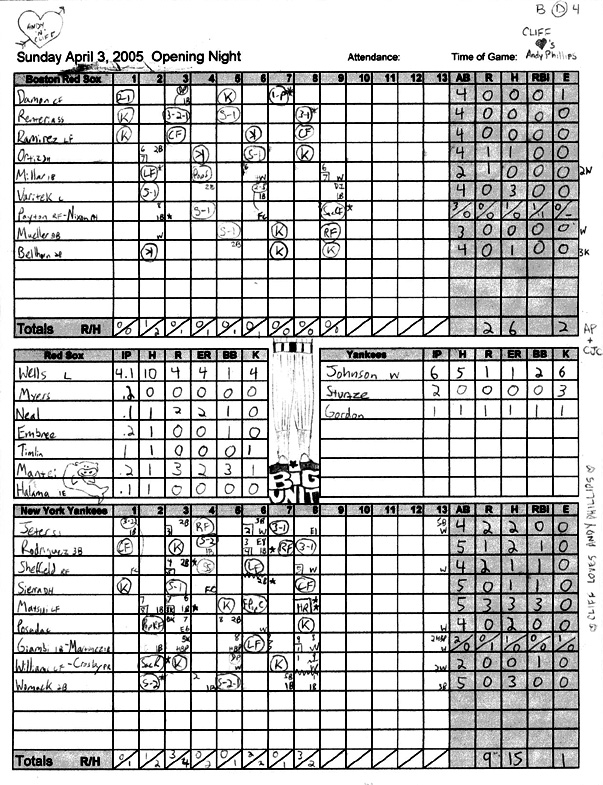
I was pretty far from the action compared to my man Cliff Corcoran, who braved the rain to sit in the rightfield bleachers. Head to Bronx Banter to check his report (complete with scorecard and mash notes to 25th man Andy Phillips, a late add to the roster with Kevin Brown doing what Kevin Brown does best, going on the DL with a balky back).

My own first trip to the Stadium is supposed to happen later this week — I’ve tickets to either Tuesday or Wedesday’s game, but I haven’t gotten my hands on them yet to confirm which date. Last night’s game and an afternoon spent flipping around my new Extra Innings package has me antsy to go. Play ball!

Bronx Baffler

Capping off a rather intensive month of contributions to Baseball Prospectus, I’ve got a new piece today that’s part of BP’s Setting the Stage series. It’s a rather jaundiced look at the Yankee offseason, a shorter and more measured take on my “I’ll Tell You About the Damn Yankees” piece of a couple months back:

I have a confession to make. I’m a fair-weather Yankee fan, bandwagoneer, carpetbagger, flip-flopper of the worst (pin)stripe. Call me what you will; I’ve heard it all and worse. If you’ve read me elsewhere you probably know all this, and it’s nothing new. That’s not what I’m talking about.

No, my confession is this: After a lifetime hating all that the interlocking NY stood for, I moved to Manhattan just in time to be seduced by the class and composure of the Joe Torre team thatended the Bronx’s championship drought in 1996. Over the ensuing seasons, the Yankees have brought me a joy that’s included celebrating their 1999 World Championship with 57,000 of my closest friends in The House That Ruth Built. Now, however, after all of that fun, I’m coming to loathe this team just as I was raised to do.

On the heels of their unprecedented collapse in last year’s American League Championship Series, and on the eve of a 2005 season that opens with them facing the same archrivals who subdued them, this Yankee team fills me with dread. The jig is up; the Yankees have created severe problems for themselves, and the money they’ve used to solve those problems is in considerably shorter supply than they’ve led us to believe. They’re a $200 million tightrope walker, and I have to admit, I’m curious at what the splatter would look like if they tumbled.

I have to admit that I could have gone on for three times the length of the published article — did in fact, but reined myself in before the BP editors could publicly horsewhip me for another War and Peace-length tome. I don’t really loathe the Yanks, just a lot of what they’ve done this offseason. More than the product on the field — and I picked them for the Wild Card with the Red Sox taking the AL East — I worry they’re losing ground to the Red Sox in the front-office brainpower arms race. If it meant a rethinking of the team’s player development and roster construction philosopies, a lonely October and a clearing out of the Tampa deadwood wouldn’t be the worst thing that happened to the franchise. Fortunately, if I’m wrong, I still get to enjoy ballclub that if things break right, ought to have another shot at Championship #27. That’s what we call win-win.

Off to Milwaukee for the weekend, setting the TiVo in time to catch the Opening Night festivities when I return on Sunday. The winter of my discontent is finally about to end, and I couldn’t be happier.

Quick Hit List

I’m pleased to announce a new feature on Baseball Prospectus, one that I will be handling on a weekly basis. It’s called the Prospectus Hit List, and what it is, essentially, is a power ranking of all 30 teams, with some quick commentary. The first edition, which runs today, is based entirely on BP’s PECOTA standings forecasta, which Nate Silver described in his article on the American League:

These standings are based on compiling the PECOTA projections for each team’s rosters as listed in the most recent iteration of the team depth charts that are available on our fantasy page. The depth charts attempt to account for playing time over the course of the entire season, rather than just on Opening Day, which should provide an appropriate reward to teams with superior depth. The individual projections are transformed into team runs scored and runs allowed totals by means of a version of the Marginal Lineup Value formula, and the runs scored and runs allowed totals are transformed into wins and losses by means of Pythagenport. A final adjustment is made based on strength of schedule.

Silver’s article on the NL numbers just went up today, though he provided me with a different iteration which paints a more dire picture of the Giants’ hopes without Barry Bonds. His published numbers bracket the Giants’ win totals at 87 wins for Bonds playing 85 percent of the time and 78 wins at 0 percent; the playing time estimate for the Hit List win total of 81 extrapolates to somewhere around 40 percent. I think it will be higher than that, but it’s clear that any shot the Giants have at playing ball in October is contingent upon his timely return. In a tight division race, one or two wins could be all the difference in the world.

The next Hit List will run two weeks from today, and thereafter it will be a free weekly feature, pointing out trends and leading the way into other BP content. It’s not a new concept, but I hope it’s one our readers will enjoy. As my first shot at contributing to BP on a weekly basis, it should be fun.

• • •

On the subject of BP, Will Carroll turned in a fine article last week that quite frankly has me a late-for-St.-Patty’s-Day green with envy. Rather than focus strictly on injuries as is his specialty, Carroll observed a growing trend in roster management: the multi-position super-utility player in the tradition of Tony Phillips, with Chone Figgins as the best example today. Players like Figgins are a natural to combat both increased roster specialization (those godawful 12-man staffs, especially) and mitigate the effects of injuries on a team. Incidentally, Figgins is my choice for 2004 Futility Infielder of the Year, not that you’d know it since I’ve had plenty of other tasks on my front and back burners.

Writes Carroll of the trend:

In the past, the designation “utility player” was an almost derogatory term for a player who would probably never contend for a starting position, a nice way of calling a guy a bencher. Today, it’s a logical reaction to 12-man pitching staffs. By having one player who can fill several roles, the bench becomes longer, making Figgins the 25th, 26th and 27th man on the roster on those days he’s not starting.

The lack of flexibility this creates is apparent on a team like the 2004 Angels. The team dealt with a significant run of injuries, yet was able to keep players in their defined bench roles because of one factor: Chone Figgins. Figgins would play 92 games at third base, 54 games in center field, 20 games at second base, 13 games at shortstop, two games in right field and one in left field. Instead of being limited to the backup catcher (Jose Molina), infielder (Figgins), outfielder (Jeff Davanon, for the most part), and DH (a combination of players, led by Tim Salmon and whichever injured player needed to be off the field on a given day), the Angels in effect had a bench that was expanded by at least two players. Both Figgins and DaVanon are switch-hitters, making matchup management easier as well.

Good stuff. It will be fascinating to see whether Figgins, a 5’8″, 160 pound waterbug who hit .296/.350/.419 last year, including 17 triples, can have another good season, and how other former superutilitymen such as Melvin Mora (the 2003 Futility Infielder of the Year) and Brandon Inge fare. In the grand tradition of Phillips, these guys are invaluable to their teams, and while they have their limitations, they’re some of the more interesting players around.

• • •

One final BP-related note to pass along. I’ve gotten word through the grapevine that Carlos Gomez, a/k/a Chad Bradford Wannabe, whom I interviewed last spring, has been signed by the Sioux Falls Canaries of the Northern League. Gomez had a rocky season last year with the New Jersey Jackals of the Northeast League, injuring a knee in the spring and being released after pitching only 13.1 innings. He’s a fascinating study in how a player can take the lessons of Moneyball to heart in order to give himself a competitive advantage, great fun to interview and impossible not to root for. Here’s wishing him nothing but the best as he resumes chasing his dream.