I Come to Bury Bonds

Barry Bonds has had a rough offseason. His BALCO grand jury testimony was leaked, he’s endured three knee surgeries since October (two on the right knee), he’s been threatened with a subpoena to appear before Congress, and on Sunday it was revealed that his former longtime girlfriend sang allegations of his steroid usage and potentially unreported income to the BALCO grand jury.

Bonds went to Orange Alert on Tuesday, five days after his most recent surgery. He told reporters that he might miss part or even all of the season, and shifted a good deal of the blame to the media for his physical and psychological ailments:

“My family’s tired. You [media] guys wanted to hurt me bad enough, you finally got there.

“You wanted me to jump off the bridge, I finally have jumped. You wanted to bring me down. You’ve finally brought me and my family down. Finally done it. From everybody, all of you. So now go pick a different person. I’m done. Do the best I can, that’s about it.”

When asked if there was something specific he was talking about, Bonds said, “Inner hurt, physical, mentally. Done. I’m mentally drained. I’m tired of my kids crying. Tired.”

Bonds used the word tired no fewer than 14 times in his soul-baring spiel yesterday, dragging his 15-year-old son into a surreal photo op. If it didn’t sell particularly well, it’s because we’re all as tired of Barry Bonds as he is of… well, everybody. It’s tough to muster sympathy for the man right now. He’s spent the past five years thumbing his nose at the media, and for him to blame them for his downfall is both laughable and pathetic. His problems beyond these multiple knee woes are of his own making, from his involvement in BALCO to his alleged tax woes to the ways he’s defied reporters over the years.

The brazenly defiant stance works well when you’re hitting homers at unprecedented rates and can tell writers exactly how far up their own ass they can go, but not so well when you don’t have a bat to do the talking. So Bonds switched to playing the sympathy card, perhaps because after watching the media coil rope for Mark McGwire in the wake of his Capitol Hill clam-up, he realized that playing the race card was an even tougher sell.

I’ll be the first to admit that I’m not the world’s biggest Barry Bonds fan, though my distaste for the man goes well beyond which side of the fence I fall in the Dodger/Giant rivalry. In the manner of another another megasuperstar, Michael Jordan, Bonds’ combination of arrogance and dominance has left me ever colder as the broken records piled up. For all of the grandeur of his accomplishments, he’s spent too long showing the world his own hard-heartedness, and on Tuesday the world received the opportunity to give that lack of love right back. He’s as much as told us he didn’t need anybody in his corner, and now that’s exactly what he’s got.

I’m sorry Bonds’ body isn’t working and that he won’t be able to make Opening Day. Beyond that, I’m just fine watching his chickens come home to roost, watching him at the center of this Greek tragedy, felled by his own hubris. My inner Nelson Muntz is having a field day. Cue the “Schadenfreude” song.

During his homer-happy ascendency, I had maintained a cool neutrality when it came to Bonds. Pitched to or around, either way it made the highlight footage, but at some point the homers became as boring as the walks, the spectacular mundane. The big shot at the World Championship that had long eluded him? I couldn’t root for the Giants there, but I was happy to see him shed his lingering reputation for postseason choking. Happier still to see him misplay Troy Glaus’ hit in the rally that forced a seventh game.

Mostly neutral I was, until Bonds started smack-talking the Bambino in the summer of 2003:

“The only number I care about is Babe Ruth’s. Because as a left-handed hitter, I wiped him out… That’s it. In the baseball world, Babe Ruth’s everything, right? I got his slugging percentage and I’ll take his home runs and that’s it. Don’t talk about him no more.”

The slight was unnecessary and inaccurate, even coming from a star of Bonds’ magnitude, because for all of the records the Bambino held or still holds, it’s his cultural impact and his legend that remain even more impressive. Just ask Pedro Martinez about the wisdom of tap-dancing on the Bambino’s grave, or the entirety of Red Sox Nation, which spent 86 painful years trying to chase his ghost away.

As I pointed out , Bonds’ comments were factually way out of line.

• Bonds (.595) is still 95 points of slugging percentage behind the Babe (.690), and one year or two years or five of BB at his current level ain’t gonna get him there even if he passes Ruth in total homers.

• Bonds would still need to rattle off something along the lines of a 94-46 record with a 122 ERA+ as a pitcher to approach the Babe’s total contribution on the diamond in the regular season.

• Bonds would need to PITCH THE RED SOX TO A WORLD CHAMPIONSHIP (or two) before he could top the Babe as far as World Series feats go.

• When that happens (i.e., when Hell freezes over and I vote Republican), Bonds will still trail the Babe in the sheer weight of his total contribution to American culture. Where’s Barry’s home run for the dying kid, or his “Called Shot”? Who cares that he makes more than the President of the United States? Which enemy of ours will charge into battle telling American soldiers, “To Hell with Barry Bonds!”?

Soon afterwards, I found myself in Bonds’ corner. His raw displays of emotion upon the deteriorating health and ultimate death of his father, Bobby Bonds, showed an unseen side at a time when the topic of fathers and sons was heavily on my mind; I had recently Roger Kahn’s The Boys of Summer while backpacking with my Dad. Keyed by an amazing Dan Le Batard article in ESPN Magazine, I wrote a piece that remains a personal favorite:

Whether we grow up to be ballplayers or writers or brain surgeons, as children we come to the game via our fathers (and sometimes our mothers) — somebody who throws us fat whiffle-ball pitches in the backyard, who explains why the glove goes on the opposite hand from the one we throw with, who takes us to the ballpark for the first time and patiently endures our barrage of questions as we struggled to reconcile the stadium game with our own narrow backyard experience, who teaches us how to read a box score and how to fill out a scorecard. Ideally baseball isn’t the only vehicle for our bonding, but it’s a sure one, with a built-in mechanism for measuring the passage of years and our own growth.

…I didn’t turn out to be a beat reporter like Roger Kahn or a big-league ballplayer … But I’m lucky enough to have my sixty-two year old father still coaching me, advising me on the finer points of work, money, travel, fishing, wine, women, and song. I can only imagine the devastation, the void I would feel if I lost that at a time, like Kahn and Bonds, when I feel my best days — marriage, children, maybe a book, whatever — are still to come. My heart goes out to Barry Bonds, who’s finally showed me that he has one.

…We can pile the superlatives on Barry Bonds, and marvel at his eye-popping numbers. But whatever words we ascribe to him, “immortality” is one we can skip. This sad summer has shown us all just how mortal Barry Bonds is, and how mighty his accomplishments are in the face of that.

It didn’t take Bonds long to piss away that reservoir of sympathy, however. Two months after that article, he announced that he was pulling out of the Major League Baseball Players’ Association’s licensing agreement, a cash grab out of naked greed.

Then came BALCO and the leaking of grand jury testimony, which for purposes of brevity and vomit reduction, I’ll skip except to say that Bonds’ preservation of deniability in his own testimony was seen as one more act of defiance. Flax seed oil? Right. The media couldn’t hang him as they did Jason Giambi, but Bonds’ slippery denials only increased their appetite for blood.

Thanks to his good fortune never to have played with Jose Canseco, he managed to keep a relatively low profile this spring, even as the Congressional Hearings on Grandstanding Over Steroids put the topic on the front pages. The day of the hearings, Bonds went down for his third surgery of the winter, one that was reported as putting him out of the season’s first month. The anesthesia had hardly worn off before the San Francisco Chronicle ran with the girlfriend story:

Prosecutors in the BALCO steroids conspiracy case subpoenaed a former girlfriend of Barry Bonds to testify before a federal grand jury in San Francisco last week, questioning her about the Giants star’s finances and whether he used steroids, The Chronicle has learned.

Kimberly Bell, 35, a graphic artist from San Jose who says she dated Bonds from 1994 to 2003, told the grand jury Thursday that in 2000, the left fielder confided to her that he had begun using steroids, according to two sources familiar with an account of her testimony.

Bell also testified that in 2001, Bonds had given her $80,000 in cash — earned, she claimed, from his sale of autographed baseballs and other memorabilia — to make the down payment on a house for her in Scottsdale, Ariz., near the Giants’ spring training facility, the sources said.

True or not, leaked or not, the money issue means that the IRS heat is now on Bonds, if it weren’t already. That may be the straw that broke the camel’s back, because suddenly Barry Bonds has bigger fish to fry than the home run records of Babe Ruth and Hank Aaron. Even if he’s not the target of the BALCO investigation, tax evasion is a different problem entirely. Nobody wants the IRS up in their grill. Just ask Pete Rose.

As real as Bonds’ frustration and as serious as his legal situation may be, his timetable for returning is probably overstated. The guess here is that he’ll miss no more than two months of the season. His world may be a mess, but the one place Barry Bonds can control things is in the batter’s box. Without that control and outlet for his anger, he’s lost. But don’t expect any cheers here if and when he surmounts the Babe and the Hammer, and don’t be surprised at the frigid response he receives from fans outside San Francisco. Bonds has never taken them into his heart, why should they take him into theirs?

For more coverage of Bonds’ situation and its impact on the Giants, please check out my latest Prospectus Triple Play at BP.

Spitting Distance

Roberto Alomar, the gold standard of second basemen for the better part of his 17 years in the bigs, called it quits over the weekend. Like most fans, I’m amazed at how rapidly he declined from being one of the game’s best players. His most valuable season according to Baseball Prospectus’ Wins Above Replacement Player figures was 2001, but the wheels started falling off as soon as he was traded to the Mets that winter.

Even moreso than his precipitous decline, I’m amazed at how many fans and writers seem to think that this early end to his career will cost him a spot in the Hall of Fame. To counter that, I did a new piece for BP showing where he fits in using the JAWS (Jaffe WARP Score) system. As it is, Alomar’s JAWS is higher than all but five of the 16 Hall of Fame second basemen:

                      WARP   PEAK   JAWS
1. Eddie Collins 174.0 57.2 115.6
2. Nap Lajoie 164.5 56.7 110.6
3. Joe Morgan 157.7 61.9 109.8
4. Rogers Hornsby 150.7 63.2 107.0
5. Charlie Gehringer 126.7 54.2 90.5
X. Roberto Alomar 126.8 47.3 87.1
6. Rod Carew 111.8 49.4 80.6
7. Frankie Frisch 113.4 40.9 77.2
8. Billy Herman 98.3 47.9 73.1
9. Bobby Doerr 100.8 44.3 72.6
10. Jackie Robinson 84.8 55.0 69.9
11. Bid McPhee 95.0 38.0 66.5
12. Bill Mazeroski 89.2 37.5 63.4
13. Nellie Fox 86.2 38.7 62.5
14. Red Schoendienst 85.8 38.9 62.4
15. Tony Lazzeri 77.8 37.8 57.8
16. Johnny Evers 65.7 31.8 48.8

That’s a hell of a player. Only his decline and the memory of the infamous spitting incident — which he did his best to turn into a positive by donating money to research the disease which took umpire John Hirschbeck’s son — threatens to delay his bronze plaque in Cooperstown.

Also in the piece, I took a look at what I call the List of the Damned, the small handful of players who aren’t active, aren’t on either the BBWAA or Veterans Commitee ballots (or awaiting the five years prior to the former), arent ineligible, and have a JAWS higher than the average Hall of Famer at their position. These are some of the most frequently asked about players when I do my JAWS pieces — Bobby Grich, Lou Whitaker, Ted Simmons, Dwight Evans, Darrell Evans — and while length prevented me from saying everything I wanted to say about them, I did at least put all the numbers in one handy spot. If this newfangled Vet Committee ever gets its shit together — you can stop laughing now — these are some of the guys I’d like to see get a shot, particularly Grich.

It’s a premium piece, so subscribe today if you haven’t already.

Daytime Television is Not Pretty

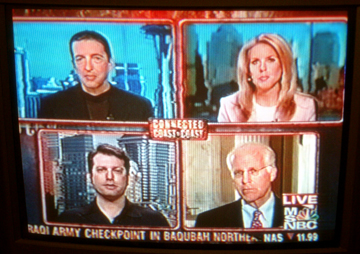
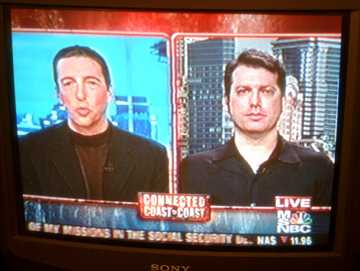
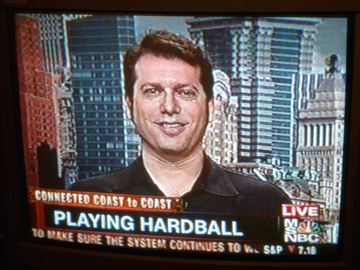
I wish I could report that I gave myself the highest marks for my appearance on MSNBC’s Connected Coast to Coast. But having reviewed the tape several times, it’s pretty clear that a smooth pro I was not. Keith Olbermann’s job is safe, and I don’t think his former employers will be calling me anytime soon either.

Unlike most shows — say, my pal Will Carroll’s appearance on The Big Idea with Donnie Deutsch on Monday night, where he was in a three-person battle royale with the host (and some of those guys could have made their points more subtly with folding metal chairs) — I was completely isolated not only from the other guests, but from hosts Ron Reagan and Monica Crowley as well. Reagan (yes, the former president’s son, though he bears more resemblance to mother Nancy) and Crowley are 3000 miles apart, with the former in Seattle and the latter in New Jersey. The show takes place live, and much of it features boxed talking heads in two- or four-way split screens, with a godawful news ticker crawling below at all times. A visual feast it is not.

Having never done TV of any stripe, I had no idea what to expect, but by the time I was called upon to enter the “set,” I knew this was a bare bones job. Just a little room with me sitting at a desk in front of a nondescript skyline backdrop. I opted to go sans glasses (which I can’t see without) because when Andra grilled me in preparation the night before, I found myself better able to concentrate when I could avoid the outward distractions. At the producer’s advice, I decided to forego the monitor to eliminate one more distraction, since I had been warned by several people not to look into it and away from the camera, lest I look shifty.

So it was me alone in a tiny room, with an earpiece and clip-on microphone, staring at a fuzzy blob that purported to be a camera. I thought this would make the whole thing seem a bit more like my appearances on Baseball Prospectus Radio, but the reality was much more complicated. I had to follow along through the first 10 minute segment of the show, getting a feel for the rapid jumps from speaker to speaker, recognizing the voices of of Senator John McCain and President George W. Bush (a Reagan, a Bush and a Jaffe on the same show — now that’s rich). As I listened to what Reagan, Crowley, and guests Congressman Christopher Shays (R-Connecticut) and Mike Wise of the Washington Post, I found myself disagreeing nearly every time they opened their mouths, particularly Shays, but I had no one to take my complaints.

Finally, after the commercial break came my turn, and I stumbled out of the gate. After sharing a laugh with Reagan over the site’s name, I got flustered by his first question, when he assumed that my chapter in Carroll’s book The Juice (the title and author of which went unmentioned) was about how steroids WERE rewriting the record book. All of my well-rehearsed talking points went out the window, and to borrow a metaphor from another sport, I had to scramble just to get back to the line of scrimmage. Not a great start.

I did better in my second spot, scoring a couple of good points, but I was never fully at ease, as I literally couldn’t see what was coming next. All I could do was react, and as a rookie in this unforgiving medium, that made for a less than professional presentation.

Worse, I didn’t see until later upon reviewing the recording that I looked like a sweaty hired goon. No makeup (none was offered), and the unforgiving fluorescent bulb in my room made every shadow on my face stand out. I looked like death at times.

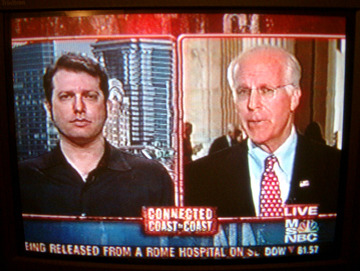
And sometimes I just looked silly; praise Jesus Alou I didn’t pick my nose. There’s at least one point where I’ve got face time in a two-up shot with Shays and I’m just sitting there blinking like a sedated toad. Of course it probably came off as me looking unimpressed by what he had to say, which is the truth.

Anyway, most of my friends and family who saw the show say I did very well. I’m not so sure I agree — there’s plenty of evidence to the contrary, and I’m not hiding it. You can hear my segments here (3 mb MP3), and the photos have already been somewhat retouched to take away the worst of the shadows — I’m not vain but I ain’t a masochist either. For the truly insane devoted, I’ll have a QuickTime clip of the show for download this weekend.

But as much as I could quibble with my appearance and my performance — I’m not even going to touch the arguments on the show for the moment, as I’ve spent the past 24 hours dwelling on that topic — I’m grateful for the opportunity to go on the air, and proud of the work that earned me that shot. It’s not every day that a guy likes me gets plucked out of the crowd to go on TV, and this site got a nice amount of exposure. I want to thank everybody who offered words of encouragement and support, and who took the time to tune in, and I’d like to welcome any of the show’s viewers visiting here on the heels of my appearance. I’ll sleep better knowing that this is one particular first I never have to go through again, and that the bar for improvement the next time around isn’t all that high.

For Those of You Just Tuning In

I’ll be the first to admit that I don’t really like writing about steroids. The topic tends to anger my blood, though as I’ve reviewed some of the things I’ve written over the past year or so in preparation for my 15 minutes (or whatever) on MSNBC’s Connected Coast to Coast (12 noon EST/9 AM PST Wednesday), that anger isn’t solely directed where you might expect, at the players who may or may not have used illegal performance enhancers.

It’s an anger that encompasses the owners for bargaining in bad faith for over thirty-five years and trying to break the Major League Baseball Players Association with tactics like collusion and picket-line-crossing replacement players. That ill will has prevent them from creating an environment of trust in which they could join the players in developing a sensible testing program prior to the 2002 Collective Bargaining Agreement. It’s an anger at Commissioner Bud Selig for keeping his head in the sand while such a debacle took place on his watch.

It’s an anger that also directed at the nation’s sanctimonious sportswriters, who are only too quick and too happy to turn on those players whose pedestals they’ve invested so much time constructing. It’s an anger at the writers who feel perfectly at home taking shots at a guy like Jason Giambi for not talking about what, on the stern advice of his both federal prosecutors and his own counsel, he has no business talking about at this time. It’s an anger at the writers who stand on their soapboxes feeling qualified to act as judge, jury, and executioner without acknowledging that the players tainted by this scandal have not been charged with any crime in a court of law.

It’s an anger at the political grandstanding that has produced these Congressional subpoenas. There’s a lust — a prurient interest, as the lawyer for the commissioner’s office put it last week — to find out who did or didn’t use illegal performance-enhancing drugs that threatens to trample such pillars of our society as due process and the right to privacy. This is a three-ring circus that may well turn into a witch hunt, with pitchforks and torches available at the concession stands.

What follows are a handful of links to my writing on the topic of steroids. Reviewing these in a late-night cram session as I prepare to go on TV tomorrow later today, I’m proud of their quality despite my distaste for the matter. I think they comprise some of my best work over the past year, and I stand behind every word I’ve written:

• March 5, 2004: Avoid the ‘Roid Noise

• December 4, 2004: The Giambi Debacle

• February 9, 2005: Bad Moon Rising

• February 11, 2005: You’re F—— Kidding Me, Right?

• February 15, 2005: This Week in Juicing

• March 10, 2005: Here Comes the Witch Hunt

I’m Bad, I’m Nationwide… and I’m on TV

Earlier this evening I accepted an invitation to appear on MSNBC’s Connected Coast to Coast with Ron Reagan and Monica Crowley. The show will air tomorrow (Wednesday) at 12 noon EST/9 AM PST. According to the producer, “[W]e are doing a segment on the latest with steroids and baseball and are also looking for a blogger to give a unique perspective on this topic.” I’m not entirely sure that this is connected to Will Carroll‘s appearance on CNBC’s The Big Idea with Donnie Deutch on Monday night, but Will told me he passed my name along to CNBC’s people, so it’s entirely conceivable.

It’s a live via satellite setup, meaning that I won’t need the folding metal chair that Will so sorely could have used to subdue the juiced-out ex-bodybuilder who could supposedly identify steroid users on site. No, I’ve never been on national TV before, live or otherwise, even on the upper reaches of the cable docket. I am going to practice not hyperventilating for the rest of the evening.

Please set your TiVos and VCRs (does anybody still use those?) accordingly…

The Rookie

After attending some half a dozen Baseball Prospectus pizza feeds and bookstore events over the past few years, this past week found me on the other side of the podium for three New York City appearances. Granted, I wasn’t the star attraction, not in a Murderer’s Row lineup that’s included Steve Goldman, Joe Sheehan and Chris Kahrl, three of the best baseball writers in America, for my money. In fact, I wasn’t even listed on the bill. But as I’ve said before, you can bat me ninth in that lineup any time. My new colleagues made me feel more than welcome in addressing the audience about BP’s philosophy and fielding questions on a wide variety of topics.

On Saturday evening at Coliseum Books, I dropped the ball, however, and while it wasn’t a crucial error, I spent the rest of the event kicking myself for not being quicker with a quip. The microphone had made its way down the row from Chris to Steve to Joe, with the topic of conversation turning to the Blue Jays, a team which, though it features BP alum Keith Law in their front office, has spent the past winter moving in a direction that appears to be less sabermetrically informed than before, with the BP 2005 essay quite critical of that direction.

Joe finished his response to a question about that essay and then turned to me with the microphone and said, “I think Jay has something to say on this.”

“I do?” I looked up at him and then out at the crowd. I froze as if I were looking at a belt-high fastball while sitting on the curve. I had nuthin’. Vapor lock. Strike three. Sit down, rookie. It really didn’t help that I already was sitting.

The microphone went back to Steve and the conversation turned to the Yankees. As Steve grew more and more animated in his answers about the Yankees — he looked ready to jab his finger into George Steinbrenner’s chest — I mentally checked out for a moments, scolding myself. Just prior to the Blue Jays question, somebody had commented about the Twins, a team I cover for BP’s Triple Play department. Damn it, I thought to myself, I did have something to say.

Fortunately, I got a chance to say it at Monday night’s event, and even got a little mileage and a few laughs as I self-deprecatingly described my big freeze and my status as the non-roster invitee on the panel. My point came amid the longest portion of the night’s discussion, one in which all four panelists chimed in on a question about successful teams that don’t appear to pay heed to performance analysis and don’t construct their teams in a way that BP might espouse. The question came from somebody using the Angels as an example.

The point I’d been itching to make was that the thread that runs through Baseball Prospectus’ work is about building a better ballclub and a better game. People might criticize BP for getting on a particular team, but that doesn’t mean we have it in for them or that we think just because they adhere to a philosophy that differs from ours that they’re wrong and we’re right. We get on a team when we can see misallocated resources and missed opportunities.

A few days ago I was reading John Bonnes, who writes a blog called the Twins Geek and has been for several years. John follows his team very closely and very well, and is a big enough player in his market that he’s got some access. Recently he interviewed Terry Ryan, the GM of the Twins. In the third installment of his interview, he had set up an opportunity for Ryan to address BP’s Twins essay (which I didn’t write) which chides the Twins for putting up with “good enough” and not aiming higher. Since I can quote in this medium rather than paraphrase, here’s Johnny:

The night before I interviewed [Terry] Ryan, my Baseball Prospectus 2005 arrived in the mail. It continued to perpetuate a myth that they had started and the blogging community has embraced — that the Twins hold themselves back from a championship caliber level by focusing on winning the AL Central. I repeated the argument to Terry and gave him a chance to talk about wanting to win the World Series. Just the opposite happened.

“Our objective is to win the AL Central”, he stated matter-of-factly. He constructs his roster to come out on top over six months. He believes, like the writers at Baseball Prospectus supposedly do, that the best team consistently comes out on top over a 162 game season. The same cannot be said in a seven game series, which for a GM, is about a team getting hot at the right time.

But surely he at least thinks the Twins are a team that could do some damage in the playoffs. After all, look at the front of their rotation and their bullpen….

“I don’t even think about the playoffs John.”

Check, please.

The point isn’t that they we happened to be “right” and Bonnes “wrong,” or that he equated something we’ve been charging for years, that the Twins do limit themselves, with myth perpetuation. As the book essay pointed out, the Twins are now in a select group of a dozen teams that have won 90+ games three years in a row without winning a pennant, and if one examines their moves during that span, their decision making patterns do suggest settling.

As a baseball fan and an analyst, I want to watch the Twins succeed, and I’m fine if they don’t do it the Billy Beane way, by emphasizing OBP and station-to-station baseball at the expense of the stolen base and the sac bunt. The Twins play in a dome and they’re one of the three turf teams remaining, and as such, they need to value speed a bit more highly than, say, the A’s. But what I’m not fine with is the consistency with which a team with a payroll in the $50-60 million range throws away money better spent elsewhere.

The Twins need to count every bean, so then why do they do things like re-sign Shannon Stewart to a three-year, $18 million deal (as they did after the 2003 season) or Jacque Jones to a one-year, $5 million deal (as they did at the arbitration deadline in December) when numerous decent low-cost alternatives exist within the organization? They’re are a corner-hitter producing factory. Over the past few years they’ve come up with Michael Cuddyer, Michael Restovich, Lew Ford, Justin Morneau, Matt LeCroy, Bobby Kielty, Michael Ryan, Dustan Mohr, Jason Kubel — useful ballplayers, many interchangeable with each other and with the previous cohort of Joneses and David Ortizes, some with higher ceilings than others. As Joe joked last night, four guys had to get shot to give Ford, who hit .299/.385/.450 as a 27-year old “rookie,” his playing time.

The team would have been better off not signing Stewart or not signing Jones and spending that $5-6 million on a third starter better than Carlos Silva or Kyle Lohse to improve their chances in a short series. They’d be better off giving Cuddyer a shot at second base, where he’s done well in limited duty (a 105 Rate2, five runs above average per 100 games, according to BP’s stats) instead of re-signing Luis Rivas for another $1.625 million. If they need a safety net for rookie Jason Bartlett at shortstop, they can do better than locking up Juan Freakin’ Castro for two years at $2.05 million. Guys like Castro should be non-roster invitees who luck into spots at the minimum salary by having hot spring trainings, not players on who you blow $50K for a third-year option.

Which isn’t to say the Twins don’t do some things right. Letting fan fave Corey Koskie go to Toronto for three-years and $17 million (a focal point of the aforementioned Jays essay) was a bullet dodged. Letting Cristian Guzman go to D.C. after years of mediocrity was the right call. Keeping Justin Morneau in the minor leagues for half a season rather than advance his service clock may save them a couple million in arbitration down the road, and the Twins have a tendency to game the system in that manner, as I’ve pointed out in a past PTP. Locking up Cy Young winner Johan Santana for four years and $40 million was absolutely necessary.

There’s more than one way to skin a cat, as the Twins have shown, and if they want to settle for 92 wins, they’ve got a good shot at the division. But if they don’t claw for every single edge, they’ll soon find themselves looking up at the Indians, a progressively-run team on the verge of jelling, as they spend a lonely October wondering what went wrong.

Anyway, that’s a longer version of the spiel I went into on Monday night, one that hopefully sheds a little light on what BP does. I do want to thank everybody who came out to one of the three bookstore events — it was a pleasure to meet people who’ve been reading me both at BP and here — and to Joe, Chris, and Steve for letting me share the stage with them and to call me one of their own now.

Riding the Sillybus

According to an entry from Aaron Gleeman, yours truly is now poisoning the minds of America’s collegiate set:

There appears to be an actual class at Tufts University called “The Analysis of Baseball: Statistics and Sabermetrics.” Seriously, it even claims to count towards an American Studies major. If you’re a fellow college student, I defy you to read the syllabus for the class and not want to transfer schools immediately. Or at least kill yourself the next time you’re sitting in a biology lecture.

The required texts for the class include Moneyball and The New Historical Baseball Abstract. During the third week of class, the discussion will focus on the “limitations of traditional batting statistics,” “count vs. rate stats,” and “details of OPS, OPS+, and Runs Created.” Required reading for Week 3? Jay Jaffe’s DIPS page and a Bill James essay entitled “Mark Fidrych and the K.”

Wait, there’s more. In Week 5 the class will discuss “The Mazzone Effect.” Week 6 focuses on “shortcomings of traditional fielding statistics” and assigns 40 pages of James’ Win Shares book as required reading. Week 7 includes discussion of VORP and Win Shares, and assigns Nate Silver’s “Introducing PECOTA” essay from Baseball Prospectus 2003 as required reading.

Are there classes like this at other schools? And if so, why was I not informed of this, say, four years ago?

Amusing, though nothing to get a swollen head about given that my latest claim to fame is based on doing the gruntwork of compiling the latest links on the topic of Defense Independent Pitching Statistics (invented by Voros McCracken) and tying a neat little bow around them in the form of last year’s numbers. Still, I wouldn’t play the role of Data Donkey if I didn’t think it was important in this case (not to mention a drawing card for the site) and I guess that’s some proof to the pudding. If anybody reading this is dropping by from that course, I’d love to hear about it.

The Futility Infielder says, “Stay in school, kids. Don’t become a destitute blogger like me.”

Here Comes the Witch Hunt

I won’t mince words: the shit just got one step closer to hitting the fan. Today comes the news that the United States Congress plans to subpoena a handful of star players to testify about steroids in baseball. Furthermore, they plan to subpoena the results of steroid and other drug tests, with the likelihood that they’ll be entered into the public record, effectively outing players who were tested with a guarantee that those results would remain private. Ladies and gentlemen, here comes the witch hunt.

Not surprisingly, Major League Baseball plans to fight the subpoenas:

Stanley Brand, a lawyer for the baseball commissioner’s office, said the committee had no jurisdiction and was interfering with the federal grand jury by trying to force testimony from Giambi and others. He said the committee wanted to violate baseball’s first amendment privacy rights and was attempting to “satisfy their prurient interest into who may and may not have engaged in this activity.”

“The audacity, the legal audacity of subpoenaing someone who’s been a grand jury witness before there’s been a trial in the case in California is just an absolutely excessive and unprecedented misuse of congressional power,” Brand said.

“Not even the Iran-contra committee attempted to do that, and when it did, it tainted irreparably the prosecutions that came out of that investigation. Now if that’s what Congress wants to do to advance what it says is the public interest in combating a very serious problem that baseball has confronted, then in my judgment they’ve torn loose from their legislative moorings and they’re marauding in an area of the law that has very serious consequences for the judicial system.”

Note that this came from the commissioner’s office, not from the players’ union. If there’s one thing labor and management can agree on, it’s that they don’t need political grandstanding from the likes of John McCain and his Congressional cronies here.

Though I’m the first to admit that it’s not my favorite topic to write about, I’d love to have the time to sit down and spill one or two thousand harsh words on this today. Alas, my schedule prevents me from penning that particular column, so instead I’ll point you to Jayson Stark‘s piece at ESPN. I don’t usually find myself agreeing with much of what he writes, but he is spot on here:

It’s fine for talk-show hosts and talk-show callers to adopt that time-honored, un-American precept that men are guilty until proven innocent. Hey, that’s show biz.

But when the United States Congress stages an event in which guilty-until-proven-innocent will, essentially, be the central theme, it makes us a little uncomfortable.

…Not that any player who used steroids with an intention to cheat doesn’t deserve to be fried from coast to coast. But this is no way to find out who did and who didn’t.

By asking these questions, in this setting.

By subpoenaing steroid-test results that would violate the right to privacy of people who justly negotiated that right.

By acting as if any of this will “clean up” a sport that finally has a respectable banned-substance list which isn’t all that different from the lists of the other pro sports.

It is, after all, a little late to clean up whatever was going on in baseball in 1998, or 1993, or even in 2001.

Those yachts have all sailed. Whatever people used or didn’t use back then, no one is going to be able to jump into a time machine and stop it.

As I advised a couple of weeks ago, get out your hip waders. You’re going to need them, because this stuff is deep.

• • •

I’d like to offer my congratulations to a handful of my closest pals in this Internet baseball racket who have bonded together to form Baseball Toaster, a new site featuring many former All-Baseball.com writers and blogs. Alphabetically, they are:

Bronx Banter — Alex Belth on the Yankees, now with 100% more Cliff Corcoran than before. My bruthas on the New York baseball scene.

Catfish Stew — Ken Arneson on the A’s

Cub Town — Alex Ciepley and Derek Smart

Dodger Thoughts — Jon Weisman on the boys in blue

Fairpole — homepage for the site’s software, designed by Arneson

The Griddle– the site’s group blog

Humbug — the poet laureate of baseball blogs, the Score Bard

Mike’s Baseball Rants — Mike Carminati on the Phillies and whatever else strikes his fancy

Post-Messenger — Will Carroll and his partner in web-racketry, Scott Long announced yesterday that they’ll now be delivering content for a small Indiana newspaper’s sports section called the Tri-County Post-Messenger, hence the name. Check Will’s take on the steroids-n-congress news. I should add parenthetically that Will’s got a forthcoming book (mid-April) on the topic of steroids called The Juice: the Real Story of Baseball’s Drug Problems, to which I’ve contributed a lengthy, data-driven chapter entitled “Do Steroids Rewrite the Record Books?” I’ll have plenty more to say about all of that soon.

These are my go-to guys, and I’m excited for all of them as they launch this new venture. Best of luck, dudes.

Paper Blue Jay

In 1922, a young sportswriter named Paul Gallico made arrangements to step into the boxing ring for a single round against heavyweight champion Jack Dempsey. Predictably, he got the snot beaten out of him, though he took pride in having departed the event in one piece, “knowing all there was to know about being hit in the ring. It seems I had gone to an expert for tuition.”

In 1960, inspired by Gallico’s bravado, one of the great writers of the century, George Plimpton, pulled some strings through Sports Illustrated (where he was a frequent contributor) and found himself on the hill at Yankee Stadium, pitching to an all-star lineup of National Leaguers. Richie Ashburn, Willie Mays, Frank Robinson, Ernie Banks, Frank Thomas (the original), Gil Hodges, Stan Lopata, and Bill Mazeroski took their hacks against the amateur Plimpton (who, in a nod to T.S. Eliot, was pitching under the assumed name of Prufrock), chasing him in short order.

Plimpton turned his account of his struggles that afternoon into a book, Out of My League: The Classic Hilarious Account of an Amateur’s Ordeal in Professional Baseball. It was a classic in short order, with no less than Ernest Hemingway hailing it as “the dark side of the moon of Walter Mitty.” The tale was so well-received that he returned to that style of “participatory journalism” for several more books, including Paper Lion: Confesions of a Last-String Quarterback, The Bogey Man: A Month on the PGA Tour, Shadow Box (in the ring against Archie Moore) and Open Net (as a goalie for the Boston Bruins).

Into this grand tradition steps Sports Illustrated‘s Tom Verducci, who spent five days in spring training with the Toronto Blue Jays, an experience which is the cover story of this week’s issue. Verducci (whom I’ve had the pleasure of chatting with at the past two winter meetings) is 44, slender, and athletic-looking, but his baseball skills are admittedly rusty:

Excluding handfuls of pickup games involving other sportswriters, I have not faced live pitching in more than 23 years, since a Rudy-like career at Penn State spent almost entirely as an outfielder on the practice squad. I have not hit with a wooden bat since I was 10, and that one was held together with nails and electrical tape.

The story opens with Verducci’s tableau of life in leftfield:

With a change in perspective, the familiar becomes intensely intimate, like actually standing on the blue carpet of the Oval Office or feeling the floorboards of the Carnegie Hall stage beneath your feet or leaving footprints upon the Sea of Tranquility. It is not an out-of-body experience but rather its opposite: a saturation of sensations.

It is also a little like transporting dynamite on your person. A feeling of power, yes, but with a constant undercurrent of danger, especially knowing that Blue Jays first baseman Eric Hinske, who keeps fouling off pitches like a finicky shopper picking through unripe fruit, could at any moment send a curving line drive screaming my way or, worse, loft a fiendish high fly into that bright, cloudless sky and cruel cross-field wind, leaving me to look as if I were chasing a dollar bill dropped from a helicopter.

Verducci takes us through his five days in the Jays’ camp, where he partakes in every BP session, runs every windsprint, shares in every clubhouse joke. He steps in against Roy Halladay and is impressed by the 2003 Cy Young award winner’s “angry” fastball, but he’s even more dazzled by Miguel Batista: “He has about eight varieties of pitches, and all of them move like a rabbit flushed out of a bush. He throws me one pitch that I swear breaks two ways — first left, then right — like a double-breaker putt in golf, only at about 90 mph.” Verducci then reminds himself that Batista (or Shitty Poet, as he’s known around these parts) was only 10-13 with a 4.80 ERA last year. To borrow a favorite line from The Great American Baseball Card Flipping, Trading, and Bubble Gum Book, “Dear Ma, I’ll probably be home sometime next week. They’re starting to throw me the curve ball.”

Over the course of his account, Verducci pitches in with plenty of observations about the cameraderie of the locker room, the personalities of the Jays’ budding stars, the techniques of the team’s coaches, and the rites of spring training — right down to the pink slip. On day five, he finally gets into an intrasquad game. While he doesn’t flail (or fail) quite as badly as Plimpton did — and with all due respect, he’s no Plimpton on the page either — his account (and the accompanying self-interview) still makes for a unique and entertaining glimpse at a side of the game most of us would kill to experience.

• • •

If you’re in the New York City area, I invite you to a Baseball Prospectus bookstore event tonight (Wednesday) at the Barnes and Noble on 106 Court Street in Brooklyn at 7 pm. Steve Goldman and Joe Sheehan will be plugging BP 2005 and answering questions, and I just may step into the box for a few myself. There are a couple more BP events in NYC on tap for this Saturday and next Monday; see below or here for details.