Buried Treasure

I’m here in the land of the polygamists and the arcane liquor laws, the land where I grew up and where my parents still live, Salt Lake City, Utah. Tomorrow I head off to Jackson Hole, Wyoming, and then to the wilderness of the Beartooth mountain range for a backpacking trip with my father, so I’ll be off the grid for the coming week.

Since I’ve been here, I’ve been sifting through a cabinet full of well-preserved sports memorabilia which I’ve preserved in my old bedroom. Among the items I came across today were a couple of Walla Walla Padres programs from the early eighties. My grandparents live(d) in Walla Walla, and when we were young, my brother and I would spend a couple of weeks every summer up there in a sort of baseball-immersion camp. In the morning my grandfather and I would walk down to the grocery store to get the morning paper, and we’d read the boxscores and game summaries on the way home. After that we’d go to the park and he would pitch to us. We’d stand at home plate facing the backstop, and he’d give us five pitches per turn. We counted our hits based on how high up the backstop they hit–one rung a single, two rungs a double… over the wall a home run. After lunch, we might play some catch, then in the evening we’d probably–unless this was 1981, the year of the strike–watch a game on TV (he was an early adopter of ESPN) or go to a Padres game.

The Walla Walla Padres were part of the Class A Northwest League from 1972 through 1982, coincidentally the last year I spent much time up there. The two programs I have here are from ’81 and ’82, and covered in autographs of various players, mostly pitchers as the bullpen was very accessible. The ’81 Padres featured a couple of very memorable ballplayers who went on to play in the major leagues. One was John Kruk, the pudgy, mulleted slob extraordinaire who gained fame as a member of the 1993 National League Champion Philadephia Phillies. Kruk titled his autobiography after one of the all-time great quotes: “I Ain’t an Athlete, Lady, I’m a Ballplayer.” I bought a copy for $1 awhile back for some very light reading.

Anyway, the other memorable player on that team was Tony Gwynn, of whom you’ve probably heard. I was already familiar with Gwynn by this juncture, because he played basketball and was the starting point guard at San Diego State, which was in the same conference as the University of Utah. Imagine Tony Gwynn as a point guard now… Gwynn didn’t last long in the Northwest League, hitting .331 and leading the league before being called up to Amarillo (AA). He was in the majors by July of the next season, and the rest is history. Also on the Padres roster that year was Greg Booker, who went on to a major league career and then a stint as the Padres pitching coach. Two other memorable players who never made the show were outfielder Mark Gillaspie, who tore up several leagues worth of pitching but never got the shot Kruk or Gwynn did, and 17-year-old shortstop Lewis Langie, who made something like 42 errors that year (I remember looking it up in a Sporting News Baseball Guide the following year). Still, two outfielders with .300+ lifetime averages in the majors is a pretty good haul for a Class A team.

The Pods’ opponent for at least one of the games we saw was the Bellingham Mariners, whose roster featured pitchers Mark Langston, who won 179 games in the big leagues, and Lee Guetterman, who spent eleven years in the show, and outfielders Phil Bradley (whose path I would cross again the next season in Salt Lake City) and Ricky Nelson, not to be confused with the son of Ozzie and Harriet.

The 1982 Padres featured a few who went on to bigger things. Pitcher Jimmy Jones, their first round draft choice, ended up winning 43 games in the big leagues. Pitcher Kevin Towers never made the big leagues as a player but is currently the General Manager of the San Diego Padres. And pitcher Mitch Williams, just 17 during the 1982 season, eventually brought a whole new level of notoriety to the job of being a closer; “Wild Thing” was a teammate of Kruk’s on those ’93 Phillies, and will forever be remembered for keeping the 9th inning interesting during the postseason. He’s currently making a comeback of sorts in the Atlantic League, as a pitching coach and occasional pitcher and pinch-hitter for the Atlantic City Surf.

I have a photo of the ’82 team which is signed by Jones, Towers, Williams, and nearly every other member of the team, including the manager and the owner/GM, a woman named Pat Nelly. But where have you gone, Osbe Hoskins, Donald “Duck” Freeman, and Rigo Rodriguez? Lord only knows.

When I get back from the woods, I’ll discuss some of the other treasures I found lurking in the cabinet…
When It Raines

It’s not quite the Griffeys hitting back-to-back home runs for the Mariners, but Tim Raines and his son set a milestone of sorts on Tuesday: the first time in modern baseball history a father and son have faced each other during a professional regular-season contest.

Raines the elder (a.k.a. “Rock”), on a rehab assignment to the Ottawa Lynx (Expos affiliate), went 1-for-3 with a double and a run scored in the first game of a doubleheader against the Rochester Red Wings (Orioles affiliate). Tim Raines Jr., “Little Rock,” also went 1-for-3, but came out on the losing end of things. Junior got the better of his father in the nightcap, going 1-for-4 with a double in the Red Wings victory, while Senior went hitless.

The two had faced each other during the exhibition season, but this regular-season meeting required a few twists of fate. The senior Raines, 41, began the season with the Montreal Expos but tore a biceps tendon. Once again, it looked as if the great fork had finally stuck in Raines to tell him he was done. But Raines is no stranger to comebacks. He struggled during the 1999 season with Oakland and was diagnosed with lupus, an autoimmune disease. After regaining his health, he went to spring training with the Yankees last year and nearly made the club. Rather than accepting a trip to the minors, he retired. Still, he worked out all summmer and eventually tried out for the U.S. Olympic team, nearly making Tommy Lasorda’s squad and rekindling a desire to continue his baseball career.

He went to camp with the Expos, the team he broke in with back in 1979 and starred for during the ’80s, and made the club as a reserve. He was hitting .265/.405 OBP/.328 SLG in 42 plate appearances when he went down. He had arthroscopic surgery on May 31; Tuesday’s game was the first of his rehab assignment.

The junior Raines, 21, was a sixth round draft choice by the Orioles in 1998. He struggled during his first three seasons in the minors, hitting no higher than .248. He began this season where he ended the last one, with the Class A Frederick Keys. But he got off to a fast start, literally–stealing 14 bases and scoring 15 runs in 23 games, earning a promotion to the AA Bowie Bay Sox. After hitting well there (.291/.402/.380, with 29 steals in 65 games), he climbed the ladder again. So far at Rochester, his numbers are similar (.273/.398/.326, 6 steals in 26 games). He’s a chip off the ol’ Rock–powerful, compact build, lots of speed and a good eye, but not much power.

The difference is that at this age the elder Raines was already starring for the Expos, stealing 71 bases in 88 games after earning Minor League Player of the Year honors in Denver the year before. But the younger Raines has clearly made some great progress this season, and suddenly their hopes for playing in the majors simultaneously don’t seem nearly as farfetched as they did at the season’s outset.

Given what they’ve been through, it would be nice to see that happen. Tim Raines was one of the most electrifying players I’ve ever seen, and though his star has faded, he’s become one of the game’s great elder statesmen–Hall of Fame caliber as a player and as a person. The game would do well to have as many chips off the ol’ Rock as possible.

The Other Mendoza Line

There’s no middle ground in the Yankees bullpen–either you’re among the charmed (Mariano Rivera, Mike Stanton, and uh…) or the damned (Jay Witasick, Mark Wohlers, Randy Choate). Fortunately, Ramiro Mendoza is among the charmed. Since the beginning of July, Mendoza is 4-1 with 3 saves and a 2.09 ERA in 38.2 innings out of the pen, and is allowing only 6.75 baserunners per 9 innings. Batters are hitting .190 with a 551 OPS against him since the All-Star break.

What’s more, he has been a model of efficiency lately. Here is the line from his last six appearances: 9 IP, 3 H, 1 ER, 2 BB, 3 SO, 81 pitches.

Something tells me the Yanks are going to need him to keep pitching like that…

Remembrance of Ballgames Past

Yesterday, I attended a hell of a game at Yankee Stadium. The Yanks fell behind the Seattle Mariners 7-1 by the second inning, but crept back. They closed the gap to 7-5 by the eighth inning, then loaded the bases in both the eighth and ninth, before finally losing 7-6.

Still, this was a great game, and it fits in with a tradition of epic Yanks-Mariners slugfests which my brother and I have attended over the past five years (average time: 3:56, combined runs per game: 18). I spent some time today trying to research the details of those games and came across this page, which has links to game summaries and box scores back to July 12, 1995. Through the aid of this, I was able to track down each of the four other Yanks-M’s games we’d attended. I’ll be writing about those in the next few days, but for right now, discovering this page and being able to reclaim these little slivers of history makes me feel completely complete.

Here is an open question I hope somebody can answer for me: How rare is it for both teams to combine to score in every inning? One of these ballgames (April 30, 1998) featured that occurrence, which I’m guessing is more rare than a no-hitter. I’ve watched two full no-hitters (Nolan Ryan’s #5 in 1981, and Jack Morris in 1984) and parts of several others, but I’ve never seen this happen until that night. Here is the line score:

Seattle                 102 000 140 0--8 11  2

New York 020 113 001 1--9 15 1

If anyone knows the answer as to how frequent this occurrence is, please email me at jay@futilityinfielder.com or via my contact form here.

Clay’s OK

Clay Bellinger has been making the most of his latest opportunity. Bellinger’s played third base for the Yankees in ten of the last eleven games, and he has four homers in that stretch, including two off of Tampa Bay’s Paul Wilson on Wednesday night. He had a stellar night at the hot corner on Tuesday, making three putouts and six assists, including a spectacular diving play and the key double-play which got the Yanks out of the eighth inning. Yesterday, he started two double-plays, including one in which which he tagged the runner who’d wandered off of third base before firing to first. He had a diving Nettles-esque stop as well, but he also committed an error amid the Mariners four-run second inning.

Bellinger’s served the Yanks as a useful spare part over the past three seasons; he’s played seven positions (everything except catcher and pitcher) and picked up two World Series rings for his contributions, which also include riding the Columbus Shuttle any time a roster spot needs to open up. Bellinger’s no stranger to the minor leagues–he spent TEN SEASONS beating the bushes before he made the Yanks Opening Day roster in 1999. He’s the type of player who’s happy just to be in the bigs, and he shows it by his hustle and his adaptability.

Bellinger’s play will probably have some bearing on whether the rumors about the Yanks deal for the Mets’ Robin Ventura come to fruition. With Scott Brosius out another two to four weeks and a free agent at the end of the season, Ventura would provide a more credible alternative than Bellinger, both for the remainder of this season and next. Since Brosius is a free agent who could probably draw a two- or three-year contract elsewhere, and highly touted Drew Henson is still at least a year away from the show, the Yanks will need a stopgap solution. They could do worse than Ventura, provided he’s healthy.

But he probably isn’t–Ventura’s mired in a slump (36-201, .179 since June 1) that’s likely injury-related. That, the fact that the Mets would have to pick up a significant portion of his salary, the fact that the two teams haven’t made a deal since 1993, and Bellinger’s recent success make a trade somewhat less than likely.

Jimy Williams, History’s Greatest Monster

Boston Red Sox manager Jimy Williams was fired yesterday after shocking evidence of his heinous crimes against the Red Sox was made public. It was Williams, brandishing a sledgehammer, who injured Nomar Garciaparra’s wrist so badly that Nomar required surgery and missed four months of the season. It was Williams, with the stealth of a cat burglar, who snuck into Pedro Martinez’s hotel room while the World’s Greatest Pitcher was asleep and bent Pedro’s right arm at such an unnatural angle that he strained the rotator cuff. It was Williams who broke Jason Varitek’s elbow when Varitek dove for a pop foul–watch the footage in super-slo-mo and you can see a middle-aged man dart out of the dugout, kick Varitek in the elbow, then make it back to the bench before Varitek starts writhing in agony!

It was Williams who, with malice aforethought, spiked Brian Daubach in the shin and then spilled a petri dish full of bacteria into the wound, causing Daubach to take a 15-day powder with a staph infection. It was Williams who, for no damn good reason at all, tore the callus off of Hipolito Pichardo’s thumb. It was Williams who lined Carl Everett’s jockstrap with thistles, then left a book in his locker entitled “When Dinosaurs Walked The Earth (Which is Round, by the Way, You Petulant Dumbass Child-Abusing Malingerer)”. It was Williams who dragged Shea Hillenbrand’s strike-zone judgement out into the middle of the Massachusetts Turnpike, where it was hit by an oncoming car. It was Williams, on the grassy knoll of I-95, who shot Derek Lowe’s fastball to death.

It was Williams who, at gunpoint, forced Rolando Arrojo and Brett Saberhagen to alternately dangle each other off of the hotel balcony, straining a couple more of his starters’ shoulders. It was Williams who forced Frank Castillo to throw his back out when he made Castillo carry Jimy’s own player piano up seven flights of stairs. John Valentin’s plantar fasciitis? That was Jimy’s doing as well–yesterday it was revealed that kept a Black and Decker vise in the manager’s office, where he often broke bones and pried muscles, ligaments, and tendons apart using only the crudest of instruments–fungo bats, scorer’s pencils, whatever he could get his hands on. Blood everywhere! MEAT FALLING OFF THE BONE!

Digging even deeper into the past, it was Williams who committed a series of murders of single women in Boston in the early sixties, thus earning the moniker “The Boston Strangler.” It was Williams who sold Babe Ruth to the Yankees in 1920 to finance a Broadway musical, thus triggering the Curse of the Bambino.

And then, to cover it all up, that madman Jimy Williams kept a team populated with the likes of Mike Lansing, Darren Lewis, Lou Merloni, Craig Grebek, Jose Offerman, and Rod Beck on the fringes of a pennant race, at times even leading the American League East Division with that motley assortment. My God–the evil lurking in the heart of this psychopath would make a Third World dictator blush.

But the Red Sox and their fans can now relax and rejoice. Jimy Williams has been fired for his terrible crimes, and the Red Sox are free from the evil clutches of history’s greatest monster.

Take Me Out To The Brawlgame

Bill Simmons, formerly known as Boston’s Sports Guy, has been writing some hilarious stuff for ESPN’s irreverent Page 2 lately. His piece on Tom Seaver’s aborted comeback was funny and poignant at the same time, one of the best articles I’ve read all year.

In the wake of the Jeff Weaver-Mike Sweeney steel cage match, this piece is a celebration of baseball’s bench-clearing brawls. Among his reasons for loving them, my favorites are number two, “Relievers charging in from the bullpen,” and the taxonomy of the various approaches the wronged hitter can take (among them “the Izzy,” previously discussed here).

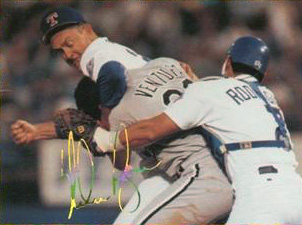
Simmons mentions two of my favorite vintage brawl moments. One is Yankees reliever Graeme Lloyd, a.k.a “The Big Dingo,” charging in from the bullpen during the Yanks-Orioles brawl triggered when Armando Benitez plunked Tino Martinez (Simmons gets the year wrong; it was 1998, not 1996, but oh well). The other is the famous Nolan Ryan-Robin Ventura showdown, a one-sided affair where the 46-year old Ryan hit the 26-year old Ventura (then with the White Sox) with a pitch in 1993. Ventura took offense and charged the mound, but Ryan grabbed him in a headlock and broke out a can of Lone Star-brand Whupp Ass. The photo pretty much says it all:

Nice Kitty-Cat

Tino Martinez and I have reached an agreement: I’ll keep lambasting him so long as he keeps hitting those game-winning home runs. We’re both dialed in, so to change this successful formula would be a mistake.

I was at the game last night, and I was just as surprised when Tino hit it as I was when Jason Giambi homered on Sunday–which is to say, not very suprised at all. Don’t get me wrong, I enjoyed it immensely; I’m not THAT jaded. It was a textbook Yankee moment, seemingly provided for the benefit of my guests, who were unfamiliar with the team, not to mention the sport (two of them are British). After scoring two runs early, they fell behind, then waited out the Devil Rays’ starting pitcher, Joe Kennedy. As soon he got tired, it was single, single, homer, ballgame.

That’s the Yankees in a nutshell: just when you think you’re safe, the nice orange kitty-cat with the black stripes will rip your throat out.

Jason Giambi, Wrecking Machine

Yesterday’s game-winning home run by Jason Giambi felt like the most foregone conclusion I’ve seen all season. As Giambi strode to the plate, I sat there solemnly, rooting for the Yankees, yet knowing that it wasn’t going to make a damn bit of difference. Not because the fix was in, not because the A’s were stealing signs, but because Giambi is that hot and that good.

For those of you who didn’t see the game: two outs, bottom of the ninth, tie ballgame, Johnny Damon on first, Mike Stanton pitching. Stanton starts off pitching Giambi high and tight, getting a strike on the first pitch, followed by three balls in a similar location. Giambi fouls off the next pitch to run the count full. To this point, Stanton has thrown nothing but fastballs, and nothing Giambi can extend his arms to hit. But Stanton decides to throw him a curve ball, Giambi guesses correctly, and for all we know that ball may still be rolling.

Friends, Jason Giambi can HIT. He leads the American League in On Base Percentage (.462), is second in Slugging Percentage (.647), fourth in Batting Average (.330), and sixth in Home Runs (29) and RBI (91). All of this while playing in a pitchers’ park. By sabermetric measures he’s even better. He’s tied for first in the A.L. in OPS (1109), he ranks first via Baseball Prospectus’s Equivalent Average and Equivalent Runs measures by a solid margin, and he’s first in Offensive Winning Percentage as well.

Check out his splits–the man simply doesn’t have a weakness when it comes to hitting. He’s left-handed, but he’s tattooing lefty pitching (.329, 1043 OPS, address all further questions regarding this matter to Mike Stanton). He plays in a pitchers’ park (Oakland’s team OPS is 47 points lower at home, while their team ERA is 0.58 runs lower there), but his home OPS is actually 14 points higher and he has almost twice as many HRs there. With runners on base? .392, 1243 OPS. Close and late? .338, 1051 OPS. Bases loaded? 6 for 9, with 17 RBI. He hasn’t had an off month all season–his worst month would still be good enough for the top 10 in OPS. As they say on SportsCenter, you can’t stop him, you can only hope to contain him.

Giambi was the hottest commodity at the trading deadline because he’s a free agent at the end of this season. Oakland’s decision to keep him and play for the Wild Card was a bold move that had a ripple effect throughout both leagues with regards. But Oakland’s gamble looks to be paying off in the short-term, as the A’s have been tearing it up–winners of 11 straight and 33 of their last 43 ballgames.

The question is whether that short-term success will translate into an ability to sign Giambi to a long-term contract at the end of the year. Giambi turned down a six-year, $91 million deal when the A’s refused to include a no-trade clause, and another MVP on the mantelpiece isn’t going to lower that cost.

Which, inevitably, brings George Steinbrenner into the equation. The footsie has already begun; Giambi sang Steinbrenner’s praises this weekend. “The man wants to win. When he thinks highly of you, you take it as a compliment,” he told reporters.

While it is tempting [drool] to imagine Giambi taking over first base [slobber] for the subpar Tino Martinez and teeing off [slurp] on that short left-field porch [belch], I find myself hoping Giambi stays put. Not because I wouldn’t want him in pinstripes, but because I have too much respect for the way Oakland has built itself into a contender, especially given their small-market constraints. The A’s are a fun team to watch, with a potent offense and a trio of young pitchers who are already among the game’s best. Their run for the AL West title last year was impressive, and they almost knocked off the Yankees in the Division Series. They figure to do some damage this season and for the forseeable future if they can hold onto Giambi. He’s 30 years old, extremely durable, immensely popular, and he can hit the ball a long, long way. I have a hard time believing Oakland GM Billy Beane will let the man walk just because of a no-trade clause.

Burst This Thought Balloon

Here’s a scary thought for Yankees fans: what if George Steinbrenner drives Joe Torre away from the Yankees? Chew on that one for a moment.

Torre came to the Yankees in the winter of 1995. At that point, the team was 14 years removed from its last World Series appearance, and 17 from its last World Championship. Torre had never distinguished himself in 14 years as a manager; he had one division title and was 109 games below .500 for his career. The New York Daily News headline on the day of Torre’s hiring read “Clueless Joe”.

But Torre’s Yankees have won four World Championships out of the past five, including three in a row, and Torre has handled Steinbrenner better than any man or manager ever has. By dint of his success, Torre’s salary has risen from $500,000 a year to $3 million. But his contract is up at the end of this season, and thus far Boss Steinbrenner has been dragging his feet about giving him a new one. Torre is reportedly seeking a three-year deal worth as high as $4 million per year, a pittance when compared to the cost of a star player, especially when your franchise is working on securing a license to print money.

The excuse for not having a deal in place is that Steinbrenner has been too busy. He’s working on a deal for a new stadium. He’s formed a partnership with the New Jersey Nets basketball team and the New Jersey Devils hockey team, and somehow the Manchester United soccer team fits in there, too. He’s building a cable network which will increase the value of King George’s property into the stratosphere. He’s probably annexed a couple of countries while he was at it, and if he hasn’t, I’d recommend Cuba and the Dominican Republic as places to start–there’s an endless supply of baseball talent there.

Mike Lupica of the New York Daily News has a good piece on the situation. According to Lupica, this is purely a Steinbrenner power play:

“[T]his story, for as long as it lasts, isn’t about logic. It is George M. Steinbrenner. He wants the Yankees to be about him, not Torre, even at a time when Torre is the most popular manager in Yankee history and the most popular sports figure in New York. This is about power, and it is about control, not about Steinbrenner’s schedule…”

While it’s probable that a deal will get done, there have been rumblings that Steinbrenner is setting up Torre to take the fall should the Yanks falter. This, of course, would be a huge mistake. Torre shouldn’t be kept on such a short leash (neither should GM Brian Cashman, who’s a free agent at the end of the season, but that’s another story); his success has earned him much more than that. Even given the Yanks’ extreme payroll (they’re now the highest in the game after their midseason additions), this has been viewed as a transitional year; Tino Martinez, Paul O’Neill, Chuck Knoblauch, and Scott Brosius are all in the final year of their contracts, and Martinez and Brosius have highly touted prospects waiting in the wings (whether they’re ready for next season is, again, another matter). But neither Torre nor Cashman deserves to twist in the wind given their level of accomplishment.

So, back to that scary thought, here’s an even scarier thought balloon floated by the Providence Journal’s Art Martone: given that Red Sox manager Jimy Williams is a goner at the end of the year, is it too much to fathom that Joe Torre could be the next Red Sox manager? Writes Martone:

“If the Yanks should get rid of Torre — a move that would be incomprehensible to me, but Steinbrenner is Steinbrenner — don’t you think Torre might take it personally? Don’t you think he’d be driven for revenge? What better revenge could there be than leading the Red Sox to the World Series championship?”

Martone goes on to point out that all of the key Red Sox players are already under contract next year, and that the expensive dead weight they’ll be shedding (Mike Lansing, Troy O’Leary, John Valentin, Dante Bichette) will enable them to spend even more on improvements. The situation might be enticing to a manager with a thirst for revenge.

Torre has said countless times that his tenure as Yankees manager will be his last job, but that he wants to continue as long as he enjoys it. It would be a shame if Torre were pushed out by an egomaniacal owner whose stripes really haven’t changed as much as we’ve been led to believe. It would be an even bigger shame if Torre were driven into the arms of the enemy. That alone should be enough for Steinbrenner to get his Yankee Doodle Dandy ass in gear and extend Torre’s contract. It would be the wrong reason, but the right result.