Yesterday’s Papers are Today’s Fishwrap

The New York Yankees apparently didn’t get the memo: the World Series started on Saturday night, with or without them. But could they be blamed for a tardy arrival after the dramatics of their victory on Thursday night? 56,000 fans at Yankee Stadium didn’t seem to think so, not as they mustered up more bile for pregame video highlights featuring Pedro Martinez and the Boston Red Sox than for the Yanks’ current opponents, the Florida Marlins.

Still weary from Thursday’s late-night celebration, I felt little of the previous week’s intensity on my way to the Stadium. There were no teal caps on the 4 train intermingled with the midnight-blue Yankees regalia, no “19-18″ sing-song taunts, no awkward sardine-can twisting. Compared to the American League Championship Series, this felt like just another ballgame, except everybody was talking about the Red Sox in the past tense.

My friend Issa and I arrive to find the mood at the Stadium still October-festive; the bunting was hanging, the giant flag made its appearance in centerfield, and the F-14s still flew overhead — only a few feet over our heads, it seemed from Section 3, Row P of the Tier Reserved section. And half the fans proudly wore their tickets around their necks on lanyards. One elderly woman had several dozen World Series ticket stubs, dating back to who knows when — Mantle, if not Ruth — laminated and stitched to a navy-blue cape. Collectively, we Yankee fans had been here before. And we knew what to expect — the Yanks had won ten straight World Series games at the House That Ruth Built dating back to 1996.

Which isn’t to say everyone in the Stadium was a Yankee fan. Immediately to my left were a pair of ditzy young women who joked that they were afraid of falling out of the upper deck. As I gleaned from the thirty-seven cell phone calls the one next to me made throughout the ballgame, they were apparently from Chicago, and though they were mourning the Cubs, they’d somehow fallen in with the Marlins’ young pitchers. Uh-huh. “If you’re so close with them,” I felt like asking,” how did you get such great seats eight rows from the top of Yankee Stadium?” More on them later.

With the Yankee staff in slight disarray after its all-hands-on-deck performance on Thursday, David Wells drew the nod for the Series-opening start. The Marlins rotation was in a bit of a state as well, so manager Jack McKeon tabbed Brad Penny, who’d been rocked in both of his October starts but had pitched reasonably well out of the bullpen.

Penny quicky got some backing from the Marlins’ small-ball offense. Speedy Juan Pierre drag-bunted David Wells’ second pitch past the bulky pitcher, and by the time the ball rolled to second baseman Alfonso Soriano, Pierre had himself a single. Luis Castillo quickly followed with a bloop hit to rightfield, with Pierre taking third. Ivan Rodriguez smacked Wells’ first pitch to centerfield, deep enough to score the run, as the Yankee Stadium crowd collectively muttered. Five pitches into the ballgame, they were down 1-0.

Wells settled down, retiring Miguel Cabrera on a popup and striking out Derek Lee to end the inning as the crowd roared its approval. What was one run to overcome against the Marlins after Thursday night’s heroic rally?

The Yanks got off to a fast start in the bottom of the inning. Alfonso Soriano reached on an infield single to shortstop Alex Gonzalez, and stole second on the next pitch — a bold move given catcher Rodriguez’s reputation behind the plate (though it should be noted Pudge corraled only 33% of opposing runners this year, compared to 49% for his career). Penny struck out Nick Johnson, however, and the Yanks failed to bring home Soriano.

The Marlins threatened in the second, with Jeff Conine and Juan Encarnacion stroking back-to-back one-out singles. But Gonzalez hit a one-hopper to third baseman Aaron Boone, and Thursday night’s hero tagged the bag to force Conine before firing across the diamond to complete an inning-ending double play.

The Yanks evened the score in the third. Number nine hitter Karim Garcia blooped a 2-0 pitch into leftfield which Cabrera muffled on the hop, and Garcia took second. Soriano failed to move the runner over on a grounder to shortstop, but Johnson walked, and then Derek Jeter stroked a single up the middle to score the first Yankee run, with Johnson taking third. Bernie Williams failed to score him, however, and then with Hideki Matsui ahead in a 2-1 count, Johnson was inexplicably picked off of third base to end the inning.

All the more frustrating was that Matsui opened the fifth with a single, followed by a Jorge Posada walk. But Jason Giambi — still in the seventh spot in the order after a two-homer game from down there on Thursday — grounded into a rally-killing double-play. Boone failed to salvage Matsui’s advancement to third, grounding out to end the inning.

Wells cruised into the fifth having retired seven straight, but he threw three straight balls to Conine to open the inning. Though Wells fought back to a full count, Conine wriggled free with a walk. Encarnacion singled, and then Gonzalez laid down a perfect sacrifice bunt to put both runners in scoring positon.

The next play reminded the 56,000 fans in attendance that it’s possible to run the complete spectrum — from the new Mr. October to boneheaded goat — in less than 48 hours. With the infield drawn in, Pierre lined a single through the hole between Jeter and Boone. Conine scored easily, but as Encarnacion headed home, Boone cut off a strong peg from Matsui and fired across the diamond to try to hold Pierre, conceding the run. I haven’t seen the replays, but to a man, the announcers and the Yanks seemed to feel that Encarnacion might have been out had Boone thrown home instead, or even let the ball go through. Instead it was now 3-1 Marlins. Only Wells seemed willing to let Boone off the hook; after the game, he remarked, “Instinct, that’s all it was. He cut off the ball. If you look on TV, you second-guess. But you can’t second-guess.”

By this time, the two women next to me were absolutely pickled; they’d been double-fisting Arbor Mist wine coolers, Strawberry White Zinfandel — a combination I’m reasonably sure ended up on my shoes the last time I tasted it. After passing by us for the third or fourth time to go to the ladies room (they were still afraid of falling over, but by now the reason was more clear), these erstwhile sorority chicks “graduated” to double-fisting Smirnoff Ices. This got Issa and me laughing as we speculated on who would be holding whose hair when the other one barfed later. These gals were in for the World Series of Girly Drink-Induced Stomach Pain. Meanwhile, we had bonded with the Yankee fans around us. A chatty fortysomething Chicago native named Scott regaled us with a ribald tale of being flashed by a teenage Derek Jeter fan at a day game, but he disappeared mid-game to catch his brother’s 40th birthday. An orange-haired woman with a nose-ring bought us a round of beers, as if to apologize for her husband’s annoyingly repetitive and cryptic cheers — “Hot Pocket! Immediately!” and “Fish! Fish! Got my Wish!” were the biggest groaners — and we returned the favor a few innings later.

Back to the ballgame. Bernie Williams cut the gap in half in the sixth inning, smashing a Penny pitch over the rightfield wall for a solo homer. The shot was his 18th postseason dinger, tying Reggie Jackson and Mickey Mantle — pretty fair company. Matsui followed with a single which chased Penny in favor of Dontrelle Willis, the Marlins’ rookie pitching sensation. Willis had a hot enough first half (9-1, with a 2.08 ERA) to make the All-Star team, but he faded in the second half, and his October had been game but grisly –12 runs allowed in nine innings.

But the Willis who came out of the pen was the one I’d tabbed as a potential sleeper in my quick pre-Series analysis, and he took care of business. Matsui was erased on a fielder’s choice, and then Posada, much to everyone’s surpise, stole second. But the lefty, who almost lost Giambi after getting him 0-2, induced the struggling Yankee slugger into a groundout to Gonzalez. Damn.

Willis retired the next five hitters as well, but he left the door open for the Yanks in the eighth. Back-to-back two-out singles by Williams and Matsui put runners at the corners, inducing McKeon to summon Ugueth Urbina. The Marlins closer rung up Posada looking to escape the jam.

Wells had yielded to the bullpen after seven gritty innings, and Jeff Nelson nearly widened the lead. A one-out walk to Cabera was followed by a Lee single, but Mike Lowell’s fly ball to rightfield wasn’t deep enough to score the run, and Nellie escaped by getting Conine to pop out foul.

The Yanks gave it one last gasp in the ninth. Giambi finally weighed in with a positive contribution, walking to lead off the inning and then yielding to pinch-runner David Dellucci. Boone flied out, but pinch-hitter Ruben Sierra walked, putting the tying run in scoring position. Next up was Soriano, who’s looked lost with runners in scoring positon since the Red Sox came to town. Sori actually had a good at-bat, coming back from 1-2 to draw the count full as Urbina couldn’t tempt him away from the plate. But Ugie took advantage of Sori’s new-found discipline, and struck him out looking. Nick Johnson got ahead of Urbina 2-1, but on the fourth pitch he popped one to Pierre in centerfield, and just like that, the Marlins took a 1-0 lead in the 2003 World Series and handed the Yanks their first home loss in the Series since October 21, 1996.

So now the Yanks need to call upon their Game Two specialist Andy Pettitte to even the series. Twice before during this October run, the Yanks have lost the opening game of the series, but Pettitte’s strong efforts have enabled them to even things out. He’s been the stopper for awhile, winning ten straight decisions following Yankee losses. The hitch this time is that Pettitte is only on three days’ rest. The Yanks can take some solace in the fact that Andy has done pretty well in those situations (2-1, 3.71 ERA in four starts, according to Fox) and that he controls the running game very well, which might help them counteract the Marlins’ small-ball tendencies

They’ll be facing Mark Redman, who’s got only three days of rest under his belt as well. But Redman threw only 69 pitches as the Marlins’ Game Seven starter in the NLCS, and was hit hard for five runs in three innings. The Yanks will have to treat him similarly, or they’ll find themselves in an 0-2 hole as they head to Florida, with Thursday’s heroics looking like so much fishwrap.

Series Starter

The Yankees won a big one the other night, but their work for the season isn’t done yet, and tonight they’ll face a pesky Florida Marlins team that generated some high-caliber drama of its own on the way to Yankee Stadium. I haven’t had much time to think analytically about this series at all — right now, I’m just happy to be here — but Aaron Gleeman has done his usual fine job of previewing things.

To me the real issues are as follows, but you’ll have to check elsewhere for the numbers since I’ve got one foot out the door:

* Both rotations are in disarray because their managers showed uncommon flexibility in using starters in relief, especially in Game Sevens. Game One starter Brad Penny got shelled twice in his starts, but has pitched well in relief. Another potential starter down the line, Dontrelle Willis, looks pretty much cooked at this point in the season and might be of dubious value — or hey, he could be the sleeper here.

* the Marlins KILL lefties, of which the Yanks have two, including tonight’s starter, David Wells. See Kid Gleeman’s fine work.

* the Fish don’t really have an answer for the Yanks’ lefties coming out of the bullpen.

* though he hasn’t hit much in October, the Yanks will suffer without Nick Johnson in their lineup for the middle three games, perhaps as much in the field (where Jason Giambi will play, injured knee and all) as at the plate.

* Jack McKeon can only mix and match starters in relief for so long before he leaves his rotation short-handed in a key game.

* the Yanks have a huge experience edge, but they’ve also shown their age this October, particularly in the field. They’ve got all the pressure on them, while the Fish have almost none.

This is anything but automatic for the Yanks, and I’m really doing a half-assed job with these five minutes of analysis (hey, I do have a life beyond this page), so I won’t actually make a prediction. But I think if the Yanks can shake off their hangovers, they’ve got a good shot here. I’ll be back tomorrow with my account of Game One.

The Big Book of Bitter Defeats

Having already revised my previous piece on Game Seven several times, I awoke this morning and slapped my head for not working the phrase “The Big Book of Bitter Defeats” in there somewhere after spending a good part of Thursday afternoon spelling out the concept. Suffice it to say that for the Sox, that one’s in there near the top of the list. ESPN Page 2’s Jeff Merron places it at #1A on his Top 10 list of Most Painful Losses in Baseball History (meaning that it actualy goes to 11, like the knob on the rack of pain which the Sox are perpetually strapped to).

The Sox are represented three other times in addition to Thursday’s game: the Bill Buckner game is #1, the Bucky Dent is #6, and the Sox victory over the Angels in Game 5 of the ’86 ALCS (the Donnie Moore game) is #7. The list is very biased towards the recent past — the only game older than the Bucky Dent one is 1951’s NL showdown, Bobby Thomson’s Shot Heard ‘Round the World. Which means I saw most of these moments — the only ones I missed in my time are the Donnie Moore (RIP) and Leon Durham (’84 NLCS) games.

I have to think that the ’91 loss for the Braves in World Series Game Seven belongs up there somewhere, as does the 1960 Mazeroski homer (even if it was the Yanks on the wrong end for about the only time), the 1952 Dodgers loss to the Yanks in 7 (2-2 tie thru 5, final 4-2 with Martin making his famous catch of Jackie Robinson’s popup with the bases loaded and 2 outs in the 7th), the 1962 Giants loss to the Yanks (Bobby Richardson snaring Willie McCovey’s liner to end the Series while Willie Mays was on second, representing the tying run in a 1-0 game), and the 1993 World Series (Joe Carter homers off of Mitch Williams when the Phils were 2 outs from forcing Game Seven against the Blue Jays). And those are more or less just off the top of my head.

Suffice it to say, the Big Book of Bitter Defeats is a very, very big book.

I Am Trying To Break Your Heart

“It doesn’t get any better than this.” Those words echoed throughout my head all of Thursday in anticipation of the ALCS Game Seven matchup between the Boston Red Sox and Pedro Martinez against the New York Yankees and Roger Clemens. I’d stopped reading analyses by mid-afternoon and decided to avoid predicting what would happen, instead surrendering to the giddy anticipation of a ballgame that might become one for the ages.

Would that little punk Pedro Martinez avenge his meltdown and put up the big game which would lift the Sox over the Curse of the Bambino and into the World Series, or would the Rocket, in perhaps his final start, equal the cool-headed performance he’d mustered in Game Three and best his hot-blooded successor, hammering a final stake into the heart of his former team? Who the hell knew?

I passed up two invitations to this ballgame, one from my pal Nick, the other from my college friend Ben, who bears a striking resemblance to Aaron Boone when he’s wearing a Yankees cap. I did so for several reasons: I was 0-for-2 in the postseason, needing some fiscal responsibility, with a Game One World Series ticket awaiting me, and a cousin I had seen only once in the past eight years — at my grandfather’s funeral in 2000 — visiting town for a night. But mostly, I wanted to share the potential glory with somebody else. I sent girlfriend Andra to the game with Ben and another college friend, Katy, the lead singer of local punk rock band, the Fire Ups.

Katy holds a special place in my personal scrapbook of Yankee lore. Minutes after they won the World Series in 1996, I went to fetch myself a cold one at an Avenue A deli. As I returned to my apartment, a voice shouted out to me from a passing car. “Jay Jaffe, do you have Yankee fever?” I turned to see Katy leaning out of a passenger window and raised my brown-bagged beer in salute. A fond memory.

So I waited for brother Bryan and cousin Eric to arrive at my East Village apartment, and just as I paused the TiVo at the first pitch, my phone rang — a pal calling from the west coast to wish me luck. “It doesn’t get any better than this,” he reminded me.

The other Jaffes arrived, and after quick greetings, we settled on the couch to watch the game, our talk immediately turning to baseball chatter. When Clemens blew a fastball by Johnny Damon on his second pitch, I got the sense that the Rocket was on, but as I discovered, it was far too early to make that judgement. He got out of the first unscathed, but having fired 21 pitches, including 10 to Todd Walker, who singled.

Pedro looked spotty as well. He struck out Alfonso Soriano to start the game, but then, what else was new? Nick Johnson worked a five-pitch walk, Derek Jeter popped out weakly… this was all in the script, I was sure. But when Bernie Williams singled on Pedro’s first pitch to put two men on, I began to think this might not be Pedro’s night after all. Even Hideki Matsui flying out to center did nothing to disspell that notion.

But it was the Sox who made sure it wasn’t Clemens’ night in the next inning. Kevin Millar stroked a ball into the right-center gap which Bernie cut off to prevent a double, but three pitches later, Trot Nixon blasted a two-run homer to draw first blood, Nixon’s third homer of the series and fourth of the postseason. The Sox added another run on a two-out double by Jason Varitek and a two-base throwing error by third baseman Enrique Wilson, in the lineup as Pedro’s nemesis. 3-0 Boston. Gulp.

Pedro cruised through the second, highlighed when he came back from a 3-0 count to whiff Jason Giambi, who’d been dropped to seventh in the Yankee batting order. In the third, Clemens worked through the dangerous 3-4-5 hitters of the Sox — Nomar, Manny, and David Ortiz — on 12 pitches, giving hope that the Rocket might at least keep the Yanks in the ballgame. Martinez countered in the third with an 11-pitch inning; he had conserved far more bullets than his match.

The fourth inning looked to be the Rocket’s final stage. Millar greeted Clemens with a first-pitch homer to leftfield, Nixon worked a walk, and Bill Mueller singled to center as Nixon took third. Joe Torre arrived at the mound, and reality set in for the Yankees fans: the greatest pitcher of his time wasn’t going to have the storybook ending they’d imagined. With their team trailing 4-0 and counting, the Yankee fans nonetheless mustered a standing ovation for Roger Clemens as he left the field for what would in all likelihood be the final time.

Taking a page from the Jack McKeon playbook, Torre brought in Mike Mussina to make his first-ever major-league relief appearance. Mussina was 0-3 in the postseason, with two losses in this series, and though he’d pitched a credible game on Monday, his postgame comments about the sputtering Yankee offense had raised some eyebrows: “I don’t bear all the responsibility. I can only control 60 feet, six inches. The other stuff has to be attended to by other people, not me.”

When he took the mound with two on and none out, Mussina pitched out of the stretch. I explained to my cousin that I called this “The Goddamn Drinking Bird” because of how far Mussina bent over, and how frustrating it was to watch him struggle. But the Moose came up big. He struck out Varitek on three pitches, got ahead of Johnny Damon 0-2, then induced a double-play grounder to Derek Jeter. The Yankee shorstop scooped up the ball moving towards second, then took several steps to cover the bag himself before firing to first to double up the speedy Boston leadoff man and end the inning. Yankee fans collectively breathed a huge sigh at Mussina’s relief.

The Yanks mustered a threat in the fourth on a two-out double by Hideki Matsui to no avail, and Moose came back out to work through the dangerous top of the Sox lineup. He got Walker to fly out on the first pitch, but gave up back-to-back singles to Garciaparra and Ramirez. He fell behind David Ortiz 2-0, and I had a sudden flashback to Ortiz’s towering Game One homer at his expense. “There he goes,” I thought. But the Moose got loose, striking out Ortiz, then retiring Millar on a grounder.

Leading off the fifth, Giambi came to the plate guessing changeup, and he put Pedro’s first pitch over the centerfield wall, just barely missing the black batter’s eye and joining a select list (18 people, 22 homers as of April 02). The Yanks were finally on the board. But Pedro looked undeterred, sawing through the next six hitters, interrupted only by a 1-2-3 encore from Mussina.

The Moose was cooked, however, and in the seventh, Torre gave the ball to two of the relievers who’d done damage in Game Six. Felix Heredia came out throwing strikes, ringing up Damon and then getting Walker to pop out foul. Jeff Nelson came in, and my cousin, a Mariners fan still smarting from the reliever’s unceremonious exit there, remarked that he looked forward to Nellie getting one last pounding, at which my brother and I nodded in agreement. But whoa, Nellie — with his slider working, he K’ed Nomar to end the inning.

At this point, my friend in Maine, not much of a baseball buff but with an avid Orioles fan for a wife, called. He thanked me for sending him a couple of pieces of Futility Infielder merchandise as a thank-you for our recent visit, then gently tweaked me about the ballgame: “All of New England is really happy right now.”

Tempting as it was, I invoked no Yogi Berra-isms here. But the smile that crossed my face was a mile wide. The first unhatched chicken had been counted. Could another chicken be rounding third. headed home to roost? “Hey,” I told my friend, “Even if the Sox win this one, they’ll have to win every World Series until I’m 59 years old to catch up to the Yanks.” I relayed the underlying message — the first “Dewey Beats Truman” prophecy from up north — to my brother and cousin during the long seventh-inning stretch.

After the usual display of patriotic ferver, the bottom of the seventh — where the Yanks have scored seven runs in their first four postseason games — arrived with Pedro having thrown only 78 pitches. By the time he’d unleashed ten more, he’d gotten to two outs and two strikes against Jason Giambi. On a 1-2 pitch, Martinez missed with a high fastball against Giambi for ball two. then on the next pitch, Big G hammered another ball over the centerfield wall to take the game to 4-2. This was doable. The Yanks wouldn’t let Pedro off the hook, either. Enrique Wilson hit a high bouncer down the first base line which Millar speared, but the Boston first baseman’s momentum carried him several steps into foul territory and he slipped before he could throw the ball to Martinez covering the bag. On the next pitch, Karim Garcia followed with a sharp single to center. Soriano struck out, but not before drawing six pitches to bring Pedro’s count to 99.

“We have a pulse,” said my brother. But it was a faint one. Nelson started the eighth by inducing Manny to a groundout, then gave way to another Yankee starter, David Wells, to face David Ortiz. Lefty against lefty. Another farewell cameo, I thought to myself, as Ortiz crushed Wells’ first pitch for a solo homer to negate Giambi’s, taking the lead back to 5-2.

The end of the half-inning was the cue for my guests to skidoo. As my bro and cuz had filed out the door, I had reached the point of surrender. Mentally, I began composing a concession speech of sorts, starting with the title, “Curse the Reverse.” Words to the effect that it had been a great run this October, but we all knew going into it that this Yankee team was good but flawed, that the strength of their starting pitching camouflaged the true weakness of their bullpen beyond Mariano Rivera, and it was only a matter of time before the glue finally melted and the walls came crumbling down, and hats off to the Sox for finding that soft underbelly with their relentless offense. As I thought these things, I wasn’t so much saddened but relieved, detached and philosophical.

But, to borrow a line from The Godfather, just when I thought I was out, they pulled me back in. And it took a hat trick of sorts, but I found my Rally Totem.

Back in late September 1999 my pal Nick and I took a baseball trip to the midwest to see Tiger Stadium before it closed, as well as Jacobs Field in Cleveland, and Wrigley Field in Chicago. I had purchased a brand new Yankees cap for the occasion; my old one, already salt-stained as it was, had fallen into a beer puddle at the Stadium and I made the mistake of trying to get it dry-cleaned, with disastrous results. But in my packing frenzy, I forgot to include the new cap, so I arrived in Cleveland hatless, and I bit the bullet to purchase yet another Yankee cap at Jacobs, much to the vendor’s disgust (the Yanks were playing the Indians that day). That one became my gamer; I was wearing it at the Stadium the night the Yanks won the ’99 World Series, and it’s stayed with me ever since, creases and salt stains and all.

But something happened this October. I wore the hat to two postseason games, both of which the Yanks lost. At home I’d hunker down in front of the tube with the hat on as the Yanks fell behind, then inevitably I would toss it aside, and the Yanks would come back. I started to catch on, schlepping it over to Nick’s, but not wearing it, treating it as though it were some wheelchair-bound relative who could still come to Thanksgiving dinner even if he could only eat mashed potatoes through a straw. The uncomfortable conclusion I reached was that this hat had lost its mojo. It had become the anti-rally cap.

I had long since considered replacing it with that other hat, the one which missed the plane, but every time I tried that one on, it didn’t fit right — too stiff and perhaps a size too small. When I moved apartments, I found a use for that hat, however. I stuck all of the baseball-related pins I’d accumlated over the years — Basebal Hall of Fame, 2001 World Series, 100th Anniversary Yankees pin, and replica World Series pins from 1927, 1938, 1943, and 1953 — and hung it on the wall with some of my other memorablia, a display item.

So there I was in the middle of the eighth inning, alone in my apartment, locked away from the rest of the world so that I could suffer the final indignity of the Yanks losing the pennant to the Boston Red Sox in solitude. And the lightbulb went on in my head: time for a new hat. I pulled my showpiece off the wall, gave the brim a good curl, and then stretched the thing front to back as if trying to rip it apart. Stuck atop my head, it wasn’t a great fit; it looked ridiculous, but it might do.

The thing worked like a charm, and in retrospect it all makes sense. The latest addition to that hat, acquired at my last regular season home game the night Jorge DePaula flirted with perfection, was the 1927 World Series pin.

The Bambino. You were expecting anyone else?

This current Red Sox offense drawn comparisons to Ruth, Gehrig and that Murderer’s Row crew, besting that crew’s all-time best team slugging percentage of .489. But we all know that any time the Red Sox go near the spectre of Babe Ruth, strange things happen. Two years ago, on May 30th, Pedro Martinez beat the Yankees, striking out 13 over eight innings and allowing no runs. After the game, Martinez responded to a reporter’s question about Ruth with a now-legendary quote: “I don’t believe in damn curses. Wake up the damn Bambino and have me face him. Maybe I’ll drill him in the ass…” In his next start, a ballgame I attended at Yankee Stadium, Pedro and the Sox pen frittered away a 4-1 lead, and Luis Sojo, the futility infielder himself, blooped the game-winning hit in the bottom of the ninth. Martinez didn’t notch another win all year as the Sox imploded in legendary fashion. You could look it up.

Nick Johnson began the eighth with a seven-pitch at-bat, getting ahead 3-1 before popping out to Nomar at shortstop. The Boston Red Sox now stood five outs away from the pennant, the same distance another star-crossed team had been only two nights before. But — wait for it — Jeter Was Next.

I pounded my hands together slowly as I recited my mantra. Jeter swung through strike one, then fouled the second pitch off to put himself in an 0-2 hole. But on the third pitch, Martinez’s 110th of the night, the Yankee captain socked one over rightfielder Trot Nixon’s head. The ball bounded off the wall and Jeter went into second standing up.

Bernie Williams stepped in, and the Fox cameras cut to Mariano Rivera in the Yankee bullpen. The message was clear: not dead yet. On the fifth pitch, Williams blooped to centerfield and Jeter sped home, cutting the lead to 5-3. Hurrah for the Yanks’ old guard.

With his ace’s odometer at 115 pitches and reliever Alan Embree at the ready, Boston manager Grady Little paid Martinez a visit. Shockingly, Pedro stayed in the game to face Hideki Matsui, who had driven in the go-ahead run against Pedro in that contentious Game Three. Godzilla ripped the third pitch, an 0-2 fastball down the rightfield line, for a ground-rule double to put runners on second and third. Little’s decision not to remove Pedro — a move which may be dissected for another 85 years by New Englanders, drew fire from Fox announcer Tim McCarver: “The way I see this, this is the most blatant situation for a second guess in this series, whether to bring Embree in to pitch to Matsui or not. If you’re not going to bring him in against Matsui, when are you going to make that move?”

Not yet, was Little’s tacit response. Martinez stayed in to face Jorge Posada and went to 2-2 on the Yankee catcher. On the fifth pitch, Posada connected for a flare into centerfield as Damon, Garciaparra, and Walker converged. Williams windmilled his arm before crossing the plate, and as the Yankee dugout, led by Jeter, spilled onto the field, Matsui followed him home. Posada alertly took second with no one covering. Tie ballgame.

After two and a half hours of staring oblivion in the face, the Yanks had reset the clock and finally driven their nemesis from the ballgame. The Stadium erupted in an obscene serenade, and I chimed in from home with one of my own. Jumping up and down like a monkey, I gave Martinez the double middle-fingered saluted I’d been waiting for all night. “FUCK YOU, ASSHOLE!” I shrieked, then waved my new rally cap madly.

The phone rang, and I knew exactly who it was before picking it up. With some 56,000 screaming fans behind her and the signal breaking up, my friend Katy screeched at the top of her lungs, “Jay Jaffe, do you have Yankee fever?” I let out a few whoops and hollers, told her that I did indeed, then hung up the phone.

I paced around the apartment, draining my beer, unable to sit down as the game resumed. My Maine man called, moaning, “What have I done?”

“Thank you, thank you, thank you!” I told him. “I needed to hear exactly what you’d said earlier. Gotta go now!”

With the go-ahead run on second, the late-arriving Embree got Giambi to pop up for the second out. Mike Timlin came on to intentionally walk pinch-hitter Ruben Sierra, subbing for Wilson. Aaron Aaron Boone came on to pinch-run, and then Timlin unintentionally walked Garcia to load the bases. Soriano, who’d struck out three times against Pedro, took the first pitch from Timlin for a ball, the Boston reliever’s ninth straight, drawing a visit from pitching coach Dave Wallace. Two pitches later, Sori connected, lining a ball which deflected off the upward slope of the pitching mound and right into the glove of Walker, who flipped to Nomar to force Garcia at second and end Boston’s nightmare inning.

Mariano Rivera came on in the ninth. If the Red Sox were going to win this game, they would have to beat the World’s Greatest Reliever. Rivera gave up a one-out single to Varitek, who yielded to pinch-runner Damian Jackson, who made it to second on a fielder’s choice, but Walker lined out to Soriano to end the inning.

The moment was delicious. The Yanks entered the bottom of the ninth knowing that one swing of the bat could end Boston’s season in heartbreak. But Timlin, Boston’s ace reliever this October, with 8.2 innings of one-hit, scoreless ball, iced the Yanks 2-3-4 hitters in short order. Rivera returned for the tenth, striking out Nomar, getting Manny on a grounder, then yielding a two-strike double into the leftfield corner to Ortiz, a ball that very nearly went out. But Millar popped out to end the inning, giving the Yanks another shot at a sudden death victory.

Tim Wakefield, the man who’d done more to get the Red Sox to this point than even Pedro Martinez, came on in relief of Timlin as the clock struck midnight. But his knuckler didn’t turn into a pumpkin; as it had in his first two outings, Wakefield’s money pitch befuddled the Yankee hitters, and they went quietly in the 10th.

At this point, Torre made the bold decision to send Rivera back out one more time. Rivera had pitched two innings several times, but he hadn’t gone three frames, we were told by the Fox announcers, since September ’96, when he was John Wetteland’s setup man. Having already thrown 37 pitches, he mercilessly cut through the Boston hitters. He struck out Nixon looking on the fourth pitch, got Mueller to ground his first pitch to second, and then rung up backup catcher Doug Mirabelli swinging. The coolest customer in pinstripes strode slowly off the mound as Fox cut to the commercial.

What happened next, at the bottom of the eleventh inning, a few ticks shy of four hours into the ballgame, has already taken its place in the lore of both franchises. Aaron Boone, a player I’d continually refered to as “useless” throughout the postseason, much to my girlfriend’s dismay, was up. Boone’s postseason futility — a .161 batting average, with a lone RBI — had drawn descriptions even more cruel: “…pressing so hard that his plate appearances evoke images of a 40-year-old secretary playing softball for the first time in her life at the company picnic.”

At 12:16 AM, Boone tomahawked Wakefield’s first pitch. In Joe Buck’s words: “Boone hits it to deep left! That might send the Yankees to the World Series! Boone a hero in Game Seven!” — the fourth home run on the first pitch of an inning. Mariano Rivera knelt on the mound as Boone rounded the bases, greeted by the other Yanks as he bounded onto the plate for the pennant-winning run. A Get Off My Property and Away From My Pennant home run! The Fox announcers let the crowd take over, and Frank Sinatra sang in the background, “Start spreading the news…”

Boone joined Chris Chambliss, Jim Leyritz, and a trio of 2001 Yankees in the pantheon of memorable Bronx Bombs, and acquired a new middle name — a Curse word, if you will — to go alongside Bucky Dent in the nightmares of the Boston Red Sox. Boston fans will likely point fingers at Little’s failure to jerk Pedro — the media already is — as the reason their promising season crumbled, but it’s the Yankee third baseman who will evoke their strongest ire. For whatever it’s worth, in a rare moment of accountability, Martinez let Little off the hook, saying “There’s no reason to blame Grady. Grady doesn’t play the game, I do. If you want to judge me or criticize me or curse me or whatever, I will swallow that, because I am responsible.”

The urge to rub this one back in the Sox fans’ faces is overwhelming. But the karmic toll it would exact is far too much to make it worthwhile. The Yanks won a pennant from the Boston Red Sox when all looked lost, and that fact will sit like a knife between the shoulder blades until the Cruse of the Bambino is finally lifted. Scenes such as this photo of the Fenway Park grounds crew painting the World Series logo onto their field (thanks to Craig D’Entrone at Punched in the Head for that link), or the copy of the New York Post‘s premature obituary for the Yanks are out there, as is this story about Red Sox “victory cupcakes” (thanks to Nick Stone for those two links). All that’s needed would be to see Wilco singer Jeff Tweedy wearing a Yankees cap as he sings “I Am Trying to Break Your Heart.”

On that topic, noted Sox fan and former commissioner Bart Giamatti wrote several years ago:

It breaks your heart. It is designed to break your heart. The game begins in the spring, when everything else begins again, and it blossoms in the summer, filling the afternoon and evenings, and then as soon as the chill rains come, it stops and leaves you to face the fall alone. You count on it, you rely on it to buffer the passage of time, to keep the memory of sunshine and high skies alive, and then, just when the days are all twilight, when you need it most, it stops.

He had to have been talking particularly about Boston fans. But at least one Boston fan took this in stride, posting on Baseball Primer:

“There is no curse, but the luck the Red Sox have historically seen in the postseason has all been front-loaded. Some fans mistake the early luck for Destiny; then, once they’ve bought into the notion that a higher power is affecting the outcome, the ensuing bad results are seen as that higher power being cruel. They remember the end result but (except for 1975) not the heaps of good fortune they had had leading up to that result, and for this I say that Red Sox fans should just grow up. Appreciate what you’ve had all along.

…I’ve seen comeback wins, I’ve seen blowouts, I’ve seen Clemens, Pedro, and Eckersley at their peaks as starters. I’ve seen the phenomena of El Tiante and El Guapo. I’ve seen Yaz still going strong in the twilight. I’ve seen the best damn outfield there ever was.

Twenty-nine years without a championship is not unreasonable, given how entertaining it has been. Thank you, Boston Red Sox, for giving me something to cheer about.

As much rage as I had at the Red Sox and their fans over the past week and a half — Cowboy Up Yours, indeed — I’ve let go of it today. The dogfight itself was exhausting enough to dispense with any further grudges, so if any Sox fans have read this far, I say to you, “Congratulations on a great season. Your team gave my team every ounce of competition it could have hoped for, and you should be proud of them today for having done so.”

The Yankees and the Red Sox played 26 times this season, and in the end were separated by one run in the bottom of the 11th inning of the 26th game. That’s as even a matchup as you’re going to see on the diamond, especially between two blood rivals, and that Game Seven, as I’ve said before, will go down in as one of the classics in baseball history.

I’ve got so much more to say about this game, and I’m hoping Andra and Nick will weigh in with their eyewitness accounts, but all of that will have go by the wayside for now. I’ve got a ballgame to go to on Saturday, Game One of the bizarro flipside to the matchup 90% of America wanted, the one which would put 85 or 95 years of futility out of one team’s misery. For the best of Friday’s coverage, check out the list of links Alex Belth has compiled at Bronx Banter and the stuff at Baseball Primer’s Clutch Hits.

Rally Cap

Those of you hoping for my complete recap of the ballgame can expect its arrival later this afternoon. In the meantime, here’s an excerpt…

By the time of David Ortiz’s home run off of Boomer Wells, I had reached the point of surrender. As my brother and my cousin had filed out the door in the top of the eighth inning, I began composing a concession speech of sorts. Words to the effect that it had been a great run this October, but we all knew going into it that this Yankee team was good but flawed, that the strength of their starting pitching camouflaged the true weakness of their bullpen beyond Mariano Rivera, and it was only a matter of time before the glue finally melted and the walls came crumbling down, and hats off to the Sox for finding that soft underbelly with their relentless offense. As I thought these things, I wasn’t so much saddened but relieved, detached and philosophical.

But, to borrow a line from The Godfather, just when I thought I was out, they pulled me back in. And it took a hat trick of sorts, but I found my Rally Totem.

Back in late September 1999 my pal Nick and I took a baseball trip to the midwest to see Tiger Stadium before it closed, as well as Jacobs Field in Cleveland, and Wrigley Field in Chicago. I had purchased a brand new Yankees cap for the occasion; my old one, already salt-stained as it was, had fallen into a beer puddle at the Stadium and I made the mistake of trying to get it dry-cleaned, with disastrous results. But in my packing frenzy, I forgot to include the new cap, so I arrived in Cleveland hatless, and I bit the bullet to purchase yet another Yankee cap at Jacobs, much to the vendor’s disgust (the Yanks were playing the Indians that day). That one became my gamer; I was wearing it at the Stadium the night the Yanks won the ’99 World Series, and it’s stayed with me ever since, creases and salt stains and all.

But something happened this October. I wore the hat to two postseason games, both of which the Yanks lost. At home I’d hunker down in front of the tube with the hat on as the Yanks fell behind, then inevitably I would toss it aside, and the Yanks would come back. I started to catch on, schlepping it over to Nick’s, but not wearing it, treating it as though it were some wheelchair-bound relative who could still come to Thanksgiving dinner even if he could only eat mashed potatoes through a straw. The uncomfortable conclusion I reached was that this hat had lost its mojo. It had become the anti-rally cap.

I had long since considered replacing it with that other hat, the one which missed the plane, but every time I tried that one on, it didn’t fit right — too stiff and perhaps a size too small. When I moved apartments, I found a use for that hat, however. I stuck all of the baseball-related pins I’d accumlated over the years — Basebal Hall of Fame, 2001 World Series, 100th Anniversary Yankees pin, and replica World Series pins from 1927, 1938, 1943, and 1953 — and hung it on the wall with some of my other memorablia, a display item.

So there I was in the middle of the eighth inning, alone in my apartment, locked away from the rest of the world so that I could suffer the final indignity of the Yanks losing the pennant to the Boston Red Sox in solitude. And the lightbulb went on in my head: time for a new hat. I pulled my showpiece off the wall, gave the brim a good curl, and then stretched the thing front to back as if trying to rip it apart. Stuck atop my head, it wasn’t a great fit; it looked ridiculous, but it might do.

The thing worked like a charm, and in retrospect it all makes sense. The latest addition to that hat, acquired at my last regular season home game the night Jorge DePaula flirted with perfection, was the 1927 World Series pin.

The Bambino.

More to come…

Roll Over Chris Chambliss, and Tell Tim Wakefield the News

The New York Yankees rallied from down 5-2 against Pedro Martinez to tie the game in the 8th inning with the Boston Red Sox five outs away from an American League pennant, and then Mariano Rivera held the Sox at bay for three scoreless innings before Aaron Boone cranked Tim Wakefield’s first knuckleball in the bottom of the 11th inning over the leftfield wall for a Get Off My Property and Away From My Pennant home run.

It’s all one long sentence and I’m less than rational right now, but WAHOO!! The New York Yankees are the American League Champions!!!

These two teams played 26 times this season, and in the end were separated by one run in the bottom of the 11th inning of the 26th game. That’s about as square a matchup as you’re going to see on the diamond, especially between two blood rivals, and the ballgame tonight will go down in as one of the classic games in baseball history.

I’ll have plenty to say tomorrow about it when I’m sick, sober, and (not so) sorry.

A Futility Infielder Vocabulary Lesson

Back from that job interview, and I think it went well, thanks for asking. Now I find myself with about eight hours to dwell on tonight’s Big Game; as my former roommate likes to whine tremulously, “What… is… going… to… hap-pen?”

Rather than pore over other people’s speculation about the game or the series, I thought I’d kill some time working on a piece I’ve had in mind for ages. My friends and I have watched enough baseball (and other sports), lived and died through so many rallies together, that we’ve come up with our own unique vocabulary to describe certain events. The name of this website comes from one such phrase, and this postseason has offered several examples of these terms in action, so now seems an opportune time to reiterate them. Special thanks to my nearest and dearest friends and family for their contributions to this over the course of our fan-addled lives together.

First off, there’s a Futility Infielder, a good fielder versatile enough to play several infield positions but a nearly automatic out with the bat — somebody who spends a lot of time South of the Mendoza Line. Enrique Wilson is the Yanks’ current Futilityman, but he’s sitting next to the king of the Futility Infielders on the Yankee bench, the man whose big hit in the deciding game of the 2000 World Series inspired this site in the first place, Luis Sojo. Futility Infielders are usually scrappy, fiesty guys who spend so much time in the dugouts that they become adept at bench-jockeying, and as they age they generally make decent managers; even more often, they end up as coaches. Don Zimmer, I’m pointing in your direction.

“Don’t hit ‘em so hard, Reggie!” is what my father used to tell me when I was learning the game and would complain about how tough it was. This was back in the late ’70s, when the Straw That Stirred The Drink was at the height of his charisma and his powers. Today, it generally evokes anybody complaining about how rough the going is getting.

Anytime you’ve got two blood rivals facing each other in a Game Seven, or a deciding contest that takes an unexpected turn, you know that one of them will be adding a page to The Big Book of Bitter Defeats. Teams who claim to be bearing a curse, such as the Chicago Cubs and the Boson Red Sox, have entire chapters within the Big Book, as do the Brooklyn Dodgers and the Cleveland Indians. The Yankees have about half a page, way in the back, devoted to Game Seven of the 2001 World Series. Deciding games of postseason series aren’t the only ones in there, however — any game which can potentially turn the momentum of a series or a season is eligible. Such decisive games can keep a Cliché Monkey working overtime, spouting phrases like “all the marbles,” “there’s no tomorrow,” and “this is do or die.”

One event which often leads to inscription in the Big Book of Bitter Defeats is a Get Off My Property Home Run, such as the one Trot Nixon hit in Fenway to win Game Three of the ALDS, or the one Derek Jeter hit in Game Four of the 2001 World Series. Once in a rare while, such a hit may be downgraded, as in Robin Ventura’s Get Off My Property Grand Single in the ’99 NLCS.

Speaking of Jeter, we’ve got another one which specifically applies only to him. Back in ’99, my two pals and I were at a ballgame sitting near a pre-teen girl and her father. Whenever Chuck Knoblauch came to bat, the girl, in a giddy attempt to show her father she was paying attention to the action, would shriek, “Jeter is next!” That was the year, of course, that Derek was unstoppable, hitting .349 with a .990 OPS and making his claim as the elite among the young AL shortstop triumverate. He’s been backsliding ever since, but still, the Yankee captain is clutch enough that we still look forward to him batting in key situations.

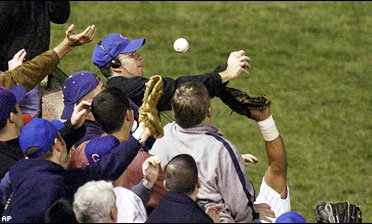
The Big Book of Bitter Defeats has a twin volume which is sort of a prequel: The Big Book of Bad Ideas. No team can inscribe itself in the former book without having copious entries in the latter. Dusty Baker leaving Mark Prior in during the eighth inning after walking Luis Castillo is straight from the Big Book of Bad Ideas, as is that poor Cubs fan failing to think before reaching for that foul ball. Not every entry in this book corresponds to an on-field action, of course. ESPN’s hiring of Rush Limbaugh came straight out of the Big Book of Bad Ideas, not that anybody should spare them an ounce of sympathy for doing so.

Onto the more mundane events which make up a ballgame. When a starting pitcher wobbles through a tough outing with all the grace of an elderly woman on an icy staircase, it’s a Granny Gooden, so named for when the latter-day pinstripe-wearing Doc K had lost a few feet on that famous fastball and piled up baserunners aplenty. The Power of Negative Reinforcment often comes in handy in these cases, when you curse at a player in a key situation for failing before he actually does so, in the hopes that it may lead to an opposite result. “Goddamn it, Karim, you can’t get a clutch hit to save your life!” or “Okay, Nelson, why don’t you just walk the damn run in so we can lose this game!” The Power of Negative Reinforcement is especially useful when you’ve got The Vein sticking out in your forehead, and is generally a sign that you’re criminally insane.

Another negative event is the RBI of Shame, which happens when a run crosses the plate during a double play. It’s no RBI at all, officially, and really isn’t much to be proud of, but once in awhile those runs do come in handy.

When the opposing clubhouse is in disarray, you might root for them to preserve the Fragile Equilibrium of Unhappiness, so that such negativity may fester. Yankee fans certainly hoped after Pedro’s tantrum in Game Three that the team’s failure to back him publicly was doing just that.

The Grim Forksman is the end, either for a player or a ballgame. Derived from the phrase, “Stick a fork in him, he’s done,” the Forksman arrives a-pokin’ to deliver just that message. When Alex “Sea Bass” Gonzalez hit the seventh-inning two-run double to expand the Marlins’ lead to 9-5, that was the Grim Forksman telling Dusty Baker it was time to go home. Similarly, when David Cone went on the disabled list with pain in his hip earlier this season, that was just the Forksman telling him it was time to hang up his glove for good. The Grim Forksman is often foreshadowed by other events; in such cases, we might say that the Chickens Are Rounding Third, as in heading home to roost.

On a more positive note is the Rally Totem. This is any object which a fan believes is annointed with the sacred power of delivering runs at a key moment of a ballgame. Hats are the most common, but sometimes it takes more than that to spark an offense into gear. The Anaheim Angels stumbled across their Rally Monkey last year, and I’ve come across Rally Beers and Rally Children in my time. You may think that stinky, beer-stained sweatshirt is your Rally Totem, and if it’s working for you, don’t let anybody else tell you otherwise.

So what have we learned? Let us recap thusly:

Tonight, two teams and two ace pitchers will face off in the Bronx. The team whose Rally Totems are more powerful than the opposition’s or who can summon the Grim Forksman to claim the other’s starter will probably win, while the loser will earmark this one in the Big Book of Bitter Defeats. Yankee fans hope Roger Clemens won’t suffer through a Granny Gooden night, and they may have to use the Power of Negative Reinforcement if their bullpen becomes a factor. They’re certainly hoping that Pedro Martinez’s meltdown in Game Three may be an indicator that his Chickens Have Rounded Third. Those wishing further ill may hope that a Sox loss will preserve the Fragile Equilibrium of Unhappiness that Boston fans know all too well. But the game may be decided on the little things; even an RBI of Shame by a Futility Infielder might put the deciding run on the scoreboard. One way or another, we can bet that the Cliché Monkeys will be everywhere tonight, tomorrow, and the rest of the postseason.

Now go forth into the world armed with these new terms and enjoy the ballgame!

• • •

If Game Seven is supposed to bring out the best in the best, that concept certainly holds true online. ESPN’s Rob Neyer has done some research and found that tonight’s ballgame is only the second time that two Hall of Famers have faced each other in a winner-take-all game (the first was Yankee Waite Hoyt vs. Cardinal Jess Haines in the 1926 World Series, but both were Veterans’ Committee inductees), as well as the most combined wins by two deciding-game starters up to that point (476).

Rob’s partner in Royal futility, Baseball Prospectus’ Rany Jazayerli, has some choice words about the differences between Dusty Baker and Jack McKeon:

Here we have a 72-year-old man, who first managed in 1973, making it to the playoffs for the first time. And instead of retreating to the ultraconservative style that is allegedly the hallmark of his age group, McKeon is managing circles around his opponents. It’s as if, after waiting through thousands of regular season games to get to this point, he’s unleashing every aggressive impulse that he’s stored up over the past three decades. McKeon gets the most basic point of the postseason, a notion that’s still lost on so many of his colleagues, Baker included: win today. Hold nothing back for tomorrow.

While Baker is screwing around with Dave Veres in a season-defining moment, McKeon has run his team throughout the playoffs as if he had an eight-man pitching staff. The irony of this is that when McKeon broke in as a manager in the ’70s, most teams relied on just eight or nine men to throw 90% of their innings. Actually, it’s not ironic at all. McKeon’s experience in a time when bullpens were structured differently (back in those Neanderthal times, managers actually had the gall to use their best relievers in key situations before the ninth inning–imagine that!) is one of the reasons he’s so successful.

Rany points out that McKeon has used four of his starters out of the ‘pen in the postseason, an idea that is “state-of-the-art–or at least it was in 1936.” Delicious.

Prospectus’ Joe Sheehan points to a couple of key plays in ALCS Game Six that are the reason there’s a Game Seven, and at the porous middle infield of the Yanks, which is nevertheless continually overrated by the announcers:

With David Ortiz and his piano on first base, Bill Mueller hit a three-hopper past the mound. When the ball was hit, I shouted, “Two!” anticipating a double play that would end the inning. Jeter, however, never got close to the ball, which bounded into center field for a single.

I won’t say it was a routine ground ball, but it was a ball that many shortstops get to, and not just the great ones. Jeter’s inability to make those plays–every…single…day–is what makes him a liability at the position. The illusion that he has range is exacerbated by his constant diving for balls that other shortstops play standing up.

In the eighth inning, Manny Ramirez hit a two-hopper to Soriano at second base, the very definition of a routine ground ball. Joe Buck called it, and I quote, a “tough play.” Perhaps, had the ball been a live grenade, or doused in the Ebola virus. It might have been a tough play had Soriano been forced to use only his feet, or had baserunner Garciaparra just been handed nunchuks and a Dear John letter from Mia.

Sheehan, a Yankee fan, also notes, “Tonight will be the first do-or-die game the Yankees and Red Sox have played since October 1, 1978, when Bucky Dent picked up three RBIs and a middle name with one swing.” Heavy and historic.

Blown Away

I’m not able to give a thorough rehashing of Wednesday’s ALCS Game Six as I’ve been doing lately; I’ve got a job interview tomorrow morning and I’m completely drained right now. Suffice it to say that while I’m disappointed the Yankees lost that see-saw battle in the Bronx 9-6, I think they have to feel better going into Game Seven on the broad shoulders of Roger Clemens than the Red Sox do about riding the fragile arm of Pedro Martinez. It’s only fitting that these two meet again to decide the series; neither pitcher is a lock against their nemesis, which is why they’ll have to play the damn thing after all.

High winds played a big factor in Wednesday’s game, particularly on well-hit balls to the outfield. But the Yanks’ big bugaboo was their bullpen. By failing to get a stellar effort out of starter Andy Pettitte, the ‘pen’s underbelly was revealed for what it is: soft and vulnerable. Jose Contreras looked sharp in the sixth in relief of Pettitte, but he imploded in the seventh, unable to protect a two-run lead while the Yanks were nine outs from the pennant. Jeff Nelson and Gabe White made the problem worse in the ninth by giving up two more runs, but if anyone was surprised by then about the Yanks bullpen, they were the only ones.

I take little solace in the fact that I was right about Boston’s big bats finally showing up. Nomar Garicaparra went 4-for-5 with a triple that became a Little-League homer on Hideki Matsui’s errant throw into the stands, David Ortiz went 2-for-5 with 3 RBI, and the Don’t Call Us Millers (Bill Mueller and Kevin Millar) combined for five hits. The Sox bullpen did a better job of patching things together in relief of starter John Burkett than the Yanks did in relief of Pettitte, and that’s why they’ve all got an invitation to the big ball in the Bronx tomorrow night.

Speaking of invitations, I’ve passed up two to go to the ballgame, in part because I’m 0-2 in the postseason, and in part because I’ve got my cousin in town tomorrow. But my girlfriend is going, and so’s my pal Nick, so in addition to thinkng about the game all day long, I’ll be there in spirit with them. Particularly after seeing how well Clemens kept his head on Saturday while others around him lost theirs, I feel good about the Yanks’ chances.

Which is more than I can say about those of the Cubs. The tenacious Florida Marlins stormed out of the gate in the NLCS Game Seven with a three-run homer in the top of the first off of Kerry Wood, and though Wood tied the game with a two-run jack of his own, he just didn’t have his stuff tonight. Though the Cubs staked him to a 5-3 lead by knocking out starter Mark Redman, Wood ended up getting clipped for seven runs. The Marlins, meanwhile, got an inspiring four innings of stellar relief from Game Five winner Josh Beckett, who tossed a 2-hit shutout on the Cubs on Sunday, and ended up winning by the same score the Red Sox did, 9-6.

So it’s the pennant for Jack McKeon and the Fish, and pure heartbreak for the Cubs and their fans, another in a long list of futility going back to the billy goat in ’45. But anyone who wants to point a finger at that poor Cubs fan who went after the foul ball in the eighth on Tuesday is an idiot. The players — and their manager, Dusty Baker — lost that game, not the fan, and anybody who’d so much as harm the hair on that poor bastard’s head for doing what every single one of them would have done in the same position deserves to be beaten senseless with a fungo bat until the Cubs finally win a goddamn pennant. And screw the Chicago Sun-Times for releasing the identity of the fan so that people can now make his life miserable, and for all of the other “journalistic” outlets which followed suit. What a disgrace.

My heart goes out to the Cubs fans in the blogosphere, particularly Cub Reporter Christian Ruzich, who had this to say about the fan in question:

I still think he was 100% in the wrong, and should have gotten out of the way of Moises, but the more I learn about him the worse I feel for him.

By all accounts, he is a huge Cubs fan. What that means, as we all know, is that he feels sick about last night’s game. And I’m not talking about his part in it — I’m talking about the same sickness that all of us felt last night and continue to feel today. Think about how bad you feel, and then think about how much worse you’d feel if you had contributed to the loss. Whether he was just not thinking, or whether it was a selfish attempt to catch a foul ball, or whatver the circumstances were, the fact is that he had a hand in helping his favorite team lose a game that they had a very good chance of winning.

Everyone’s talking about how much blame this guy deserves… In my opinion, he deserves some small part of the blame, but not nearly as much as the players who didn’t execute and the manager who didn’t put his team in a position to win.

Everyone is also talking about what punishment he “deserves” (myself included, in last night’s heat-of-the-moment post) but I think he’s punishing himself more than enough. I don’t doubt for a second that this guy feels worse than anyone in Chicago who isn’t in the Cubs clubhouse.

Well put. I could go on about all of this, but I’m tired, and it’s a big day tomorrow. No, make that a Big Day. Go Yanks!!!

Big Man, Big Game

It wasn’t pretty, but David Wells gutted through seven innings of one-run ball, keeping the Red Sox at bay long enough for the Yankees to take a 3-2 lead in the best-of-seven American League Championship Series. The Yanks broke open a scoreless game in the second with a three-run rally on a couple of big two-out hits, and Mariano Rivera survived an uncharacteristic hiccup to hold down a 4-2 win in relief of Wells. The Yanks can clinch their sixth trip to the World Series under Joe Torre on Wednesday afternoon.

Pitching on eight days’ rest, Wells lacked his usual pinpoint command, throwing only about 60% strikes instead of his characteristic 70%, and working from behind in the count much of the time. He surrendered a solo shot to Manny Ramirez in the fourth inning, but he made big pitches when he had to — Ramirez ended two other innings with fielder’s choice groundouts — and the Yankee defense made a few stellar plays behind him.

Facing Derek Lowe, the Yanks rolled up a big inning in the second. Jorge Posada drew a one-out walk, then advanced to second on a Hideki Matsui grounder. Lowe fell behind Nick Johnson 3-0, before intentionally walking the Stick to face Aaron Boone, carrying an 0-for-9 in the ALCS. Boone chopped a grounder to Bill Mueller, but the ball spun out of the third baseman’s grasp for a charitable infield single to load the bases.

Karim Garcia, a late addition to the lineup since he had been nursing a cut on his hand sustained in Saturday’s bullpen bust-up, was up next. With the fans sing-songing “Jail-bird! Jail-bird!” Garica shut them up by stroking a single up the middle that plated two runs, and Alfonso Soriano followed with an RBI single to left — only his second hit of the series.

Staked to a three-run lead, Wells didn’t exactly roll. He got into trouble in the third, when a curveball barely grazed Trot Nixon to lead off the inning. Jason Varitek — the sole member of the Sox who owns Wells, to the tune of a career .985 OPS — followed with a single, and then Johnny Damon moved them both into scoring position on a groundout to first. But Wells got Todd Walker to fly out, then blew a fastball down Broadway by the struggling Nomar Garciaparra for strike three to end the inning.

Things looked to get rocky for Wells in the next two innings. After Manny’s homer, David Ortiz followed with a single, but he was erased when Kevin Millar grounded into a double-play, and the frame ended with no further threat. In the fifth, Nixon led off by smoking a pitch which Soriano couldn’t handle. Varitek struck out and Damon forced Nixon on a great play by Soriano, who dove and backhanded the ball, then glove-flipped to Derek Jeter at second. But Wells yielded a single to Walker to keep the inning alive. He then walked Nomar on five pitches — a tough thing to do given that Boomer walked only 20 batters all year and that the Boston shortstop only walked 39 times. Boomer huffed at ump Joe West over the calls to Garciaparra, prompting a visit from pitching coach Mel Stottlemyre as the tying run came to the plate in the form of Ramirez. Whatever soothing words Stottlemyre uttered must have worked, as Manny could only slap Wells’ second pitch to Boone, who stepped on third base to escape the jam.

From there, Wells cruised, retiring his final six batters — highlighted by a diving stop by Jeter of a Varitek grounder — to set the stage for Rivera. Meanwhile, the Yanks, who’d threatened to add to their lead several times, took advantage of Boston manager Grady Little’s strange faith in Lowe. The Boston starter entered the seventh having topped 100 pitches, and with Jason Giambi leading off, the opportunity for lefty Alan Embree to come on seemed ripe. But Little stuck with Lowe, and Giambi battled him to draw a nine-pitch walk. Lowe erased his pinch-runner on a forceout, but Posada got ahead 3-1 and then stroked a single which sent Bernie Williams to third. Embree finally came on to face Matsui, and on his first pitch, Godzilla lashed a sharp comebacker which deflected off of the pitcher’s leg to Mueller. Williams had gotten a big enough jump that the third baseman had no play but the batter, and the Yanks had their insurance run to make it 4-1.

Had Johnson been able to drive in Posad from second with two outs, Torre would have likely brought in Jose Contreras for an inning, but with a three-run lead, he went to Rivera instead for a two-inning stint. Walker nearly hit the Yankee closer’s second pitch out, with the ball striking the base of the rightfield wall and caroming away from Garcia for a triple — only the second hit Rivera has surrendered this October. Nomar got the run home, grounding out but chalking up his first RBI of the entire postseason, cutting the lead to 4-2.

Rivera then blew away Ramirez, striking out the Boston slugger on six pitches. Strangely enough, shortly afterwards Fox cut to a shot of Manny laughing in the dugout while Garciaparra grimaced uncomfortably, as if to say, “Ix-nay on the aughing-lay while we’re osing-lay, dummy.” Ortiz followed with a single, but escaped the inning having thrown 19 pitches. Things went much more smoothly for him in the ninth, as he retired the side on nine pitches, finishing up with Jeter snagging a Varitek popup in one of his trademark over-the-shoulder grabs in left-center.

So the series returns to the Bronx with the Yanks within sniffing distance of the pennant. Due to the Florida Marlins’ astounding comeback to force Game Seven in the NLCS, the AL game will again take place in the afternoon. Andy Pettitte will throw for the Yanks, while the Sox are apparently set on John Burkett, who as I’ve pointed out, has had little success against the Yanks. ESPN’s Rob Neyer has a quick look at Grady Little’s other options, which include Pedro on three days’ rest, Tim Wakefield on one day’s rest, and Jeff Suppan, who battled the Yanks impressively back in September. With their backs to the wall, expect Little to mix and match with Wakefield and Suppan should Burkett falter early.

Anybody thinking the Sox will just roll over for the Yanks ought to remember that they came from down 2-0 to beat the Oakland A’s in the ALDS. While many of Boston’s big bats have struggled in this series — Nomar is 2-for-19, Ortiz is 3-for-16, Mueller 2-for-17, and Millar 3-for-19 — this is still the most dangerous offense in the AL, and their second time around against Pettitte may prove more fruitful than the first. That said, winning two games in the House That Ruth Built is a tall order when you’re combatting the Curse of the Bambino.

• • •

A few more interesting articles on this series:

• ESPN’s resident Yankee-hater Jim Caple dons the opposing colors before venturing into both teams’ ballparks and reaches a surprising conclusion.

• Old-time Yankees Graig Nettles and Goose Gossage have a few choice words about Saturday’s brawl.

New York Daily News columnist Bill Madden speculates that the Sox may try to move some of their petulant superstars this offseason. It won’t be easy, since Manny’s still got nearly $100 million remaining on his contract and Pedro’s got 10-and-5 no-trade rights. Pedro and Nomar are free-agents after 2004.

David Brooks in a New York Times Op-Ed piece: “If a Martian came down and landed in the stands of a Yankees-Red Sox game, he would get the impression that human beings are 90 percent men and 10 percent women in tight T-shirts, and that we reproduce by loathing in groups.”

Curse Words

I’ll have plenty to say about the Yanks-Red Sox Game Five later, but in the meantime, how about that other series going on? I haven’t been able to spare an ounce of agita over the Cubs-Marlins matchup, or a moment for a writeup — as a fan of a potential opponent I’m glad to see them go seven — but I’m alternately admiring the cockroach-like tenacity of the Florida Marlins and the bad luck of the Chicago Cubs.

That said, anybody who has watched Dusty Baker over the past few seasons could tell you that his propensity for staying with his starters beyond rational comprehension — hey Dusty, did you hear about this new-fangled invention called a bullpen? Been around since the ’70s — would bite him on the ass like a 15-foot alligator sooner or later, and on Tuesday, the gator ate. Ate as in eight runs in the eighth, which the Marlins scored when the Cubs were just five outs away from their first pennant in 58 years, holding a 3-0 lead.

The moment which may live in infamy for the Cubs came when a fan in leftfield attempted to catch a foul ball off of Luis Castillo’s bat, without realizing that leftfielder Moises Alou could have made the play. Alou slammed his glove in frustration, but umpire Mike Everitt ruled no interference — the ball was in the stands, the fan hadn’t actually leaned over the railing. Cubs starter Mark Prior then walked Castillo, and from there, a big inning exploded in the Cubs’ face.

Christian Ruzich, the Cub Reporter, is a man beside himself, cursing up a storm as he points out that just six living men know what it’s like to play for the Cubs in a World Series. Check him out.